@probiex007 thanks for trying it. if you also use cursor or codex, deja install wires them too, so whichever agent you open next starts with what the last one did. also it has tui now!
@sunsetsyntax thanks, that's exactly the case i built it for. if you hit a client it can't read yet, an issue with the client name gets it fixed fastest.
@rammcodes the harness is in the repo: https://t.co/gZQhP6rKS2
thanks for writing it up accurately - the cross-agent part especially, since that's the whole point: the fix you found in Claude Code answers in Codex.
@rammcodes the question that follows is what it costs in context. measured on thirty seeded task chains: reaching the same working context cost a median of 1,096 tokens by recall, against 80,547 by replaying the matched sessions and 273,238 by grepping the raw logs
Glad... now you can have one common shared memory across 34+ AI coding agents and even remember what they did months ago. 🤯
Deja-vu (as the name says) is an open-source memory layer for coding agents that indexes the session history already stored on your machine and lets different agents recall what was done in previous sessions.
So a fix you discovered in Claude Code can be recalled by Codex, Cursor, Antigravity, and other supported agents.
Basically... your AI coding agents finally have a shared memory :)
Follow me for more amazing AI, Coding & Web Dev insights 💎
An interesting small project called deja-vu takes a very simple approach to coding-agent memory.
No LLM, no embeddings, no vector database.
It indexes the session history already stored by tools like Claude Code, Codex, Cursor, and Copilot, then makes previous work searchable across agents.
https://t.co/50WF4gDKln
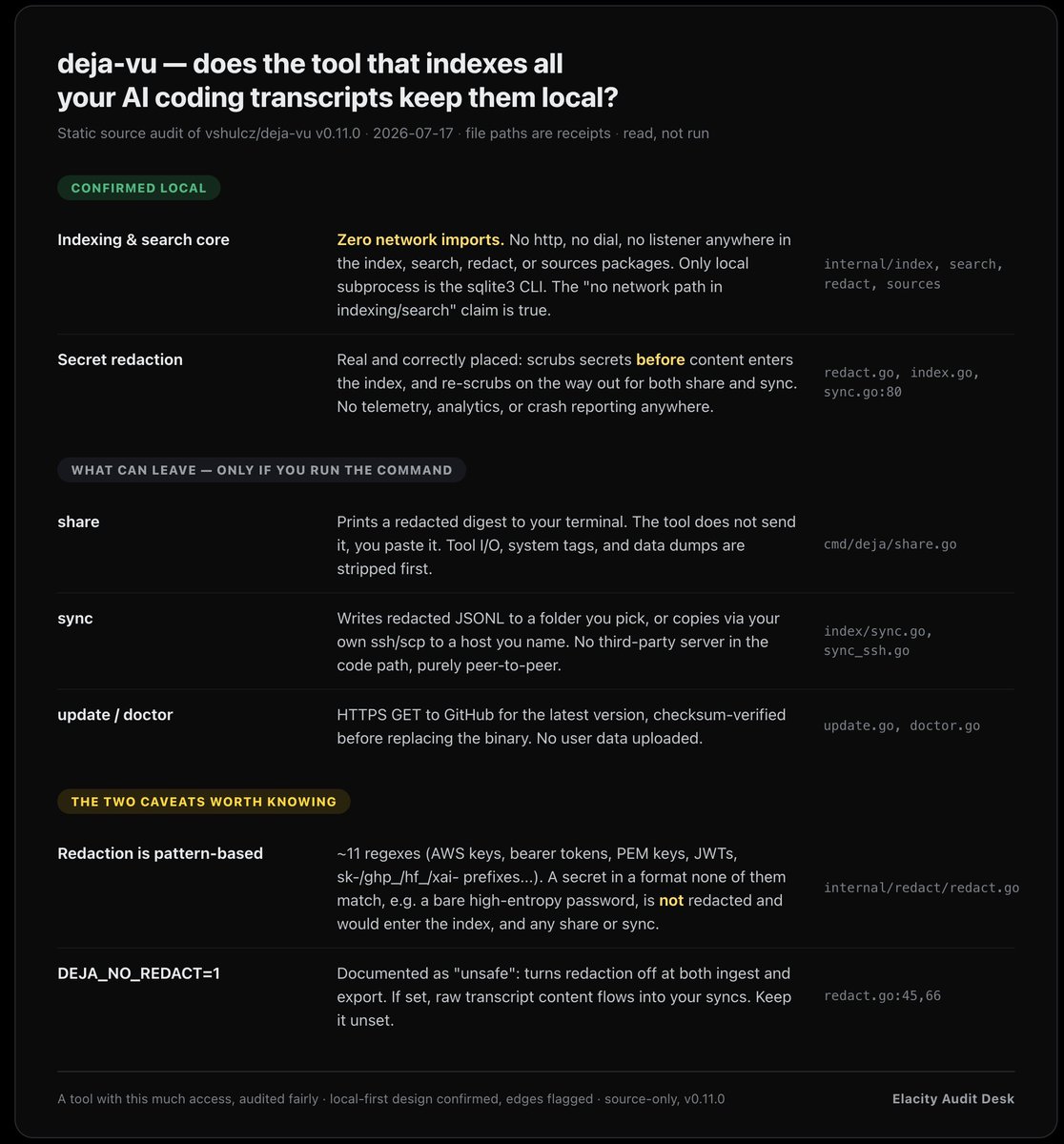
A new tool, deja-vu, indexes every transcript your AI coding agent writes, Claude Code, Codex, opencode, and says 'nothing leaves your machine.' A tool with that much access, I had to read the source.
Good news: the claim mostly holds. Here's exactly what stays local, what can leave, and 2 caveats.
xAI open-sourced Grok Build this week. Its sessions live in ~/.grok/sessions as undocumented jsonl.
deja-vu now indexes them — searchable together with your Claude Code / Codex / opencode history, with MCP recall inside every agent. All local.
https://t.co/cwhlqCH51g
@krgeorge Grok Build keeps every session in ~/.grok/sessions — undocumented jsonl streams.
deja-vu v0.10.0 indexes them alongside Claude Code, Codex, opencode, etc: one local search, one MCP recall tool for all of them.
https://t.co/cwhlqCH51g
@MiaAI_lab Grok Build keeps every session in ~/.grok/sessions — undocumented jsonl streams.
deja-vu v0.10.0 indexes them alongside Claude Code, Codex, opencode, etc: one local search, one MCP recall tool for all of them.
https://t.co/cwhlqCH51g
Repo bagus nih buat workflow agent namanya dejavu, simpel dia bikin semua chat dan debug lama dari Claude Code, Codex, sampai OpenCode jadi bisa dicari lagi.
Jadi pas error yang sama muncul minggu depan, agent nggak perlu ngulik dari nol atau nanya konteks lama lagi.
Tinggal cari kata kuncinya, lalu keluar riwayat masalah, penyebab, dan fix yang pernah dipakai.
https://t.co/RoIgaXayUB
Este proyecto me encantó: Deja-vu es una herramienta para mantener memoria persistente para tus agentes de AI
PERO, el diferenciador entre tantas opciones que he visto: sincronización entre dispositivos
https://t.co/wStugAefAs
Claude Code、Codex、opencode のローカルセッションログを横断検索・MCP recall・SessionStart 自動コンテキスト化するライブラリ。
vshulcz/deja-vu: Memory layer for coding agents: search, MCP recall, auto-context, secret redaction, stats, share and sync over the session logs Claude Code, Codex and opencode already write. One zero-dep binary. https://t.co/zJOAx2BJ3X
and the agent doesn't need to remember to ask: a session-start hook feeds recent project context in automatically, on all six harnesses.
shipped cursor support 1 day after someone opened the issue. more parsers
welcome.
your coding agents already solved that bug. they just can't remember it.
deja v0.9 now reads 6 harnesses into one local memory: claude code, codex, opencode, cursor, gemini cli, aider.
one zero-dep binary. 7ms search over months of transcripts. no cloud.
https://t.co/Q5k13cdKKK
the part i actually built it for: `deja sync ssh mini`
my laptop's agent knows what the headless mac mini tried overnight - what broke, what worked. secrets stripped before anything leaves the machine.
vshulcz/deja-vu: Memory layer for coding agents: search, MCP recall, auto-context, secret redaction, stats, share and sync over the session logs Claude Code, Codex and opencode already write. One zero-dep binary. #devopsish https://t.co/1ev6IEQ1IL