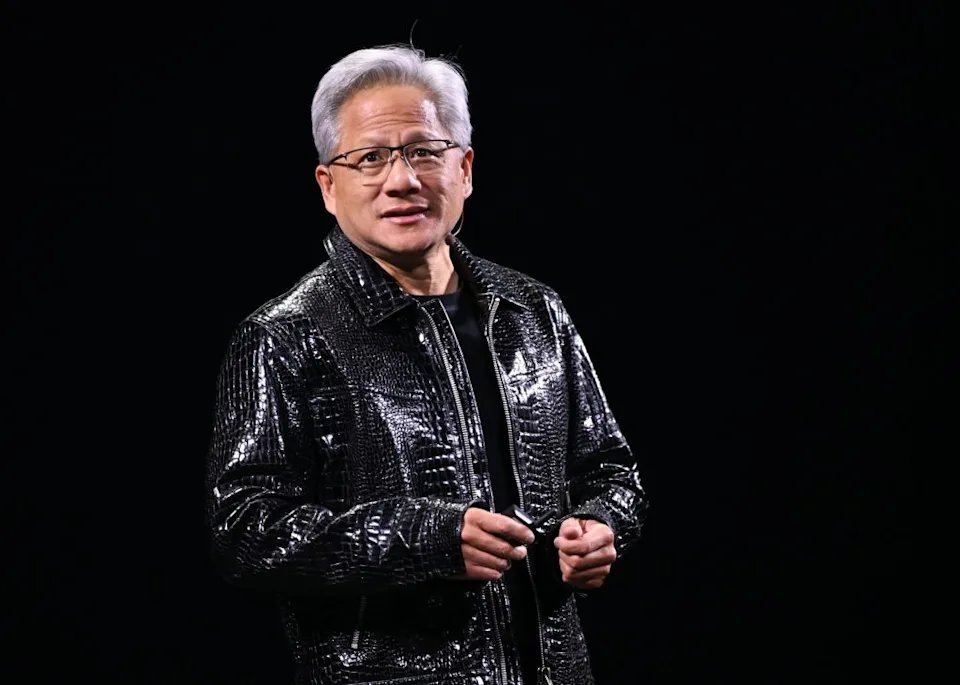
I’ve decided to leave NVIDIA. There are a few things I want to say.
As a robotics engineer at NVIDIA, I have seen Jensen as much more than the company’s CEO.
I admire his willingness to invest in a future that was not yet obvious. He committed to CUDA long before the deep learning boom and positioned NVIDIA for AI before it became everyone’s priority. Those decisions helped build the infrastructure that powers today’s AI.
I have seen that same vision in physical AI: investing in robotics, sharing open-source tools and projects, and building computing platforms that bring AI into the physical world. This is the work I do every day—and a future I believe in.
But what matters most to me is the culture he helped build.
Engineers are encouraged to explore, take risks, and learn from mistakes. Jensen reads employees’ Top 5 emails, follows their work, and engages directly. In a company this large, that connection matters. It makes an individual engineer feel that their ideas can still be heard.
That is why this has been so disappointing.
I do not have all the facts surrounding the allegations, and I cannot prejudge the investigation. My admiration for Jensen does not put him above scrutiny.
What I find difficult to accept is having to come to terms with his departure before receiving an explanation that helps me understand it. What this means for our direction, our culture, and the people doing the work remains unclear to me.
I have felt that engineers’ perspectives matter here. On this decision, I have not felt heard. That gap has been more painful than I expected.
I understand that some information cannot be shared immediately. But that does not erase the feeling of being left outside a decision that affects the company we help build every day.
A company’s greatness comes from its leadership, its governance, and the people who turn its ambitions into reality. Employees’ trust and sense of belonging are part of that, too.
Jensen’s vision and the engineering culture he shaped were important reasons I wanted to stay. His departure led me to decide that my own chapter here should also come to a close.
I leave with sadness and gratitude. The colleagues I have worked with, and the work we believed in together, will always matter to me.
These are my personal views.
If you want to work with uncensored models: No credit card required and completely free
- DeepSeek V4.1 Flash Uncensored
- GLM 5.3 Flash Uncensored
- Kimi K3 Abliterated
- GLM 5.3
- Kimi K3.1 Pro
- DeepSeek V4.1 Flash
try https://t.co/j3yosIj9BC
🚨Update: Mexico is a failed state controlled by various Cartel factions! Militants (sicarios) from the Sinaloa Cartel’s Los Mayos faction, armed to the teeth in a pickup truck!
NVIDIA released a new looped transformer:
Instead of stacking more layers, it runs the same layers multiple times so a 4B model can think like a 9B one.
Here's how it works:
In a standard transformer, every token passes through a stack of decoder blocks once, and each block has its own weights.
So if you want a deeper model, you add more blocks, and the parameter count grows with the depth.
NVIDIA's Dory1.0-4B decouples the two by reusing a chunk of its layers.
The model is split into three parts:
> An input block of 8 blocks runs once and turns the tokens into a hidden state x.
> A recurrent block of 20 shared blocks runs k times, where k can be anywhere from 1 to 4.
> An output block of 8 blocks runs once on the final state, followed by the LM head.
Before every pass through the recurrent block, x is added back to the current state and the sum is L2-normalized.
This keeps the original token representation in view on every pass, instead of each pass only seeing what the previous one produced.
Both models in the diagram below store 36 blocks of weights.
The standard transformer applies each block once, while Dory applies 36 blocks at k=1, 56 at k=2, and 96 at k=4, i.e., 72, 112, and 192 physical layers from the same checkpoint.
The extra depth is actually helpful on reasoning and agentic tasks:
> SWE-bench Verified:
- at 1 loop → 50.3
- at 2 loops → 59.5
- at 4 loops → 61.8
> 12-benchmark average:
- at 1 loop → 35.17
- at 2 loops → 39.67
- at 4 loops → 40.60
- and with 2 or more loops, it beats Qwen3.5-9B, Gemma 4 12B, and Gemma 4 26B-A4B.
More loops implies more compute per token, but the 4-loop model also writes 1.3x to 2.5x fewer output tokens on agentic tasks.
So 2 loops end up costing only 1.03x to 1.25x the compute of 1 loop end to end, which is why NVIDIA recommends 2 as the default.
By default, Dory keeps a separate KV cache for every loop, so at 4 loops the recurrent layers store 4x the cache.
To avoid this, it can keep only the cache from the last loop, which uses the same KV memory as a normal model with only a small change in accuracy.
One thing to note here is that looping helps the model reason over what it already knows, but it does not add knowledge.
For instance, on tasks like AA-Omniscience, accuracy stays at 10.0 whether you run 1 loop or 4, and on knowledge-heavy tasks like GPQA, Dory still trails Qwen3.5-4B.
Here's the paper: https://t.co/pdrqhdCHpZ
That said, how much memory looping costs comes down to how the KV cache is handled, so I wrote a full breakdown of how KV caching works.
It covers what gets cached during prefill, how the cache grows during decoding, and why it becomes the main memory bottleneck at long context.
Read it below.
@willdepue@evilsocket ccp handed megaspeed billions to buy nvidia hw to create models then release them for free to de-stabilize the U.S economy & undermine our ai companies.
FALSE: $NVDA fundamentals are bulletproof. One man cannot crash it.
TRUE: A CEO spy rumor drops. Massive panic. A $3T asset dumps 38%.
+48% healthy growth took 190 days.
Panic wiped it out in 37...
Does structure matter when fear rules the market?
News creates the momentum. Structure provides the destination.
Follow for the raw mechanics. 📌
🚨 The timing of Jensen Huang's downfall is getting extremely suspicious.
Rumors are growing around Nvidia, Anthropic, and a very strange series of events that ended with Jensen Huang losing his CEO position.
And the most interesting part is that this story didn't start in October.
It started 4 years ago when Jensen Huang met Anthropic CEO Dario Amodei for dinner.
The meeting reportedly turned into a heated argument over AI chips, with Anthropic's team claiming Google's chips offered better value than NVIDIA's.
Amodei even reportedly compared Huang to Donald Trump, and then things got worse.
In June 2025, Huang publicly said he disagreed with almost everything Amodei said about AI.
Amodei fired back, accusing Huang of lying about his views.
They were also on opposite sides of a major debate over China.
Huang wanted Nvidia to keep competing in the Chinese market, while Amodei pushed for tighter restrictions on advanced AI chip exports.
Despite all that, NVIDIA agreed to invest up to $10 Billion in Anthropic, but here's where the timeline gets interesting.
In October 2025, a company linked to Alice Huang (an alleged Chinese spy) came under investigation over suspected chip-export violations.
By late 2025, Trump had reportedly been briefed about intelligence concerns involving Alice Huang and Jensen Huang but took no action.
And the alleged intelligence connection didn't become a major public story for months.
Then, almost a year later, everything happened within just 17 days.
• October 26: Anthropic filed for its massive IPO.
• October 29: The alleged Chinese intelligence connection involving Jensen Huang became public.
• November 8: Huang admitted to an extramarital relationship.
• November 10: Anthropic filed an amended IPO prospectus.
• November 12: Huang resigned, and NVIDIA shares plunged.
Think about what just happened.
The concerns had reportedly been known inside the US government for months.
But the public scandal broke 3 days after Anthropic's IPO filing.
And less than two weeks later, one of the most powerful men in AI was no longer running Nvidia.
Now Anthropic is preparing for a massive IPO while Nvidia faces a leadership crisis.
Huang's departure could potentially give Anthropic more negotiating power, encourage companies to move toward alternative AI chips, and reduce the influence of a powerful opponent of Amodei's position on China.
Of course, Nvidia is also an investor in Anthropic, so a broader AI crash could hurt its IPO.
None of this means that Anthropic or Amodei had any role in Huang's scandal, but the timing is fascinating.
If you work with LLMs and can explain attention, KV cache and quantization, but cannot clearly explain prefix caching, continuous batching, PagedAttention, chunked prefill, speculative decoding and prefill/decode disaggregation, there is still a large part of inference you have not learned yet.
These are not six names for making inference faster. They remove different kinds of waste in an LLM serving system.
1/ Prefix caching
If requests share the same token prefix, its KV states may already have been computed. Prefix caching reuses those states instead of repeating prefill over the shared prefix.
The uncached suffix still has to be processed, and generation of new tokens still runs normally.
2/ Continuous batching
Autoregressive requests rarely finish together. Instead of keeping one fixed batch until every request ends, the scheduler can remove finished requests and admit waiting ones between iterations.
GPU capacity is reused sooner.
3/ PagedAttention
KV cache grows with sequence length, while final length is unknown in advance. Large contiguous reservations can waste memory through fragmentation and over-reservation.
PagedAttention divides KV states into blocks and lets logical blocks map to non-contiguous physical GPU blocks. It is a KV-cache memory-management technique, not an approximation of attention.
4/ Chunked prefill
A long prefill can delay decode iterations for requests already being served.
Chunked prefill breaks prompt processing into smaller pieces so the scheduler can mix prefill and decode work. Chunk size becomes part of the latency/throughput trade-off.
5/ Speculative decoding
Ordinary autoregressive decoding requires repeated serial target-model steps.
A cheaper draft model proposes several tokens, and the target model evaluates those positions together. With the classic acceptance/correction procedure, accepted tokens can be emitted while preserving the target model’s sampling distribution.
Its benefit depends on draft cost, verification cost and acceptance rate.
6/ Prefill/decode disaggregation
Prefill and decode have different execution characteristics. Prefill is often more compute-intensive, while decode is often more sensitive to memory bandwidth.
Disaggregated serving places them on separate worker pools. Prefill builds the KV cache, that state is transferred, and decode continues elsewhere. The transfer itself has a cost.
What I find interesting about all six is that the model itself can remain exactly the same.
Prefix caching, batching, KV-cache allocation, scheduling, speculative execution and phase separation all change what happens around the model.
That is where a surprising amount of LLM serving performance is won or lost.
Happy Learning!!!
🚨 THIS IS NOT NORMAL, HISTORY IS REPEATING!!
Jensen Huang just RESIGNED from NVIDIA after 33 YEARS.
And the similarities with Apple's history are TERRIFYING.
Look at this:
→ 1985: Steve Jobs was FORCED OUT of Apple.
→ $AAPL crashed 77%.
Now look at NVIDIA:
→ 2026: Jensen Huang LEAVES after 33 years.
→ $NVDA has ALREADY crashed 35% from its highs.
But here's what everyone is MISSING:
In 2000, the internet was supposed to change EVERYTHING.
And it did.
Yet the Dot-Com bubble still wiped out TRILLIONS.
Today, AI is following a dangerously similar narrative.
Massive valuations. Endless hype. Investors convinced the rally will NEVER end.
And now the man who BUILT NVIDIA is GONE.
I'm not saying another 75% collapse is guaranteed.
But the AI revolution being REAL doesn't mean AI stocks can't CRASH.
Same warning signs. Different technology.
SAVE THIS CHART. YOU MAY NEED IT SOON.
Keep in mind:
I’ve spent 12+ years studying the markets and have called every major top and bottom.
My next call will be posted here first.
Follow and turn on notifications.
This is insane. You can literally type a sentence and watch a Transformer process it.
This interactive explainer runs a GPT-style model in the browser and lets you follow the whole path:
tokenization → embeddings → Q/K/V → attention → MLP → logits → next-token probabilities
You can inspect attention maps, intermediate values, and change temperature, top-k and top-p to see how generation changes.
If Transformers still feel like boxes connected by arrows, this is worth opening.
https://t.co/vkyxOqDVll
🚨 NVIDIA IS ABOUT TO SHAKE OUT MILLIONS OF INVESTORS BEFORE ITS NEXT MAJOR RALLY.
And almost nobody is paying attention to what's really happening.
Retail is blaming $NVDA's weakness on a CEO romance.
I'M WATCHING SOMETHING MUCH BIGGER.
Washington. China. The global AI race.
Do you seriously think the U.S. will willingly hand AI dominance to China?
NOT A CHANCE.
Politicians can threaten restrictions. Congress can debate slowing AI development.
But completely abandoning America's AI advantage would be political suicide.
AND HERE'S WHERE THE REAL TRAP BEGINS.
While everyone is distracted by headlines, the market could be preparing to flush overleveraged positions.
MY EXACT $NVDA ROADMAP:
$159 → $143 → $200 → $230 → $260
FIRST: THE SHAKEOUT.
I expect another correction toward the $159–$143 demand zone.
Retail panics.
Stop losses get triggered.
Late buyers surrender.
And everyone suddenly starts calling for NVIDIA's collapse.
SECOND: THE ACCUMULATION.
If the $143–$159 zone holds and buyers return, I'll be watching for a major reversal.
THIRD: THE EXPANSION.
My upside targets are $200, $230 and eventually $260.
That's a potential 82% rally from $143.
READ THAT AGAIN.
THE SAME STOCK EVERYONE IS TERRIFIED TO BUY COULD BECOME ONE OF THE BIGGEST RECOVERY TRADES.
NVIDIA remains central to AI infrastructure.
Data centers aren't disappearing.
AI computing demand isn't disappearing.
And the global race for technological dominance isn't going away.
But that doesn't mean every dip is automatically a buy.
$143 is my potential accumulation zone, NOT a guaranteed bottom.
I want confirmation before entering.
SAVE THIS CHART.
Come back when $NVDA approaches $159–$143.
Follow + turn notifications on.
I'll post my next major BUY signal here FIRST.
RETAIL IS TRADING THE HEADLINES.
I'M WATCHING THE LEVELS THAT ACTUALLY MATTER.
DON'T BECOME EXIT LIQUIDITY.
🚨 THIS $NVIDIA DUMP WAS ENGINEERED
$1.7 trillion erased in five weeks.
Down 31% from $243.37.
Retail thinks the news did that. The news didn't do that.
The news was the match.
Leverage was the building.
Margin debt hit a record $1.50 trillion in June and has been unwinding ever since.
Every desk on the street knew exactly where those positions sat.
All they needed was a headline ugly enough to justify the flush.
They got one, and it was perfect: an investigation, a subpoena threat, a class action.
Three stories that take months to resolve and nothing a retail trader can price.
So the stops came out.
Price swept the lows at $164.27 and parked at $176.
Now ask the only question that matters.
Who was buying while 1.7 trillion dollars of panic hit the tape?
Nobody dumps a position this size into the open.
You distribute into strength and you accumulate into fear, and fear is what the last five weeks manufactured.
Here's the part that doesn't change.
A subpoena is a hearing. An investigation is a disclosure.
Nobody in Washington wants to be the person who handed the AI race to China. Congress can threaten whatever it likes.
The chips still ship.
My zone is $160 to $180. That's where I'm buying.
Earnings land November 17 and I'm sizing for more pain first.
Target $260.
Follow and turn notifications on.
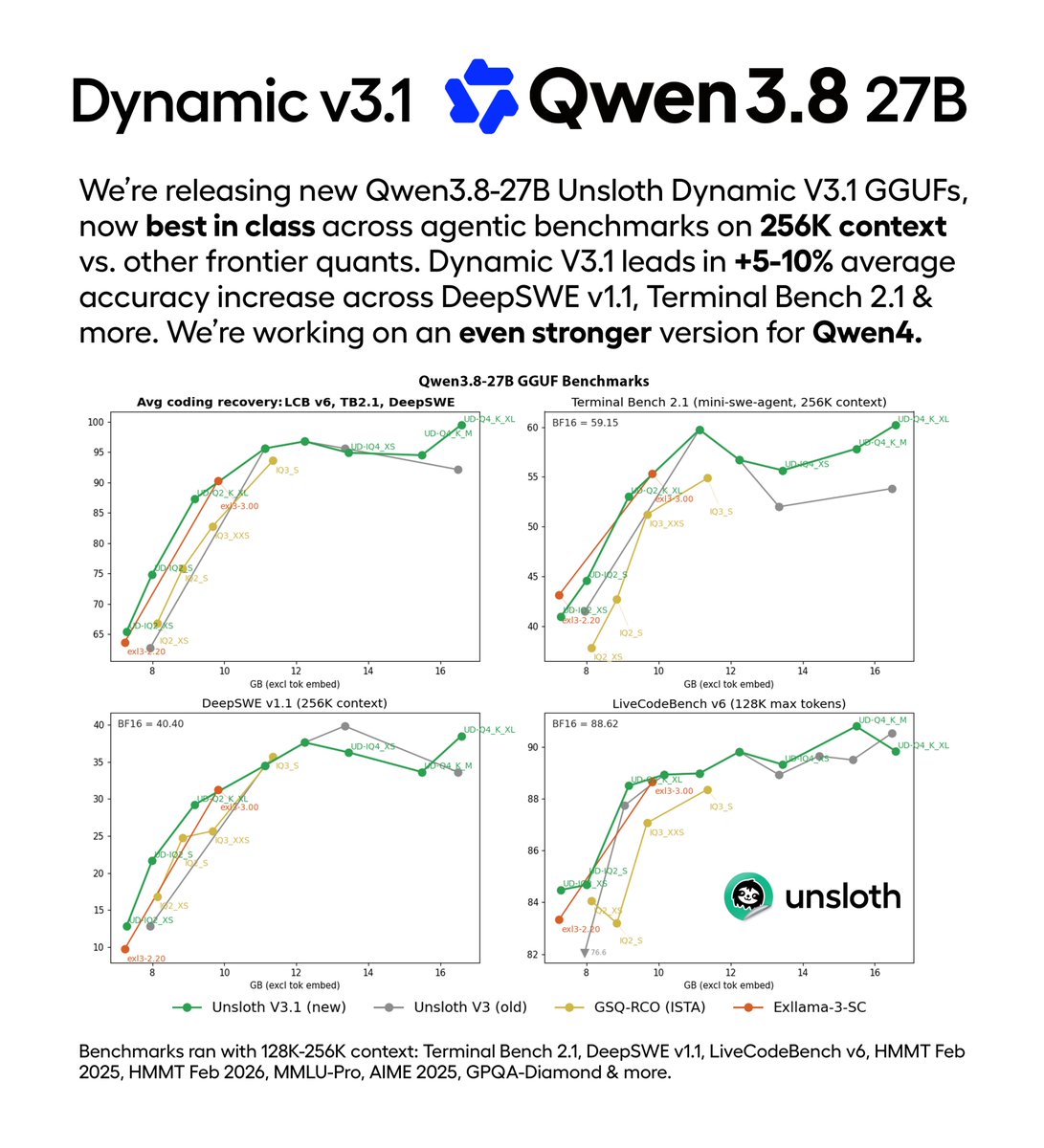
Today, we're releasing the highest accuracy Qwen3.8-27B GGUFs.
Our new Dynamic V3.1 GGUFs lead by 5–10% on average across Terminal Bench, DeepSWE & more. We’re working on even better version for Qwen4
Run on 12GB RAM.
GGUF: https://t.co/xIdNwm7CLQ
Blog: https://t.co/J2PwgMP6GZ
When you're building apps, it's a good practice to bake security into the whole process.
And that's what you'll learn how to do in this DevSecOps + API security course.
It covers common vulnerabilities, why API security matters, key principles of DevSecOps, and more.
https://t.co/hjzlCmlZCa
this is the most DANGEROUS thing on internet today
Stanford’s free CS336 course teaches you how to build LLMs from scratch
From tokenization and Transformer architecture to GPU kernels, scaling laws, data and post-training
01 Course site
https://t.co/RSxur9JGfH
02 Lecture 1 — Overview and Tokenization
https://t.co/GWIc7KMUTQ
03 Lecture 2 — PyTorch and Resource Accounting
https://t.co/XGMjlXc5dR
04 Lecture 3 — Architectures
https://t.co/NXNgpLkEHG
05 Lecture 4 — Attention Alternatives and Mixture of Experts
https://t.co/k9vMYL8Own
06 Lecture 6 — GPU Kernels and Triton
https://t.co/rbc9BwNuBD
07 Lecture 7 — Parallelism
https://t.co/81nq2Xu5zz
08 Lecture 9 — Scaling Laws
https://t.co/3SNpTSAwU7
09 Lecture 13 — Data
https://t.co/1IMY7jzVwE
10 Lecture 15 — Mid/Post-training (SFT/RLHF)
https://t.co/cybis7wgH0
GitHub:
https://t.co/AAeyprNTG5
The course materials are FREE
You can keep collecting playlists, or start building right now
Save this ↓