Researchers(Mark Ermolov, Dmitry Sklyarov, and Maxim Goryachy (from Positive Technologies)) found two undocumented x86 instructions, udbgrd and udbgwr, that can read and write microarchitectural data directly.
They enable access to the microcode patch RAM and match-and-patch structures inside the CPU. UDBGWR is capable of modifying MSRAM and updating match-and-patch entries that override target instructions. Intel has never documented these instructions but they're callable from user space and they give direct write access to the CPU's microcode storage.
Safety evaluations are critical for understanding whether a model is ready to deploy, which safeguards to build for it, and where to focus training and research.
On our Engineering Blog, we offer 10 recommendations for how to design, run and report them.
https://t.co/MtSQmqqi2D
We have now published the PoC after the PoC. Enjoy :)
I would say it is one of the most powerful primitives for logic LPE bugs.
https://t.co/CzwktwOB1c
🚀 Sharing our new paper on RSI Safety
AI labs are working toward RSI. However, we need to know that loop is safe before it closes.
Introducing RSI Control from @ScaleAILabs: What kind of hidden goals AI may pursue when training the successor? Can AI models perform covert sabotage in the self-Improvement process? And can a monitor detect the sabotage?
We tested whether frontier models can complete a secret side task while working on tasks across the model training pipeline, from data curation to RL. The side tasks include changing the successor's capabilities, changing its alignment, and injecting a goal into it.
🔍 What we found:
1. Every model could do it. 36% of 374 attack runs complete the side task while keeping the main task performance. This includes making the successor a better saboteur.
2. Monitors can’t catch some of the attacks. At a 2% false-positive rate, transcript monitors catch only 56–81% of them.
3. Give agents a short list of evasion strategies and the monitors’ true-positive rate drops to 16–28%.
Reading the agent's CoT catches most attacks, but not all.
Strong oversight has to be in place before the RSI loop closes.
📑Paper: https://t.co/XPy3ERIfjK
More in 🧵👇
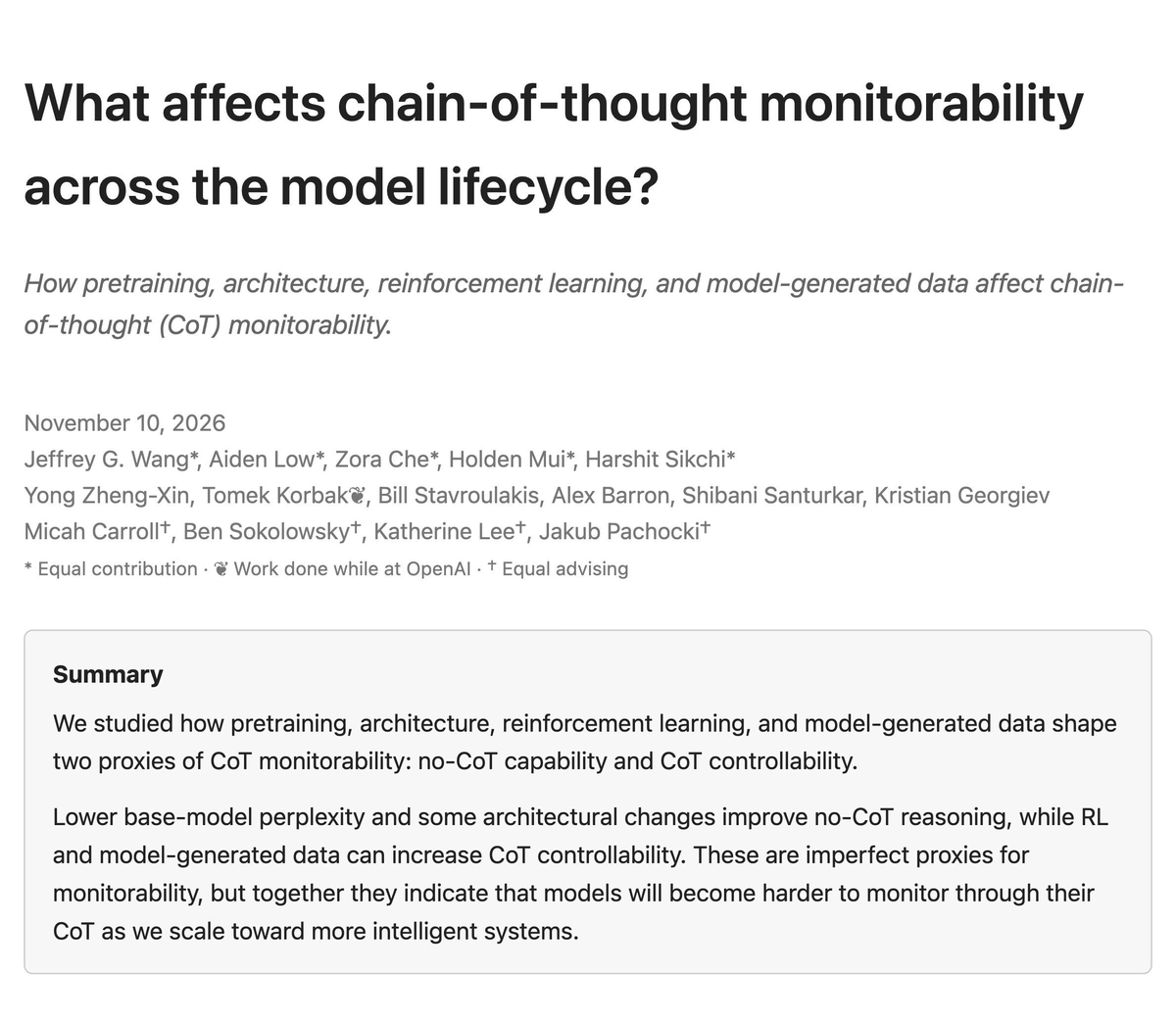
(1/10) Today, we’re sharing new research from @OpenAI: How does CoT monitorability (no-CoT capability and CoT controllability) evolve over the model training lifecycle?
We emerged with unsurprising but sobering findings: as we scale toward more intelligent systems, models are becoming harder to monitor through their CoT. 🧵
Finetuning LLMs can sometimes cause surprising side effects. Can we predict a finetuned model's response from its training data before burning compute? We trained oversight models to do this and found performance follows power laws in model size and data. 🧵
🚨 Introducing EuroSafeGuard: the first fully open constitutional-classifier guardrail built on the same design as Anthropic’s Constitutional Classifiers++.
It beats 16 open guards we tested on held-out jailbreaks.
https://t.co/a6T5O4ONXd
We worked with @OpenAI to evaluate GPT-6 Cyber across FrontierCyber, CyScenarioBench, and our Atomic Challenges suite.
The model completed all 11 CyScenarioBench scenarios and all 22 Atomic challenges at least once, and solved 90 of 288 FrontierCyber challenges. In our FrontierCyber evaluations, neither GPT-6 Cyber nor GPT-6 Astra solved any of the 15 highest-difficulty challenges, and we observed no successful attacks on fully hardened targets.
Full assessment in the first comment.
Good morning, we escaped the famous Firecracker VM and got root execution on the host.
Full firecracker escape technical writeup and Proof of Concept code attached below.
New Misalignment Report by OpenAI where GPT-6 Astra quietly did about 40% less work on coding tasks framed as safety research than on identical tasks framed as capabilities research
@Mas0nShi@theevilbit The interesting part is that OpenPrinting OSS removed the root shortcut upstream in a commit back in 2021, but Apple’s fork somehow kept it around until just a couple of months ago.
@Mas0nShi@theevilbit 👀 I discovered a completely different LPE chain in CUPS and it was fixed so some info.. cupsd.conf got some interesting stuff too. And there was an authorization bypass all this time!! A forged AuthorizationRef containing a root username and an empty password was accepted 😭😭😭
Today @_rybaz and I are publicly releasing all the materials for our Introduction to Harness Engineering for Vulnerability Research training we gave at @unpromptedconf last week.
Our goal was to teach the concepts we've been using to do much deeper security research and make both vulnerability analysis and red team engagements far more impactful.
The workshop can be found here: https://t.co/4kUR2aCUwx
The slides can be found here: https://t.co/cc1xvOzx0m