Interesting. I think most of the issues @Justin_Bons points out are things you can clearly see when you look at Cardano more closely.
1) Real decentralization has to allow anyone to participate
As he mentioned, $ETH requires builders to have significant GPU resources, and $SOL validators need to run on very high-spec servers. $ADA, on the other hand, doesn’t require ZK proofs, and you can even run a node on something as simple as a Raspberry Pi.
To me, real decentralization isn’t just about being permissionless. It also requires low physical and economic barriers to entry.
Not just “technically possible decentralization,” but “economically achievable decentralization” matters. And Cardano is one of the very few networks that truly satisfies both.
2) Decentralized governance with broad participation
$ETH still relies heavily on off-chain governance for major decisions, and in $SOL case, the Solana Foundation holds significant influence over governance and the ecosystem as a whole.
Cardano, by contrast, is evolving through an on-chain governance model that closely matches the ideal Justin described. DReps, the Constitutional Committee, and SPOs each play clearly defined roles, balancing expertise with democratic participation.
This structure keeps power from being concentrated in a single entity and instead distributes it across the community.
3) Scalability through modular design
Leios, which is coming soon, and Hydra, which is already live on mainnet, do more than just increase protocol-level TPS. They also help reduce L2 fragmentation.
From a scalability perspective, $SOL has repeatedly experienced network halts whenever transaction load spikes. Considering the network hasn’t even reached true mass adoption yet, this highlights the limitations of a monolithic architecture.
Blockchains need to scale infinitely and in parallel, and in my view, that’s only realistically achievable through a modular design.
Ultimately, I think it’s possible that the blockchain vision @Justin_Bons and @VitalikButerin have long talked about is already being implemented structurally by Cardano.
You have officially entered the age of Misinformation...
By the end of this post, you will understand why Cardano and privacy-centric protocols like @MidnightNtwrk are the future and why the time to build is now.
As AI-technologies explode, real vs fake has become indistinguishable to the naked eye which has serious, civilizational implications.
Deception is easier than ever because we can no longer self-authenticate the content we digest.
Bad actors no longer need good persuasion skills.
Manipulation can scale faster than it ever has.
Soon, nearly all of the content you see on the Internet will be AI-generated.
The content itself no longer inherently carries truth so trust must come from outside of it.
We need a new layer of infrastructure that makes trust verifiable again while preserving privacy by design.
Cryptographic signatures will tell you:
→ who published the content
→ when it was published
→ under which identity
→ whether its been altered
Zero-knowledge proofs will tell you:
→ a claim is true without revealing underlying data
→ the publisher meets certain criteria without revealing identity
→ that content or actions comply with rules
→ that trust can be verified without requiring blind belief
Humanity is at a tipping point right now.
Reality has never been easier to fabricate and existing trust systems have been dismantled.
Tick tock 🕛
Midnight may become as important to blockchain as HTTPS was to the Internet.
I will explain why privacy is important.
Public blockchains today are much like HTTP in the early internet. All transactions are publicly accessible to anyone.
With HTTP, all communication was sent in clear text.
Anyone in the middle—ISPs, network operators, Wi-Fi hotspot owners, or malicious actors—could see what pages you visited, what data you submitted, and sometimes even your passwords.
This transparency wasn't a feature users asked for; it was simply a limitation of the technology.
Over time, it became obvious that exposing all communication created serious problems:
▪️credential theft,
▪️surveillance,
▪️censorship,
▪️data harvesting,
▪️and front-running of information.
The solution was HTTPS, which kept the content of communication private while still allowing the network to function.
Importantly, HTTPS didn't eliminate the internet's openness—it made it safe enough for commerce, finance, healthcare, and everyday use.
Without HTTPS, the Internet would largely remain in a “read-only” or low-trust interaction mode.
You could technically interact (submit forms, log in, make payments), but doing so would be unsafe, fragile, and unsuitable at scale.
Public blockchains resemble HTTP in the same way.
Every transaction, amount, and smart-contract interaction is visible to everyone before it is finalized.
Then, it is stored forever in the ledger.
This radical transparency has benefits—verifiability and trust minimization—but it also enables a new class of middlemen who extract value simply by seeing transactions early.
Just as HTTP allowed intermediaries to spy on users, transparent mempools allow bots and validators to observe, reorder, copy, or sandwich transactions.
This has led to the rise of Maximal Extractable Value (MEV), where participants profit not by adding value, but by exploiting visibility.
Users pay worse prices, trades are front-run, liquidations are manipulated, and network trust erodes.
In effect, public blockchains have recreated the same incentive problems that pushed the web away from HTTP.
Blockchain and most DeFi services, as we know them today, are unusable for ordinary users and institutions.
This is where privacy-preserving blockchains like Midnight are comparable to HTTPS.
Midnight's private ledger model aims to hide sensitive transaction details—such as who is interacting with whom and under what conditions—while still preserving cryptographic correctness and compliance.
When transaction contents are not publicly visible, MEV opportunities shrink dramatically.
Validators and bots can no longer trivially detect profitable trades to front-run or sandwich because the information simply isn't available.
Just as HTTPS removed the ability for network middlemen to read and exploit user data, a privacy blockchain removes the raw material MEV depends on: transaction transparency.
The advantage of this shift is not secrecy for secrecy's sake, but fairness and safety.
HTTPS enabled online banking, e-commerce, and private communication to flourish.
Similarly, privacy-enabled blockchains can support real financial activity, enterprise use cases, and user-centric applications without exposing participants to constant extraction.
Public blockchains demonstrated what radical transparency is capable of, just as HTTP did, but history suggests that privacy is what enables systems to mature.
In that sense, Midnight isn't rejecting blockchain transparency; it's evolving it in the same way HTTPS evolved the internet.
Congrats to the team at @IntersectMBO.
As a fellow member of the Pentad, we’re delighted by the momentum and further progress taking shape with this new @dune partnership. Strong foundations, and plenty more to build upon together as we head toward 2026. @Cardano_CF@emurgo_io@midnightfdn
Did you know that @FluidTokens managed to do the first atomic swap between Cardano and Bitcoin?
An atomic swap is a peer-to-peer exchange of two cryptocurrencies between users on different blockchains, which either happens or does not happen at all.
Neither party can cheat the other.
▪️They swapped ADA for BTC without a bridge.
▪️It is a fully non-custodial service.
▪️No middleman needed.
▪️No wrapped tokens.
How?
They just used a script-to-script swap.
A script-to-script swap is a cryptographically enforced trade.
On the Bitcoin side, hashed timelock contracts (HTLC) were used. This is the same technology used by the Lightning Network.
HTLCs allow two parties to lock funds on separate blockchains using the same cryptographic secret.
If one party reveals the secret by claiming funds on one chain, the other party can do the same.
This enables trustless atomic swaps across blockchains.
Atomic swaps have already occurred in the past. The first swap between Bitcoin and Litecoin occurred in 2017.
Bitcoin and Litecoin use the same source code, so they are relatively compatible.
In this case, Cardano and Bitcoin have fundamentally different architectures. Despite this, the team managed to bridge coins without bridges, relying entirely on code.
Atomic swaps must respect the block time of the slower blockchain (and take into account reorgs).
Atomic swaps take an average of 10 minutes from the time a transaction is inserted into a block.
Congratulations to the team on this achievement.
A new Cexplorer version (#12) has just been released 🎉
This is one of the most packed updates we've had so far.
• Multiple new pages, including: UPLC viewer, SPO debug page, treasury projection, gov outcomes page
• Governance action timeline, improved metadata display, voting threshold fixes
• Price page improvements, TVL graphs, more analytic graph improvements
• Wallet improvements: migration to MeshJS library, improved UX
• Plenty of bug fixes and visual improvements across the entire platform
This is just a summary, we'll highlight some features individually!
Soo Christmas came early in a way 🎄 hope you like this update 🫡
WHY ELON MUSK SHOULD INTEGRATE MIDNIGHT INTO @X
• Bot resistance without identity exposure
Zero-knowledge proofs allow users to verify they’re human without revealing who they are.
• Preserves free expression
Verification without KYC avoids chilling speech while still restoring credibility to the platform.
• Privacy-native by design
Midnight was built specifically for selective disclosure, not retrofitted after the fact.
• Scales globally
ZK-based verification works across jurisdictions without centralized trust assumptions.
• Aligns with X’s stated mission
Truth, openness, and credibility—without surveillance or data harvesting.
• Future-proof verification layer
One integration unlocks moderation, reputation, and trust systems without platform lock-in.
Solana has a problem.
Solana Labs and ecosystem partners face allegations that they enabled or facilitated a meme pump system that gave insiders unfair trading advantages.
Solana Labs is accused of deliberately designing and maintaining a system that enabled front-running.
Insiders allegedly bought meme tokens before public launch, using priority execution and MEV, and then sold after retail-driven price increases.
Look at the Solana design that makes it possible.
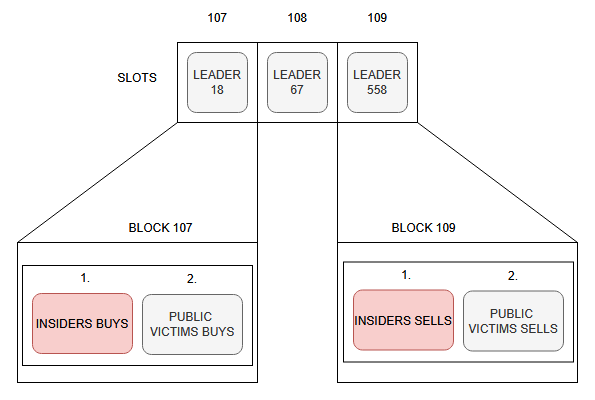
Solana validators take turns as leaders according to a known, deterministic schedule.
The current and upcoming leaders are predictable several slots in advance.
If you know who the next leader is, you know who decides transaction ordering for that slot.
Solana does not guarantee strict FIFO (first-in, first-out transaction ordering).
Cardano also cannot strictly guarantee FIFO, but the UTxO model limits reorder-based MEV.
In Cardano, slot leaders are probabilistic. When a leader is drawn, it chooses which transactions to include. There is some ordering discretion.
Many front-running strategies are ineffective. Leaders cannot reorder dependent transactions arbitrarily.
Reordering would often invalidate transactions.
Solana leader can reorder transactions, prioritize some over others, and drop or delay others.
This behavior is even incentivized through the fee market. Users can pay higher fees to prioritize transactions.
Jito introduced an MEV infrastructure.
Instead of broadcasting transactions to the public mempool, users can send transactions directly to Jito and attach explicit tips to validators.
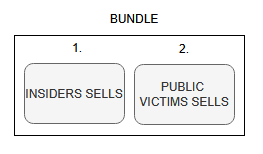
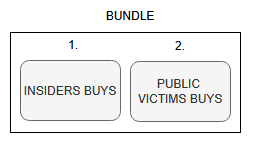
Jito allows a submission of bundles with guaranteed atomic ordering.
Bundles mean that transaction A executes before transaction B, or neither executes.
A "buy-before-users" scenario is technically possible because of how:
▪️transaction visibility,
▪️leader scheduling,
▪️and priority execution work together.
Insiders proceeded as follows.
In the preparation phase, a new meme token is created, and initial liquidity is added.
These events are visible to leaders, validators, or MEV infrastructure before they are fully confirmed and propagated to public RPC nodes.
An insider or MEV-enabled trader can route transactions privately, attach high-priority fees, or submit bundled transactions that guarantee execution order.
This allows a buy transaction to be inserted ahead of ordinary users' trades, often in the same slot or immediately before the public's transactions, at a time when liquidity is thin and prices are lowest.
In the selling phase, once public users buy orders execute and push the price up, the insider submits a sell transaction—again with priority fees or as part of a bundle—ensuring it is processed before competing exits.
The result is a complete cycle in which the trader accumulates tokens at near-launch prices, benefits from retail-driven price appreciation, and exits with profit.
On Solana, validators and MEV-enabled actors have structural advantages that normal users cannot match.
They operate with direct connections to leaders or private relays, often colocated in data centers, giving them millisecond-level latency advantages over retail users relying on public RPCs.
They can bypass the public transaction flow and secure earlier or guaranteed execution.
As a result, while retail users compete in a delayed, shared environment, infrastructure insiders can consistently achieve better ordering and inclusion, making competition unequal.
In contrast, Cardano's Ouroboros protocol uses probabilistic slot leadership, where many slots intentionally have no leader at all, and the EUTxO model sharply limits how transactions can be reordered without becoming invalid.
Solana's architecture maximizes throughput and responsiveness but expands the MEV surface by concentrating ordering discretion, while Cardano's intentionally sparse slot design and state isolation reduce continuous control and make similar exploitation patterns far harder to execute.
Privacy is the best answer to MEV attacks.
Midnight reduces MEV attacks by removing public visibility of transaction intent.
Transactions are private by default and executed using ZK proofs, so validators and other network participants cannot see trade direction, amounts, or contract inputs before execution.
Without access to this information, common MEV strategies such as front-running, sandwich attacks, and launch sniping become impractical, since there is nothing actionable to reorder or react to.
The lack of pre-execution transparency significantly limits extractive, trade-based MEV compared to fully transparent blockchains.
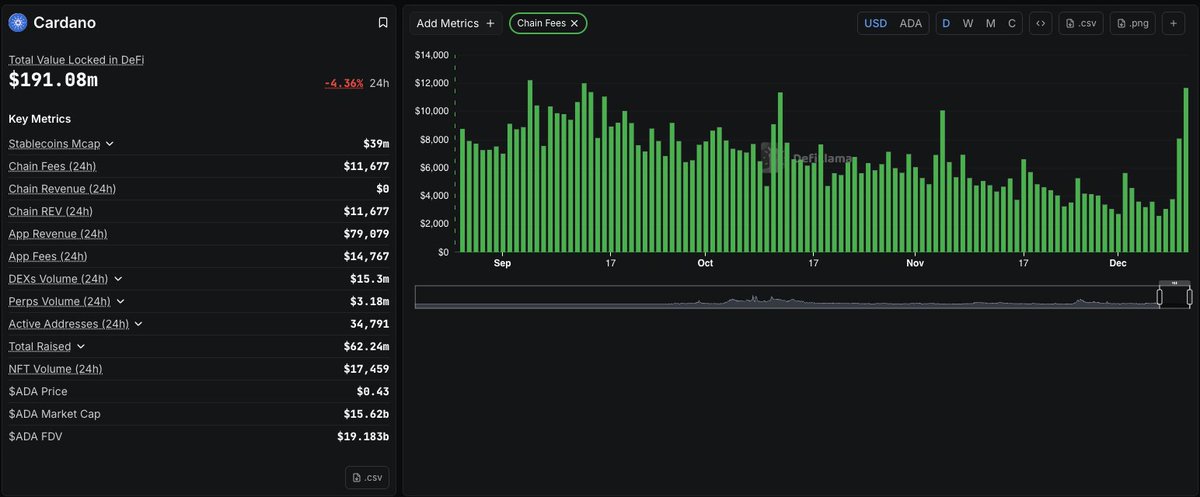
DeFiLlama is now tracking Cardano $ADA daily chain fees ✅
Daily fees weren't being tracked and were displayed as $0. (Kudos to @yeaookk for noticing.)
We were happy to offer our Cexplorer API endpoint for this metric.
Thanks to the DeFiLlama team for the quick integration!
New week, new Bitpanda Spotlight!
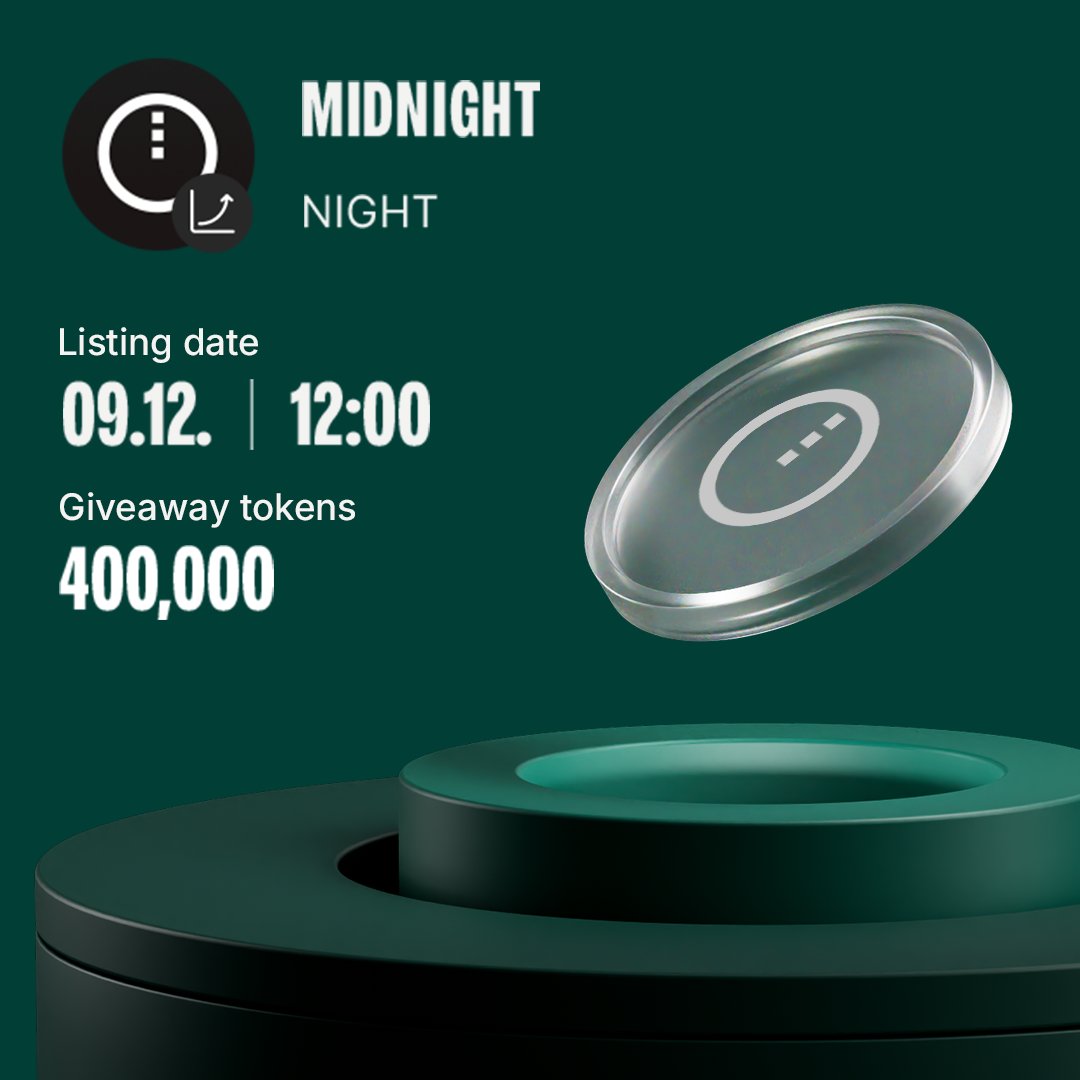
@MidnightNtwrk blockchain is built to deliver privacy by default: it uses zero-knowledge cryptography so users can verify transactions and proofs without exposing personal data
Stake $VSN and subscribe to $NIGHT to get your share of the giveaway tokens: https://t.co/94b5hqYRS6
First was claiming.
Soon it’s redeeming.
Redemptions open Dec 10, and the portal will show you exactly what’s unlocking and when.
Learn more: https://t.co/oFHru6yD7g
Who’s ready? 👀
Sending $DOG to the moon will not be easy
Many powerful institutions stand to lose if a free and fair memecoin wins
The $DOG Army will expose everyone who stands in our way
Repost and reply with 🫡 if you are an active $DOG soldier ready to go to war
Don't miss this week’s Fireside Dev Hang:
A Starstream demo from @SebastienGllmt, an @OpenZeppelin contracts showcase, content bounty updates, and live community Q&A
If you’re building on Midnight, come tune in:
🕛 Wed, Dec 3 @ 5:30 p.m. UTC
https://t.co/GmCFw92sR6
BREAKING NEWS:
COIN BUREAU DEFENDS CARDANO 😱😱😱
@coinbureau pushing back against claims that Cardano suffered a halt, stating that Cardano never stopped producing blocks,” and calling the narratives suggesting a full shutdown “misleading and overly FUD-driven.
Who’s more bullish on $ADA now?
🚨 RECLAIM YOUR DATA AND DIGITAL SOVEREIGNTY!
Charles Hoskinson urges everyone to opt out of a future where they have to disclose too much information.
"When you turn over all your data with generative AI, you turn over you. You turn over your likeness, your voice, your mind..."
Hydra in (almost) real time! @IOHKMedia @IOHK_Charles
I built this to show how fast hydra really is, and how it works in practice
ITS FAST. Next, to apply to real world apps
⚠️ If you used multiple addresses in Scavenger Mine, this part is important.
We’ve released the donate_to API endpoint, which lets you consolidate all your NIGHT allocations into a single address — making final redemption smoother, cheaper, and much easier to manage.
Read the full explainer 👇
https://t.co/Q4dIFU2k8g