Studying who owns US rental housing by using a new method tracing ownership through Census, IRS, and SEC records. Individual landlords own the large majority of rental units in 11 metros, from @stephkestelman, @rebeccardiamond, @john_eric, @katempenn, @WinnieVanDijk, and @john_voorheis https://t.co/YMdG5KIdZO
Excited to FINALLY release toughest+most rewarding paper I've worked on...
….we attack a 150 year old Walras question that's gone unanswered, not for lack of trying (Hicks, Samuelson, Arrow; our chances?😱)...
Q: Is the market equilibrium stable or unstable?¯\_(ツ)_/¯
🧵
Presenting several new and counterintuitive facts about Modern Portfolio Theory, from Oliver Hellum, Theis I. Jensen, Bryan T. Kelly, and Semyon Malamud https://t.co/Fn7obttknI
Recently accepted by #QJE: “Codification, Technology Absorption, and the Globalization of the Industrial Revolution,” by Juhász (@juhreka13), Sakabe, and Weinstein (@deweinstein): https://t.co/nOdU36sriX
A new tractable model with persistent, spatially correlated utility explains a new fact about how migration evolves over time, with implications for dynamics and welfare.
New paper by @greg_l_howard & Shao:
https://t.co/cZsXMwNM83
#REStud#EconX#EconTwitter
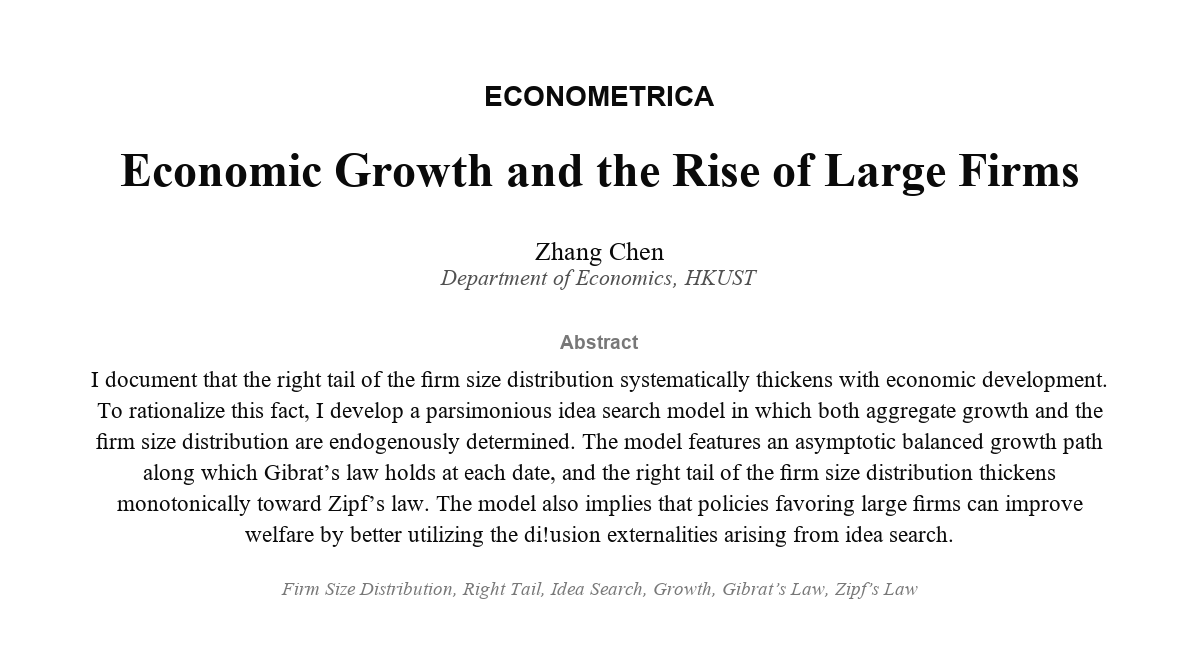
Why do richer economies have more very large firms? This paper shows that the upper tail of the firm size distribution thickens as economies grow. A model of idea search explains why, showing how growth itself can produce rising concentration.
https://t.co/ocOxbeV3Ww
Stricter density zoning laws (FAR, min lot) lead to larger housing units and higher prices per unit. Just Accepted new paper by Amrita Kulka @AmritaKulka Aradhya Sood @SoodAradhya and Nicholas Chiumenti https://t.co/ZBtrpLQe0f
Why do standard statistical methods struggle with spatial data?
A new @EconomicsUCD working paper introduces a simple but powerful way to improve spatial inference by “pre-whitening” dependence in the data — helping researchers draw more reliable conclusions.
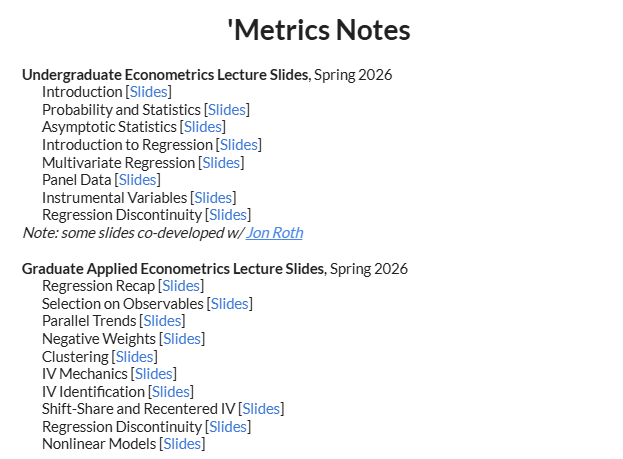
I've updated my undergrad and grad 'metrics course slides from this spring -- including new material, (many) fixed typos, and more!
Check 'em out on my website (link below), and feel free to email for the source materials if you'd like to use some of it for your own teaching
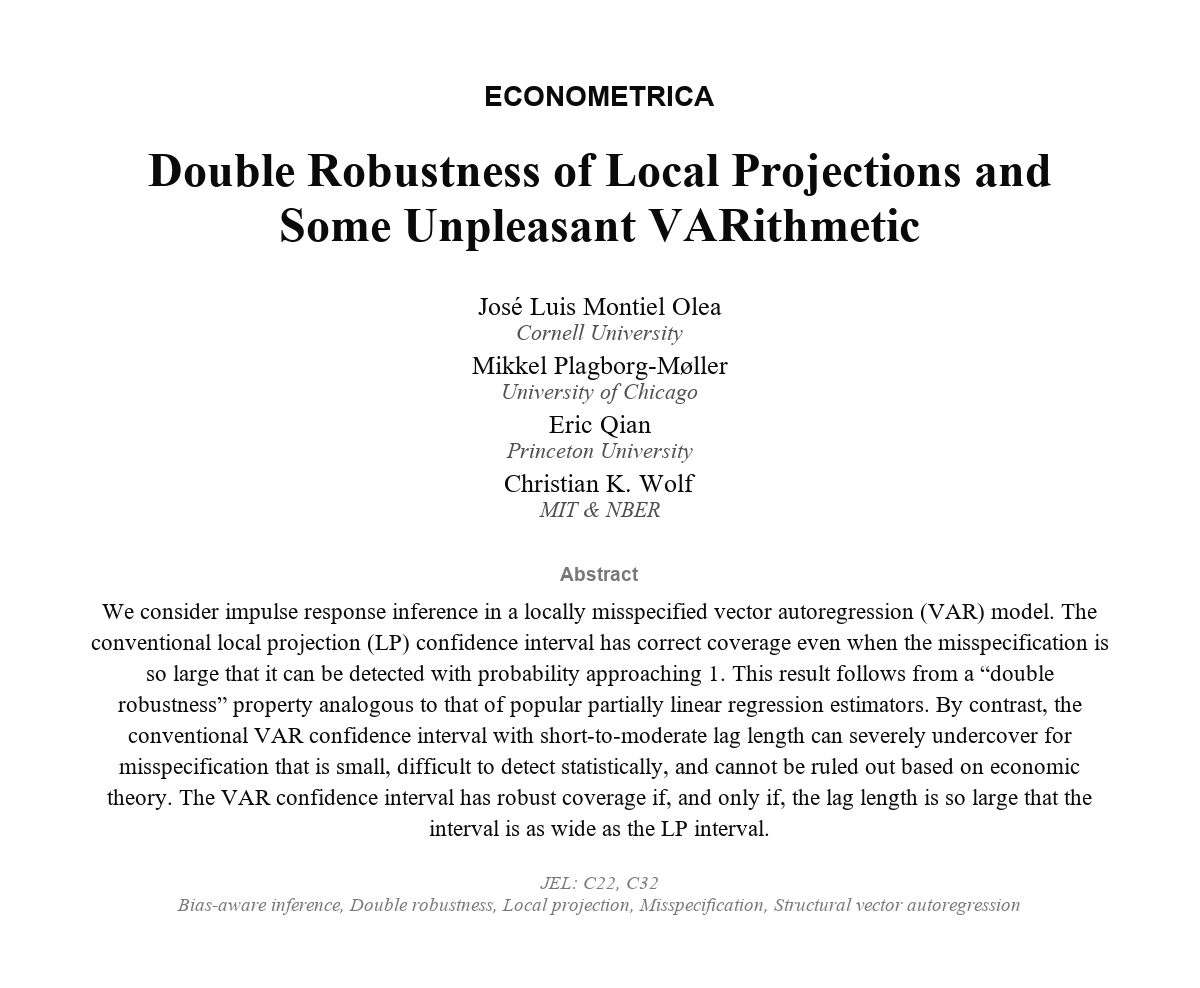
Local projections are surprisingly robust to misspecification. By contrast, VAR confidence intervals with short-to-moderate lag length can severely undercover for misspecification that is small, difficult to detect, and cannot be ruled out a priori.
https://t.co/rFObJ2dWfN
Using a quantitative GE model with heterogeneous banks, we show ECB collateralised lending mitigated real effects of euro-area money-market disruptions.
New paper by De Fiore, Hoerova, @rogers_ciaran , and @haralduhlig
https://t.co/HYwxzDfmR0
#REStud#EconX#EconTwitter
For researchers interested in U.S. banking and finance, we are sharing a new data resource!
It contains information on bank balance sheets, bank runs, and bank failures from the 19th century to the present:
Data from hundreds of thousands of ancient coins is used to reconstruct granular time series of trade and real consumption around the Mediterranean from the 4th to the 10th century, from @johannesmboehm and Thomas Chaney https://t.co/f9xGg9Gxmv
Accurate housing price indexes require aggregating from homogeneous local market areas weighted by dwelling units or interior space—a standard most repeat-sales and hedonic models currently miss, from Daniel Broxterman, William Larson, and Anthony Yezer https://t.co/xRkQabBRZ3
Next slides up in my course on the political economy of early America:
“The Atlantic World.”
https://t.co/9H6Ka6d5EO
Three big questions I want to tackle:
Why did Europeans reach the Americas in 1492 rather than 1192 or 1792?
Why did rival European empires build such different institutions in the same hemisphere?
How did the Atlantic system shape the conditions under which British North America emerged?
I spend a lot of time on Britain because the Stuart Century is absolutely central to understanding 1776. That so few Americans grasp this today is unfortunate. You really need to see why James I (hardly a household name for most people in the U.S.) shocked the British Isles so profoundly before you can make sense of what happened in Philadelphia on July 4, 1776.
The previous slide decks are:
https://t.co/XliMkesFHO
https://t.co/vmIj3W5UEr
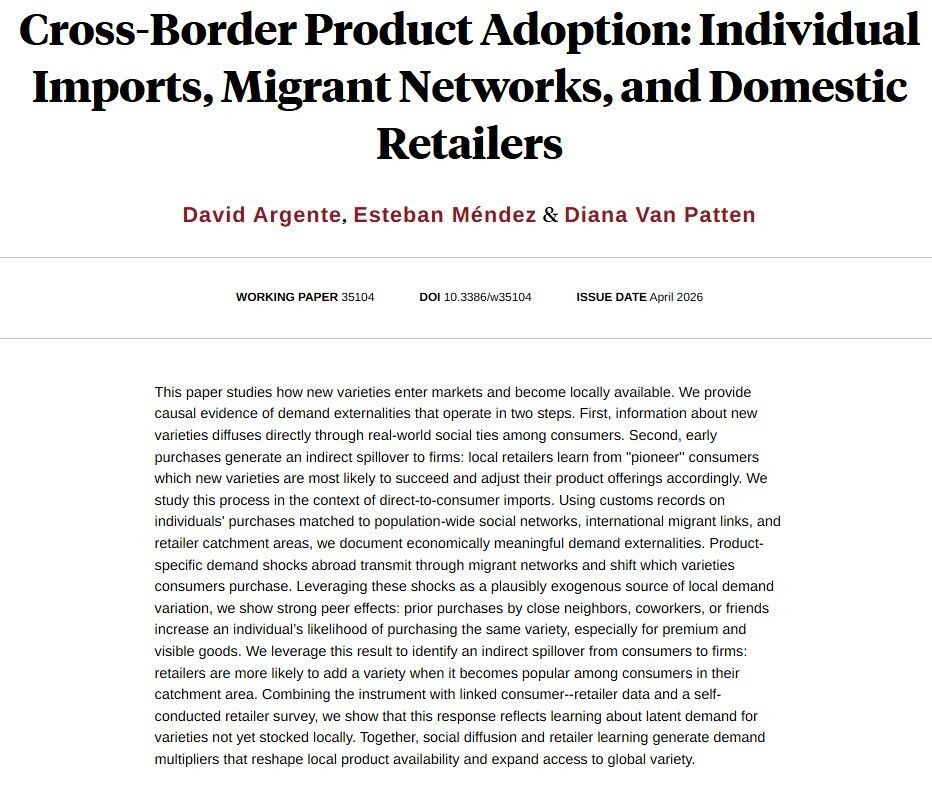
Social ties spread demand for new products; retailers learn from early buyers and expand offerings, amplifying access to global varieties through local demand spillovers, from @dargente05, Esteban Méndez, and @dianavanpatten https://t.co/9vNUn11LhO