I've decided to translate all my previous company write-ups to English ( $AEP.V, $HQI, $CPH.TO + an overview of my portfolio)
Also, I finally came up with a proper name and a logo for the blog. Feel free to check it out and let me know what you think! ⬇️
🚨Stock at 0.9× P/E? The Cheapest Company We’ve Ever Bought🛢️
We just bought what might be the most absurdly cheap stock we’ve ever found.
A tiny, almost completely uncovered Asian refinery that was priced for bankruptcy just a year ago is now potentially generating more net profit in a single year than its entire market capitalization.
Yes, you read that correctly.
The stock has already rallied several hundred percent from its lows. We wish we’d discovered it earlier.
But we believe the market still hasn’t fully understood what’s happening.
And here’s the interesting part: this might be one of the most attractive geopolitical hedges we’ve found in the current environment.
The very conditions putting pressure on broader equity markets are creating extraordinary profits for this company.
Why are we so bullish?
→ Less than 1× P/E: We estimate FY2026 net profit of ~RM2.8bn against a market capitalization of roughly RM2.4bn.
→ An extraordinary Q3: Our model projects ~RM965m of net profit in a single quarter, approximately 40% of the company’s market cap.
→ The perfect product mix: Nearly half of refinery output consists of diesel and jet fuel, precisely the products experiencing some of the most extreme global shortages.
→ A hidden competitive advantage: Unlike many Asian refiners, the company sources a substantial portion of its crude locally, avoiding much of the extraordinary tanker freight and insurance costs.
→ A complete balance-sheet transformation: We estimate that the current windfall could eliminate net debt and leave the company generating cash even after refining margins normalize.
→ Potential dividends and re-rating: If our estimates materialize and cash conversion improves, the company could have substantial capacity to return capital to shareholders.
The market appears to be pricing in a rapid return to almost zero profitability next year.
We think that scenario is excessively pessimistic.
The global economy isn’t necessarily running out of crude oil. It’s running short of the ability to refine crude into the fuels the world actually needs.
Russian refineries remain under attack, Middle Eastern refined-product exports are disrupted, Chinese exports are restricted, and global diesel inventories are exceptionally tight.
Meanwhile, the U.S. midterm elections are approaching, and we see considerable uncertainty around what happens next in the Middle East.
And while expensive growth stocks may struggle with renewed inflation, elevated rates and geopolitical uncertainty, this refinery could continue generating extraordinary cash flows.
That’s precisely the kind of differentiated exposure we want in our portfolio.
The valuation is what makes it so interesting
At approximately RM4.05/share, that represents around +40% upside in our base case and +127% in our bull case.
Of course, this is a cyclical, single-asset business, and our bear case is not a guaranteed downside floor.
But we believe the potential cash generation provides an unusually attractive margin of safety relative to the current valuation.
We spent a LOT of time researching this one.
We went through historical financial statements, reconstructed the refinery’s product mix, analyzed diesel and jet-fuel crack spreads, modeled crude sourcing and tanker costs, and rebuilt the company’s quarterly earnings almost barrel by barrel.
We also studied its hedging exposure, working-capital requirements, historical crises, customer contracts and potential dividend capacity.
This isn’t a simple screen showing a low P/E.
The company has almost no meaningful analyst coverage, and we believe very few international investors are paying attention.
We genuinely think this is one of the most unusual and asymmetric opportunities we’ve uncovered this year.
📖 Our full deep dive, valuation model, scenario analysis and investment thesis are now available on Substack:
https://t.co/hZFfE2rH1G
🚨 EXCLUSIVE: A 10%+ Portfolio Position. Multiple Catalysts. Our Best Macro Idea for the Next 6 Months?
Only freely available management interview and deep dive into key findings $AXL.L / $AXL.V 🛢️
Our third-largest portfolio position and our biggest geopolitical/macro bet has already delivered exceptional returns. Our earliest purchases have nearly doubled, yet we remain extremely bullish.
What will you find in our latest deep dive?
🔹 Exclusive management insights: Previously unpublished details from our direct conversation with management, covering current production, year-end expectations and the company’s ambitions for 2027 and beyond.
🔹 The biggest catalyst: Where things currently stand with the extension of Arrow’s crucial Colombian production licence, why it matters so much and what could happen if it is approved.
🔹 Updated cash flow and valuation model: Why we believe Arrow remains extraordinarily cheap even after its recent rally, and why the market may still be underestimating its earnings potential.
🔹 The perfect geology for an oil price spike: We explain why Arrow’s specific Colombian well economics make a temporary surge in oil prices disproportionately valuable. In fact, we struggle to find another producer that benefits more from this particular macro environment.
🔹 Capital allocation and future growth: Management’s plans for reinvestment, production expansion, potential acquisitions and what they ultimately want to achieve over the coming years.
And perhaps most importantly, we explain why today’s extraordinary oil prices could effectively finance a substantial portion of Arrow’s future growth.
This is what makes the opportunity so interesting to us.
Why we’re still extremely bullish on oil 🛢️
The Strait of Hormuz remains heavily disrupted, Iranian attacks have intensified, and exports from the Persian Gulf continue to face enormous logistical and security challenges.
At current shipping and insurance costs, transporting oil through alternative routes can become economically unattractive if prices fall substantially. Without a meaningful de-escalation or agreement, we struggle to see a rapid normalization of the physical oil market.
There are also significant geopolitical uncertainties ahead, including the possibility of renewed U.S.–Iran escalation after the midterm elections. Meanwhile, rebuilding depleted strategic inventories could provide additional support for oil demand.
Even the forward curve suggests that oil prices could remain elevated well into 2027.
And Arrow is exceptionally well positioned for that environment.
During our conversation, management made a remark that perfectly summarizes the situation:
“High oil prices are extremely good for our company, but not so good for humanity.”
Company is one of our favorite geopolitical hedges
What we particularly like is the asymmetry.
If geopolitical tensions continue escalating, oil prices could remain extremely high while broader equity markets suffer. In that environment, Arrow’s unhedged production and strong operating leverage could translate into extraordinary cash generation.
But even if oil prices normalize, Arrow still has meaningful company-specific catalysts, including licence extensions, production growth and potential acquisitions.
We believe another 50%+ appreciation over the next six months is possible.
If you read the full management interview, our updated model and the explanation of Arrow’s unique well economics, I think you’ll understand why we remain so bullish even after the rally.
We’ve spent considerable time researching this company and speaking directly with management to bring you insights that are difficult to find elsewhere.
📖 Full exclusive management interview, investment thesis and updated valuation model on Arborator Capital Research:
https://t.co/hZFfE2r9c8
As always, our research is currently free.
The AI Boom’s Most Unlikely Winner?😳Stock Hidden in Germany’s Fading Industrial Heartland, 20%+ IRR Through 2030!
• €879m+ of new orders in 9 months — >2x last year’s revenue
• Production capacity set to ~3x to ~1GW
• Exploding backlog & data-centre pipeline
• ~43% founder ownership
• Massive operating leverage as volumes ramp
• 20%+ potential IRR through 2030
• Still valued like a German industrial rather than an AI infrastructure company
We are not heavily invested in an AI-related theme as we were a year ago, but we found another story very compelling.
I’ve been bullish on modular, behind-the-meter power for years. Back in 2024, I wrote about $BE on my Czech blog, pitched it in several interviews (no one liked it) and made a video about it for my Czech YouTube channel.
The thesis was simple: the real AI bottleneck wouldn’t just be chips. It would be electricity. Data centres would need huge amounts of reliable power, and they would need it much faster than the grid could provide it. Modular, on-site generation looked like a no-brainer.
$BE has since appreciated by more than 2,000% from around the time I published that thesis.
The problem today? The obvious AI power plays: $BE , $GEV and increasingly $INIO — have already attracted enormous investor attention and, in our view, valuations leave much less room for error.
Then we found this company.
Reading about it immediately reminded me of the original Bloom thesis. Different technology, different company, but essentially the same bottleneck: fast, modular, reliable power behind the meter.
And this time, we think the valuation still makes sense.
The inflection is only beginning. Manufacturing capacity is set to roughly triple just as data-centre orders are exploding, creating potentially enormous operating leverage on both revenue and profitability.
And data centres aren’t the whole story. Behind the AI opportunity sits an established German business: biogas CHP, power generation, Ukraine energy infrastructure, a growing heat-pump business and a highly profitable service operation.
There’s another optionality we find interesting. Modular gas-engine plants are inherently decentralized. Instead of relying on a handful of huge generation assets, critical infrastructure can be supported by many independent units. As Europe thinks increasingly about energy resilience and the protection of critical infrastructure, we believe that characteristic could become significantly more valuable.
Peter Lynch famously warned against looking for the “next Walmart”, “next Microsoft” or “next anything.” Those comparisons usually don’t end well.
So this isn’t the “next Bloom Energy.”
But the market may be giving us a second chance to invest in the same bottleneck — through a different technology, at a very different valuation, just as the earnings inflection begins.
We own it.
Full thesis on our Substack. 👇
https://t.co/hZFfE2r9c8
And over the next few days, we’ll also publish a dedicated update on our first full quarter since opening the fund to external investors — including performance, comparison with benchmarks, portfolio characteristics, and some of the most important lessons and developments from the quarter. So stay tuned for that as well.
Credit: @MoodyWriter13 was one of the earliest accounts we found highlighting this company and its behind-the-meter/data-centre opportunity. Big thank you also to our Czech portfolio manager colleague, who firstly brought us this opportunity. His Substack:
https://t.co/UcAkdhazv7
You should follow Jan @AC__research. Those czech young guns are build different-humble and turning lots of rocks-of course also give the guy on the left @lasse108 a follow, future king of Denmark likely.
I love those photos with lots of stock picking skills in the background 😅
❗️We just bought almost 1% of a tiny European gas producer.
And we think it may be one of the most asymmetric bets we’ve found this year.
European gas is back above €80/MWh, storage levels are low, and we don’t think Europe’s energy problems are over.
We’re Europeans ourselves, so our thinking is simple: if we’re going to freeze at home this winter, we’d rather get rich while doing it than just freeze.
Over the past few weeks, we’ve therefore bought as many shares as liquidity allowed. Together with our partners, we now own close to 1% of the entire company.
And liquidity matters here. A large part of the shares is held by management, insiders and other long-term holders, so building a meaningful position isn’t particularly easy. We don’t plan on selling ours anytime soon either.
Why do we like this setup so much?
• Potential ~5x production growth. The company is approaching several important catalysts that could allow production to increase dramatically over the coming months and years.
• Multiple near-term catalysts. Permits, reserve development and new production could all materially change the economics of the company. Several of these catalysts could arrive within the next few months.
• Extremely attractive gas economics. The company produces exceptionally clean, low-cost natural gas and sells its production essentially at spot prices, even achieving a premium to the relevant benchmark.
• The downside case still looks attractive. We don’t need another European energy crisis for the investment to work. If only a few things go right and gas prices eventually normalize, we still see a realistic path to 100%+ upside over the next 3–4 years.
• The bull case is much more interesting. The company owns additional projects to which we believe the market currently assigns essentially zero value. If those assets are developed and European gas prices remain elevated, our bull case points toward roughly a 5x return over the next four years.
• And management is unusually aligned. The CEO has significant skin in the game, takes relatively modest compensation, and doesn’t want to endlessly recycle cash into new oil & gas projects. The objective is to derisk and monetize the existing assets and ultimately return the cash to shareholders.
That last point is particularly important to us. We’ve looked at plenty of tiny commodity producers where management seems more interested in building an empire than creating per-share value. We think the incentives here are very different.
The asymmetry is what ultimately made us build such a large position.
If European gas prices normalize significantly, we believe the company can still create substantial shareholder value simply by executing on the assets it already owns.
But if Europe’s energy crisis persists, production ramps as planned, and some of the assets currently valued at essentially zero begin to be monetized, the economics become completely different.
It’s also exactly the kind of diversification we’re looking for right now. While seemingly everyone is chasing the same AI trades at increasingly demanding valuations, this is a tiny, overlooked European gas producer with completely different return drivers and potentially enormous operating leverage to one of Europe’s biggest macro risks.
My colleague put together what I think is one of the best write-ups we’ve published on our Substack so far — very concise, straight to the point, and easy to follow. Definitely worth a read if the idea sounds interesting.
Our full investment thesis, valuation scenarios and the company itself are all in the Substack write-up below.
1/3 — THE ENERGY CRISIS IS BACK 🛢️🔥
Hormuz is still effectively closed. The war is escalating. Brent is back above $100/bbl. And Europe may be heading straight into another energy shock.
At this point, tankers in the Gulf are starting to look less like commercial vessels and more like targets at a shooting range.
And the problem is no longer just crude oil.
The entire global energy system is becoming increasingly tight at the same time:
→ Brent is back above $100/bbl
→ Normal shipping through Hormuz remains severely disrupted, cutting off one of the most important arteries of the global oil & LNG market.
→ Russian refining capacity and product exports remain constrained.
→ Middle Eastern exports of refined products have been severely disrupted.
→ Global inventories of middle distillates are extremely tight.
→ European diesel is now trading around $200/bbl, while diesel refining margins recently reached all-time highs.
→ US diesel prices have also reached record levels.
And now natural gas is joining the party.
European TTF is approaching €80/MWh — the highest level since early 2023 — while European storage is only ~67% full heading into winter.
This is becoming a particularly nasty combination for Europe:
Less LNG + less refined-product supply + extremely tight diesel markets + low gas inventories + winter approaching.
And unlike earlier this year, this is no longer just a theoretical geopolitical risk premium.
It is showing up directly in physical energy markets.
Diesel cracks are exploding. Gas is exploding. Oil is above $100. Shipping remains heavily disrupted. And the longer Hormuz stays constrained, the more inventories are being drawn down.
We have been positioning our portfolio for this scenario for months.
And interestingly, we don’t think crude oil itself is necessarily the best way to play it anymore.
There are several businesses downstream — particularly refiners and a few very specific European gas producers — where the earnings sensitivity to what is happening right now is absolutely enormous.
Some of them are effectively turning into cash-printing machines at current spot prices.
And that’s where we have been putting capital.
↓ Our three favorite ways to play the energy shock:
Drones are perhaps the most important theme of modern warfare – and the few companies that offer protection from them could benefit massively.
Trust me, you'll want to read this writeup:
🤖💥The Ultimate Drone Warfare Portfolio: 3 of Our High-Conviction and the most interesting Ideas
Drone warfare is no longer the future of modern warfare. It is already here.
Ukraine has shown how cheap FPV drones can inflict enormous losses on conventional forces at a fraction of the cost of traditional weapons. The recent conflict in the Persian Gulf has highlighted the other side of the equation: relatively inexpensive drones can rapidly consume enormously expensive and limited air-defense inventories.
The economics of warfare are changing and we believe drones and, perhaps even more importantly, counter-drone technologies are one of the strongest structural defense themes of the coming decade.
It has therefore become one of the largest thematic exposures in our portfolio.
In our new write-up, we reveal three very different ways we are playing this trend:
1) A niche counter-drone monopoly at an inflection point — a relatively undiscovered company growing close to 100% YoY, operating in a highly specialized part of drone defense. We met with management last week, tested the technology ourselves and came away with several insights that are difficult to get from public information. The company has just crossed the profitability and order momentum inflection point.
2) A broader counter-drone winner collecting contracts one after another — a larger but still relatively underfollowed company with one of the most comprehensive portfolios of technologies designed to detect, track and defeat drones. We believe it offers one of the cleanest ways to play the enormous spending cycle now beginning in counter-UAS defense.
3) A recently listed specialist micro-cap with huge optionality — a tiny company building technology used in drone and counter-drone training, with an interesting recurring-revenue model and potentially enormous upside if it can successfully scale from its current base.
These aren’t the obvious defense stocks everyone already owns like $LMT $ONDS $RCAT $RTX or $AVAV . They are niche businesses operating in parts of the drone ecosystem where we believe growth could remain exceptional for years.
And some of them already represent very significant positions in our own portfolio.
We have put the three together into our “Ultimate Drone Warfare Portfolio” and published the full investment theses on Substack.
Read the full write-up on Arborator Capital Research:
https://t.co/hZFfE2r9c8
@ACapitalLP $AXL.L small oil producer with no hedging, on track to generate 100% of its EV in cash flow this year. And a big catalyst in license extension, which just became more likely with latest elections
https://t.co/Ra3K0oKbTQ
🔥 The ultimate portfolio hedge against further escalation in the Strait of Hormuz? We think we’ve found it.
A stock that could benefit enormously if oil prices spike further… while still offering substantial upside even if geopolitical tensions ease.
Since the conflict around the Strait of Hormuz escalated, we’ve been asking ourselves one question:
Is there a stock that benefits massively if oil spikes… but can still generate outstanding returns even if tensions fade?
After weeks of research, we think we’ve found exactly that.
In our view, it’s one of the most attractive macro hedges available today.
If tensions escalate further, it could be among the biggest equity beneficiaries.
If they don’t, we still believe the company is undervalued based on its own fundamentals.
It’s currently our third-largest position, behind only FitEasy $212A.T and Smart Shooter $SMSH . (Other write ups are on Substack)
Here’s why:
• 🛢️ Virtually no oil hedging – almost every additional dollar of Brent flows directly into cash flow.
• 💰 Net cash equal to roughly one-third of its market cap, with no debt.
• 📈 Trading at roughly ~1× this year’s EBITDA (our estimates).
• 💵 EV/FCF below 2× even assuming Brent prices slightly below current levels.
• ⛽ Expected to generate cash over the next two years approaching today’s entire market capitalization.
• 🚀 Several company-specific catalysts (independent of oil prices) that we believe could unlock 30–50%+ upside on their own.
• 📊 Every analyst report we reviewed values the shares roughly 50–100% above the current price.
The market has started to price in higher oil prices, but in our opinion it still hasn’t fully reflected either the improving company-specific outlook or just how much operating leverage this business has to elevated Brent prices.
We published our full investment thesis, valuation model and scenario analysis today.
The full write-up is available on our Substack link in below 👇
One of our highest-conviction ideas is going live today🔥
44% revenue growth until 2028
4x 2028 earnings
Potential dividend approaching 10% in 2028
Large discount versus peers
High barriers to entry
non AI and uncorrelated to broader market
55 % IRR over 3 years in the base case
Imagine finding a founder-led company with a unique competitive position, operating in a niche market with powerful long-term structural tailwinds, trading at a valuation that looks more like a struggling cyclical business than a high-quality compounder.
That’s exactly what we believe we’ve found.
Based on management guidance and our own work, the business is expected to compound revenue at roughly 44% per year through 2028, while earnings should grow even faster as margins expand. Yet despite that growth profile, the company is currently trading at only ~4x our 2028 earnings estimate, with the potential to deliver a dividend yield approaching 10% on today’s purchase price if management executes on its stated payout policy.
What makes this opportunity even more compelling is that the business combines:
* Founder-led management with strong alignment.
* A vertically integrated model that gives it structurally higher margins than peers.
* Significant barriers to entry and multiple long-term growth drivers.
* A much higher-quality business than comparable companies, yet trading at a meaningful valuation discount.
* A business model that we believe is considerably less cyclical than the market currently assumes.
Over the past weeks we’ve aggressively built a large position, because we believe the current valuation materially underestimates both the quality of the business and its earnings power over the next several years. If the company simply executes on its existing project pipeline, we think the market will eventually be forced to recognize that disconnect.
The full deep dive is now live on our Substack.
We cover the complete investment thesis, competitive advantages, valuation model, key risks, management incentives, and detailed return scenarios explaining why we believe this is one of the best risk/reward opportunities we currently see anywhere in the market.
Link is in the bio.
🚀 Our first deep-dive on Substack is finally live!
We decided to start with our largest portfolio position — $212A.T #212A (FitEasy).
In our opinion, it’s one of the most mispriced small caps we’ve found globally, and we believe it has the potential for more than 100 % return over the next 2–3 years if the business continues executing as we expect.
📖 Read the full write-up here:
https://t.co/5ZQxAPNNel
Compared with the X thread, the Substack version includes an updated valuation model, cleaner formatting and a more detailed explanation of our investment thesis.
A huge thank you to everyone who has already read and shared it.
Since publishing the write-up, FitEasy has gained another ~10%, accompanied by noticeably higher trading volumes. We’re glad the company is reaching a wider audience and, more importantly, we continue to believe the investment thesis is playing out.
At the same time, $SMSH.TA (Smart Shooter) has also appreciated by more than 10% since we first shared our research. Together with FitEasy, these remain our two highest-conviction positions today.
We’re currently working on several additional deep dives covering what we believe are highly asymmetric investment opportunities across different sectors and regions.
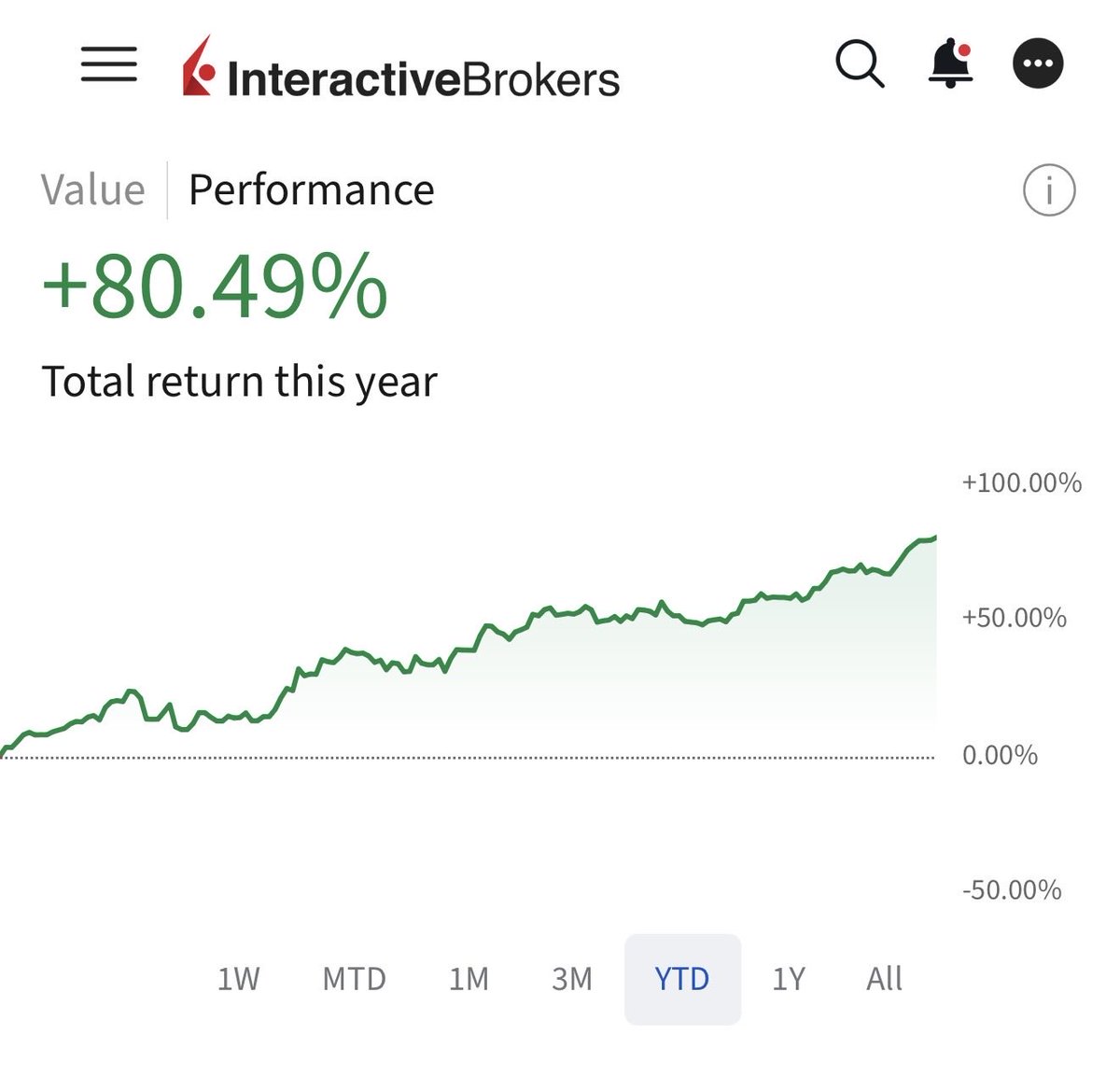
Thanks to the recent performance of these positions, my personal portfolio has now surpassed +80% YTD.
Hopefully that’s only the beginning. We look forward to sharing many more ideas with you over the coming months.