We're releasing the Origami Dataset we prepared for the #RoboticOrigamiChallenge we co-organize with @chris_j_paxton@micoolcho, @DJiafei and @lightwheel for #IROS2026!
It's one of the largest tactile datasets out there and it's built on #SharpaWave, our 22-DoF five-finger tactile hand. It shows both head & wrist camera views; and records deformation and tactile patterns from the fingertips as the paper folding task unfolds.
What's in the dataset:
1. 682 episodes across 51 collection seasons, 4.76M frames at 30 FPS
2. 6 synchronized camera views plus
3. 10 fingertips x 6-axis force/torque signals, synchronized frame by frame with vision and motion
4. 2 tactile video formats: a raw sensor stream for maximum fidelity, and a lighter deformation map
5. 65D joint-space state and action across two arms and two dexterous hands
6. Full LeRobot 3.0 coverage across all seasons, ready to drop into existing pipelines for long-horizon imitation learning, and/or visual-tactile representation learning
Dataset on Hugging Face: https://t.co/lmQrGxUjxP
Wave URDF & tactile assets: https://t.co/WSGPeMSDgA
#RoboticOrigamiChallenge #HuggingFace #Robotics #TactileSensing #EmbodiedAI #IROS2026 #TactilePolicies #Robots #PhysicalAI #datasets
When SceniX joined World Labs, we said spatial intelligence was never only about perceiving and generating virtual and physical worlds, but also interacting with them. Today, we’re sharing early results from that vision: building worlds that train robots. 🌎🤖↓
To unlock real value, AI needs to move beyond siloed software. Join us to learn how we're building the connective layer needed to turn isolated data into genuine site-wide intelligence. https://t.co/O0p37bG9sG
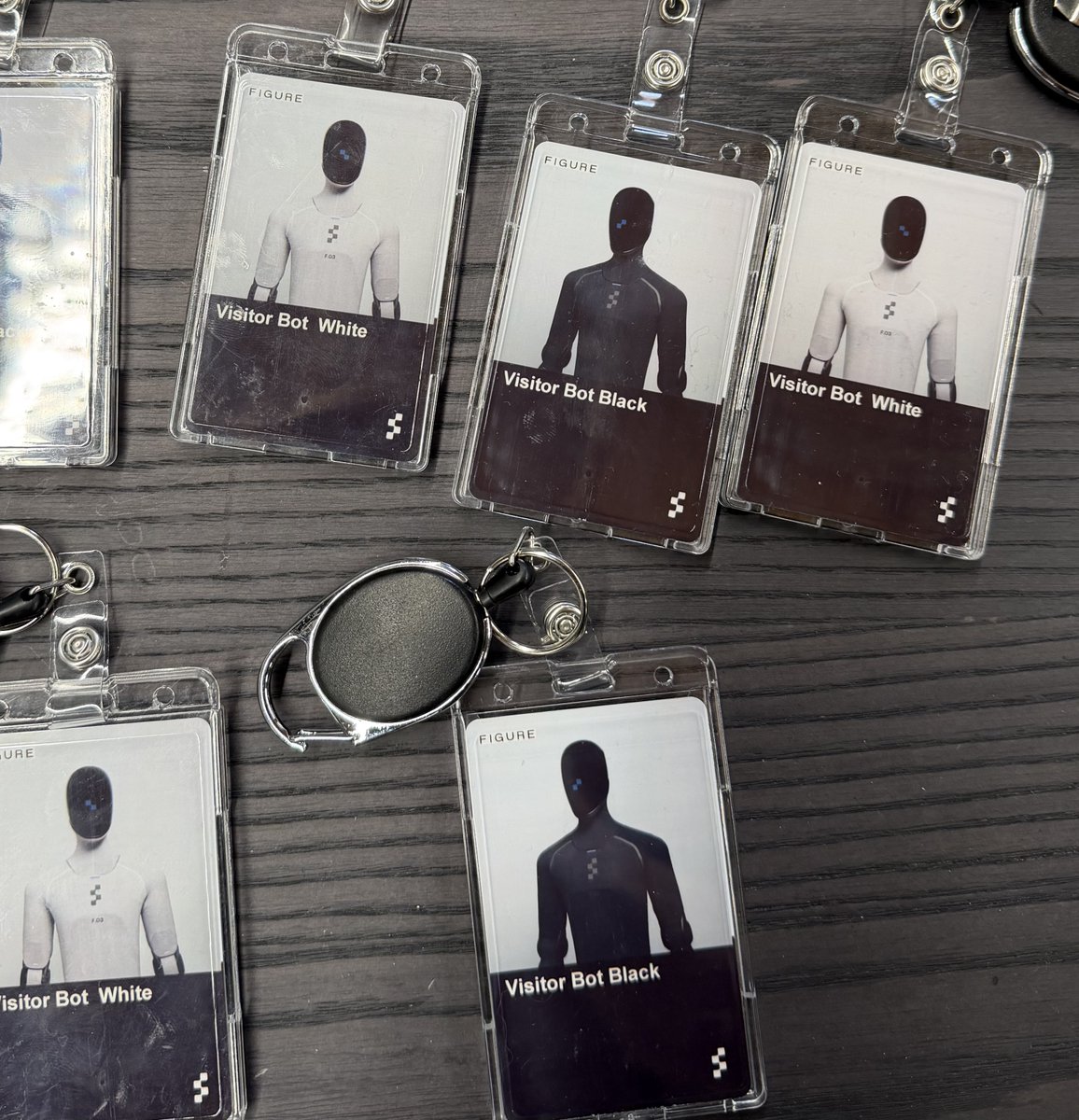
Figure robots now have visitor passes!
They have full access to every door on campus. Soon there will be hundreds of them walking around campus, just coming and going
Most robot teleoperation copies hand motion but not "feel" so the robot crushes or drops whatever it's holding, and you throw the demo away.
A new @NTUsg paper (from Research Fellow Haichao Liu, Dr. Ziwei Wang & team) addresses this: the robot reads its own fingertip tactile feedback and auto-corrects grip force in real time, while the human stays in control of the motion.
Result: success on a hard assembly task went from 4% → 97%, using less than half the force.
The bottleneck in dexterous robots training is also about collecting clean data where nothing got crushed along the way. This research help closing the gap. So do the #SharpaWave, that enable high quality data collection for complex manipulation tasks, like screwing.
Link to the paper in comments!
#DexterousManipulation #TactileSensing #AIRobotics #NTU #Dexteroushands #Robots #Teleoperation
For my first post, I’m sharing a letter @NVIDIA signed on why open models matter.
AI will transform every industry, power every company, and be built by every country.
Open models strengthen safety and cybersecurity, accelerate innovation and diffusion, and enable sovereignty.
The world needs both frontier closed models and frontier open models.
https://t.co/AUKzoQ5Ikb
Jack Ma-backed Ant Group is testing an overhaul to its Alipay super app that would introduce an AI agent interface, a major escalation in its battle for users with archrival WeChat https://t.co/vs60HJMPPM
The Chinese economy has slowed considerably in recent years. It will take a lot more than a few high-tech successes, no matter how spectacular, to lift Chinese spirits https://t.co/fPbmKeRAUL
Photo: Alamy
Today, @SpaceX (Nasdaq: SPCX) makes its public market debut with a $75Bn offering (pre-greenshoe) at $135 per share, marking the largest IPO in history.
Congratulations to the SpaceX team. We are honored to serve as joint lead bookrunner and sole stabilization agent.
OpenAI Robotics is hiring, looking for exceptional full-stack hardware, ops, systems, and ML engineers to help us program and manufacture robots that are useful for society.
AI should be able to help people in the physical world. In the short term, we are focused on robots to support skilled workers to build our future infrastructure; in the long term, we imagine everyone having a personal robot doing anything they need.
Our world simulation research program, led by Aditya Ramesh (@model_mechanic), has evolved over the past year into OpenAI Robotics. Progress is rapid, and based on a foundation of co-design between robotics hardware and ML research.
If you love working hands-on across the robotics stack and want to build the future, please consider joining us. Send an email with your background and evidence of exceptional accomplishment to: [email protected]
Two economists just published a mathematical proof that AI will destroy the economy.
Not might. Not could. Will — if nothing changes.
The paper is called "The AI Layoff Trap." Published March 2, 2026. Wharton School, University of Pennsylvania. Boston University. Peer reviewed. Mathematically modeled.
The conclusion is one sentence.
"At the limit, firms automate their way to boundless productivity and zero demand."
An economy that produces everything. And sells it to nobody.
Here is how you get there.
A company fires 500 workers and replaces them with AI. A competitor fires 700 to keep up. Another fires 1,000. Every company is behaving rationally. Every company is following the incentives correctly. And every company is building a trap for itself.
Because the workers who were fired were also customers.
When they lose their jobs faster than the economy can absorb them, they stop spending. Consumer demand falls. Companies respond by cutting costs — which means automating more workers — which means less spending — which means more falling demand — which means more automation.
The loop has no natural exit.
The researchers tested every proposed solution. Universal basic income. Capital income taxes. Worker equity participation. Upskilling programs. Corporate coordination agreements.
Every single one failed in the model.
The only intervention that worked: a Pigouvian automation tax — a per-task levy charged every time a company replaces a human with AI, forcing them to price in the demand they are destroying before they pull the trigger.
No government has implemented this. No major economy is seriously discussing it.
Meanwhile the numbers are already tracking the curve. 100,000 tech workers laid off in 2025. 92,000 more in the first months of 2026. Jack Dorsey fired half of Block's workforce and said publicly: "Within the next year, the majority of companies will reach the same conclusion."
Nobody is doing anything wrong. Companies are following their incentives perfectly. That is exactly the problem.
Rational behavior. At scale. Simultaneously. With no mechanism to stop it.
Two economists built the math. The math leads to one place.
Source: Falk & Tsoukalas · Wharton School + Boston University ·
He Xiaopeng is not the best known of China’s tech bros, but he is one to watch. His early bet on giving EVs tech features that now define the Chinese market paid off. Now he wants to do the same with robots https://t.co/FEVeJuRNcH
Sharing more details on what’s going on:
> Our original goal was an 8-hour run. After zero failures yesterday, we decided to keep going. We’re now over 24 hours of continuous autonomous operation without a failure. This is uncharted territory
> The task is small package sorting. F.03 detects the barcode, picks up the package, and reorients it barcode face-down onto the conveyor
> Humans average around 3 seconds per package. F.03 is now around human parity. The robots are reasoning directly from camera pixels
> The robots are fully autonomous running Helix-02, our in-house neural network running entirely onboard F.03. There is no teleoperation - every action comes directly from Helix-02
> If the robot gets stuck or the AI policy goes out of distribution, Helix triggers an automatic reset. You’ll occasionally see this happen during the livestream
> YouTube commenters started naming the robots Bob, Frank, and Gary yesterday, so we added name tags to each robot
> If a robot has a software or hardware issue, it autonomously leaves for maintenance and another robot takes over. We run our labs at Figure this way to maximize uptime. We haven’t had a failure yet, but statistically we probably will at some point
The Trump-Xi summit will expose America and China as a dysfunctional duo. Register for free to learn why mutual vulnerability is no substitute for global leadership: https://t.co/6zmt0gmSoR
How big is the gap between America and China on AI? And what do the country’s manufacturing prowess and huge trade surplus mean for the world economy?
Our panelists offer their take on Inside Economics https://t.co/6B3c9R5UZs