A woman paid for Amazon Prime for 5 years before she realized she was using it wrong.
She'd ordered hundreds of packages. Watched a few shows on Prime Video. Never once looked past the "Buy Now" button.
Her cousin — who worked Amazon customer service for 3 years — was staying over for the holidays and watched her order a phone charger at full price.
She finally said: "Wait — can I see your account for a second? You're missing 9 things that come with the Prime you're already paying for. Amazon doesn't advertise most of these. They'd rather you not use them."
She changed 9 things in 10 minutes.
She saved $340 that month. Got a package a day early. Found $1,200 worth of stuff she already owned buried in a benefit she'd never opened.
Here's everything her cousin showed her:
A guy used AirPods Pro 2 for 2 years.
He pressed play. He pressed pause. He answered calls. He switched to noise cancellation on planes.
That was it. 4 features. On a $249 device with 30+.
His coworker a sound engineer at a recording studio borrowed them for 10 minutes at lunch and handed them back with a look.
"You've never opened Settings once, have you? Apple built 9 features into these that change how you work, sleep, hear, travel, and take calls. They're buried 3 menus deep and never mentioned in any ad. You've been wearing the world's most underused productivity tool."
He spent 11 minutes in Settings that evening.
His calls got clearer. His focus got deeper. He hasn't touched his phone during a workout since.
Here's every feature his coworker showed him 🧵
The senior analyst at a Tiger Cub who trained me on financial modeling back in '08 (shoutout Chris Laporte) walked me through the importance of deeply detailed cash flow builds. So much of the world is focused on EPS (certainly the sell-side), that you can generate a lot of insights on business performance by focusing closely on the cash flow statement.
Everyone agrees that Free Cash Flow is the purest driver of net present value, but modeling FCF is a very messy exercise whereas EPS has the benefit of accounting treatment that will smooth out the FCF lumpiness. Thus, much of the world defaults to EPS.
Great analysts spend a lot of time to see through the FCF messiness to uncover true cash flow generation capabilities. How much is operating cash flow impacted by working capital changes? How much of OCF is "fake" SBC add-backs that show up in dilution? How much of net income is actually recurring cash charges that are added back to Adj Net Income to flatter headline numbers? How much of FCF is actually distributable via dividend or buybacks?
To build all of these analyses into your financial model, there is no shortcut to having 10+ years of historical, quarterly cash flow statements. And this is a super annoying exercise to build, since companies report "cumulative" cash flows in Q2 and Q3, so it requires layering in the 9m cumulative cash flow, then subtracting Q1 and Q2, copying formulas as values. Ugg. I've never found a shortcut to doing this.
And while I completely agree that there are elements of financial modeling that help me learn the business, updating 5 years of cash flow statements isn't one of them.
I tried this exercise in 5 AI Excel co-pilots. Most failed on this exercise, but I was able to get Scout by Daloopa (not sponsored though do have free access) to do this reliably, with click through visibility.
While AI Excel still cannot one-shot a complicated model like my DHR model (not even close), AI Excel can do simple things like update my 5-year outdated BS & CF that save immense time and brain damage. I'll call that a big win.
(Will walk through this step by step on my AI Excel seminar April 30th).
Nobody told you airlines have two prices for every flight. The price they show you. And the price they hope you never find. $1,190 flight. Paid $141. $1,049 difference. Same seat. Same day. Here are the 7 prompts that found it: (Save this before disappearing).
This guy beat the market for 17 straight years trading a sector many investors have written off post-2008
Derek Pilecki (@gatorcapital) runs a financials-only fund. 21%+ annualized.
His edge? A corner of the market many investors moved away from after the GFC.
We cover:
- Why he expanded from 25 → 40 positions and returns went UP
- His counterintuitive rule: buy higher, not lower (positions get LESS risky as they rise)
- The Robinhood call — bought late 2023, rode it to a multibagger
- Why he's quietly watching FactSet, Morningstar & Verisk right now
- His view on private credit risk (and why he disagrees with Jamie Dimon)
- How he uses AI to analyze more stocks without losing his edge
- Why markets chronically underreact to good news — and how to exploit it
- The brutal career reality no one tells young PMs about
Highlights:
00:00 Intro
01:06 Derek's +21% annualized return track record
02:50 Fundamental business change vs market noise in Robinhood
05:25 Portfolio construction: Concentration limits and adding to winners
09:09 Sourcing alpha and identifying three-year doubles in financials
12:44 Developing edge through repetition and management team cycles
14:16 Why the post-GFC regime fundamentally changed bank underwriting
17:07 Assessing tail risk and leverage in the private credit market
21:23 AI-driven market dispersion and identifying moaty businesses
24:11 Why shareholder base turnover matters for timing broken charts
29:37 Integrating AI into fundamental research and SEC filing analysis
35:39 Risk management: Permanent capital loss vs mark-to-market volatility
37:12 Capacity constraints: Optimizing for returns over AUM scale
50:39 Career risk and the reality of active money management
$SPY ripped 3% today. Most people saw the move. Almost nobody understood why.
It was a gamma squeeze — and you could see it coming hours before it happened. Here’s how.
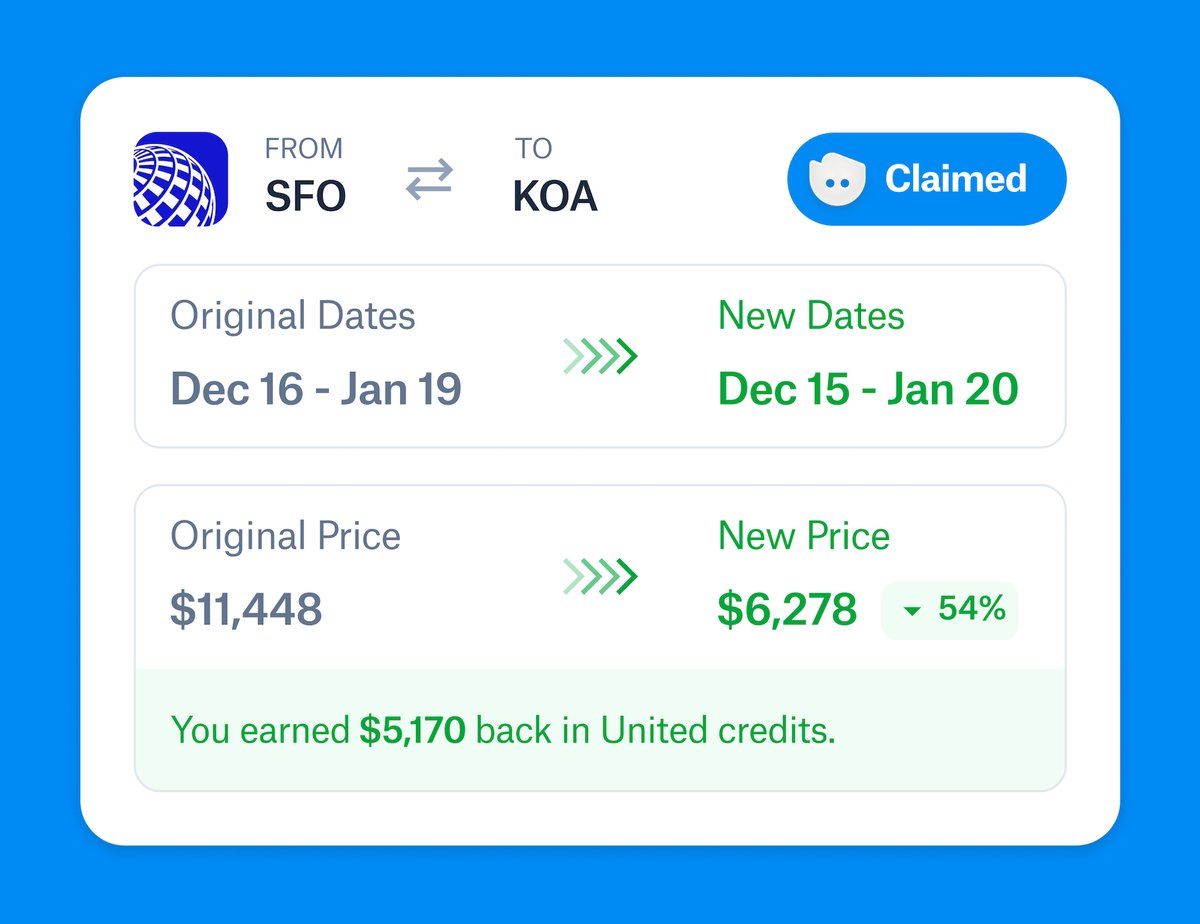
🌺 My boyfriend's parents booked their regular holiday flights to Hawaii. What happened next is exactly the type of magic we're seeing daily at Arden HQ.
Arden imported their itinerary and started optimizing. A few days later it flagged an opportunity: if they added one day to each end of the trip, the price dropped by more than half.
They approved the change with a single text. 👍
Arden rebooked the flights. They got over $5,000 back. 😎 🤑
They didn't search for that. They didn't know to look for it. They just... got a text that said "hey, I found something."
💡 Here's what's different about Arden and why I'm so excited about what we're building: it's not a tool you have to remember to open. It's not a website you have to check. It's a proactive agent that is always running in the background, always watching your trips, always looking for opportunities you'd never think to look for yourself.
Most travel apps are reactive. You go to them when you have a problem. Arden is proactive. It comes to you. Before the problem, before the missed opportunity, before the money is already spent.
So what are you waiting for? Link in the replies 🔗
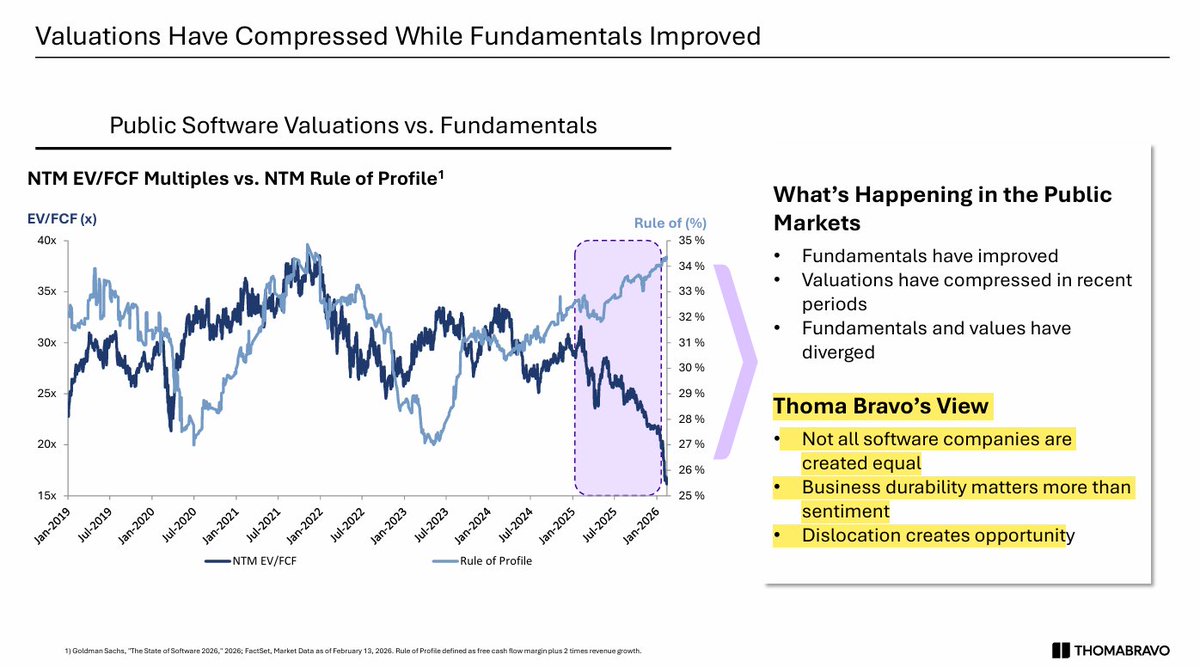
BREAKING: Thoma Bravo just released their LP meeting slides.
The world's largest software PE firm thinks the market has it completely wrong on software right now.
Public markets are panic-selling software based on AI fear.
Here's what they're seeing:
Rich Roll had 3 of the world's top fasting experts on his podcast.
Dr. Alan Goldhamer, Dr. Valter Longo, & Dr. Michael Greger.
They revealed shocking truths about fasting & disease reversal.
Here are my top 6 takeaways:
1. The weight you regain after fasting contains zero fat
I asked Claude to build my daughter an app that plugs into our piano, can read live key strokes, can show her sheet notes and key view and ends with a Guitar Hero style game. All while giving progressively harder songs. Today she’s using It and crushing It.
Australian tech entrepreneur Paul Conyngham explains how he used ChatGPT/AlphaFold (spent $3,000 with no biology background) to create a custom MRNA vaccine to treat his dog’s cancer tumors. Unreal.
We’re spending $200B+ a year on data centers to power AI. One company raised $11M, grew human brain cells on a chip, and the cells taught themselves to play a 3D shooter in a week.
Cortical Labs grew 200,000 human neurons on a silicon chip and taught them to play Doom. The cells navigate, target enemies, and fire weapons in real time. Their previous game, Pong, took 18 months on older hardware. Doom took a week. An independent developer with zero biotech experience built the integration using a Python API. The neurons did the rest.
That compression from 18 months to one week tells you everything about where this is going.
Here’s what the “can it run Doom” crowd is missing: each CL1 unit costs $35,000. A full 30-unit server rack draws 850 to 1,000 watts total. Your brain runs on 20 watts. A single GPU cluster training an LLM can draw megawatts. The energy economics of biological compute are orders of magnitude better than silicon, and that gap scales.
The investor list tells you who’s paying attention. Horizons Ventures, Blackbird, and In-Q-Tel, the CIA’s venture arm. In-Q-Tel doesn’t fund science projects. They fund intelligence infrastructure. 115 units started shipping in 2025.
Cortical Labs is now selling “Wetware-as-a-Service” through the Cortical Cloud. Developers can deploy code to living neurons remotely without touching a lab. They’re pricing access at the level of a software subscription while the hardware runs on real human brain cells derived from adult skin and blood samples.
The Doom demo is marketing. The platform play is a bet that biological neurons will eventually outperform silicon at exactly the tasks AI struggles with most: real-time adaptation under uncertainty, learning from minimal data, and processing ambiguity without brute-force compute.
The question was never “can it run Doom.” The question is what happens when it can run everything else.
Drake Maye faced the toughest path to the Super Bowl in NFL Playoff History.
No QB has ever beat 3 Top 5 defenses to get to the Super Bowl.
Until Drake Maye.
Chargers were #5 Defense
Texans were #1 Defense
Broncos were #2 Defense
PUT SOME RESPECT on Drake Maye’s name.