Έλληνας Software Engineer, Astrophotographer, Enthusiast Astronomer - Published in US: Sky & Telescope, Astronomy & BBC Sky at Night, Astronomy Now & others
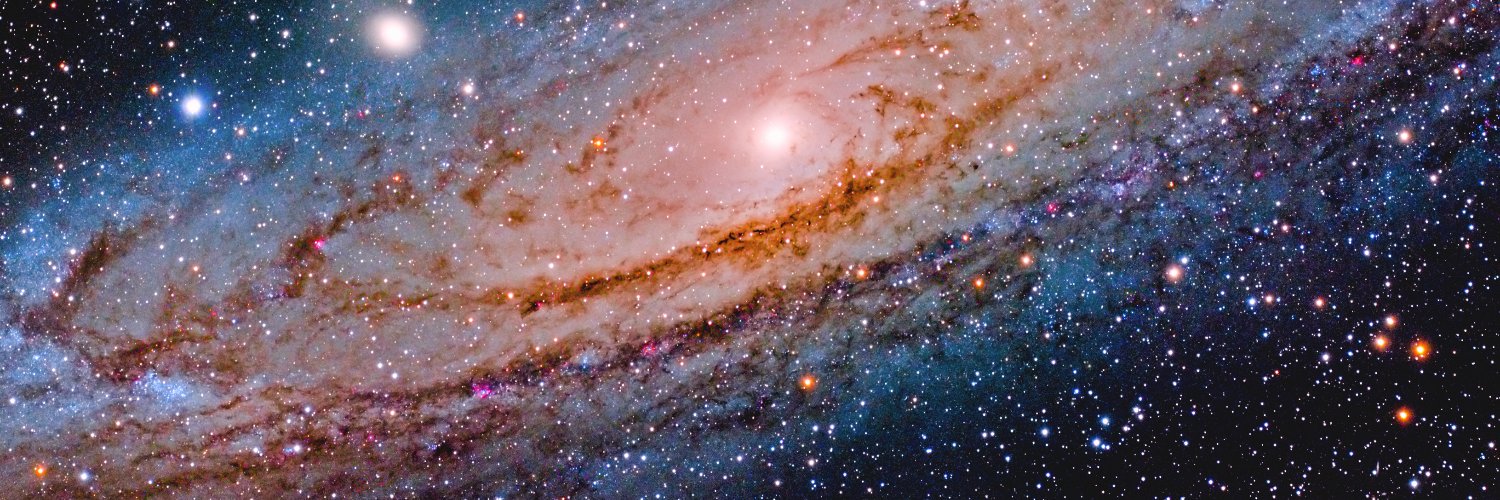
This is my best galaxy photograph so far. All Andromeda's distant 2,5 million years away photons were collected under the truly dark skies of Exmoor last month using a reduced fast astrograph FSQ-85ED and a Nikon D810A for 6 hours #Astrophotography#Galaxy#Space#Cosmos#Exmoor
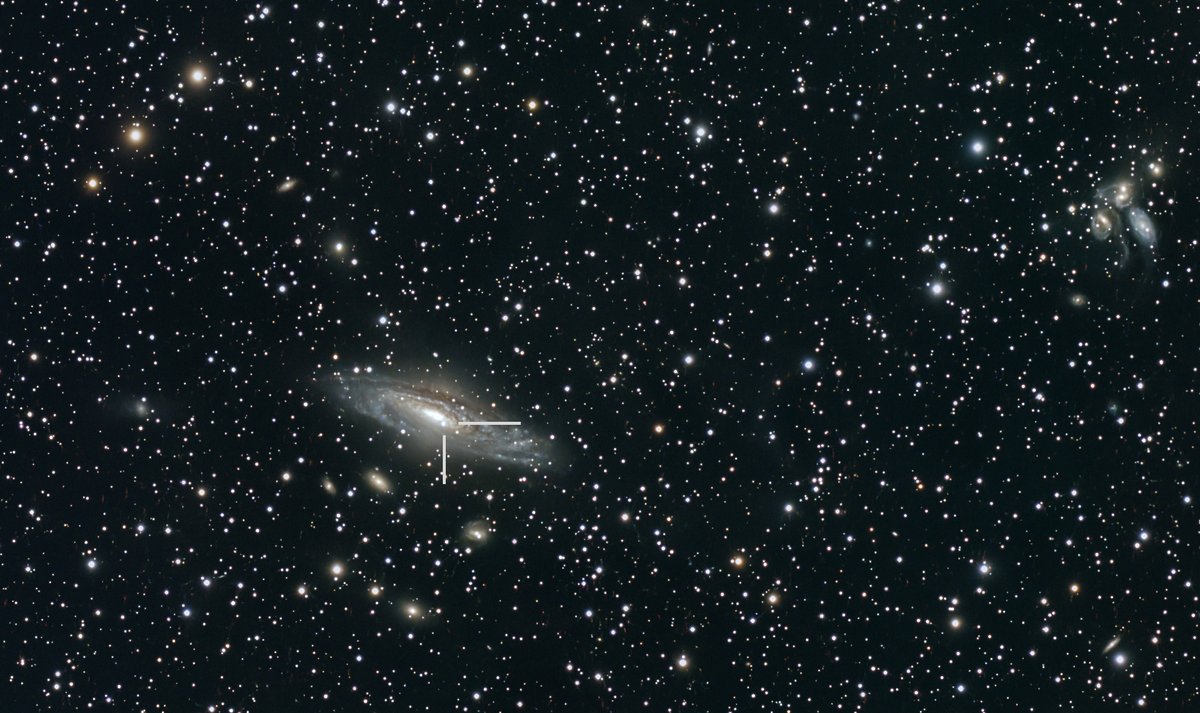
I spent 2 nights, capturing the light of the Type Ia supernova SN 2026aaiv) in the galaxy NGC 7331 (45.4 million light years away) in the constellation Pegasus (Πήγασος)
I used my Takahashi FSQ-106ED at f/5 with a Nikon D180A on the EM-400 Temma 2M guided for approx. 2.7 hours
Capturing the light of a strong supernova tonight - Type Ia supernova SN 2026aaiv) in a galaxy 45.4 million light years away from us. The NGC 7331 galaxy in the constellation of the mythical Ancient Greek horse, Pegasus (Πήγασος).
#supernova#astrophotography
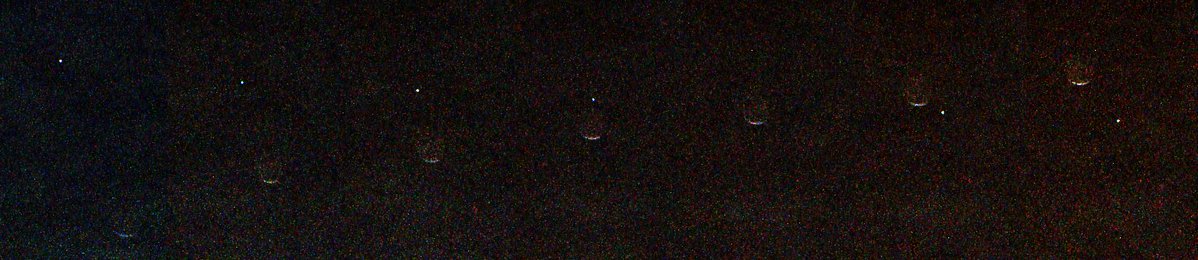
Stargazing …or rather, Earthgazing… on Mars! 🌏🔭
Perseverance watched as Earth vanished behind the moon Phobos in the evening sky. This is the first time humanity has made an observation from the surface of another planet showing Earth disappearing behind a celestial body.
An intriguing view of the Barnard 68 molecular cloud
Its interior temperature is only about 16 K (-257 °C / -431 °F), making it one of the coldest known places in space..
(Credit: ESO)
What's connecting these two volcanoes? In ancient folklore, the two volcanoes, Parinacota (left) and Pomerape (right), are connected by representing a mythical prince and princess who engaged in a forbidden romance. Beneath the ground, the two peaks are not known to be connected by a common pool of hot magma, and neither volcano has erupted in the past 1000 years. Above the ground, there is usually nothing in the sky that connects them -- except if you use careful timing and look from a specific location. The featured well-planned image was captured from Bolivia in mid-April with a series of camera exposures taken on the same day and from the same location. Then, Barnard's Loop appeared to connect the volcanic peaks. Also visible in the image is the Orion Nebula in the center, the star Betelgeuse on the right, and the Rosette Nebula on the upper right.
Image Credit & Copyright: Gonzalo Laserna Vargas
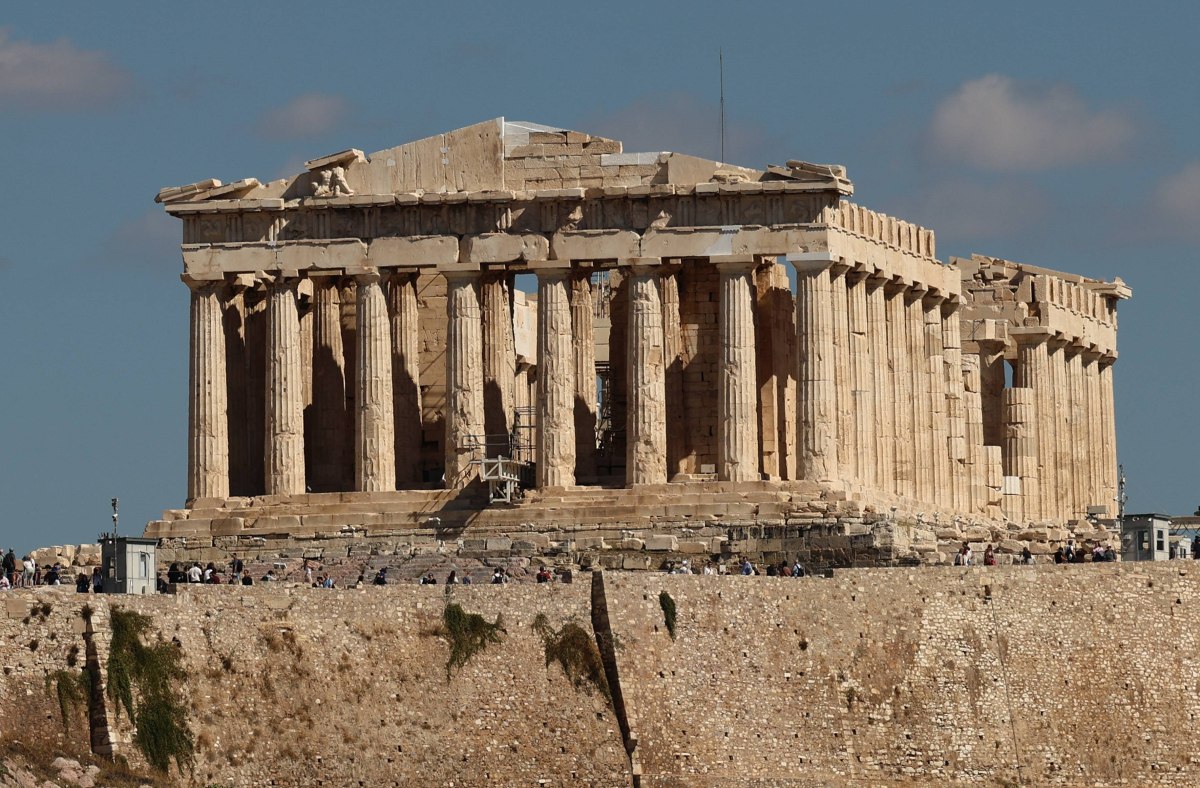
For the first time in about 220 years, the west façade of the Parthenon in Greece can be see in its fullest possible form. The next step is for the sculptures currently in the British Museum to be returned and placed where they truly belong. After that, the reconstruction of the temple should be completed and painted, so that it marks the beginning of a new era for humanity. Greece will once again lead the way in philosophy and the values that humanity needs in order to progress in life.
Athanasios Psilopoulos, a Greek marble mason who has been working on the restoration of the Parthenon since 1995, talked about what he discovered:
"When we took down the last column from the pronaos (the porch at the front of the temple), we found an ancient wooden dowel that had been there for 2.500 years. The fact that it hadn’t rotted away means that not even air was getting in. They took it and immediately put it in a vacuum chamber so it wouldn’t deteriorate. This is astonishing, two pieces of marble sealed so airtight that no air could enter. It’s incredible that you can join two marbles together and, after 2.500 years, find the wood inside still perfectly intact, and discover what was inside. I was stunned when I saw it. I said to myself, “We are nothing.” That’s what I said."
I hope that one day we get to see the Parthenon fully restored and complete, exactly as it was 2,500 years ago, with its original colors and the mythological representations of the ancient Greeks on the pediments.
We have identified a near-Earth asteroid designated 2024 YR4 that currently has a measured probability of about 4% of impacting the Moon on 22 December 2032.
If such a collision occurred, the kinetic energy released would be comparable to a medium-yield thermonuclear explosion, capable of excavating a crater roughly a kilometer across with a molten central pool and triggering a global “moonquake” of about magnitude 5 recorded by lunar seismometers.
The impact would vaporize and eject large amounts of lunar material; models suggest that some debris, up to hundreds of kilograms, could survive passage through Earth’s atmosphere, providing unique samples but also producing an intense meteoroid shower in the days following the event, with tens of millions of fragments per hour potentially entering Earth’s atmosphere and some larger fireballs visible to the naked eye.
Ejecta distribution simulations indicate certain regions of the Earth could receive material, and the increase in particles in Earth orbit would pose risks to satellites and other infrastructure through enhanced collision probabilities and cascade effects analogous to the Kessler Syndrome.
The low but non-negligible impact probability has driven discussion of mitigation strategies, including a possible deflection mission, balanced against the scientific value of an observed natural high-energy lunar impact.
👉 https://t.co/nSLWBwZM6j
The stunning star-forming region known as NGC 1333
Ferocious stellar winds, likely from the bright blue star at the top of the image, are blowing through a curtain of dust.
(Credit: NASA, ESA, STScI)