It is sickening that the USA is now lifting sanctions on Russian fuel, and transparently ridiculous to blame Ukraine for the spike in prices that obviously began with the closure of the Strait of Hormuz. Putin is murdering innocent Ukrainian civilians every day. The Ukrainians are fighting for their lives. And yet the White House is apparently determined to force American drivers to bankroll Putin’s slaughter. It won’t work and I doubt it will make much difference to the price of fuel.
If we want Russian oil and gas back on the world market then let’s end this war - with a free, sovereign and independent Ukraine.
BREAKING:
Russia has just blatantly disrespected President Trump by violating the energy ceasefire he announced on Truth Social today. Russia violated the energy ceasefire in less than 12 hours, proving Putin is a liar.
Russia just attacked a power plant in the eastern Ukrainian city of Kharkiv, which is less than 40 miles away from the Russian border.
Russia never keeps their word.
New in Claude Code: your sessions can now message each other.
Instead of having to re-explain yourself in another session, you can now tell Claude to do it. It sends a summary (not your history or files), and the other session picks it up mid-task.
I poured my 10 years of teaching experience into a skill.
It's called /teach, and it can teach you anything.
Here's how it taught me to solve a Rubik's cube:
HTML is the new markdown.
I've stopped writing markdown files for almost everything and switched to using Claude Code to generate HTML for me. This is why.
If your memory dies when your harness dies, you built the harness too thick.
Memory is markdown. Skills are markdown. Brain is a git repo. The harness is a thin conductor — it reads the files, it doesn't own them.
Farzapedia, personal wikipedia of Farza, good example following my Wiki LLM tweet.
I really like this approach to personalization in a number of ways, compared to "status quo" of an AI that allegedly gets better the more you use it or something:
1. Explicit. The memory artifact is explicit and navigable (the wiki), you can see exactly what the AI does and does not know and you can inspect and manage this artifact, even if you don't do the direct text writing (the LLM does). The knowledge of you is not implicit and unknown, it's explicit and viewable.
2. Yours. Your data is yours, on your local computer, it's not in some particular AI provider's system without the ability to extract it. You're in control of your information.
3. File over app. The memory here is a simple collection of files in universal formats (images, markdown). This means the data is interoperable: you can use a very large collection of tools/CLIs or whatever you want over this information because it's just files. The agents can apply the entire Unix toolkit over them. They can natively read and understand them. Any kind of data can be imported into files as input, and any kind of interface can be used to view them as the output. E.g. you can use Obsidian to view them or vibe code something of your own. Search "File over app" for an article on this philosophy.
4. BYOAI. You can use whatever AI you want to "plug into" this information - Claude, Codex, OpenCode, whatever. You can even think about taking an open source AI and finetuning it on your wiki - in principle, this AI could "know" you in its weights, not just attend over your data.
So this approach to personalization puts *you* in full control. The data is yours. In Universal formats. Explicit and inspectable. Use whatever AI you want over it, keep the AI companies on their toes! :)
Certainly this is not the simplest way to get an AI to know you - it does require you to manage file directories and so on, but agents also make it quite simple and they can help you a lot. I imagine a number of products might come out to make this all easier, but imo "agent proficiency" is a CORE SKILL of the 21st century. These are extremely powerful tools - they speak English and they do all the computer stuff for you. Try this opportunity to play with one.
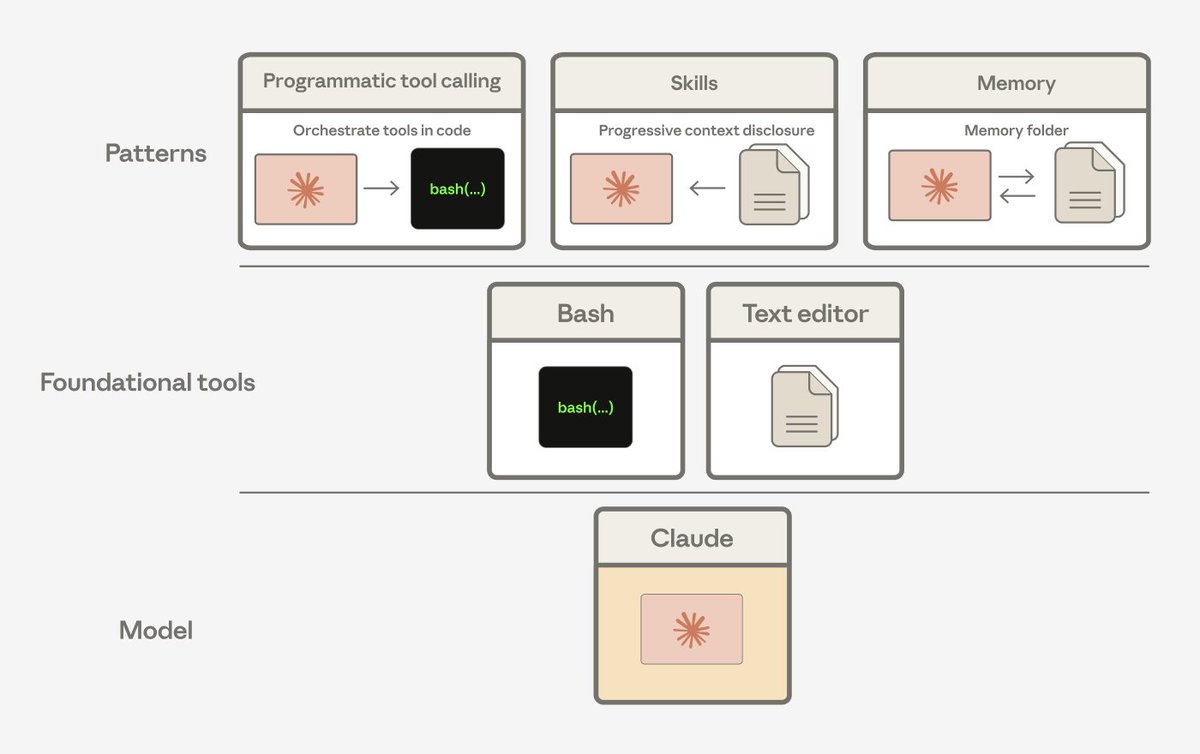
i just published a short article on building applications w/ Claude. captures a few lessons from my own work and many discussions with others at Anthropic.
https://t.co/VYnSSGwDet
Today we're launching local scheduled tasks in Claude Code desktop.
Create a schedule for tasks that you want to run regularly. They'll run as long as your computer is awake.
Released today: /loop
/loop is a powerful new way to schedule recurring tasks, for up to 3 days at a time
eg. “/loop babysit all my PRs. Auto-fix build issues and when comments come in, use a worktree agent to fix them”
eg. “/loop every morning use the Slack MCP to give me a summary of top posts I was tagged in”
Let us know what you think!
Anthropic just dropped a massive update to the skill-creator skill for Claude Code / OpenClaw. One prompt to install it:
"Anthropic updated their skill creator skill and I'd like for you to update/put this in so when we ask about creating new skills we can use this skill creator skill https://t.co/LiNRICe53E"
Introducing the Google Workspace CLI: https://t.co/8yWtbxiVPp - built for humans and agents.
Google Drive, Gmail, Calendar, and every Workspace API. 40+ agent skills included.
AGENTS dot md files don't scale beyond modest codebases.
Lots of discussions on this lately.
If you're building serious software with Claude Code or any agentic tool, a single AGENTS dot md will eventually fail you. This paper shows what comes next.
A 1,000-line prototype can be fully described in a single prompt. A 100,000-line system cannot. The AI must be told, repeatedly and reliably, how the project works, what patterns to follow, and what mistakes to avoid.
Single-file manifests hit a ceiling fast.
This new paper, Codified Context, documents a three-tier infrastructure built during real development of a 108,000-line C# distributed system across 283 sessions over 70 days.
The system uses a three-tier memory architecture: a hot-memory constitution (660 lines, always loaded), 19 specialized domain-expert agents (9,300 lines total) invoked per task, and a cold-memory knowledge base of 34 specification documents (~16,250 lines) queried on demand via an MCP retrieval server.
Across 283 sessions, this produced 2,801 human prompts, 1,197 agent invocations, and 16,522 autonomous agent turns, roughly 6 autonomous turns per human prompt, with a knowledge-to-code ratio of 24.2%.
Crucially, none of it was designed upfront: each new agent and specification emerged from a real failure, a recurring bug, an architectural mistake, a convention forgotten, and was codified so it could never require re-explanation again, turning documentation into load-bearing infrastructure that agents depend on as memory, not reference.
Paper: https://t.co/ZXBzhhkzsq
Learn to build effective AI agents in our academy: https://t.co/1e8RZKs4uX