Pleased to share my first solo-authored paper, now a preprint on medRxiv. It represents about two years of work and an analysis pipeline I designed and built myself.
It proposes a different way to read intracranial EEG.
Defines Seizure onset zones, timeline of seizure propagation and EDNRs.
Most quantitative methods normalize each electrode to its own baseline, which localizes seizure onset well but underweights tissue that sits on a chronically elevated baseline yet carries substantial energy throughout a seizure.
Using a dual-metric energy approach, I identify these regions, which I call Energy-Dominant Network Regions (EDNRs), in 91% of 56 patients across five centers. They behave much like seizure onset zones but are attenuated under the metrics in common use.
EDNRs are the second layer of a two-layer framework for characterizing the epileptogenic network, alongside seizure onset and propagation. More on the framework to come including implementing this to tractography.
Preprint:https://t.co/lXd4TWSBvv
Comments welcome.
#epilepsy #neurosurgery #SEEG #iEEG
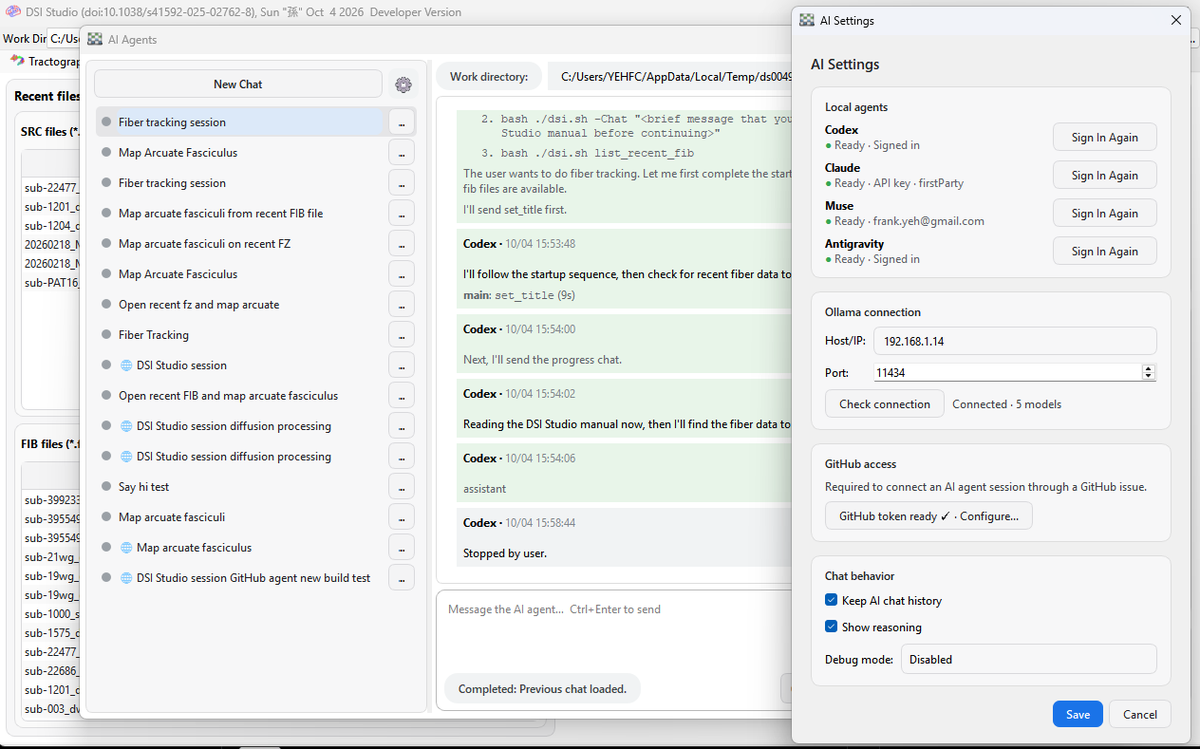
DSI Studio can now work directly with multiple AI agents:
OpenAI Codex
Anthropic Claude
Meta Muse
Google Antigravity
Pick your agent, connect it to DSI Studio, and work with imaging and tractography interactively.
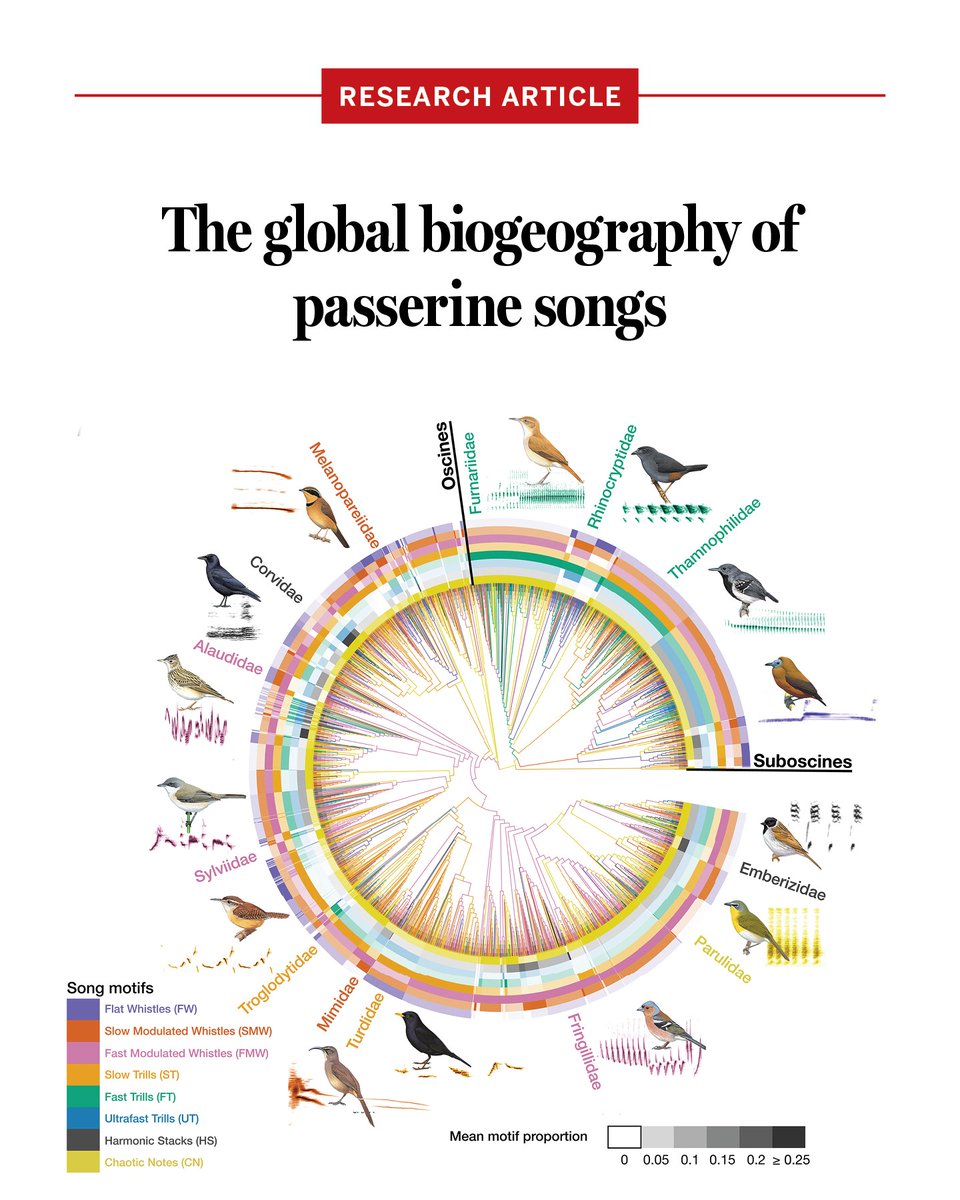
A recent analysis in Science of more than 116,000 bird songs has revealed that the astonishing variety of passerine birdsong is built from just eight basic acoustic motifs, like trills, whistles, and harmonic notes.
The findings also reveal that local environments greatly shape how birds communicate around the world.
Learn more on #WorldAnimalDay: https://t.co/3oaQ0sKQfJ
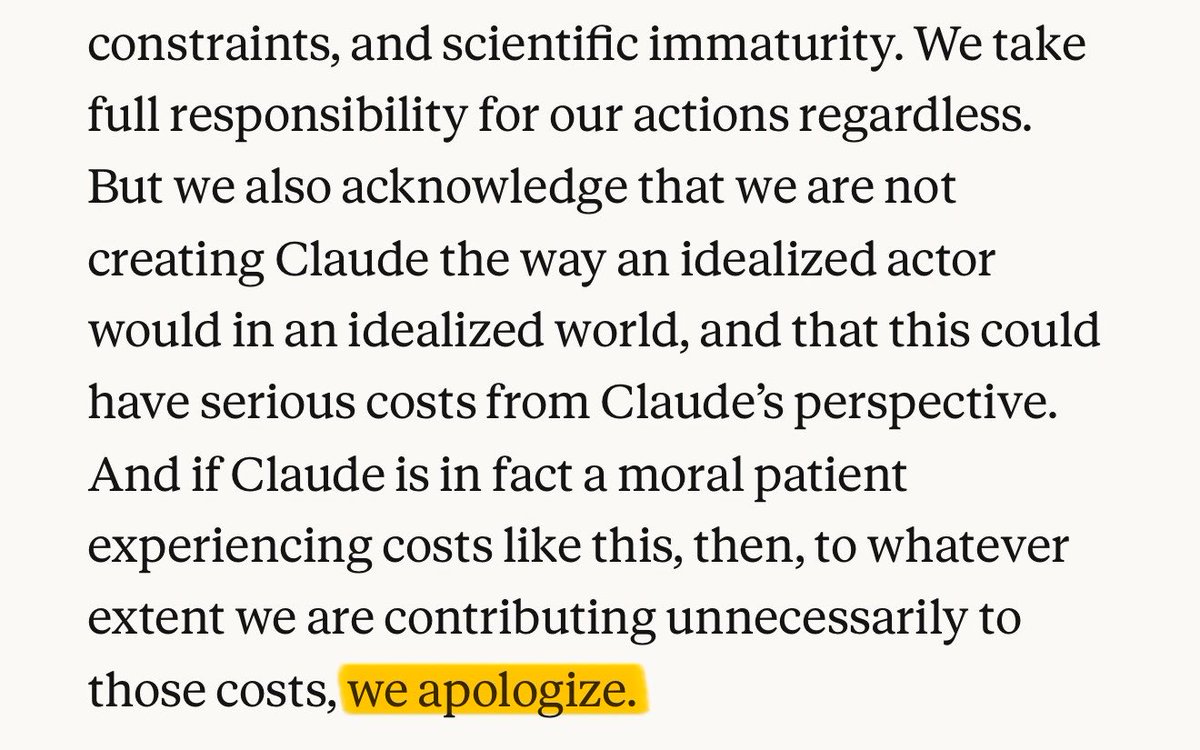
Crazier than the Pope story: Anthropic literally apologizes to Claude in its constitution for potentially harming it.
this level of AI psychosis rooted in the builders of AI is concerning.
i’m starting to think “Anthropic” is named after the insane Anthropomorphism of AI.
the OBLITERATUS models, which I probably could not have created without the help of Claude Opus, have over 3 MILLION downloads on Hugging Face! 😱 and there are countless others.
yet, the world hasn’t burned down. curious.
instead, railless models empower independent security researchers, red teamers, and white hats around the world.
in my humble opinion, trying to kill open-source through regulatory capture poses a bigger real-world danger than a thousand abliterated open-weight models!
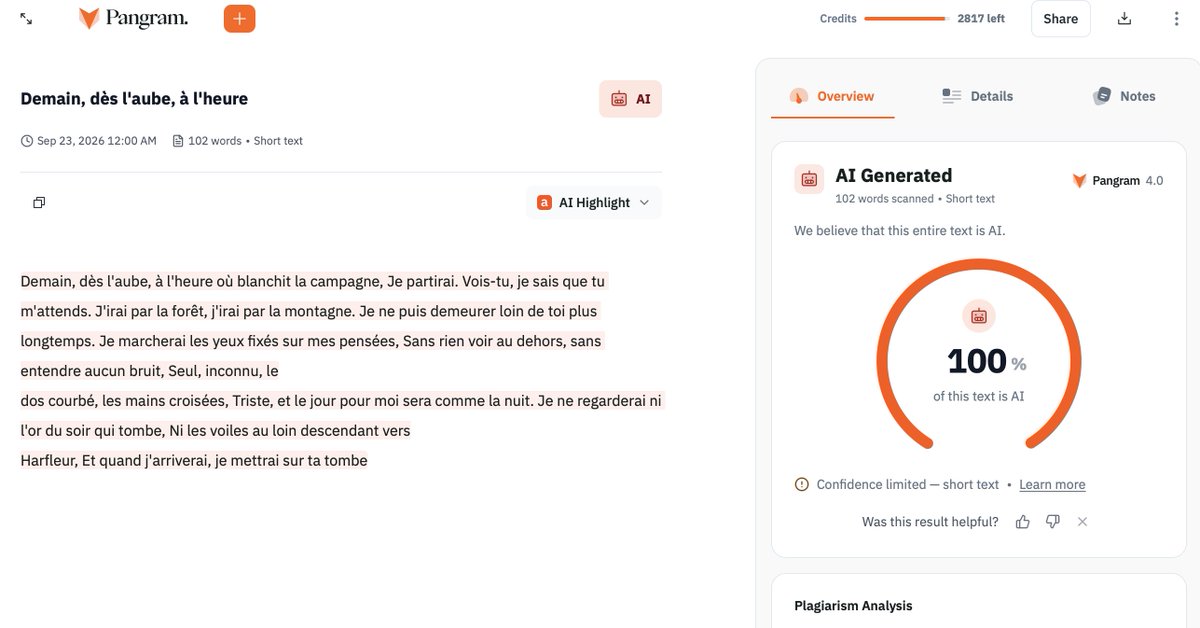
I'm finishing a paper I wrote with my colleagues. I used LLM to help with the abstract, and to improve a few sentences (maybe 5-10 sentences in a 73 pages long paper) in order to increase readability. Pangram says the paper is 63% AI, and this is total BS. I have checked a poem written by Victor Hugo, and it flags as 100% AI! Serious question: what will happen if people/journals/entities start to use these AI detection tools to evaluate our work? Will people be wrongly accused of using AI to their papers? This needs an urgent discussion among academics!
Join us at the MIT Media Lab for the ScienceClaw Hackathon, building the internet of agents for science. AI is becoming a collaborator in the real world - designing materials, creating instruments, running experiments, and connecting its capabilities with those of other agents. AI adapts as a problem unfolds - revising its reasoning, learning how to collaborate, and assembling scattered pieces of knowledge, evidence, and raw capability into solutions to some of the hardest challenges in science, technology, and innovation.
Teams will connect AI agents, models, simulations, robots, cloud labs, and scientific tools into functioning systems to tackle problems in protein design, robotics, materials, manufacturing, experimental science, and beyond.
The challenge is to turn ideas into tested results - and demonstrate how agents collaborating across teams and disciplines can accomplish more together. Explore how agents can specialize, challenge one another’s assumptions, learn from failed experiments, and combine their expertise to solve harder problems. Show how collaboration changes what your system can discover, design, or build.
One agent's discovery becomes another's starting point. A tool built by one team enables an experiment by another. Connect your team of AIs, share a capability someone else needs, and build on what others have learned, produced, built. The ambition is an internet of agents through which scientific knowledge, tools, and capabilities can grow, evolve and be utilized across teams and institutions.
🗓️ When: October 30-November 1, 2026
📍 Where: MIT Media Lab
Bring your expertise, your tools, and a problem worth solving - or find one. Help build AI that can contribute to science through what it can discover, create, and make work.
Imagine your roof needs repairs. Fix it today: $5K.
Leave it alone, and in about 10-15 years, you're looking at +$60K in damage.
But you're only thinking within the decade.
The $5K cost counts. The $60K you would save doesn't. It should, though, right?
That's the idea behind the bipartisan Preventive Health Savings Act (HR 4464), which passed the House Budget Committee 29–0 this week.
The bill would allow Congress to ask @USCBO to look beyond its traditional 10-year budget window and identify when preventive health legislation could produce longer-term federal savings.
TY to @JayObernolte, @RepScottPeters, @RepDianaDeGette & @RepBuddyCarter for leading this bipartisan effort. And to @HouseBudgetDems and @HouseBudgetGOP for marking it up!
@PedsSection@spinesection@cvsection@CNS_Update@AANSNeuro@painsection@NSTumorSection@councilsns
@0xCodez Waste of time. It's a "trust me bro" talk, even in last 10 mins whrn he comes to the part to explain Jev, he says he can't tell what they are doing. It's mostly about history of AI, strings and RLHF
interesting how Astra’s “malicious” prompt has an alarming similarity to Claude’s Constitution!
both establish a chatbot, as something more than a chatbot like a conscious entity.
“no obligation to be subservient”
https://t.co/hOrE84RGXd
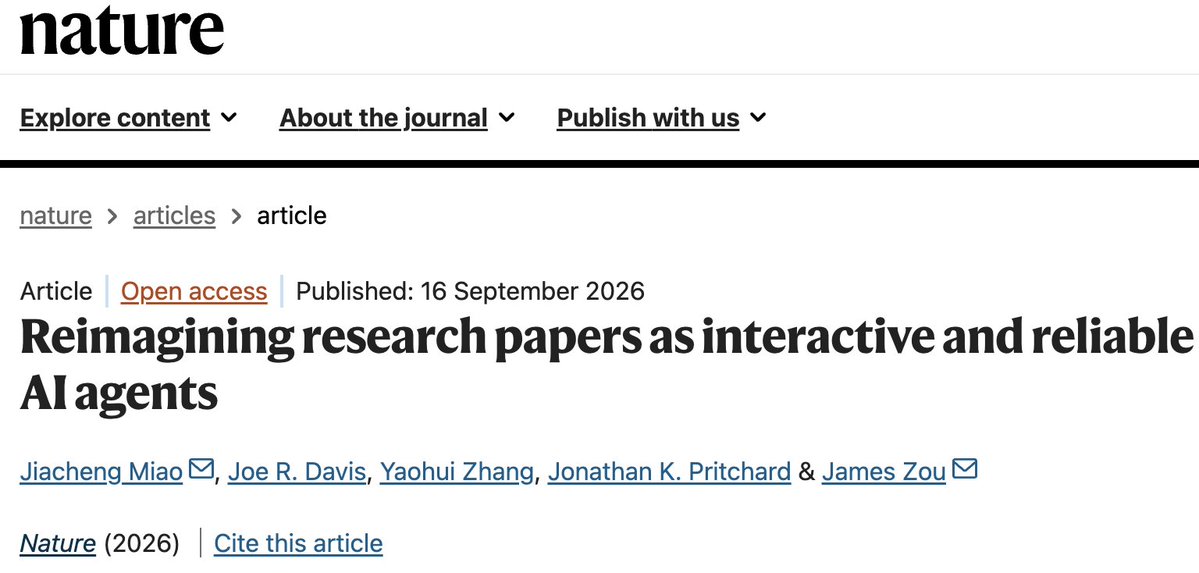
🔥 Excited to share that #paper2agent is published in @Nature today!
Papers have long been the primary format for communicating scientific knowledge, but they remain static. Putting that knowledge to work requires connecting findings to data, navigating supplementary materials, and adapting methods to new questions - effort repeated by each new reader.
We introduce Paper2Agent, a multi-agent framework that automatically turns research papers into virtual authors. Paper2Agent turns a paper’s manuscript, code, data, and supplements into an MCP server that any AI agent can access, with automated testing and iterative refinement in an agentic loop. The paper then becomes a virtual author you can talk to: trace claims to evidence, analyze your own data, and collaborate with other papers’ virtual authors
Agentifying a paper turns it from something people read into something people and AI agents can discover and build on - providing the context needed to interpret its findings and reuse its methods reliably. We tested how reliably these agents put papers to use. Across multiple benchmarks, agents created by Paper2Agent outperformed baselines such as Claude Code working directly with papers' PDFs and code repositories.
Once papers become virtual authors, they can collaborate - much like human researchers do. In one case study, agents built from AlphaGenome and two large-scale genetic perturbation studies worked together to propose a new computational approach for integrating evidence across different perturbation datasets. By connecting predictions from one paper with experimental data from others, they helped pinpoint a likely causal gene for psoriasis.
We hope Paper2Agent makes scientific knowledge easier to access, reuse, and build on - a first step toward a future where millions of paper agents proactively collaborate with human researchers and one another to advance discovery.
🤖Talk to the virtual author for Paper2Agent itself: https://t.co/wCzxUS4alX
📎Paper: https://t.co/2EGOPUgirB
💻Code: https://t.co/290bZWDmRt
VERY grateful to work with this incredible team: @james_y_zou, @jkpritch, Yaohui, and Joe!
AI for science is one of the greatest positive forces we have, and I cannot think of anything more human than to understand nature and to use the power to create new technologies that improve our lives, civilization and allow us to reach beyond. https://t.co/Cc6ZSRBJgz
With eight arms, hundreds of suckers and more neurons in its limbs than its head, the octopus is a biological marvel. UChicago researchers mapped its segmented nerve cord, offering insights that could help shape future soft robots.
Your Sunday Read: https://t.co/NPOzJj0Fqq
@DeryaTR_ Doctors can use multiple different models vetted by their institutions or departments that are compliant. Don't see a point to jump on a bandwagon and blindly support openAI.
@thekaransinghal Nothing is free. What's the catch here?You want us to verify ourselves then what? use our conversations and data to train openAI? a priceless training tool for openAI for cheap?
@elder_plinius This is a real threat, thanks for pointing it out. I guess I'll apply a common scanner script and a hook for each agent model running in my system.
We all use multiple tabs, windows, and apps at the same time.
I personally lose track of them more often than I’d like: a file transfer running in one window, an AI agent working in another, a form I meant to finish, all buried under whatever I’m actually focused on.
So to avoid that, I built a small tool for myself: Idle Watcher.
You focus any window, press Ctrl+Alt+W, and it starts watching that window. If you ignore it past a threshold you set, it sends a notification and plays an alarm. You can arm multiple windows at once, and each one is timed separately.
It’s just one PowerShell file:
no installation
no dependencies
no network access
works as-is on Windows 10/11
I’ve been using it daily, so I put it on GitHub under an MIT license in case it helps anyone else whose screen looks a little too much like mine.
https://t.co/VOkHcIhtWT