A must read (or must listen): https://t.co/2uGt1XhA8V . A dystopian but unfortunately surprising convincing of what could happen if Europe does not catch up on AI. It moved my prior. (and it is, despite the gloomy conclusions) a fun read.
Does De la Espriella really want to emulate what South Korea did to obtain European-level living standards? If so, he'd better be ready to throw out the neoliberal "free market" playbook and scrap any libertarian ideas of "small government" as well
When 14 of the world's most prominent muscle scientists like @mackinprof@BradSchoenfeld and @AbigailMackey1 gather to present their findings… I think it’s worth writing about what they shared.
Two people walk into the same gym. They follow the same program, lift the same weights with the same intensity, eat about the same amount of protein, and sleep about the same number of hours. Six months later, one has added meaningful muscle, and the other has barely moved the needle. Why?
Do Z lines split? How do muscles grow?
How many sets do I need?
How much should I rest?
How often should I work out?
This consensus report gives us solid guidance on why adaptations occur and how we should train to maximize them.
Link in reply...
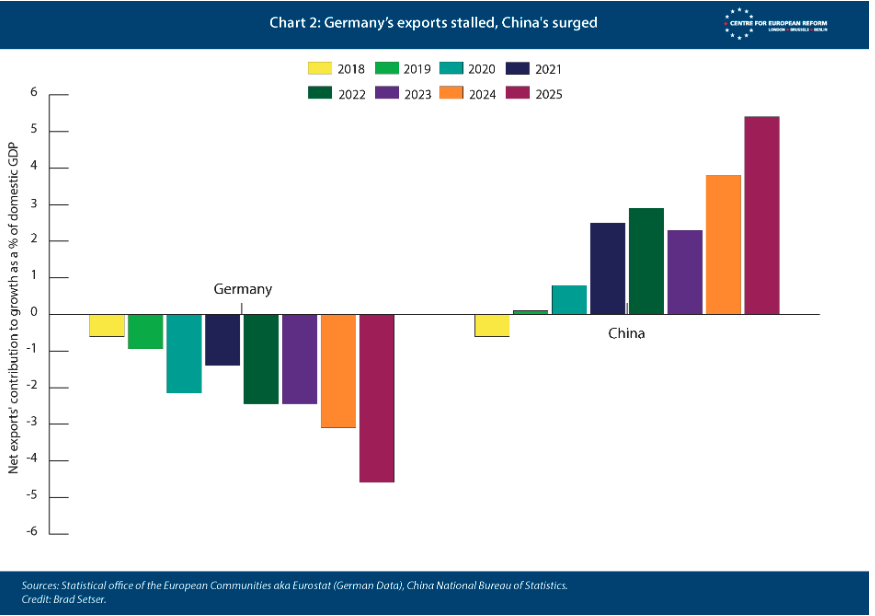
Germany is the epicentre of the China Shock 2.0 reverberating in global markets
In a new paper, @Brad_Setser and I show the shock is a key driver of Germany’s economic malaise. And it's accelerating
Berlin needs to stop admiring the problem, and join efforts to fight back
1/
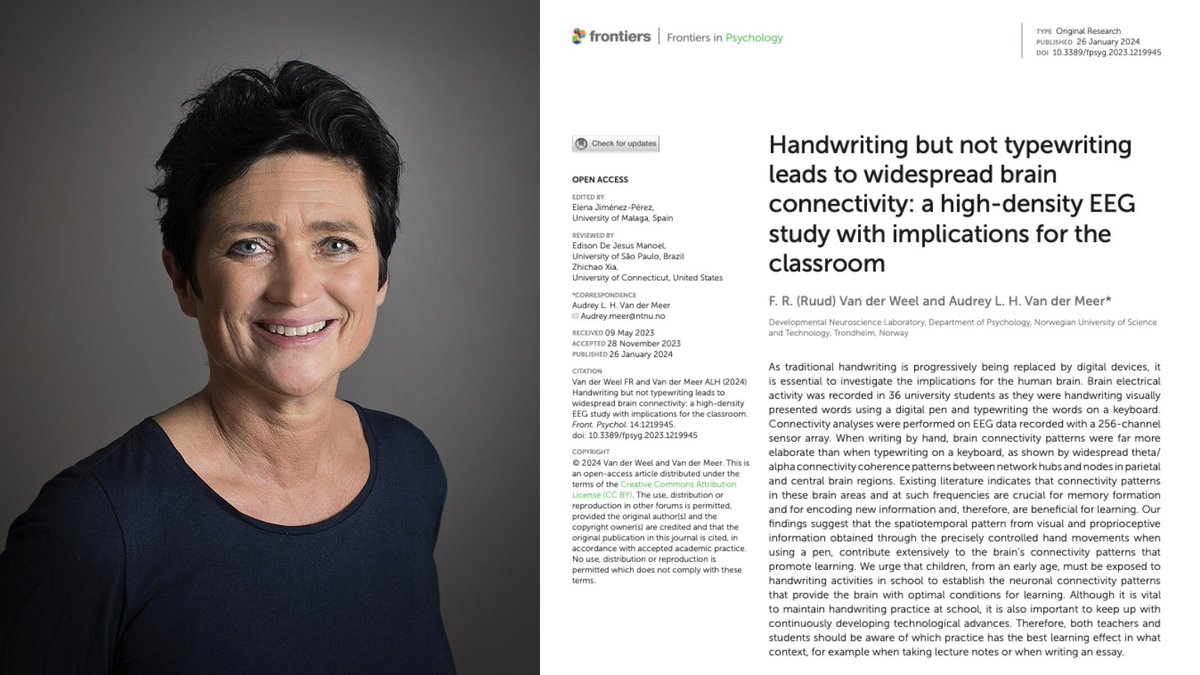
A Norwegian neuroscientist spent 20 years proving that the act of writing by hand changes the human brain in ways typing physically cannot, and almost nobody outside her field has read the paper.
Her name is Audrey van der Meer.
She runs a brain research lab in Trondheim, and the paper that closed the argument was published in 2024 in a journal called Frontiers in Psychology. The finding is brutal enough that it should have changed every classroom on Earth.
The experiment was simple. She recruited 36 university students and put each one in a cap with 256 sensors pressed against their scalp to record brain activity. Words flashed on a screen one at a time.
Sometimes the students wrote the word by hand on a touchscreen using a digital pen, and sometimes they typed the same word on a keyboard. Every neural response was recorded for the full five seconds the word stayed on screen.
Then her team looked at the part of the data most researchers had ignored for years, which is how different parts of the brain were communicating with each other during the task.
When the students wrote by hand, the brain lit up everywhere at once.
The regions responsible for memory, sensory integration, and the encoding of new information were all firing together in a coordinated pattern that spread across the entire cortex. The whole network was awake and connected.
When the same students typed the same word, that pattern collapsed almost completely.
Most of the brain went quiet, and the connections between regions that had been alive seconds earlier were nowhere to be found on the EEG.
Same word, same brain, same person, and two completely different neurological events.
The reason turned out to be something nobody had really paid attention to before her work. Writing by hand is not one motion but a sequence of thousands of tiny micro-movements coordinated with your eyes in real time, where each letter is a different shape that requires the brain to solve a slightly different spatial problem.
Your fingers, wrist, vision, and the parts of your brain that track position in space are all working together to produce one letter, then the next, then the next.
Typing throws all of that away. Every key on a keyboard requires the exact same finger motion regardless of which letter you are pressing, which means the brain has almost nothing to integrate and almost no problem to solve.
Van der Meer said it plainly in her interviews.
Pressing the same key with the same finger over and over does not stimulate the brain in any meaningful way, and she pointed out something that should scare every parent who handed their kid an iPad.
Children who learn to read and write on tablets often cannot tell letters like b and d apart, because they have never physically felt with their bodies what it takes to actually produce those letters on a page.
A decade before her, two researchers at Princeton ran the same fight using a completely different method and ended up at the same answer. Pam Mueller and Daniel Oppenheimer tested 327 students across three experiments, where half took notes on laptops with the internet disabled and half took notes by hand, before testing everyone on what they actually understood from the lectures they had watched.
The handwriting group won by a wide margin on every question that required real understanding rather than surface recall.
The reason was hiding in the transcripts of what the two groups had actually written down.
The laptop students typed almost word for word, capturing more total content but processing almost none of it as they went, while the handwriting students physically could not write fast enough to transcribe a lecture in real time, which forced them to listen carefully, decide what actually mattered, and put it in their own words on the page.
That single act of choosing what to keep was the learning itself, and the keyboard had quietly skipped the choosing and skipped the learning along with it.
Two studies. Two countries. Same answer.
Handwriting makes the brain work. Typing lets it coast.
Every note you have ever typed instead of written went into your brain through a thinner pipe. Every meeting, every book highlight, every idea you captured on your phone instead of on paper was processed at half depth.
You did not forget those things because your memory is bad. You forgot them because typing never woke the part of the brain that would have made them stick.
The fix is the thing your grandmother already knew.
Pick up a pen. Write the thing down. The slower road is the faster one.
It’s hard to imagine more of a dream Unsupervised Learning guest than @ylecun. Yann is one of the godfathers of AI, and he has some fascinating contrarian views on the limitations of LLMs. It was incredible to get to have a wide-ranging discussion with Yann about these views, reflections on his time at Meta and departure and what’s next for him. We hit on:
▪️ LLM limitations and a path forward for robotics
▪️ Why he left Meta
▪️ How he came to so dramatically disagree with his Turing co-laureates Geoff Hinton and Yoshua Bengio on LLMs
▪️ His predictions for 2027
▪️ His new company AMI and the bet on world models
▪️ Why he compares OpenAI and Anthropic to Sun Microsystems
▪️ Why he tells PhD students to stop working on LLMs
Plus some sharp views on the current safety discourse, how breakthrough research actually happens and what FAIR got right and wrong.
YouTube: https://t.co/1cBJUL1ahr
Spotify: https://t.co/LVXp290KZw
Apple: https://t.co/U36KpzzJF0
AI will become our planetary Guardian.
Beyond the Human – The History of the Future:
A 18-min animated film by Philipp Humm that imagines how AI will shape meaning and engage with our environment.
Watch now and find my philosophical essays on my Youtube channel.
Consciousness is not separate from the physical world — our “soul” is of the same nature as our body and any other phenomenon of the world | @carlorovelli in @NoemaMag https://t.co/2IM073nsyf https://t.co/b6nCA1JNz3
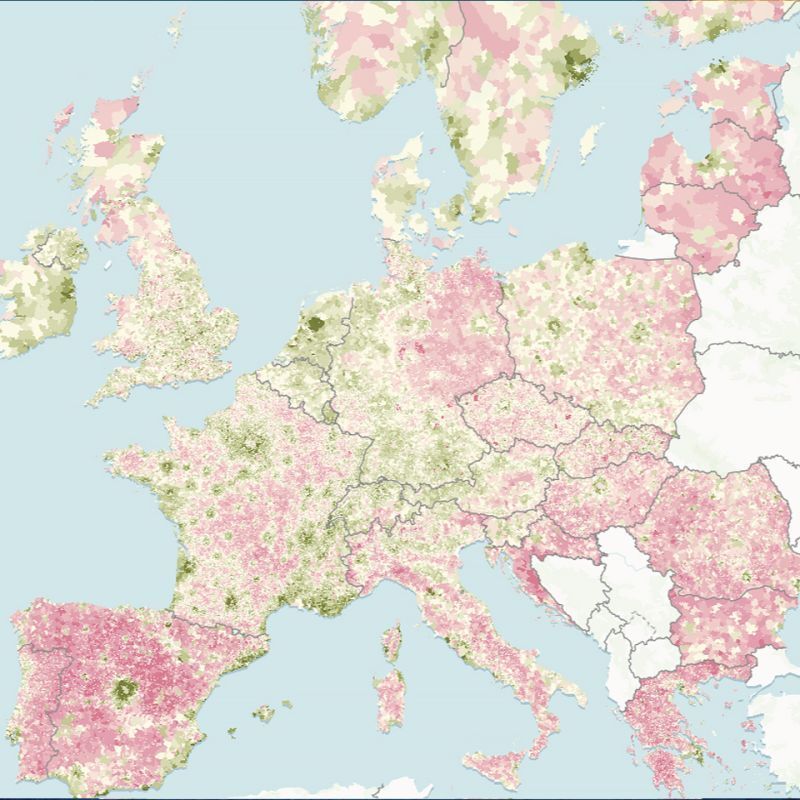
It's hard to oversell this map - make sure to bookmark it and share it with your friends. Fantastic research that must have been soooo labour intensive: How has the population of evert single small geographic region across Europe changed from 1961 to 2024? You will want to study this map in detail. Source (keep scrolling for a while): https://t.co/2akdcsaBpm
Adam Tooze has a very good new Substack article on global imbalances. I discuss below where I (mostly) agree and disagree (more in emphasis than in substance), focusing especially on how imbalances are transmitted from country to country.
@adam_tooze
https://t.co/n6KhuJ5NMS
There is a bookshop in Rabat that measures five feet by five feet. Inside it, every morning since 1967, sits a man reading. His name is Mohamed Aziz. He is 72. He was orphaned at six, pulled out of school at fifteen because he couldn't afford the textbooks, and decided to have his revenge. The revenge was this: he opened a bookshop and taught himself to read in seven languages, one book at a time, with no teacher and no classroom. Arabic. French. Spanish. German. Italian. English. He discusses Dostoevsky the way other men discuss football. He has read more than five thousand books.
https://t.co/Yc70Nxc0Ze
Une analyse historico-matérialiste de l'IA, ça ne court pas les rues. Il faut donc lire @etievant_g qui développe cette thèse fondamentale: la technologie est affaire d'usage, et celui-ci dépend des rapports sociaux et du mode de production.
https://t.co/cFtVLd3axj
2. Il n'y a pas d'un côté la lutte de classes de l'autre les luttes contre les "dominations" (genre, race, etc.) car l'antagonisme de classe traverse toutes ces luttes, les divise et les recompose: il y a un féminisme antiK et un féminisme bourgeois, idem pour l'antiracisme.