Check out my book "Outside Mental Health: Voices and Visions of Madness" (also free ebook download) https://t.co/OZjaayRZgu
"Troubling and illuminating" — Kirkus Reviews
"Bold, fearless, and compellingly readable." —Christopher Lane, author of "Shyness: How Normal Behavior Became a Sickness"
“Hall’s style is equally comforting and intense” — Publisher’s Weekly 2022 Booklife Prize Nonfiction Finalist
“Hall remains articulate, impassioned, and unmedicated…” — Newsweek Magazine
Candidate Chris Bennett Supports Abolishing Forced Psychiatry: A Breakthrough for Mad Liberation?
By Will Hall
What if the upcoming midterm election for the first time sends a politician to Washington who is publicly on record against forced psychiatry?
https://t.co/JHV7bgHuHP
I'm really disappointed at hearing more and more simple dogmatic fallacies from so many critics of psychiatry. The result is a reversal - psychiatry says "depression" is x, so the critical psychiatry people say "depression" is y. News flash: "depression" is certainly junk diagnosis, and a lazy term for a vast array of human experience with a vast array of possible "causes" or pathways to resolution, and also a term people use to attempt to give language to very painful chronic debilitating low moods. By your claim in this post, it's impossible for someone to feel "depressed" from a vitamin deficiency, which is technically a - gasp! - "chemical imbalance". Decades of research show that low levels of vitamin D deficiency can produce mood symptoms that someone might call "depression." Vitamin D deficiency can be caused by many things and resolved by many things, including - gasp! - taking a pill. But this simple common sense medical truth is impossible from your formulation. It's like critics are on such a lazy crusade that common sense just gets lost. There are many, many examples of biological "imbalances" causing experiences that would be described and reported as depression, and can easily be solved by addressing the "imbalance." Your dogmatic formulation here - depression is caused by dispiriting life circumstances never a chemical imbalance! - would even erase all the people that take benzos and report benzos causing depression, or take antipsychotics and report antipsychotics causing depression - results of taking a pill that causes a chemical imbalance in the brain/body. It's like critics are so fanatical to shoot down psychiatry's absolutism they get intoxicated with their own absolutism in reverse, using logic so dogmatically they just reproduce psychiatric dogmatism in the reverse direction and end up shooting their own arguments in the foot. Are people really going to be convinced there is more wisdom in the critical psychiatry camp when critics of psychiatry indulge in fallacies that any ordinary person with some common sense could spot from a mile away?
I have to disagree on all counts. First, just from the perspective of iatrogenic medication harm as one example (which has devastated generations), "neutrality" was/is in many instances the problem. We need therapists willing, at times, to risk "invasiveness," to step out of a pose of "neutrality" that ends up siding with harmful unquestioned standards of care, and to not remain silent when people are harmed and often killed. Second, seeing psychotherapy as a relationship "all its own" and unlike any other, as you do here, is *extremely* dangerous. It asks patients to suspend common sense and basic human expectations because of the presumed unique, exceptional, almost magical psychotherapeutic relation. Claiming psychotherapeutic exceptionalism as you do leaves it to the experts to determine what to expect and accept in human relating, what the boundaries and rules are, and the patients just have to go along because it's so special and well, they're just patients and dont' know or have the special training. There is a very short distance between this elitist exceptionalism and what patients frequently do - set aside their own flashing warning signs that something is wrong and defer to the expertise and "skill" of the therapist to know what's best. Many patients have been harmed, had their lives destroyed, and spiraled into suicide all while defering to the expertise of the professional in the "special" "unique" therapeutic relationship. How many patients got worse and worse in therapy but just stuck around because, well, they aren't the expert, the therapist is? Your post displays what is so often worst about psychotherapy - professionals claiming special skills, knowing better, wielding opaque techniques unique to therapy that don't play by ordinary human rules, alienating everyone except the cartel of those who are inside the profession and speak its obfuscating language, and rising above everyone else as a special priesthood-like elite. So many therapists use your framework of "we're different, it's special" to justify being complete a**holes that I'm convinced the profession actually attracts complete a**holes.
Steven Morgan, who was well known for his activist efforts in challenging conventional psychiatry, which included writing for Mad in America, recently passed away. We share some of his work and some memories of Steven from our editors who knew him.
https://t.co/7KhY64HZpa
My latest PsychForce Report news roundup -- tracking all the news that is news in civil commitment (or at least some of it...) All the links with my commentaries here:
https://t.co/D80gGbexBz 1/6
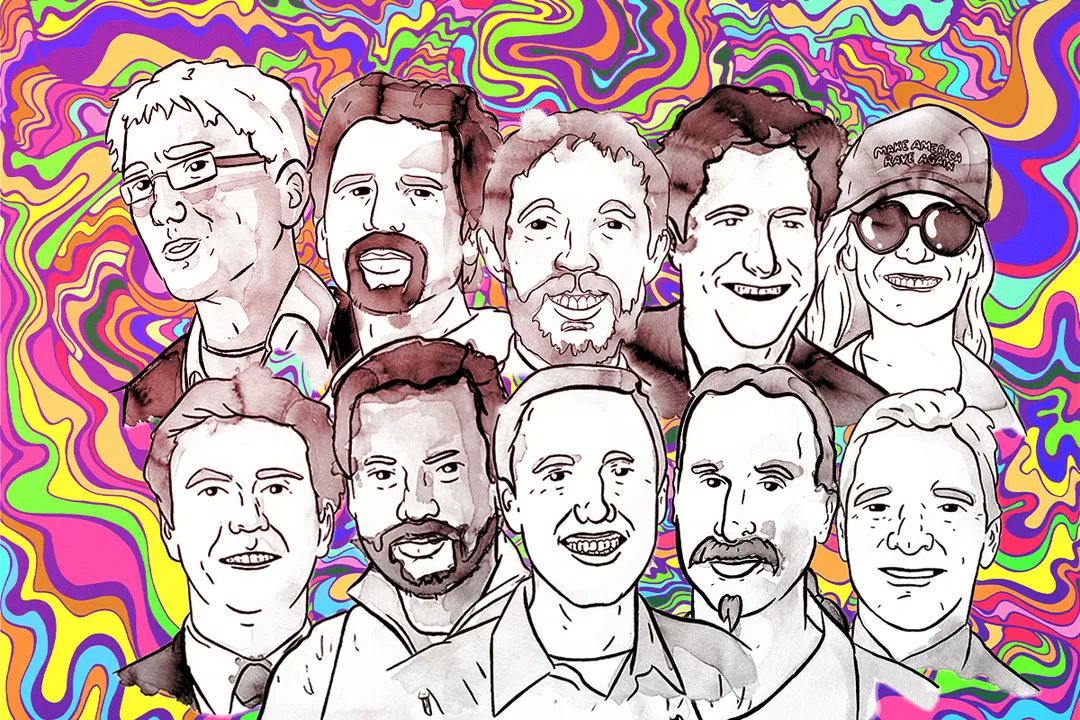
A new @Truthdig overview provides readers with a primer on the main characters directing the Psychedelic Science Funders Collaborative — the organization at the heart of Psymposia’s "Psychedelic Syndicate" report.
New @psymposia exposé reveals more corruption and abuse at the frontier of pharma psychedelic therapy. Honored to play a support role in the vital work of @NeseLSD@TehseenNoorani@msmacb and whistleblowers.
The Psychedelic Syndicate
Our year-long investigation reveals how a group of Silicon Valley elites sought to capture the psychedelic therapy industry.
https://t.co/fx2V1UTRQ5
Serious question: What is the solution?
Reflecting on my critical work on the dangers of established drugs like SSRIs and antipsychotics, as well as my critical work on the dangers of new drugs in the pipeline, psychedelics...
How do we turn all this around?
All of it?
How do we take patient harm - millions of people harmed and more and more! - seriously?
What is the real solution?
Should we keep appealing to reason to get psychiatrists to listen? Hope for savior political unicorns like RFKJR to do the right thing? Pile more research on top of research to just get ignored? Keep raising the alarm in the media -- like we've been doing since the 1970s?
Is that really going to work? Is that ok with us - accept our fate as critical voices pressing for change that never decisively arrives?
How about a real solution?
How about removing the power of these corrupt industries and medical cartels behind failed medical and social policies?
How about we end privatized health care and science funding and establish clinical and research that serve real human outcomes, not profit?
How about we reverse the perverse market incentives for corruption at the root of dangerous medical treatments?
How about we replace a economic and political system that drives corporate led public health policies to always ignore the root causes of mental distress?
How about we create a system that can take real action on the social determinants of mental health (poverty, inequality, housing, social isolation, polution, overwork, trauma, nutrition, neglect, lack of community resources...)
Do you really think there is any real solution short of replacing the system itself?
It's a serious question.
If you have another real solution other than replacing our current gangster capitalist global system - what is it? What is your solution?
And if you agree a real solution for mental health requires a a new economic and political system... do you realize we will never get a new system if we don't start asking for it?
A US reader's review of Chemically Imbalanced - out now in the US as well as UK: 'As Vasily Grossman put it, “It is the writer's duty to tell the terrible truth, and it is a reader's civic duty to learn this truth.”' https://t.co/NR0eETqX8R @flint_books
New show on Madness Radio! Compassionate Therapy | Michael Montgomery
Can psychotherapy work against the mainstream system? What does it take to be truly compassionate as a professional? And what are the downsides of promising alternatives such as Open Dialogue? Michael Montgomery grew up in Ireland and experienced firsthand the impacts of trauma and violence; a meeting with a visionary friend introduced him to psychiatric oppression. Today he is an existential psychoanalyst in the tradition of R.D. Laing and trained in Open Dialogue, and he joins Madness Radio guest producer Nicki Glasser and host Will Hall to discuss his work.
https://t.co/dBpGurtlEP
Green Party of California: Forced Treatment Must Be Abolished
By Will Hall
On August 5, the Green Party of California—with 93,000 voters registered in the state—endorsed the abolition of forced psychiatric treatment.
https://t.co/dUonrETFWM