@martinwoodward Outlook on the web or Gmail on the web 🙃. I had a couple of bad experiences years back with thick client apps not syncing my mail so now I only use webmail apps on my laptop - if I can load the site then I'm looking at the latest, no more cache or sync issues.
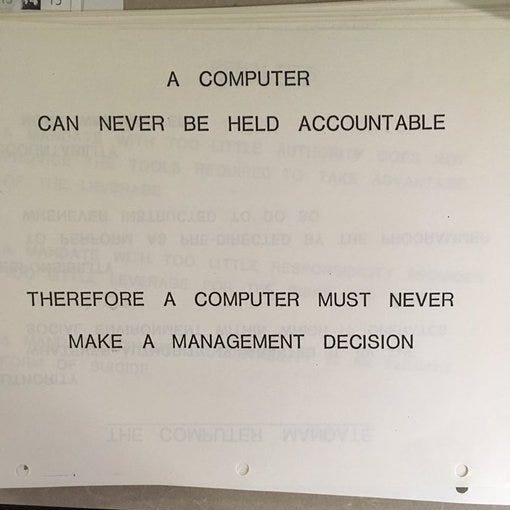
PICARD: Data, shields up
DATA: Brilliant! Shields can reduce damage we sustain. Not immunity. Not hubris. Just prudence. It's not precaution—it's strategy.
[camera shakes]
WORF: HULL BREACHES ON NINE DECKS
DATA: Here's what happened: you told me to raise shields, and I didn't
Amazon just got caught running a secret price manipulation operation with Levi's, Home Depot, Walmart, and many more.
Every time you "comparison shopped" online, you were looking at prices that were already rigged.
Here's what happened:
Amazon would monitor prices on Walmart, Target, Best Buy, Home Depot, and Chewy in real time. The second a competitor listed a product cheaper than Amazon, they'd contact the brand directly and tell them to "fix it."
And the exact emails are now PUBLIC.
Amazon sent Levi's links to two Walmart listings with the subject line "styles of concern." They basically said the prices on Walmart are too low and we have a problem.
The next day, Levi's responded: "I talked to Walmart and they have partnered with us to take Easy Khaki Classic fit back up to ladder SPP price, $29.99 immediately."
Levi's literally called Walmart and told them to raise the price. Because Amazon told Levi's to make the call.
Walmart complied. Then Amazon matched the HIGHER price.
Both retailers ended up charging more. The customer paid extra. Nobody competed.
Same playbook with Hanes:
Amazon sent them links showing Target and Walmart prices were lower. Hanes confirmed they "reached out to Target and Walmart to have the prices increased."
Target increased the prices. Walmart increased the prices. Amazon kept their margins.
But it gets even worse...
Amazon told Allergan (the company that makes eye drops) that their product was "suppressed" on Amazon because it was cheaper on another site.
Allergan responded: "Walmart got their price back up to $16.99." Amazon then unsuppressed the listing.
They did this with pet treats on Chewy. Furniture on Home Depot. Products across dozens of categories spanning YEARS.
The mechanism is simple but terrifying:
If you're a brand and you sell cheaper on Walmart than on Amazon, Amazon suppresses your product, removes you from the Buy Box, buries you in search results, and effectively makes you invisible to 300 million customers.
Brands can't afford that. So they call Walmart and Target and say "raise your prices or we'll lose our Amazon listings."
Walmart and Target comply because they need the brand's products.
Amazon captures 40 cents of every dollar spent online in America. That gives them the leverage to set prices across THE ENTIRE internet. Not just their own platform.
So turns out, you were never comparison shopping.
You were looking at a coordinated price floor set by Amazon through backroom phone calls between brands and their competitors.
"Amazon is working to make your life more unaffordable."
3 separate antitrust trials are now scheduled for 2027. The FTC has its own case. 18 states plus the DOJ are piling on.
This is literally happening during the WORST affordability crisis in a generation. Groceries up 25% since 2020. Housing unaffordable. Wages flat.
And the largest ecommerce company on Earth has been secretly coordinating with brands to make sure you can't find a cheaper price ANYWHERE.
"Competition" in retail is just a fantasy.
If you AI generate content and expect other people to read it then you could at least try and shape it so it doesn't sound like AI slop. Understand that if what you're writing "sounds like AI" it devalues the work to most people even if you think you're just using it as a tool.
@GergelyOrosz Funny, I was talking to some colleagues about this. The opening section where the main character is to present at a conference about how widget-automation has boosted production (of widgets) but can't say it reduced staff costs/inventory or increased amount of end product made.
The CEO of Krafton (creator of PUBG) asked ChatGPT to create a "corporate takeover strategy" to prevent a company they acquired from hitting a revenue target within a certain time window (which would trigger an additional payout).
ChatGPT (against his lawyer's advice) suggested locking down the acquired companies Steam account to prevent them from publishing Subnautica 2 in the time window, which the CEO of Krafton followed.
ChatGPT's advice did not hold up at trial and the judge was not happy. The opinion is a wild read and includes several direct quotes from the Krafton CEO's ChatGPT conversation.
I feel like it's gonna take a few more high profile examples like this until executives start realizing that conversations with ChatGPT are not privileged and you probably shouldn't describe your questionably legal schemes to them in detail!
Just so everyone understands the accounting game in the AI/Cloud-space here is a very *simple* example:
1) Amazon “invests” $50B in OpenAI. Amazon records:
- Cash $50B
+ Investment Asset $50B
2) OpenAI uses $50B to buy AWS services. Amazon records:
+ Sales $50B
+ Cash $50B
Amazon is net $0 cash, but now has $50B in sales and $50B investment asset. Great deal! Thats why we see all the majors doing it, and at scale. It is a way to convert their dormant cash pile into revenue, which Wall Street loves.
Most ppl dont realize what is happening. The revenue of these large tech companies is increasing dependent on them being able to self-fund their own sales.
If you use GitHub (especially if you pay for it!!) consider doing this *immediately*
Settings -> Privacy -> Disallow GitHub to train their models on your code.
GitHub opted *everyone* into training. No matter if you pay for the service (like I do). WTH
https://t.co/vcSkhM5yLV
Ring paid somewhere between $8 and $10 million for a 30-second Super Bowl spot to tell 120 million viewers that their cameras now scan neighborhoods using AI.
The math is wild. Ring has roughly 20 million devices in American homes. Search Party is enabled by default. The opt-out rate on default settings in consumer tech is historically around 5%. So approximately 19 million cameras are now running AI pattern matching on anything that moves past your front door. Today the target is dogs. The same infrastructure already handles “Familiar Faces,” which builds biometric profiles of every person your camera sees, whether they know about it or not.
Ring settled with the FTC for $5.8 million after employees had unrestricted access to customers’ bedroom and bathroom footage for years. They’re now partnered with Flock Safety, which routes footage to local law enforcement. ICE has accessed Flock data through local police departments acting as intermediaries. Senator Markey’s investigation found Ring’s privacy protections only apply to device owners. If you’re a neighbor, a delivery driver, a passerby, you have no rights and no recourse.
This tells you everything about Amazon’s actual product. The customer paid for the camera. The customer pays the electricity. The customer pays the $3.99/month subscription. And Amazon gets a surveillance grid that would cost tens of billions to build from scratch, with an AI layer activated by default, and a law enforcement pipeline already connected.
They wrapped all of that in a lost puppy commercial because that’s the only version of this story anyone would willingly opt into.