I looked at every @MailChimp home page ever and made a visual breakdown of how their product positioning and brand have evolved. It was fun! There are lots of pictures. https://t.co/K8YsOzffvj
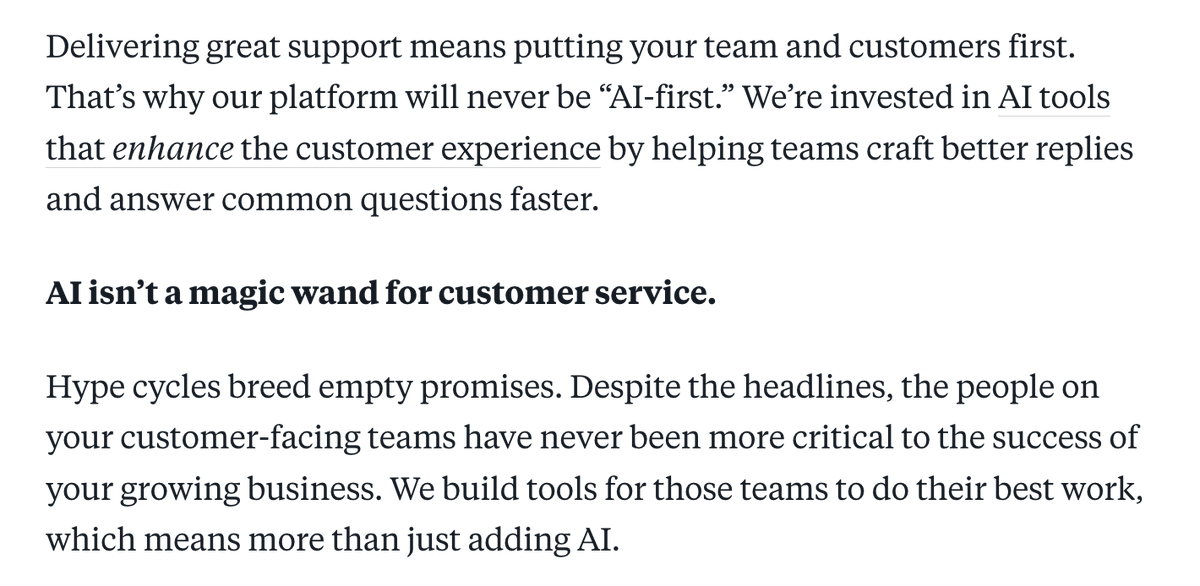
Notice they're not ignoring AI. It's the only link in this open letter! But the way they talk about it feels much different than what their customers are seeing everywhere else. This takes a lot of alignment between product, marketing, and leadership.
I like this big messaging swing from @helpscout. Go to their competitors' homepages and you'll find "AI-first" front and center on more than one. This really stands out, and feels true to the brand they've built.
For a deeper dive into 37signals' copy, this post I did several years back on the history of the @basecamp homepage has a lot of fun stuff: https://t.co/Nc5ckTyQ59
I’ve been thinking a lot about the @heyhey homepage from @37signals lately.
They’ve long been among the best software companies at copywriting, but the page’s headline leads with something I often steer clients away from — the word “WE.”
And yet…I think it works for them in this case! But why?
“Because they’re 37signals, duh,” wasn’t a satisfying answer to me, so I recorded a quick breakdown of the 3 main reasons “we” works here — and how to figure out if you can pull it off in your own copy.
It comes down to something I call the Earned We...
This new product page from @descript has some of my favorite copy I’ve seen recently.
It’s for their cheekily named new product Underlord — an AI editing assistant for video and podcast content.
As a copywriter, it was a delight to go through. And there are a lot of great lessons you can take from it to apply to your own copy.
I broke them all down in this video (which I made using Descript, of course!)
What stands out to you about this page?
Building always-on, business-critical AI applications or agents on a constantly updating and growing volume of unstructured data requires resilient and fast data infrastructure.
I am super excited to finally announce @tensorlake's open-source, real-time data framework, Indexify.
Real-time processing: Optimized for tasks like summarization, extraction, embedding, and parsing, Indexify works well with frequently updated data. It can ingest any data modality at scale, with incremental updates that don't require re-processing entire documents.
Reliability, Multi-Cloud and Hardware Acceleration: Indexify reliably processes data even during transient infrastructure failures, ensuring high availability . Extracted data is automatically stored in storage systems. Pipelines can run on GPUs, CPUs, and across multiple clouds for flexibility and resilience.
Observability: Fully observable, Indexify allows you to identify bottlenecks in extraction pipelines and retrieval APIs for semantic searches and SQL queries.
Indexify has been tested on AWS with hundreds of thousands of documents and images to ensure production-readiness.
It comes with retrieval APIs for RAG applications, autonomous agents or any AI application. It's fully extensible, allowing you to bring any model into pipelines.
Blog Post: https://t.co/wG6ofubaC5
GitHub: https://t.co/as17Pi2UM2
Website: https://t.co/rQLevPKGeE
Discord Community: https://t.co/mofdmarOZj
@SethPartnow 100% — it's truly confounding that the league and its broadcast partners seem to not understand having JVG / jaded former players whine through every game might not be a great way to help people enjoy the product
@SethPartnow That's a challenge you have to overcome with improving any product. Can't depend solely on *what* consumers say, you have to dig into *why* they say it. And be open to the possibility that they're not always going to be able to tell you exactly what they want