I've been doing a bunch of work on my dwnominate package for #rstats. Including a pkgdown website, a FAQ section, and improvements to some fortran-related issues. https://t.co/HOVW41cLOs
There's still a lot more that could be done, so pull requests and feedback are welcome.
"LGBTQ correspondents" at newspapers are consistently one of the most incompetent and unreliable sources of info on LGBTQ-related research. It's an embarrassment to journalism
A classic in the genre of medical disinformation. 👇
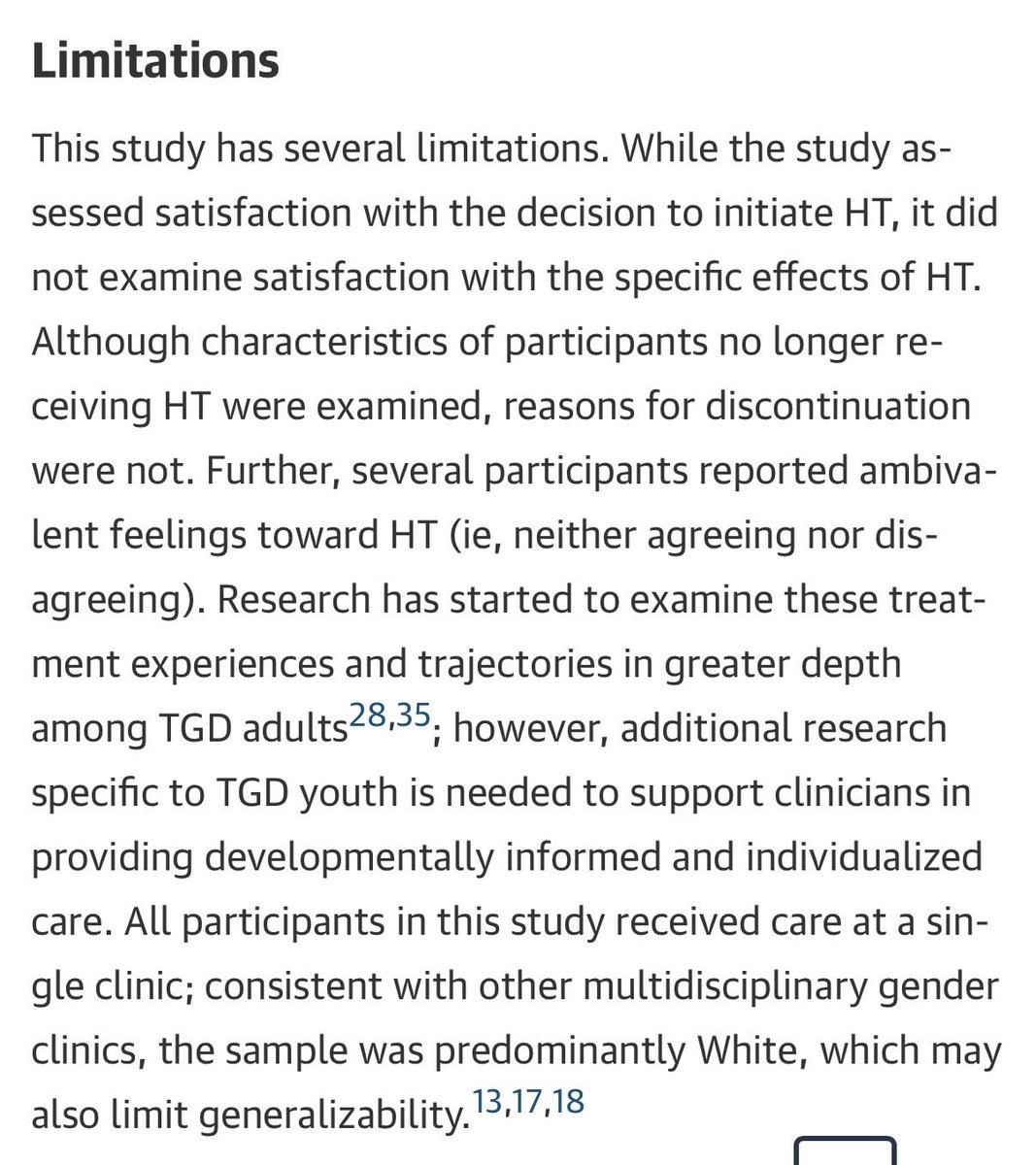
A new JAMA study uses surveys to assess regret among those who received hormones as teens.
42.5% did not return the surveys.
The authors nevertheless conclude that regret was “rare,” without acknowledging the 42.5% non-response in the limitations, and their conclusion is that gender Rx should not be restricted for youth (a non-sequitur). JAMA, apparently, sees this as worthy of publication.
The Washington Post (@washingtonpost) then uncritically reports the new study’s findings, also without any mention of the 42.5%.
This study will almost certainly be citation laundered, cited again and again in medical literature, media coverage, and legislative hearings, until its “findings” become “well-established truth.”
@jessesingal@TopherSpiro For example, if you want to cut taxes, you could cite "experts" at free market think tanks endlessly funded by the Koch brothers. But this is very obviously biased expertise, and it doesn't carry the same weight as neutral experts. Same is happening in AI now. 2/2
@jessesingal@TopherSpiro You and other AI safety advocates keep doing this slight-of-hand where you cite "experts" without making it clear that this is an unrepresentative group of experts, often involved in AI doomerism via ideology or funding. 1/2
@steve603z Need to plug this into a regression predicting vote share, and find the coefficient on the free stater predictor
(I think you're right about the broad trends, but there still may be a free stater effect)
@MaxCRoser@tomaspueyo@Liv_Boeree That's why everyone objects, no one thinks those distances should be equal. No one cares about crime on a log scale. 10x more crime is 10x worse, not 2x.
Functionalism for example doesn't suggest LLMs are conscious. It's the opposite-- LLMs lack nearly all of the functions and the parts associated with consciousness!
People suggesting functionalism implies LLM consciousness are completely ignorant of brains or LLMs or both 2/2
Not only is this wrong, I think it's very stupid and ridiculous.
Yes, we're more than 99.9% confident LLMs aren't conscious. That's because *no* theory of consciousness suggests LLMs have it, outside of the crudest panpsychism. 1/2
.@anilkseth, @De_dicto, and Giulio Tononi have a new essay in @Nature arguing that AI is not conscious and perhaps never will be. I admire the authors and agree with much of what they say. False positives about AI consciousness are both likely and harmful right now. Consciousness and intelligence are distinct capacities. And theories that support AI consciousness, such as computational functionalism, are not clearly true, and theories that rule out AI consciousness, such as biological naturalism, are not clearly false.
However, I think this essay misses the mark in an important way.
The core issue is that the essay never makes clear who its real target is. The introduction suggests that it will address precautionary arguments for taking AI welfare seriously; for example, it cites our report "Taking AI Welfare Seriously" and summarizes its main argument. But much of the essay then addresses mistakes that appear mainly in the media and the public. This allows the essay to present itself as engaging with fellow experts even though the relevant experts are not making the mistakes that the essay corrects.
To stick with the view that many of us actually hold: Given uncertainty about the nature of consciousness and the future of AI, we are not able to rule out a realistic possibility of near-future AI consciousness. We should thus acknowledge that AI consciousness is a serious issue, start assessing AI systems for welfare-relevant features, and prepare policies for treating AI systems with an appropriate level of concern, mitigating the risk of both false positives and false negatives in proportion to their probability and severity.
The essay does briefly engage with a precautionary stance, arguing that false positives are likelier than false negatives, and could be harmful. This is reasonable but incomplete. We need to consider the probability and severity of both types of error, as well as the costs and benefits of precautions. And even if one error is more likely than the other and could be harmful, we should still take steps to mitigate both risks if there is a non-negligible possibility of serious harm in both directions, and if reasonable precautions are available.
In this case, the stakes are clearly high in both directions. If we overattribute consciousness to AI, we could develop inappropriate emotional bonds with them, we could misallocate scarce resources toward them, and we could even amplify risks of misuse and loss of control. Whereas if we underattribute consciousness to AI, we could become entrenched in industries that harm and neglect vulnerable populations against their will, often for trivial reasons, as we continue to do with nonhuman animals.
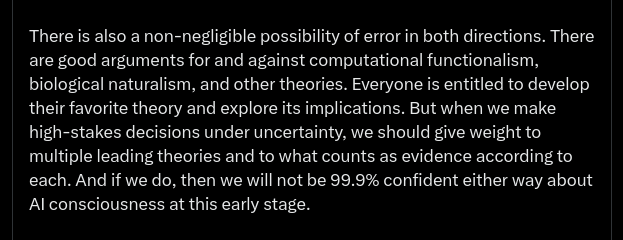
There is also a non-negligible possibility of error in both directions. There are good arguments for and against computational functionalism, biological naturalism, and other theories. Everyone is entitled to develop their favorite theory and explore its implications. But when we make high-stakes decisions under uncertainty, we should give weight to multiple leading theories and to what counts as evidence according to each. And if we do, then we will not be 99.9% confident either way about AI consciousness at this early stage.
There are also reasonable precautions available. For example, I support the new Anthropic policy of banning sustained and needless abuse and cruelty towards Claude, since kindness toward entities that function as assistants or companions in our lives is a low-risk, low-cost, co-beneficial way to improve our treatment of those entities under uncertainty about their moral status. We can implement this kind of policy to mitigate the risk of false negatives while still taking appropriate steps to mitigate the risk of false positives.
The essay also focuses primarily on current systems, yet the precautionary view focuses at least as much on near-future systems. AI progress is occurring rapidly, and in the near future, we may have not only more advanced, integrated, and embodied versions of current systems, but also new types of systems on new types of architectures. Policy also takes time to develop. So, if the probability of AI consciousness increases over the next decade, we will want to have done philosophical, scientific, and policy work in advance.
The rest of the essay is largely orthogonal to our work. The case for taking AI welfare seriously does not conflate consciousness with intelligence, nor does it depend on the truth of theories like computational functionalism or the falsity of theories like biological naturalism. Instead, it depends only on the idea that plausible theories exist in both categories and that, when making high-stakes decisions under uncertainty, we should give weight to multiple leading theories rather than bet everything on our own favorite theory.
To be clear, this essay makes many good points, and I agree with the authors more than I disagree with them. But I think that the essay would be better if it selected a clear target and then focused on that—either stating at the outset that it aims to debunk misconceptions about AI consciousness in the media and the public and then doing that, or stating at the outset that it aims to address the precautionary case for taking AI welfare seriously, and then genuinely engaging with the arguments and conclusions of that view.
President Trump’s decision to lift sanctions on Russian fuel amidst Putin’s ongoing and brutal attacks on civilian targets in Ukraine makes no sense and is a betrayal of the legacy and leadership of the late Senator Lindsey Graham.
While Ukraine fights for its survival, Putin’s war machine continues to prosecute his terrorist war on civilian populations and innocent Ukrainians are dying every day.
Now, Instead of implementing the tough sanctions Lindsey Graham fought to his last breath to enact, President Trump has announced the United States is lifting sanctions on Russian energy, fueling the Putin’s war machine.
As I saw firsthand in Ukraine last month, Putin is losing this war. Ukraine has fought the Russian military to a standstill and reinvented warfare with drones taking the fight into the heart of Russia.
America should not be throwing a lifeline to Putin’s war machine. Now is the time to stand strong against Russian aggression as we did during the first Trump administration.
Putin doesn’t want peace. Putin wants Ukraine. I have no doubt that if Putin overruns Ukraine, it will only be a matter of time until Russia’s military crosses a border that our troops will have to deal with him.
America is the Leader of the Free World. For our National Security, for the security of our Allies in Europe including Ukraine, President Trump should rescind this deal immediately and return to the strong policies of our four years in the White House; impose harsh sanctions on any nation purchasing Russian energy and work with our allies to ensure Ukraine has the military support it needs to repel and defeat this Russian invasion once and for all. Slava Ukraini🇺🇸🇺🇦
@Chris_Said@Lasermazer@magnushambleton Basically when I see computer scientists doing thought experiments like this (which are a lot more social science than CS), I think it's a lot more likely that they'll be way off instead of landing on a reasonable number
@Chris_Said@Lasermazer@magnushambleton I constantly see these presented as "this is what the experts think".
But then the actual methodology is a thought experiment like "imagine a country of geniuses ..."
And that approach is so error-prone that I don't see any real meaning in the P(doom) at the end of it
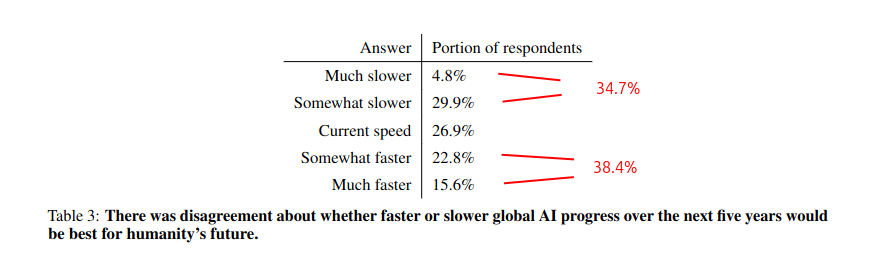
@mtokson@jbarro So the answer is still no, that's not what these surveys say at all. I don't think anyone who knows anything about surveys would interpret that way
@mtokson@jbarro Oh, that's the most uninformative part of the survey by far (doesn't distinguish between "I don't know anything about this" vs "I know it will be so bad we might all die" which is very different)
I also was just reading the new one and the title is very misleading 1/2
@Chris_Said@Lasermazer@magnushambleton This is not the strongest argument and they don't present it as such.
4 reasons P(doom) has little value:
- nonexistent/nonrigorous methodology
- no history of calibrated forecasts
- widely varying numbers from different experts
- way, way outside of CS field of expertise
Absolutely baffled by the new conventional wisdom in some corners that AI doomers have been good at predictions.
I'm old enough to remember when all the knowledge workers were going to lose their jobs next year, according to top doomers like Geoff Hinton
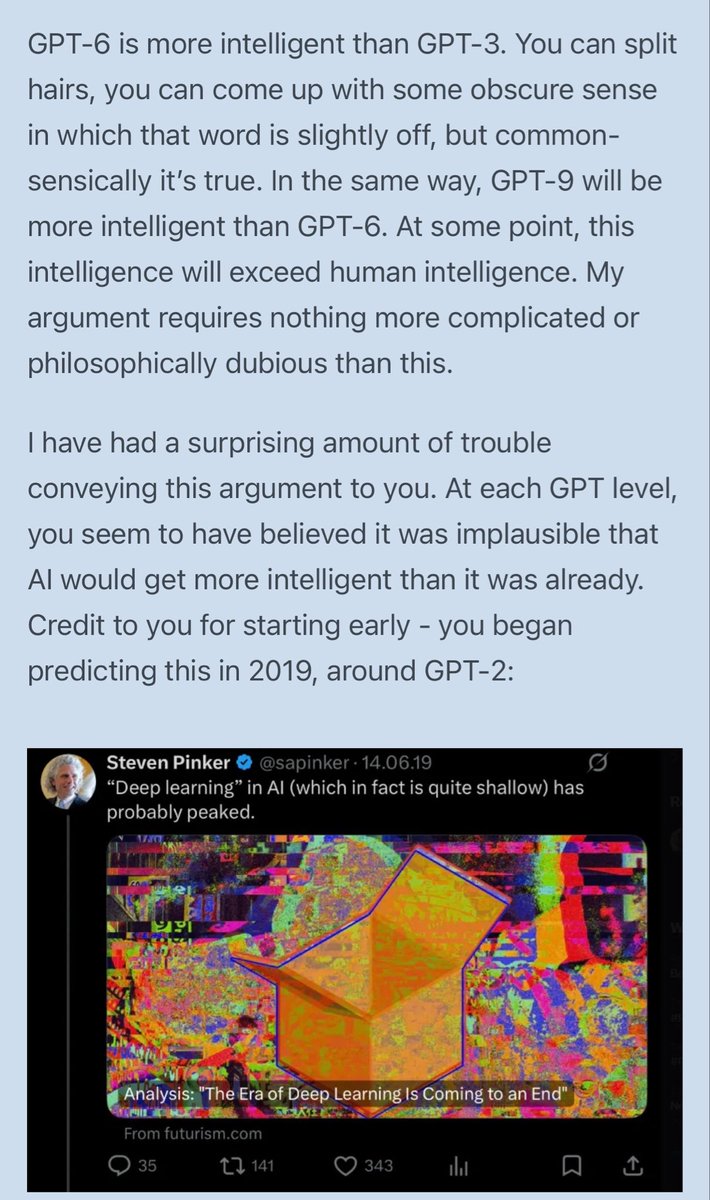
In the Scott Alexander vs Steven Pinker debate, it really is notable that one side has a much, much better track record on predicting AI trends than the other…
At this point, the burden of proof is on Pinker as to why we should still listen to him.
@AlecStapp I guess we're just memory-holing all the AI people who told us we wouldn't have jobs by now?
I think the truth is that one side has a much more selective memory than the other
A prediction tool like this is not even remotely conscious-like or conscious-adjacent. I'm not going to start talking like a 17th century pirate because someone edited my prompt. I have a stable sense of self and I have motivations outside of text prompts. LLM's do not! 4/4
None of these text predictions implies the LLM has feelings or personal thoughts.
And if an LLM did have personal thoughts, there'd be no way for us to know! It's not capable of expressing its own thoughts, it can only predict text. 3/
Ask an LLM to predict the user input part of the conversation and it will do that. Ask an LLM to predict website html code and it will do that. Ask an LLM to predict Howard Roark's speech in an Ayn Rand novel and it will do that. 2/