Research-driven GTM Messaging & Positioning for SaaS and Tech | Buyer research → sharper positioning → LinkedIn + X content that supports sales | Ghostwriter
When a founder starts working with me, no X or LinkedIn content gets written in the 7 days.
Cause I spend it reading recordings and support tickets, and it's the part that decides whether the writing works at all.
Here's what the week actually looks like:
1. Day one is a 90 minute call with the founder, and most of it's one question repeated.
What would this buyer use tomorrow if you disappeared today?
2. Day two and three are recordings.
I listen to the opening of the last 8 renewal calls, where customers explain what nearly made them leave
3. Day four is support tickets from each customer's first 30 days, because those show what people expected to buy
4. Day five is one page.
Who it's for, what they use instead, what breaks in that alternative, and the three phrases buyers used more than once
Founders answer day one with competitor names first. It takes about 40 minutes to get to the real answer.
That one page goes to whoever runs sales before it goes anywhere near a post.
If sales disagrees with it, the writing would've been wrong for months.
Writing starts in week two, and by then it's mostly assembly.
The hard part was deciding what to say, and that happened while nobody wrote anything.
Steal the week:
→ Block five days before your next content push and write nothing during them
→ Read the two sources nobody reads, which are renewal calls and first-month tickets
→ Get one page agreed with sales before a single post gets drafted
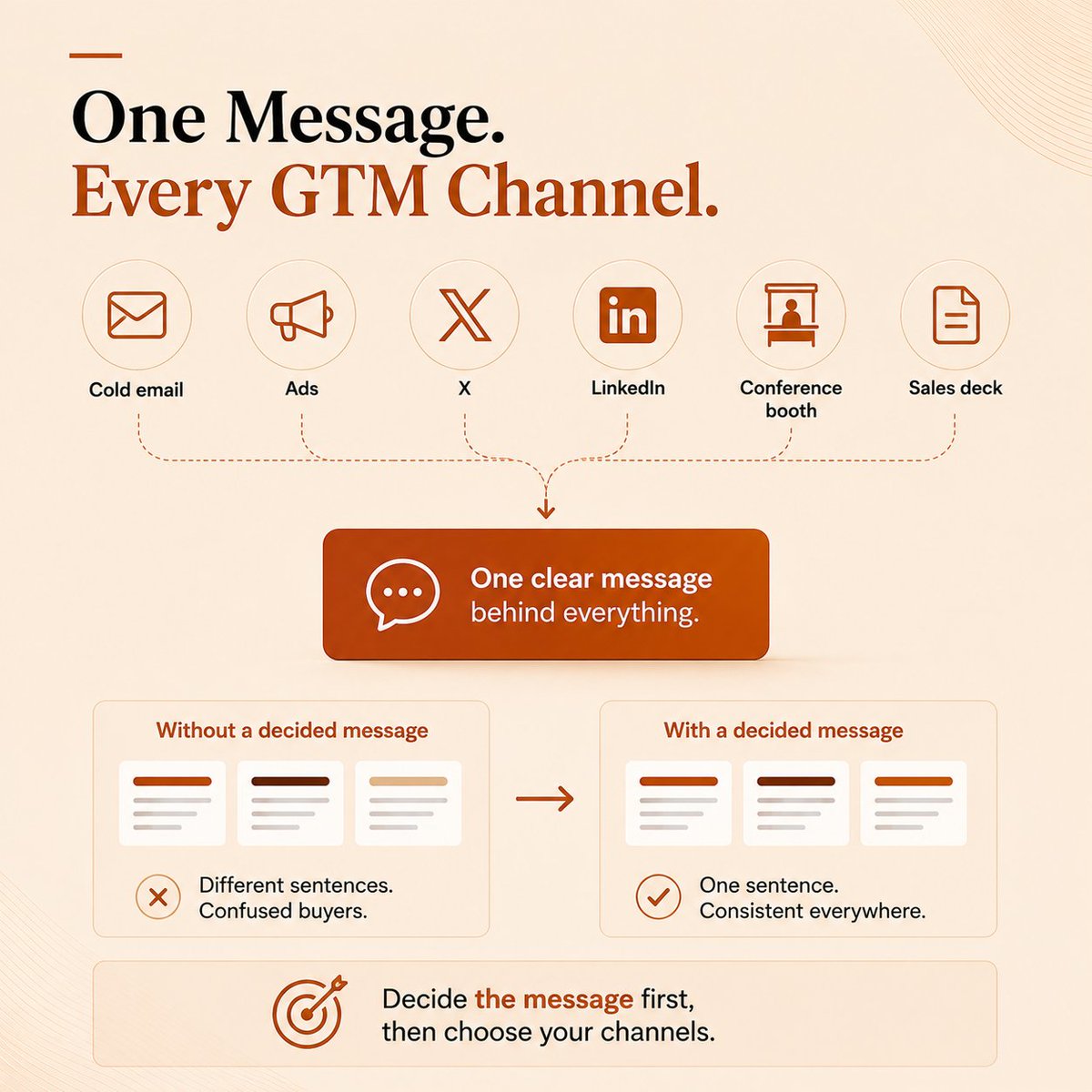
SaaS GTM channels: Cold email, ads, X, LinkedIn, a booth at a conference, a sales deck.
Behind every one of those sits the same message, and most founders never wrote it on purpose.
Instead they jumped straight to the activities.
So they run ads with a message nobody chose, then send cold email with a message nobody chose.
When the numbers come back weak, they change the channel.
So they switch agency, then creative, then outreach tool, while the same sentence sits underneath all of it.
You can find out which problem you've actually got in ten minutes:
• Open your homepage, your last ad and your last cold email side by side
• Read only the first line of each one
• Ask whether a stranger would guess they came from the same company
If those three lines say different things, then you don't have a channel problem.
You never decided what the message was, so every channel invented its own.
Fix the sentence once, though, and every channel inherits it.
Change the channel again and you'll be reading this same post next quarter.
If your company has 20 dashboards and nobody to own them, this is for you.
At some point, your CFO will ask:
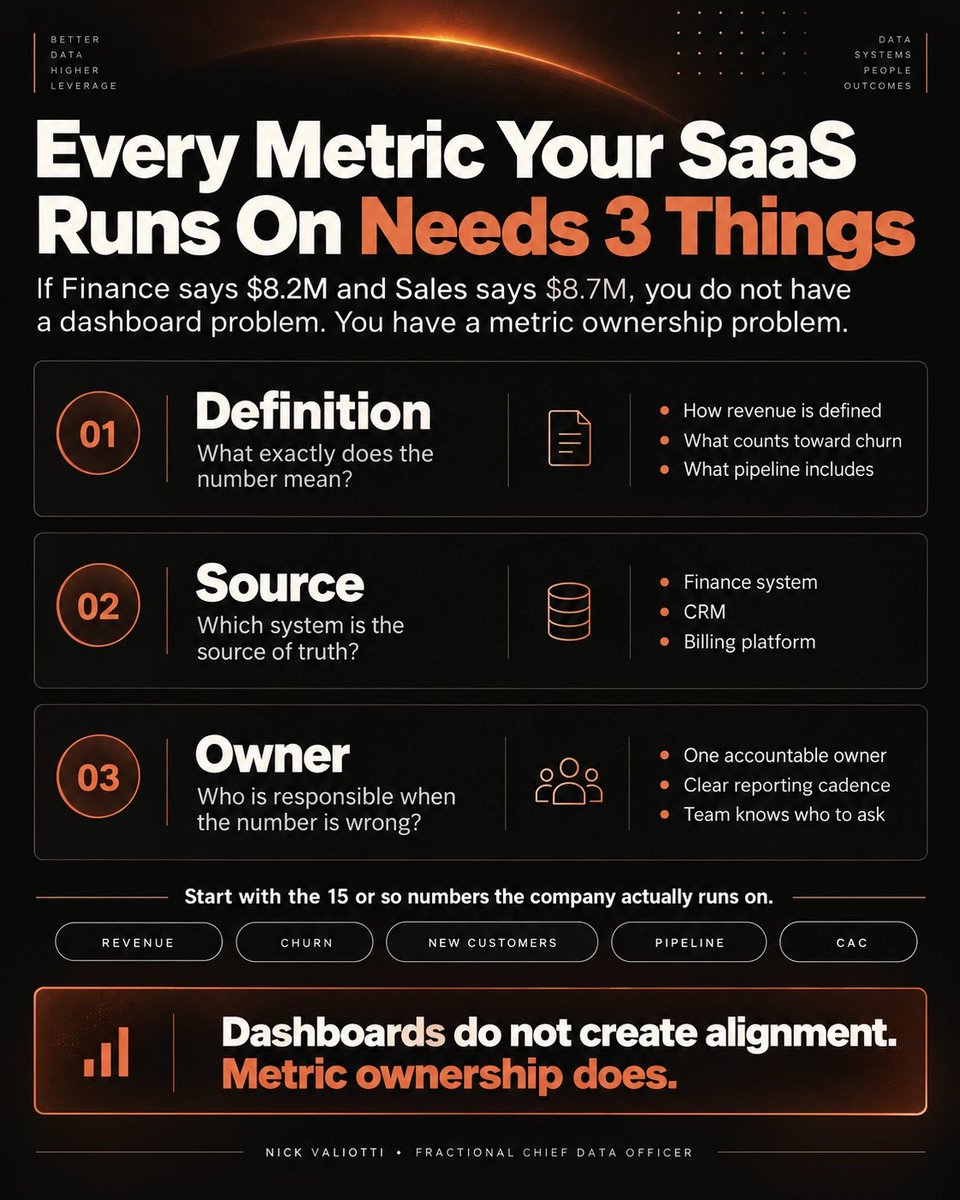
“Why does Finance say we made $8.2M, while Sales says $8.7M?”
Then someone will suggest:
“We need to hire a $300K Head of Data.”
Maybe.
I’ve worked with SaaS founders at exactly this stage as a part-time Chief Data Officer.
We start by choosing the 15 or so numbers the company actually runs on:
- Revenue
- Churn
- New customers
- Pipeline
- CAC
Then we decide exactly:
- What each number means
- Where it comes from
- Who is responsible for it
Once the system works, I hand it back to the team.
You don’t always need another data hire. Sometimes you need someone to make the data you already have usable.
Comment below with your stage and the one number your team argues about most, I’ll reply.
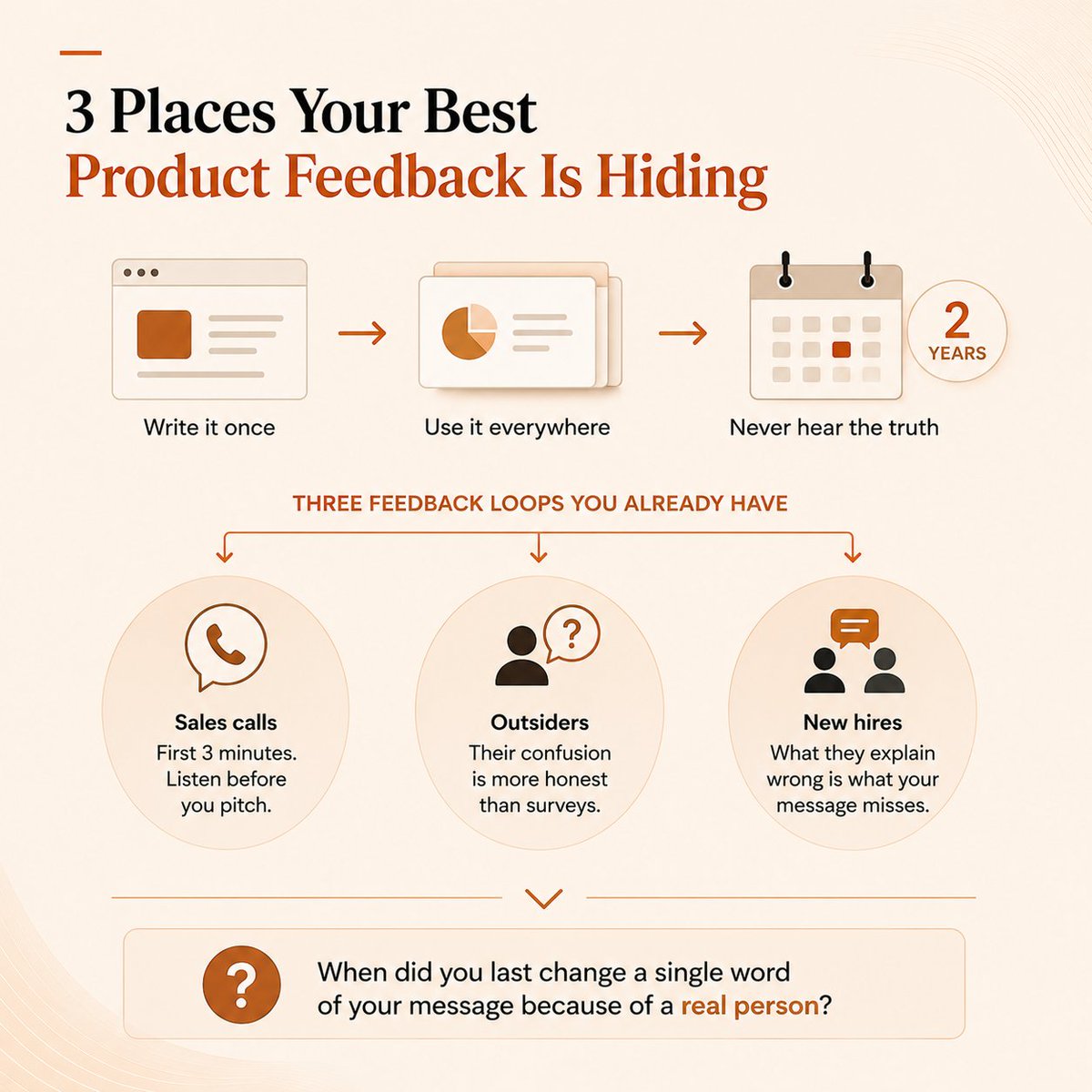
Most founders write their product message once, then never hear an honest reaction to it again.
It goes on the site. It goes in the deck. Two years pass.
Meanwhile the only feedback arriving comes from people being polite.
Or from a dashboard that reports what happened without explaining why.
But you already have three feedback loops running. You're just not listening to them:
• The first three minutes of any sales call, before your pitch starts and the buyer borrows your words
• Anyone outside your industry who asks what you do, because their confusion is free research and more honest than a survey
• The moment a new hire explains your product to a friend and gets it slightly wrong, since whatever they got wrong is the part your message doesn't carry
None of that needs a budget. It needs you to watch the reaction instead of moving to the next slide.
So here's the question worth sitting with this week.
When did you last change a single word of your message because of something a real person did in front of you?
There are two versions of every product value proposition, and founders keep publishing the wrong one.
The written version sounds like this:
"Our platform revolutionises how compliance teams manage regulatory workflow at scale."
Everyone winces, including the person reading it out loud.
The spoken version sounds like this:
"You know how someone on your team spends the last week of every quarter rebuilding the same audit pack? We do that part automatically."
Same product and same claim. But one gets a polite nod, while the other gets "wait, say that again."
The difference isn't cleverness. It's the order things arrive in:
• The spoken version opens with something the listener already knows is true
• Once they've agreed, they're listening rather than judging
• Only then does it say what you actually do
Flip that order and they're evaluating you before they've agreed there's a problem worth solving.
As a result, everything you say next has to fight uphill.
So write yours out loud instead of typing it.
Start here, then finish the sentence with something a buyer has complained about to your face:
"You know how..."
If the result feels too casual to put on a website, you're finally close.
SaaS GTM channels: Cold email, ads, X, LinkedIn, a booth at a conference, a sales deck.
Behind every one of those sits the same message, and most founders never wrote it on purpose.
Instead they jumped straight to the activities.
So they run ads with a message nobody chose, then send cold email with a message nobody chose.
When the numbers come back weak, they change the channel.
So they switch agency, then creative, then outreach tool, while the same sentence sits underneath all of it.
You can find out which problem you've actually got in ten minutes:
• Open your homepage, your last ad and your last cold email side by side
• Read only the first line of each one
• Ask whether a stranger would guess they came from the same company
If those three lines say different things, then you don't have a channel problem.
You never decided what the message was, so every channel invented its own.
Fix the sentence once, though, and every channel inherits it.
Change the channel again and you'll be reading this same post next quarter.
@thenitinkamal You described me here, Nitin
I wasted months chasing likes from people who would never buy from me
My analytics looked great but my bank account didn't hahaha
@heypetar The technical founders that I know hand off growth too early because they think it's someone else's job, unfortunately
They should read your tweet, Petar, lol
@romanbuildsaas The comment-to-lead flow is underrated, I think
Most teams treat social engagement as a vanity metric and never pull that list into a sequence
The filtering step is what makes it work, because without ICP fit you burn time on people who were never going to buy
@cdolan04 The 3-game series still drives me crazy
You grind through 162 games and then one bad start can end your season
That Harper homer is exactly why people stay up past midnight watching baseball hahaha
@matthias_mrc Seriously, Matt, those months are the most honest test you will ever face
Your product does not care about your mood and your users do not care that you had a bad week