10 Books in 'Popular Physics' category that you can read as a beginner ✍️
1. The Character of Physical Law by Richard P. Feynman
2. The Quantum World: Quantum Physics for Everyone by Kenneth W. Ford
3. The Road to Reality: A Complete Guide to the Laws of the Universe by Roger Penrose
4. In Search of Schrödinger's Cat: Quantum Physics and Reality by John Gribbin
5. Subtle is the Lord: The Science and the Life of Albert Einstein by Abraham Pais
6. The Universe in a Nutshell by Stephen Hawking
7. QED: The Strange Theory of Light and Matter by Richard P. Feynman
8. Warped Passages: Unraveling the Mysteries of the Universe's Hidden Dimensions by Lisa Randall
9. The Elegant Universe: Superstrings, Hidden Dimensions, and the Quest for the Ultimate Theory by Brian Greene
10. Three Roads to Quantum Gravity by Lee Smolin
Cybernetics was AI before AI.
This #book, written in 1950, anticipated the AI safety and alignment problem. Using metaphors such as asking a genie for a wish that is grossly misinterpreted, Wiener urged humans to never abdicate moral responsibility to machines.
The 75 year old book is eerily prescient and wide ranging in scope. Many of our modern concepts such as neural networks, world models, learning mechanisms and control via closed loops originated in the Cybernetics movement of 1940s.
Reading this book is like reading about the pertinent issues of the day. Writing obviously feels dated, but the ideas are contemporary.
I’m amazed how far reaching some people and their ideas can be!
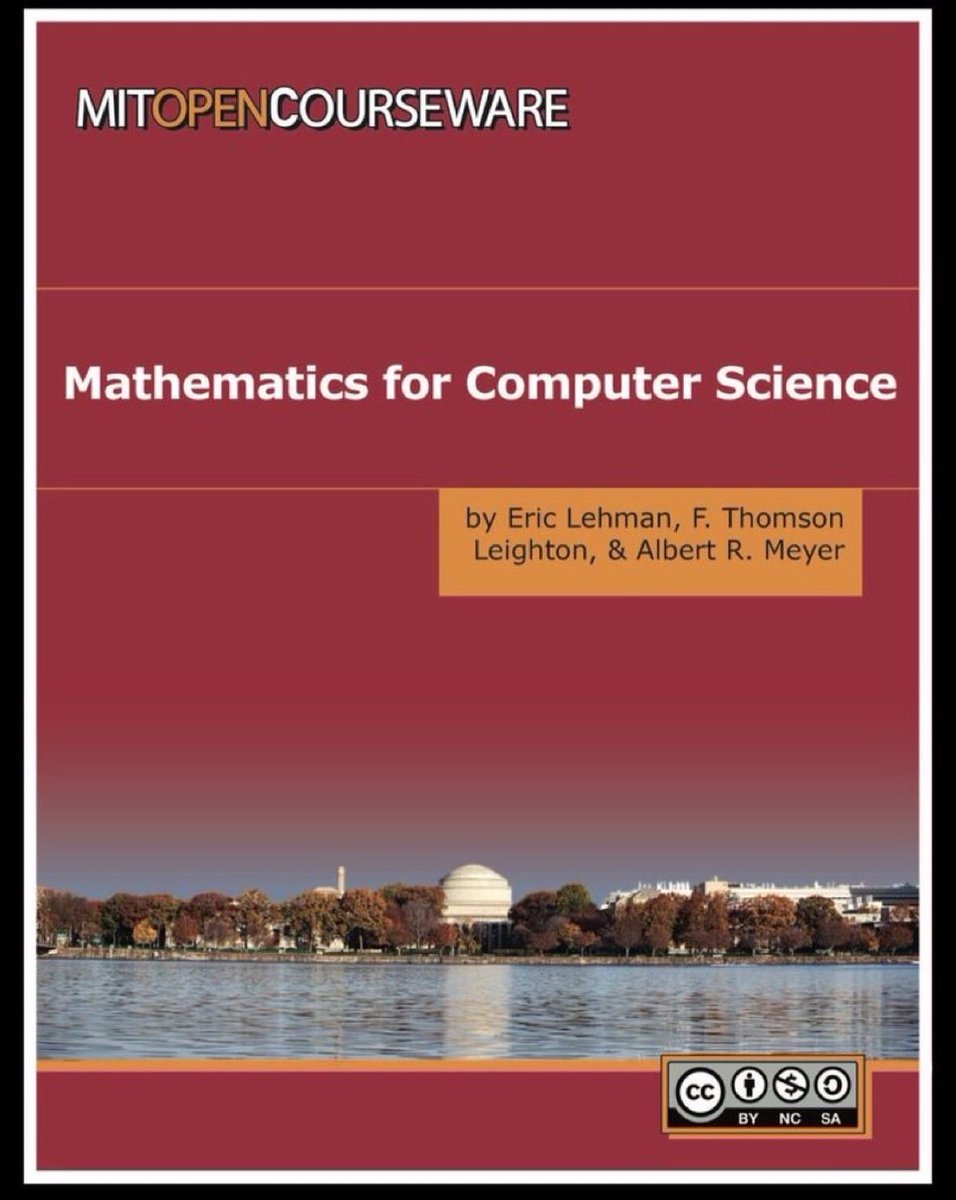
MIT just made one of the best Computer Vision books available for FREE.
If you are interested in robotics, embodied AI, autonomous driving or vision AI, this is a must-read.
Topics
• Image Formation
• Cameras & Optics
• Machine Learning Fundamentals
• CNNs & Transformers
• Image Processing
• Feature Extraction
• Representation Learning
• Generative Models
• Camera Calibration
• Stereo Vision
• 3D Reconstruction
• Structure from Motion
• Radiance Fields (NeRF)
• Motion Estimation
• Vision-Language Models
• Object Recognition
• Research & Paper Writing
Perfect for
• Computer Vision Engineers
• Robotics Engineers
• Embodied AI Engineers
• Autonomous Driving Engineers
• AI Researchers
Learn from MIT for free:
https://t.co/8odQmXFTzg
The most quoted sentence in probability theory was written by two Soviet mathematicians:
"All epistemologic value of the theory of probability is based on this: that large-scale random phenomena in their collective action create strict, nonrandom regularity."
Gnedenko and Kolmogorov, 1954.
Networks by Professor A. D. Barbour and Professor Gesine Reinert
A comprehensive look at probabilistic and statistical methods for the analysis of networks, together with their theoretical underpinnings.
📚 https://t.co/p6p2mrsPTa
Your brain has waves—just like the ocean. And these tiny waves of electrical activity travel across your brain, helping it process what you see. But Salk scientists now think they do even more.
A new review suggests these traveling brain waves help your brain build an internal model of the world, allowing you to interpret what you see, fill in missing information, and even predict what comes next.
🔗 Read more: https://t.co/CVg2yoSPKl
#Neuroscience #BrainResearch #SalkInstitute
MIT released the legendary 700-page book that actually teaches machines how to think. 😗
Real math. Real code. Real-world deployment.
Self-driving cars, robotics, RL, POMDPs, aviation, autonomy, medicine. Game Theory, Bayesian RL, everything.
- This is the graduate-level Algorithms for Decision Making book by Kochenderfer, Wheeler & Wray
- https://t.co/5WapJ7eJlJ
📖 Nearly 3 years after the publication of Causal Analysis (@mitpress), I'd like to highlight the lecture slides accompanying the book. Available here as PDF and editable TeX files, together with datasets & code in R, Python, & Stata: https://t.co/5Zah7NVoH9
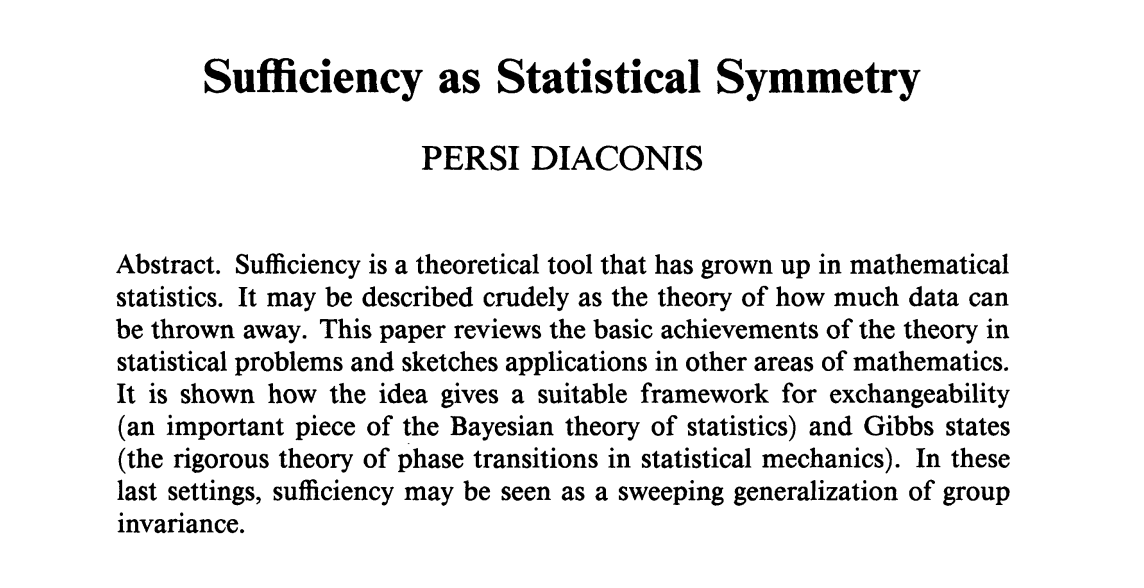
Must read! A great introductory and outreach article on sufficiency beyond vanilla exponential families:
"Sufficiency as statistical symmetry" by Prof. Diaconis
PDF: https://t.co/IkyIkeHMke
I'm beyond thrilled about the prospect of assisting @deontologistics on some open problems in mathematized philosophy. Thanks for following me and being receptive to my correspondence with you!
Emotions are fundamental to human life, but when dysregulated, they can contribute to anxiety and trauma-related mood disorders.
In a new #SciencePerspective, researchers dive into new approaches to understand emotions across species and how these insights could be used to advance treatments for psychiatric disorders.
Learn more: https://t.co/3RRhdCBNOq
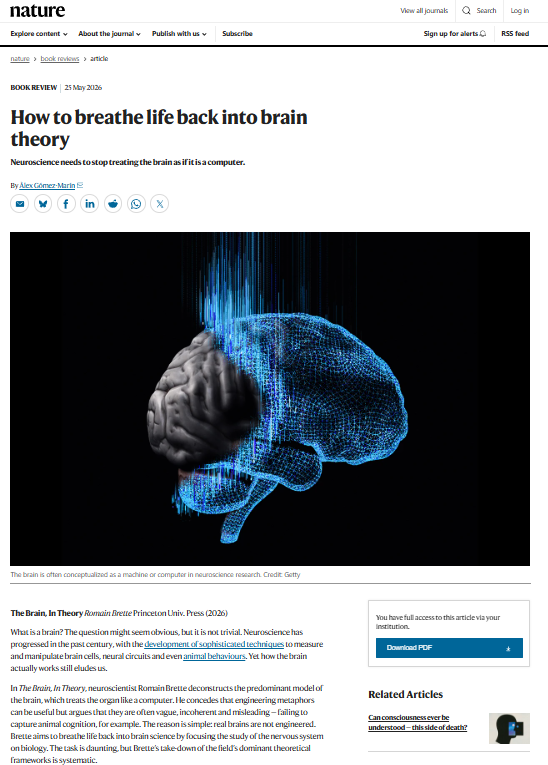
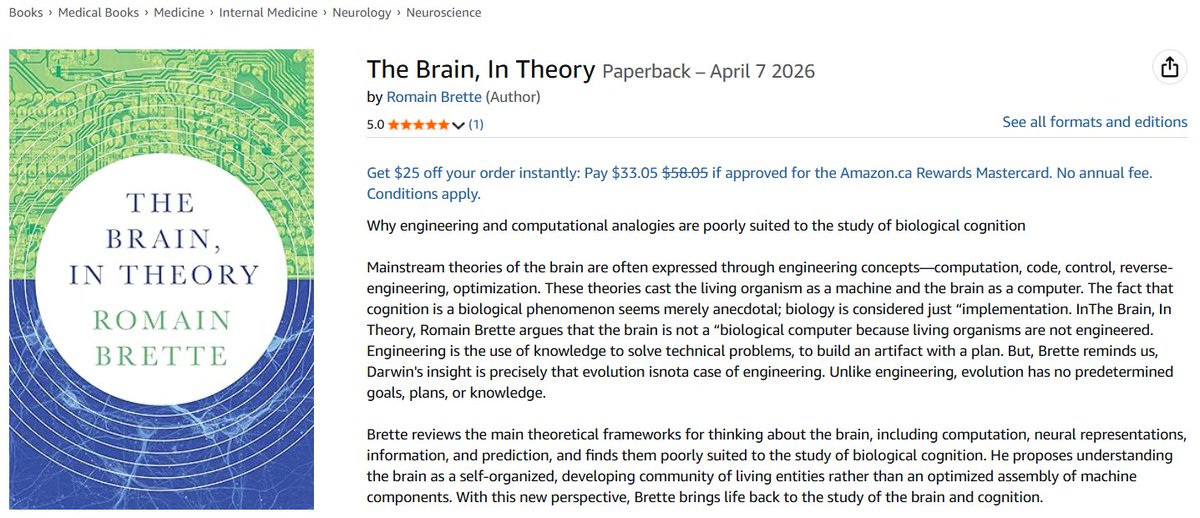
"Why engineering and computational analogies are poorly suited to the study of biological cognition"
https://t.co/uG9nALa8dA
[ ... including many of the significant limits of current climate action, rather than nature+ positive solutions, furthered by profound integration with natural biotic and abiotic systems]
"The Brain, In Theory," Romain Brette
Princeton University Press
07APR2026
https://t.co/46hWQywHBg
Mainstream theories of the brain are often expressed through engineering concepts—computation, code, control, reverse-engineering, optimization.
These theories cast the living organism as a machine and the brain as a computer.
The fact that cognition is a biological phenomenon seems merely anecdotal; biology is considered just “implementation.”
In The Brain, In Theory, Romain Brette argues that the brain is not a “biological computer” because living organisms are not engineered.
Engineering is the use of knowledge to solve technical problems, to build an artifact with a plan.
But, Brette reminds us, Darwin’s insight is precisely that evolution is not a case of engineering.
Unlike engineering, evolution has no predetermined goals, plans, or knowledge.
Brette reviews the main theoretical frameworks for thinking about the brain, including computation, neural representations, information, and prediction, and finds them poorly suited to the study of biological cognition.
He proposes understanding the brain as a self-organized, developing community of living entities rather than an optimized assembly of machine components.
With this new perspective, Brette brings life back to the study of the brain and cognition.
𝑻𝒉𝒆 𝑩𝒓𝒂𝒊𝒏, 𝑰𝒏 𝑻𝒉𝒆𝒐𝒓𝒚 ... a 📘
↗️This non-AI Book is ... well, a timely AI Book and an early candidate for the best read of 2026.
🥊 It's a counter-punch to several BigTech bros and AI KOLs, including medical influencers here on @X, who obtusely opine on the complex and continually evolving world of neuroscience.
🇫🇷 Dr. Romain Brette, a prominent French neuroscientist and leader in the field of neuroinformatics, challenges the dominant engineering, computational, and "neural coding" metaphors used to explain brain function.
🧠 He argues that treating the brain as a computer that "encodes" and "decodes" information is ill-suited to the study of brain cognition and dismisses the intrinsic, goal-oriented reality of biological organisms.
💡He proposes understanding the brain as a self-organized, developing community of living entities rather than an optimized assembly of machine components.
Amazon:
🔗https://t.co/FrJZLBL21Z
Nature:
🔗https://t.co/AtpAyauuNT
@OctavioHenao@leafs_s ¿Y qué conduce la evolución? ¿Del caos puede devenir orden, organización? ¿O, lo que entendemos como mundo es simplemente el producto de un acomodo espontáneo de partes?










![gecko39's tweet photo. "Why engineering and computational analogies are poorly suited to the study of biological cognition"
https://t.co/uG9nALa8dA
[ ... including many of the significant limits of current climate action, rather than nature+ positive solutions, furthered by profound integration with natural biotic and abiotic systems]
"The Brain, In Theory," Romain Brette
Princeton University Press
07APR2026
https://t.co/46hWQywHBg
Mainstream theories of the brain are often expressed through engineering concepts—computation, code, control, reverse-engineering, optimization.
These theories cast the living organism as a machine and the brain as a computer.
The fact that cognition is a biological phenomenon seems merely anecdotal; biology is considered just “implementation.”
In The Brain, In Theory, Romain Brette argues that the brain is not a “biological computer” because living organisms are not engineered.
Engineering is the use of knowledge to solve technical problems, to build an artifact with a plan.
But, Brette reminds us, Darwin’s insight is precisely that evolution is not a case of engineering.
Unlike engineering, evolution has no predetermined goals, plans, or knowledge.
Brette reviews the main theoretical frameworks for thinking about the brain, including computation, neural representations, information, and prediction, and finds them poorly suited to the study of biological cognition.
He proposes understanding the brain as a self-organized, developing community of living entities rather than an optimized assembly of machine components.
With this new perspective, Brette brings life back to the study of the brain and cognition.](https://pbs.twimg.com/media/HNHeLZ7W0AARReb.jpg)