TODAY, CANCER CAN MEAN MONTHS OF TREATMENT OR EVEN DEATH.
TOMORROW, IT COULD MEAN ONE INJECTION.
The OECD estimates the global biotech market to grow from around $1.6 trillion in 2024 to nearly $4 trillion by 2030.
And some of tomorrow’s biggest biotech players are still small caps today.
These are the 5 layers I believe investors should understand:
1. Genomics & Infrastructure
$ILMN — sequencing backbone
$PACB — long-read sequencing
$TWST — synthetic DNA infrastructure
2. AI Drug Discovery / TechBio
$RXRX — AI + massive biological datasets
$SDGR — computational drug discovery / molecular design
$ABCL — antibody discovery platform
3. Precision Medicine & Diagnostics
$TEM — AI + clinical/genomic data
$NTRA — genetic testing + MRD/oncology
$GH — liquid biopsy + cancer screening
4. Gene Editing
$CRSP — CRISPR + bereits kommerzieller Proof
$NTLA — in-vivo gene editing
$BEAM — next-gen base editing
5. RNA Medicine
$MRNA — mRNA platform
$BNTX — mRNA + oncology
$ALNY — RNA interference
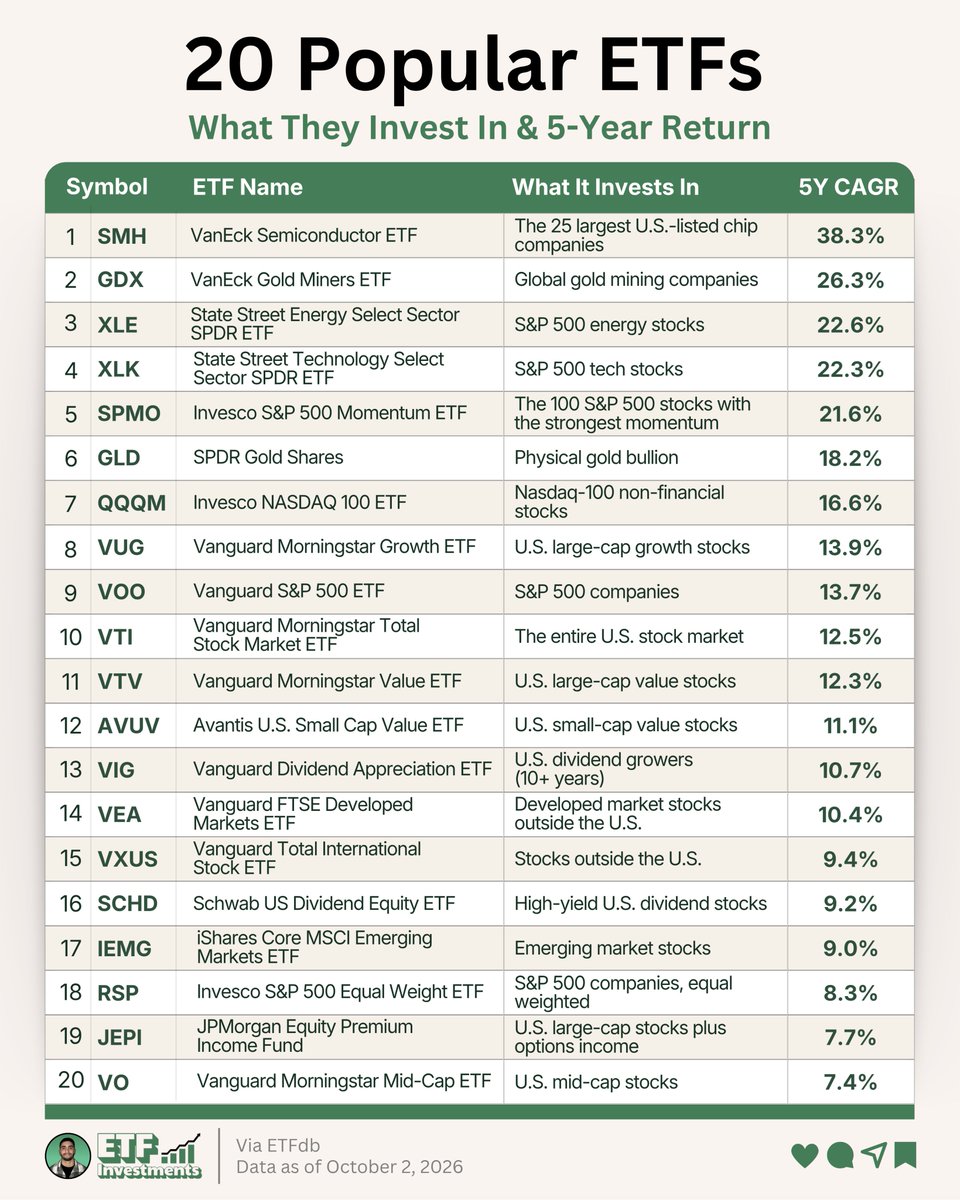
Here are 20 popular ETFs and what they invest in 👇
$SMH: Invests in the 25 largest U.S.-listed chip companies
$GDX: Invests in gold mining companies around the world
$XLE: Invests in the energy stocks in the S&P 500
$XLK: Invests in the tech stocks in the S&P 500
$SPMO: Invests in the 100 S&P 500 stocks with the strongest price momentum
$GLD: Invests in physical gold bullion
$QQQM: Invests in the 100 largest non-financial companies on the Nasdaq
$VUG: Invests in large U.S. growth companies
$VOO: Invests in every company in the S&P 500
$VTI: Invests in the entire U.S. stock market
$VTV: Invests in large U.S. value companies
$AVUV: Invests in small U.S. value companies
$VIG: Invests in U.S. companies that have raised their dividends for at least 10 years in a row
$VEA: Invests in developed market stocks outside the U.S.
$VXUS: Invests in stocks outside the U.S., across both developed and emerging markets
$SCHD: Invests in high-yield U.S. dividend stocks with strong financials
$IEMG: Invests in emerging market stocks
$RSP: Invests in all S&P 500 companies at an equal weight
$JEPI: Invests in large U.S. stocks and sells options to generate monthly income
$VO: Invests in U.S. mid-cap stocks
Which of these do you own?
THE WEEKEND PROCESS BEHIND MY $100K MONTHS
Here’s SECRET. Don’t lose it.
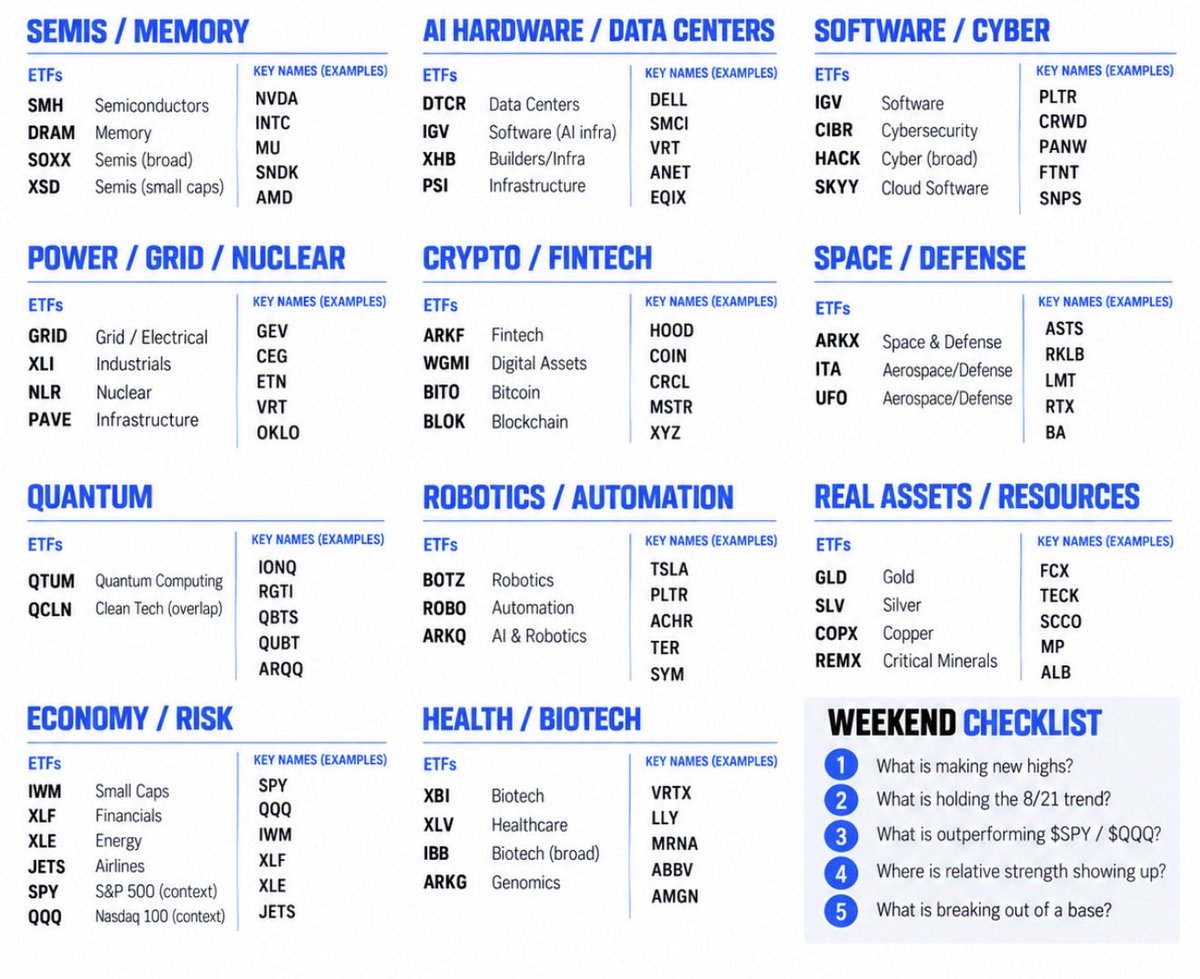
I don’t start with individual stocks.
I start with sector ETFs.
That’s how names like $MU, $RKLB, $NVDA, $HOOD and others end up on my radar.
They tell me where money is flowing before I ever start hunting for individual names.
Here are some of the areas I scan:
TECH / AI
$SMH - Semiconductors
$DRAM - Memory
$IGV - Software
$CIBR - Cybersecurity
$DTCR - Data Centers
POWER / INDUSTRIALS
$GRID - Grid / Electrical
$XLI - Industrials
$NLR - Nuclear
CRYPTO / FINTECH
$ARKF - Fintech / Crypto
$WGMI - Digital Infrastructure
SPACE / QUANTUM / ROBOTICS
$ARKX - Space
$QTUM - Quantum
$BOTZ - Robotics
REAL ASSETS
$GLD - Gold
$SLV - Silver
$COPX - Copper
$REMX - Critical Minerals
ECONOMY / RISK
$IWM - Small Caps
$XLF - Financials
$XLE - Energy
$JETS - Airlines
HEALTH
$XBI - Biotech
$XLV - Healthcare
Then I ask:
What is making new highs?
What is holding its 8/21 trend?
What is outperforming $SPY and $QQQ?
Where is relative strength appearing?
What is breaking out of a base?
THEN I open the strongest ETFs and look for the stocks leading them.
Find the sector. Find the leader. Wait for the setup.
Do this work before Monday.
HOW TO RETIRE EARLY FROM AI IN THE NEXT 3–5 YEARS
Keep this.
Most people will spend the next 3–5 years chasing what already moved.
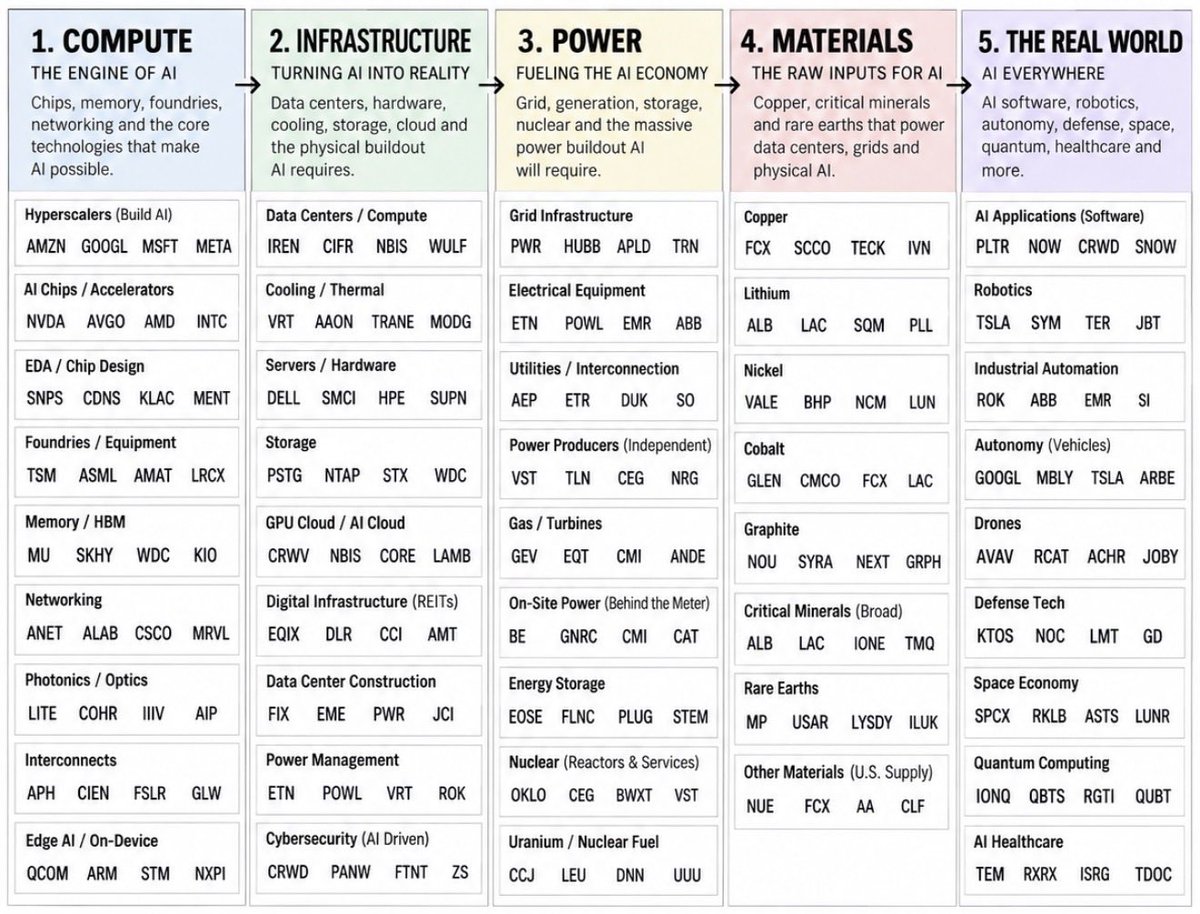
Follow the money EARLY:
MONEY IS FLOWING INTO COMPUTE
AI Chips: $NVDA $AVGO
Memory / HBM: $MU $SKHY
Foundries: $ASML
EDA / Chip Design: $SNPS
Networking: $ANET $ALAB
Photonics: $LITE
Interconnects: $CIEN
↓
COMPUTE IS FORCING AN INFRASTRUCTURE BOOM
Data Centers: $IREN $CIFR
Cooling: $VRT
Servers: $DELL $SMCI
Storage: $PSTG
GPU Cloud: $CRWV $NBIS
Construction: $FIX
Digital Infrastructure: $EQIX
Cybersecurity: $CRWD
↓
INFRASTRUCTURE IS FORCING A POWER BOOM
Grid: $PWR
Electrical Equipment: $POWL
Power Producers: $VST
Gas / Turbines: $EQT
On-Site Power: $BE
Energy Storage: $EOSE
Nuclear: $OKLO
Uranium / Nuclear Fuel: $CCJ
↓
POWER REQUIRES RAW MATERIALS
Copper: $SCCO
Critical Minerals: $LAC
Rare Earths: $MP
↓
THEN AI EXPANDS INTO THE REAL WORLD
AI Applications: $PLTR
Robotics: $TSLA
Industrial Automation: $ROK
Autonomy: $GOOGL
Drones: $AVAV $RCAT
Defense: $KTOS
Space: $SPCX $RKLB
Quantum: $IONQ
AI Healthcare: $TEM
This is the entire AI buildout.
You need to position around what has to be built next.
How to Handle Speculative Stocks
Speculative stocks can go up 100%, 200%, or even more in a short time. But they can also fall 50%, 70%, or 90% when the story cools down, the hype fades, or the market turns against risky assets.
That means the upside can be huge. But the downside can be just as brutal. That is what makes them interesting. But it is also what makes them risky.
You usually find them in hot sectors like AI, quantum computing, biotech, crypto, space, robotics, drones, nuclear, defense tech, new energy, or any sector getting sudden attention.
Sometimes they are driven by actual fundamentals. But often they just move because of news, hype, momentum, short squeezes, or exciting stories about the future.
Many of these companies are not profitable yet. Many have weak balance sheets. Some trade at extreme valuations. And usually the whole story is based on what the company could become, not what it already is today.
There is nothing wrong with having exposure to them. In fact, they can offer some of the best opportunities in the market. But they need to be handled differently. These are usually not “buy and forget” stocks. They need more discipline, strict risk management, and a clear plan.
The goal is simple: capture the upside, but protect yourself from the downside.
With speculative stocks, price action matters a lot. You want to look for stocks that are breaking out, making new highs, moving above key resistance levels, or forming strong patterns like flags, cups, or tight consolidations. You do not want to buy something that’s been falling just because it looks cheap. Cheap can always get cheaper. Instead, look for names where the market is already showing strength.
Volume is just as important. A strong move should come with strong volume. Volume tells you whether real demand is coming into the stock. A breakout on weak volume is not as convincing. A breakout on heavy volume is much more interesting because it shows that buyers are stepping in with force. Ideally, volume should be several times higher than the stock’s normal daily volume. Price shows the move. Volume confirms the move.
There is usually a reason why the stock is moving. It could be an earnings surprise, a product launch, an analyst upgrade, a government contract, sector news, an FDA decision, a crypto move, a short squeeze, or a wave of social media attention. You do not need to know every detail, but you should understand the basic reason behind the move. A stock moving on a real catalyst is usually more interesting than a stock moving only because people are chasing it.
One of the most important rules is to avoid chasing vertical moves. If a stock has already doubled or tripled in a few days without any pause, be careful. At that point, a lot of early buyers are sitting on big gains. If the stock starts to weaken, selling can get very fast. Instead of chasing, wait for a better setup. That could be a pullback, a consolidation, a retest of the breakout level, or a new base. It’s better to at least wait for a pullback or small consolidation.
Speculative stocks should usually be smaller positions. A range of 1–5% of your portfolio is often enough, depending on how risky the stock is and how much conviction you have. You want the upside to matter, but you do not want one bad trade to hurt your whole portfolio. These stocks can drop 30–40% very quickly, sometimes in a single day. Small position sizes help you stay calm and make better decisions.
Before entering, decide where you are wrong. A common rule is to place a stop 5–10% below your entry price, or just below a key support level, breakout point, or moving average. For very volatile stocks, the stop may need to be wider. But if the stop is wider, the position size should be smaller. The main point is simple: know your risk before you enter. Do not start thinking about risk after the stock is already down big.
Once the stock starts working, take profits in stages. Speculative stocks can move fast, so it often makes sense to lock in some gains along the way. You do not need to sell everything at once. For example, you could sell part of the position when the stock is up 25%, 40%, 50%, or 100%. This takes pressure off. It lets you secure some profit while still giving the rest of the position room to run.
A simple approach is to sell 25–50% after a strong move, then manage the rest with a trailing stop. That way, you do not need to perfectly time the top. You protect yourself, but you still leave room for upside if the stock keeps going.
After a big gain, your job changes. At first, your job is to protect your capital. Later, your job is to protect your gains. A trailing stop can help with that. You can trail your stop 5–10% below the recent high, below the 10-day EMA, below the 20-day moving average, or under the latest support level. The goal is to give the stock enough room to keep running, but not so much room that you give back the whole gain.
Never let a big winner turn into a loser. If you have a strong gain, protect it. That can mean selling part of the position, moving your stop above your entry price, or raising your stop under support. You do not need to sell the exact top. Nobody does that consistently. The real goal is to avoid turning a great trade into a bad one.
Speculative stocks often give warning signs before the move fully breaks. Watch for lower highs, failed breakouts, heavy selling volume, weak closes, breaks below key moving averages, or big gap-ups that quickly fade. Also watch for volume drying up after the hype. These stocks are often momentum-driven. Once momentum fades, the downside can be quick.
And sometimes if the setup stops working, cut the loss and move on. Hope is not a strategy. A small loss is normal. A large loss usually happens when you refuse to act. One of the biggest mistakes is turning a trade into a long-term investment just because the stock went down. If you bought because of momentum, a breakout, or a catalyst, then you should exit when that reason disappears.
Volatility is part of the game. A speculative stock can be up 20% one day and down 15% the next. That does not always mean something is wrong. It is just how these stocks behave. This is why sizing matters so much. When the position is too big, every move feels emotional. When the position is sized correctly, you can think clearly.
Avoid FOMO. Do not buy just because a stock is up. That is not a plan. A good plan tells you why you are buying, where you are buying, how much you are buying, where you are wrong, where you take profits, and when you exit. If you miss the first move, that is okay. There will always be another setup. FOMO makes you buy too late, size too big, and sell too emotionally.
Speculative stocks can be amazing opportunities. They can create huge winners. But they can also destroy capital when you handle them without discipline.
The point is not to avoid them completely. The point is to treat them for what they are: high-risk, high-reward setups.
Use small position sizes. Respect price action. Watch volume. Know the catalyst. Take profits. Cut losses. And never let excitement replace risk management.
Robotics investment has hit a high.
Yet:
$OUST +34% over the last 5 years.
$AEVA -62% over the last 5 years.
$AMBA -40% over the last 5 years.
$AMZN +36% over the last 5 years.
Etc
I think it's clear where the money may flow next.
A humanoid robot is not built by one company.
Behind every robot body is a full supplier stack: AI chips, cameras, sensors, motors, joints, power electronics, batteries, magnets and rare earth materials.
The robot maker gets the spotlight.
The suppliers may capture the hidden value.
• AI brains
➝ NVIDIA
Jetson robotics compute, foundation models, GR00T ecosystem and GPU infrastructure.
➝ Qualcomm
Low-power edge compute for robots, perception and industrial AI devices.
• Sensors & perception
➝ Ouster
LiDAR for 3D mapping, navigation and obstacle detection.
➝ Cognex
Industrial vision systems used for inspection, recognition and machine vision.
➝ Allegro
Magnetic position sensors used inside motion systems and joints.
➝ VPG
Force sensing, strain gauges and measurement components.
• Edge AI inference
➝ Ambarella
Edge vision processors for robotics, automotive and real-time perception.
➝ CEVA
DSP and AI inference IP used in embedded devices.
➝ Lattice Semiconductor
Low-power FPGAs for sensor fusion, control and embedded robotics.
• Motors & motion
➝ Nidec
Electric motors used across robotics, automation and industrial motion.
➝ RBC Bearings
Bearings and precision components for mechanical movement.
➝ Regal Rexnord
Motors, drives and power transmission systems.
➝ AMETEK
Precision instruments, motion systems and control components.
• Joints & precision motion
➝ Harmonic Drive Systems 6324.T
Strain wave gears used in high-precision robot joints.
➝ THK 6481.T
Linear motion guides, bearings and ball screws.
➝ Allient
Integrated motion systems for compact automation.
• Power electronics & control
➝ Navitas
GaN power semiconductors.
➝ Texas Instruments
Motor control chips, MCUs and analog components.
➝ Wolfspeed
Silicon carbide power devices.
➝ Renesas
Microcontrollers and industrial control chips.
➝ Infineon
Automotive-grade power electronics.
➝ STMicroelectronics
Motor control, sensors and embedded chips.
➝ Monolithic Power Systems
DC-DC power modules and compact power systems.
➝ onsemi
Power management and sensing chips.
• Energy & rare earth materials
➝ EnerSys
Industrial batteries and stored energy systems.
➝ MP Materials
US rare earth and magnet supply chain exposure.
➝ USA Rare Earth
Magnet manufacturing and rare earth processing.
➝ Lynas Rare Earths
Major non-Chinese rare earth producer.
➝ Energy Fuels
Rare earth and uranium exposure.
Humanoid robots are a hardware stack.
The winners may include the companies inside the robot.
10 SMALL-CAP NAMES UNDER $5B WORTH WATCHING
1. $CLPT navigation platform for neurosurgeons
2. $OSS rugged edge compute for the battlefield
3. $OUST eyes & perception for physical AI machines
4. $NVTS GaN power for $NVDA 800V data center shift
5. $AMBQ ultra-low-power silicon for always-on edge AI
6. $AMBA edge AI vision chips for cameras, cars & robots
7. $TMDX expanding organ care with fleet & network effect
8. $TE building America's solar supply chain from cell to module
9. $AEHR wafer-level burn-in for photonics, HBM & high-power AI chips
10. $ONDS autonomy & counter-drone systems for the modern battlefield
The Next Trillion-Dollar Wave Isn’t in Semiconductors. It’s in Your Bloodstream.
Everyone’s watching chips, NeoCloud, and power. Meanwhile, AI is quietly rewiring healthcare from reactive to predictive — and almost nobody is positioned for it.
Healthcare is moving through the same kind of capital cycle we’ve mapped in AI infrastructure: a foundational layer (genomics) enabling a diagnostic layer (AI-read data) enabling a delivery layer (personalized treatment) enabling a behavioral layer (digital therapeutics that keep patients engaged). Four layers, four sets of plays.
1. Gene Therapies — The Foundational Layer
This is the “silicon” of biotech: rewrite the underlying code, fix the disease at the source. 2026 has been a genuine inflection point — the FDA has leaned into faster, more flexible review pathways for cell and gene therapies, and the pipeline is converting.
•$QURE (uniQure) — surged sharply this month on a major gene therapy advancement; a name riding the regulatory tailwind directly
•$RGNX (REGENXBIO) — AAV gene therapy platform with a PDUFA decision already through in February and multiple late-stage pivotal readouts through 2026; partnered with AbbVie on what could be the first gene therapy for a non-rare disease (wet AMD)
•$NTLA (Intellia) / $CRSP (CRISPR Therapeutics) / $BEAM (Beam Therapeutics) — the core gene-editing complex; CRSP remains range-bound despite holding the world’s first approved CRISPR therapy, which is exactly the kind of “stuck but structurally important” setup worth tracking
2. AI-Assisted Diagnostics — The Inference Layer
This is where AI infrastructure spend actually shows up as patient outcomes. The model: ingest multimodal data (genomic, imaging, clinical), run inference, return an actionable diagnosis faster than a human panel.
•$TEM (Tempus AI) — the clearest pure-play. Q1 2026 revenue +36% YoY to $348M, diagnostics revenue +35%, MRD test volume up ~500% YoY, full-year guidance raised to $1.59–1.60B. This is the diagnostics version of a NeoCloud growth curve
•$PACB (Pacific Biosciences) — sequencing infrastructure, the “memory layer” underneath every genomic diagnostic
•$BFLY (Butterfly Network) — point-of-care imaging, AI-assisted ultrasound, democratizing diagnostic access
3. Precision Medicine — The Targeting Layer
Where genomics and diagnostics converge into “right drug, right patient, right time.”
•$PRAX (Praxis Precision Medicines) — CNS precision neuroscience, translating genetic epilepsy insights into targeted therapies, multiple readouts ahead in 2026
•$RGNX again earns a mention here — its retinal and Duchenne programs are precision-targeted by genetic subtype, not blanket indications
•Watch the AbbVie/Gilead-style partnership pattern — Big Pharma is increasingly outsourcing precision targeting to smaller platform companies rather than building in-house, which is where the asymmetric upside sits
4. Digital Therapeutics — The Engagement Layer
The layer that keeps patients adherent and reduces cost-of-care between clinical touchpoints — software as the prescription.
•$HIMS (Hims & Hers) — already a long-term holding in the core portfolio; consumer-facing digital health at scale
•$GDRX (GoodRx) — Pharma Direct revenue +82% YoY in Q1 2026, a real signal that the direct-to-consumer medication/therapeutics rail is accelerating
•$TDOC (Teladoc) — legacy name still worth tracking as the digital-care distribution layer consolidates
The framework, simply:
Genomics writes the code → AI reads the code → precision medicine targets the code → digital therapeutics keeps you compliant with the fix. Same wave structure as chips → memory → photonics → energy, just running through biology instead of silicon.
This sector moves on binary catalysts (PDUFA dates, trial readouts) rather than smooth growth curves like NeoCloud — size positions accordingly and expect volatility around data releases.
Not financial advice.
AI Infrastructure Roadmap
What you need to research to outperform over the next few years
Now → memory + optical transceivers
2027 → 800V + early CPO
2028 → PLP + scale-up optical
2029 → glass substrates + HBM5
2030 → optical I/O chiplets + embedded cooling
2031 → 3D DRAM + microfluidic cooling
The AI-Revolution is heavily compute constrained.
Hyperscalers are paying billions of dollars to accalerate the buildout.
These are the best positioned businesses across the AI-Infrastructure buildout stack.
Layer 1: Data centers
- $CRWV
- $IREN
- $ORCL
Top pick: $NBIS
Layer 2: Connectivity
- $AOI
- $ALAB
- $LITE
Top pick: $CRDO
Layer 3: Energy
- $OKLO
- $FLNC
- $EOSE
Top pick: $BE
Layer 4: Supply Bottlenecks
- $AXTI
- $IQE
- $COHR
Top pick: $WOLF
Layer 5: Thermal Management
- $NVT
- $MOD
- $PH
Top pick: $VRT
What are your top picks?
AI가 전기를 먹기 시작했다!
데이터센터 내부에서 벌어지는 조용한 혁명!
많은 사람들은 AI를 반도체 산업의 이야기라고 생각한다.
하지만 엔지니어들이 보는 AI는 조금 다르다.
그들이 보는 AI는 사실상 거대한 전기 소비 장치다.
예를 들어 최신 AI 서버 랙 하나는 과거 데이터센터 전체가 사용하던 수준의 전력을 소비하기 시작했다.
1. 문제는 GPU가 아니다.
전기를 어떻게 넣을 것인가가 문제다.
GPU는 1V를 사용한다. 그런데 데이터센터는 800V를 원한다.
흥미로운 사실이 하나 있다.
AI GPU는 실제로 매우 낮은 전압에서 동작한다.
대략
GPU 코어: 0.7~1.0V
HBM 메모리: 1~2V 수준이다.
하지만 데이터센터는 반대로 높은 전압을 원한다.
왜일까?
전력 공식 때문이다.
P = VI
전력(P)이 같다면 전압(V)을 높일수록 전류(I)는 줄어든다.
전류가 줄어들면
케이블 굵기 감소, 발열 감소, 구리 사용량 감소, 전력 손실 감소가 발생한다.
그래서 최근 AI 데이터센터는
48V→ 400V→ 800V DC구조로 이동 중이다.
2. 왜 800V가 중요한가?
전력 손실은 전류의 제곱에 비례한다.
Ploss = I2R
여기서 엄청난 차이가 발생한다.
예를 들어 1MW를 전송한다고 가정하자.
48V 시스템: 전류 약 20,800A
800V 시스템: 전류 약 1,250A
전류가 16배 감소한다.
손실은 전류 제곱에 비례하므로
16² = 256배 차이가 난다.
그래서 업계가 갑자기 800V DC 이야기를 하기 시작한 것이다.
이건 단순한 기술 업그레이드가 아니라 데이터센터 경제성을 바꾸는 구조 변화다.
3. 여기서 등장하는 것이 SiC
기존 실리콘은 800V 이상 영역에서 문제가 생긴다.
고전압에서는 스위칭 손실 증가, 발열 증가, 효율 감소가 나타난다.
그래서 등장한 것이 실리콘 카바이드(Silicon Carbide, SiC)다.
SiC는 절연파괴 전압이 높음, 고온 동작 가능, 스위칭 속도 빠름이라는 특징이 있다.
쉽게 말하면 "더 뜨겁고 더 강한 전기를 다룰 수 있는 반도체"다.
데이��센터 내부에는 사실 수천 개의 초고속 스위치가 있다
4. 많은 사람들이 전력반도체를 전선을 연결하는 부품 정도로 생각한다.
실제로는 아니다.
전력반도체는 초고속 스위치다.
초당 수십만 번에서 수백만 번 전기를 켰다 껐다 한다.
왜 그럴까?
전압을 변환하기 위해서다.
예를 들어
800V
↓
50V
↓
12V
↓
1V
과정을 거쳐야 GPU가 사용할 수 있다.
이 과정에서 전력반도체는 엄청난 속도로 스위칭을 반복한다.
진짜 병목은 자기(Magnetic) 부품이다
여기서 투자자들이 거의 보지 않는 영역이 나온다.
대부분 사람들은
GPU→ 전력반도체까지만 본다.
하지만 엔지니어들은 전력반도체 → 자기소자를 본다.
왜냐하면 전력 변환 과정에는 반드시 인덕터, 변압기, 초크 코일이 필요하기 때문이다.
전력반도체가 아무리 좋아져도 자기소자가 따라오지 못하면 효율이 무너진다.
5. SST(고체변압기)가 ��목받는 이유
현재 변압기는 수십 년 전 구조와 크게 다르지 않다.
무겁다. 크다. 반응 속도가 느리다.
반면 SST는 전력반도체, 고주파 변압기, 디지털 제어를 결합한다.
기존 변압기가 수 톤이라면, SST는 훨씬 작고 빠르게 전압을 제어할 수 있다.
AI 데이터센터가 늘어날수록 변압기 → SST전환 압력이 커질 수 있다.
6. 그런데 SST의 진짜 문제는 열이다
사람들은 SST를 전기 기술로 생각한다.
실제로는 열 기술이다.
전력 밀도가 높아질수록 전력반도체 발열, 자기소자 발열, PCB 발열 이 동시에 증가한다.
그래서 최근 데이터센터에서는 공랭→ 수랭→ 직접액체냉각→ 액침냉각으로 이동하고 있다.
결국 전력 산업과 냉각 산업이 합쳐지기 시작한 것이다.
7. AI의 다음 전쟁터
많은 사람들은 AI 전쟁을 GPU 전쟁으로 본다.
하지만 데이터센터 내부를 들여다보면 진짜 전쟁은 다른 곳에서 벌어지고 있다.
800V 직류 전력망. SiC 전력반도체. 고체변압기. 자기소자. 액체냉각. 그리고 이 모든 것을 연결하는 전력 아키텍처.
AI가 발전할수록 GPU의 성능보다 중요한 것은 전기를 얼마나 효율적으로 움직일 수 있는가가 된다.
결국 미래의 AI 데이터센터는 컴퓨터 공학의 결과물이 아니라, 전력공학·재료공학·열역학이 결합된 거대한 산업 시스템에 가까워질 가능성이 높다.
그래서 ���금 가장 흥미로운 질문은 "어떤 AI 모델이 이길까?"가 아니라,
"1MW짜리 AI 랙에 전기를 넣고 열을 빼낼 수 있는 기업은 누구인가?" 일지도 모른다.
🚨 NVIDIA is making the biggest power architecture pivot in data center history.
The shift to 800VDC for Rubin is NOT just a GPU upgrade.
It's a full supply chain reset — and most investors are watching the wrong ticker.
Here's the 4-layer opportunity map 🧵
Why 800VDC?
Rubin targets 200kW+ per rack.
At that density, 48V delivery creates catastrophic copper losses. You'd need busbars the size of an arm!
800VDC cuts current by ~16x at the same power level.
Thinner copper. Less heat. Smaller form factors. Higher efficiency.
This isn't a product cycle. It's an architecture RESET.
NVDA's 800VDC architecture for Rubin is the starting gun for a 4-layer power supply chain reset. Every hyperscaler building Rubin clusters must rebuild their power stack — from the grid to the GPU.
4 layers. Dozens of beneficiaries. Multi-year capex cycle locked in.
🔴 Layer 1 — SiC/GaN semiconductors
🔵 Layer 2 — Power management ICs
🟢 Layer 3 — Busbars & connectors
🟣 Layer 4 — Grid edge infrastructure
LAYER 1 🔴 — Wide Bandgap Semiconductors ($SiC / $GaN)
800V systems can't use silicon.
SiC/GaN are the ONLY materials that handle high-voltage switching at these frequencies.
Key names:
→ $NVTS — pure-play GaN/SiC fabless, highest beta
→ $ON — best-in-class EliteSiC platform
→ $STM — largest captive SiC fab in Europe
→ $WOLF — foundry economics, captures industry demand
LAYER 2 🔵 — Power Management, Gate Drivers & Protection
The GPU still runs at 0.8V–12V. Someone has to step down from 800V.
That's billions in VRM/PMIC content per Rubin cluster.
Key names:
→ $VICR — most direct 800VDC play. Factorized Power Architecture built for this
→ $MPWR — already in Blackwell. More content per Rubin socket
→ $ADI — isolated gate drivers, critical for 800V safety compliance
→ $TXN — volume play, every PSU uses their analog ICs
$VICR deserves its own separate tweet (I’ll write later).
Vicor's Factorized Power Architecture converts 800V bus → point-of-load in a single step with industry-leading efficiency.
They didn't pivot to 800VDC.
Already engaged with hyperscalers on Rubin deployments.
This is the most asymmetric bet in the entire supply chain map.
LAYER 3 🟢 — Busbars, Connectors & Power Modules
The physical copper architecture of the rack.
At 200kW per rack, connector ASP per system goes up massively.
Key names:
→ $APH — connector kingpin for AI infra, sticky design-wins
→ $TEL — certified 800V connectors = regulatory moat
→ $NVT — thermal + power distribution for high-density racks
→ $MEI — laminated busbars are core competency, deep value
LAYER 4 🟣 — Industrial Power Infrastructure
Grid edge → switchgear → transformers → DC distribution.
Long lead times. Large contracts. 10–20 year asset lives.
Key names:
→ $VRT — highest beta AI power play. Co-architected with NVDA on liquid-cooled racks
→ $ETN — PDUs + switchgear in nearly every hyperscaler globally. 800V-ready now
→ $GEV — transformer/switchgear backlog is multi-year. Grid electrification compounder
→ $SIEGY — medium-voltage DC infrastructure at scale
$VRT is the clearest pure-play on the 800VDC wave.
Vertiv's power + thermal systems are co-designed with NVIDIA for liquid-cooled, high-density deployments.
They're not chasing the market. They're co-architecting it with Jensen.
When Rubin ships at scale, VRT's order book goes vertical.
My 800VDC watchlist by conviction tier:
HIGH BETA (growth leverage):
$VICR · $VRT · $NVTS
QUALITY COMPOUNDERS (durable revenue):
$ETN · $APH · $MPWR
DEEP VALUE (overlooked):
$MEI · $AOSL
Watch procurement acceleration in H2 2026 as hyperscalers lock supply ahead of Rubin delivery.
Researching the power semis theme is fun:
Legacy 54V has become a bottleneck. $NVDA's 800 VDC is the optimal architecture for next gen power distribution.
For 800 VDC: Looking at smaller MC names like:
1. $AOSL @ $1.36B - cover full 800VDC conversion chain w/ announced 800VDC support.
2. $WOLF @ $2.87B - indirect exposure via transformer front end.
3. $POWI @ $4.68B - collaborating w/ Nvidia on the main stages of 800VDC racks.
4. $NVTS @ $6.30B - pure-play GaN + SiC. Only one of these names to be selected for Nvidia's 800VDC Kyber/Rubin Ultra rack.
$VICR are another name, but feel like a lot of pricing-in has happened over the last ~1 year.
I personally already have large-cap exposure via:
1. $IFX (Infineon) - current favourite: broadest grid-to-core play + named Nvidia 800VDC partner.
2. $STM (STMicroelectronics) - complete SiC supply chain. For disclosure, I'll likely rotate out soon to fund smaller MC buys since their SiC book is mainly auto/industrial + the data center slice is still small.
Will look to take positions in smaller MC names for more supercharged returns.
So feel free to recommend any other relevant names.
And will ofc post up any research along the way.