Over the past week, I’ve been overwhelmed by the love and support of friends, industry colleagues, and people I've never met. Thank you to everyone who has shown kindness to my family and me. It means the world to me.
I came to the United States 53 years ago, and becoming an American citizen is one of the greatest gifts and proudest moments of my life. NVIDIA has been my life’s work. Building it into the company it is today alongside my colleagues has been a privilege and an honor. Nowhere but in America could a company like NVIDIA be possible. I love our country, and I love NVIDIA.
I did not live up to the standards expected of everyone at NVIDIA, and I have made serious mistakes in my personal life. I created problems for the Board that I deeply regret. I own my mistakes completely, and I am committed to cooperating with the Board’s independent investigation.
Since my departure, I’ve seen an outpouring of calls from NVIDIA’s employees, investors, business partners, and customers for me to return as CEO. Many continue to reach out to me directly as the company navigates complex technology, market, competitive, and geopolitical dynamics. NVIDIA is a once-in-a-generation company. If the Board of Directors decides that my return is in the best interest of our shareholders, our employees, the company, and America, I would be honored to answer these calls and return as CEO.
Thank you again to everyone who has shared their good wishes. I am profoundly humbled by your support. To my family: I love you, and I will spend the rest of my life being worthy of yours.
Jensen
@Convulit @DrScotMSullivan So this 'cause' exists, yes? And it also began at t (since there is no time to begin earlier)? So it also has a cause, according to the first premise?
I think what you already see is AI driving down the cost of supply, leaving trust&security, distribution, and aggregate demand as scarce inputs. It's been said "the taste economy" is on the rise, along with creators and influencers -> I think these are a couple sparks. Being in the network position looks very nice, I think you see
On consciousness, Rorty has helped me a lot here, particularly this chapter from Philosophy and the Mirror of Nature.
We asked GPT-6 Astra to edit Qwen3.5-0.8B weights to improve math.
It directly changed only 0.016% of weights, fixing 0.8B's reasoning loops & improving math up to 6x and even instruction following 3x, without gradients or training.
We call this Weight-Space Programming: frontier LLMs can now natively read/write neural network weights! 🧵
Blog: https://t.co/bOWCcFhCVq
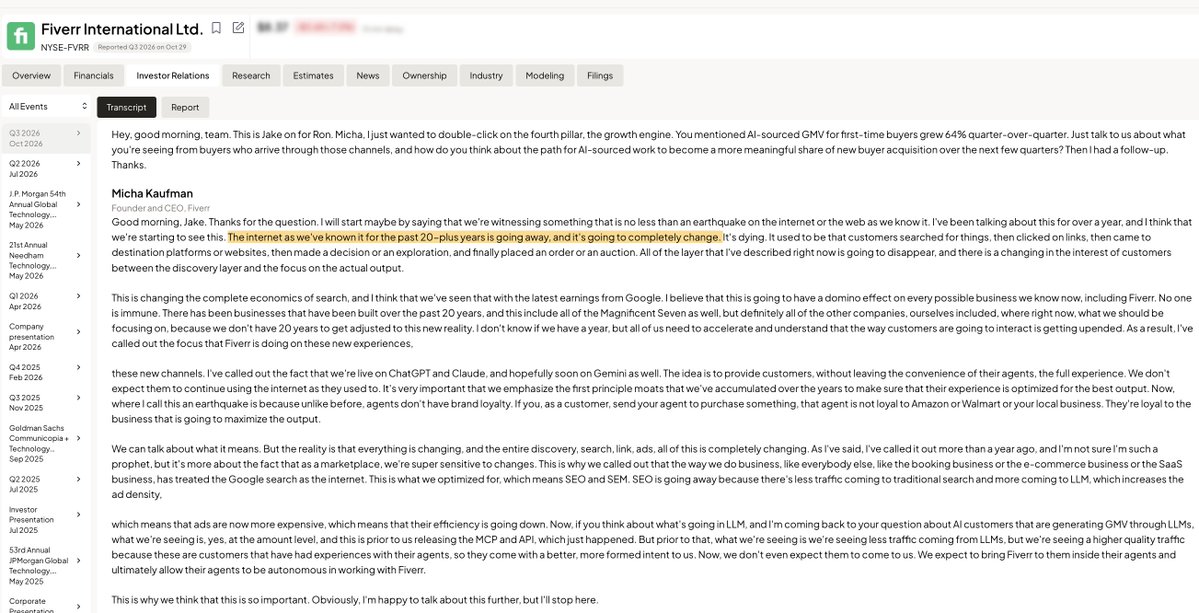
$FVRR: Fiverr CEO gave a lengthy response on the disruption AI agents are causing to the internet, particularly search, advertising, e-commerce, and brand loyalty.
"This is changing the complete economics of search"
A lot of people are not good people. They are just people who have never been in a position where being good would cost them something. Many people are not as principled as they think. They have simply never been sufficiently tempted.
It is easy to talk about loyalty when you have nothing to gain from betraying someone. It is easy to preach honesty when the truth doesn't threaten your interests. It is easy to condemn infidelity when you have never had an opportunity to cheat without getting caught. It is easy to talk about integrity when doing the right thing doesn't come at a personal cost.
I think we sometimes give people too much credit for virtues they have never actually had to demonstrate under pressure.
Your character is not fully revealed by what you say you would never do. It is revealed by what you have the opportunity to do, what you stand to gain from doing it, and what you choose when nobody can hold you accountable.
I'm now building an "improvements" feature into all of my personal vibecoded applications: a freeform text input that's hooked up to an agent that yolo implements whatever is submitted.
It's an interesting experience -- the activation energy barrier to sanding any rough edge or implementing any new feature becomes extremely low. Someone else who uses one of the applications I created has already implemented 150 improvements over the course of a few days. This pattern feels like a new kind of tool -- liquid software? -- and every application that doesn't have this feature now has a slightly rigid and anachronistic flavor. Why can't I just tell it how I want it to be different?
Now, it's not obvious to me how this pattern can or should scale. Does it become unmaintainable after a while? (Maybe model intelligence improvement outstrips my feature appetite such that it's fine?) How does collaborative software work in this model? Can software designed this way be secure and reliable?
Whatever the larger questions about broader deployment, it definitely works great in a personal context. It reminds me a little of the visions of Lisp/Lisp machines, Smalltalk, and HyperCard -- systems that the user can take control of and modify. Those visions never quite worked, though: the vast majority of software today is not end-user modifiable in any useful way. So, while this "liquid" affordance is a very small touch, the way it changes one's relation to the software feels a bit transgressive and empowering in a Lickliderian and Engelbartian way.
Reddit's earnings call has exposed the new reality for thousands of companies.
"AI mode does not drive traffic. Not for us and not to anybody as far as I know. It used to be a traffic driver. Now it's not." - Reddit CEO.
The reality is that AI is fundamentally changing the way that humans access the internet.
Just 24 hours prior to this statement, Google's stock erased -$480 billion on the same issue: AI is disrupting the traditional search model.
For decades, the internet operated on a simple model. Search engines directed users to websites, and those websites monetized the traffic.
AI is destroying this business model, and it's happening at an accelerating pace.
The traditional model of internet traffic is rapidly becoming outdated.
The internet has entered a new era.