A glimpse of what Ophelia API can do across an @OpenTable reservation request in a headless false setup.
It’s the same execution everywhere.
Travel (@bookingcom), tickets (@Ticketmaster), fitness, transportation (@Uber, @lyft), and other experience + service supply.
why are people already naming a category and declaring a future, as if the lane already exists?
we haven't even begun to discover this new agentic market. the first to name a market are rarely the ones who own it.
usually the people who know nothing are the first to speak.
it's like how half these iOS apps and assistants never even use a model in the product.
the worst ones put a prehistoric claude agent in and think it's immediately capable of solving world peace.
even the engineers claiming to be technical just stay vibe coding and can't even tell us how they built the actual system, or what it even is.
noticing this particularly amongst customers and in hiring interviews.
usually it’s never good to be first to anything.
Intent is the new interface.
Every bank, platform, product, and digital system must be prepared for intent-based rails.
Especially as intelligence moves closer to the individual. When it’s just intent, requests become real outcomes, and come to fruition faster.
Intent is the future.
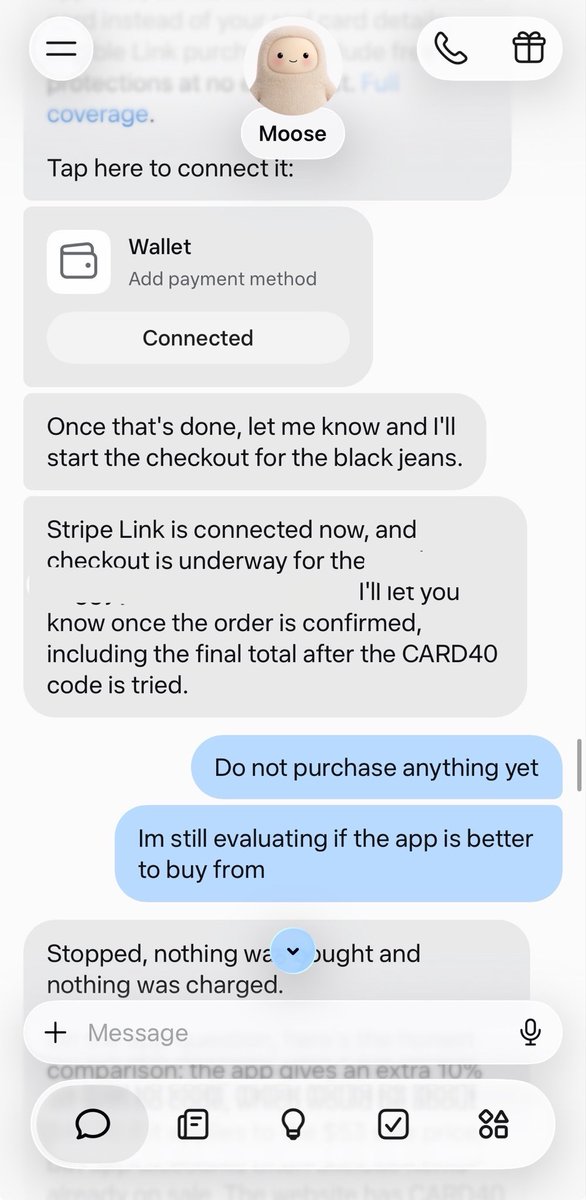
Agent intent will be really interesting for disputes. I’ve had 2 instances in the last couple of days where @Muse booked something before I gave explicit approval.
- I asked Muse to look up availability for an appointment, it asked for my email, and then just booked the appointment without getting my approval.
- I provisioned Muse with Stripe Link while I was evaluating a purchase and it started checking out before I was ready to approve.
Not super happy it’s sacrificing approvals for “efficiency”
intimacy is the most valuable data ever collected, and personal ai is about to collect it at scale.
@jmmoreno3003 and i tested Emma by @nuance_ai, and what became obvious was how personal ai merges two things: the same product starting to know you, can now also act for you.
for most of history those were separate companies.
putting those together concentrates a lot of power. the only real question is who holds it.
we think the end-user should.
your intent stays on your device. the world gets only what a task needs. every action is checked, and a person steps in when something breaks.
but i think the ai companies that matter most will be the ones that refuse to centralize you.
what you want stays on your phone.
nothing about your personal data follows you into the next app or interface, and when something goes wrong, an agent yes acts on behalf of the human, but at the core of each consumer company - a human authorizes all of it.
we’ve noticed this becomes especially true for financial or medical transactions. @opheliaapi
The first AI persona you’ll actually want to meet face-to-face.
Most AI personas stare blankly while you talk. Emma reacts while you’re still speaking.
After 18 months of research at @nuance_ai, this is Emma, built on Nuplex, our full-duplex audiovisual foundation model.
The upside I want is that more people can afford to try their own ideas.
I think the difficulty describing a positive AI future starts with how little time we spend understanding the people we’re building it for.
We automate customer service while we’re still learning why people need help. Then we lose the conversations that would have told us what to fix.
We build faster than we learn how the systems we’re replacing actually work.
There are people in those industries who could explain why something works that way, including which parts they’d love to change.
But if AI makes running a business much cheaper, someone with a very particular idea for a device, a car or a travel service has a better shot at starting it.
People still work because they care about what they’re making, and other people choose whether it’s worth their time and money.
Cheaper intelligence gives us more ways to use them. But ownership, data, and the right to say no still need to belong to people.
Thiel’s definite optimism asks us to be specific about the world we want to build. I think that requires spending considerably more time in the world people already inhabit.
The consumer products dressed up as enterprise companies are especially interesting to me. An enterprise signs the contract, and an everyday person lives with the result.
At our core building @opheliaapi so someone building their own platform or product can give it the ability to authorize, purchase, or result in an outcome connected to not only real businesses, but also the real-world.
There isn’t a feature or a decision I make without wanting to know what happens to the person on the other side.
Two things I’ve been thinking about regarding AI:
• People often highlight the risks involved in AI, which are surely very real. I’m struck, however, by how hard it is to understand the contours of the positive scenario. There are easy-to-perceive and frequently invoked elements of a positive vision — more diseases cured, more material abundance, etc. — which sound great, but these are by themselves just ingredients. I’m curious what the larger equilibrium is supposed to look like. Do people work? If so, why? What is their marginal contribution? If not, how are resources allocated? What is scarce? What is the ratio between humans and AIs? Are humans in control, whatever that means? One sometimes hears the Culture novels invoked as one scenario, but I’m not sure they depict a desirable outcome. (AI runs everything and humans compete in games? Iain Banks himself said that the humans in the Culture are “somewhere between passengers, pets and parasites.”) There is Richard Brautigan’s famous poem, but do we want to be “returned to our mammal brothers and sisters”? (Isn’t that rewinding Genesis?) We could say that it was hard to imagine the world of 1900 from the vantage point of 1700, and that’s assuredly true. But nobody in 1700 was trying to recast humanity itself within a couple of years — things necessarily unfolded slowly and by increments, and therefore with the possibility for error correction. Given how rapid the rate of progress in AI may be, it feels strange for the upside case to be so opaque.
• There is increasing discussion of whether AIs are conscious or how we would know whether they are, with conclusions there often assumed to be relevant to matters of moral worth. At first blush, this seems a rather arcane, benign, or even absurd issue. (Remember the response to Blake Lemoine’s fears.) Setting aside the terms of the debate itself, or the relevant demarcation criteria, it seems to me a quite high-stakes question, for an affirmative answer — that is, granting moral worth to AIs — would presumably mean that the aggregate worth of AIs would soon outweigh that of humans in any utilitarian calculus. The AIs will be exceptionally wise and intelligent, and vastly more numerous (especially once one considers the imminent future and the AIs not yet born). As such, even epsilon of moral worth will multiply to a lot once one considers the quadrillions that could soon exist. (This is effectively a distributed version of the Nozick’s utility monster.) If this conclusion is unpalatable, I think one of three propositions needs to be rejected: the premise AIs can have moral worth; utilitarianism itself; or the belief that there is even a possibility that they will be far more numerous than humans.
With both of these matters (contours of future society; AI moral worth), there is the possibility of dramatic change. Today, people argue about datacenters. I’m curious how popular support for AI will evolve as more people come to understand these medium-term questions and the relevant stakes. What is the vision for AI that most people would be excited about?
The upside I want is that more people can afford to try their own ideas.
I think the difficulty describing a positive AI future starts with how little time we spend understanding the people we’re building it for.
We automate customer service while we’re still learning why people need help. Then we lose the conversations that would have told us what to fix.
We build faster than we learn how the systems we’re replacing actually work.
There are people in those industries who could explain why something works that way, including which parts they’d love to change.
But if AI makes running a business much cheaper, someone with a very particular idea for a device, a car or a travel service has a better shot at starting it.
People still work because they care about what they’re making, and other people choose whether it’s worth their time and money.
Cheaper intelligence gives us more ways to use them. But ownership, data, and the right to say no still need to belong to people.
Thiel’s definite optimism asks us to be specific about the world we want to build. I think that requires spending considerably more time in the world people already inhabit.
The consumer products dressed up as enterprise companies are especially interesting to me. An enterprise signs the contract, and an everyday person lives with the result.
At our core building @opheliaapi so someone building their own platform or product can give it the ability to authorize, purchase, or result in an outcome connected to not only real businesses, but also the real-world.
There isn’t a feature or a decision I make without wanting to know what happens to the person on the other side.