The Philippines is a fantastic example of how deep and fast the drop in fertility is nearly everywhere on the planet.
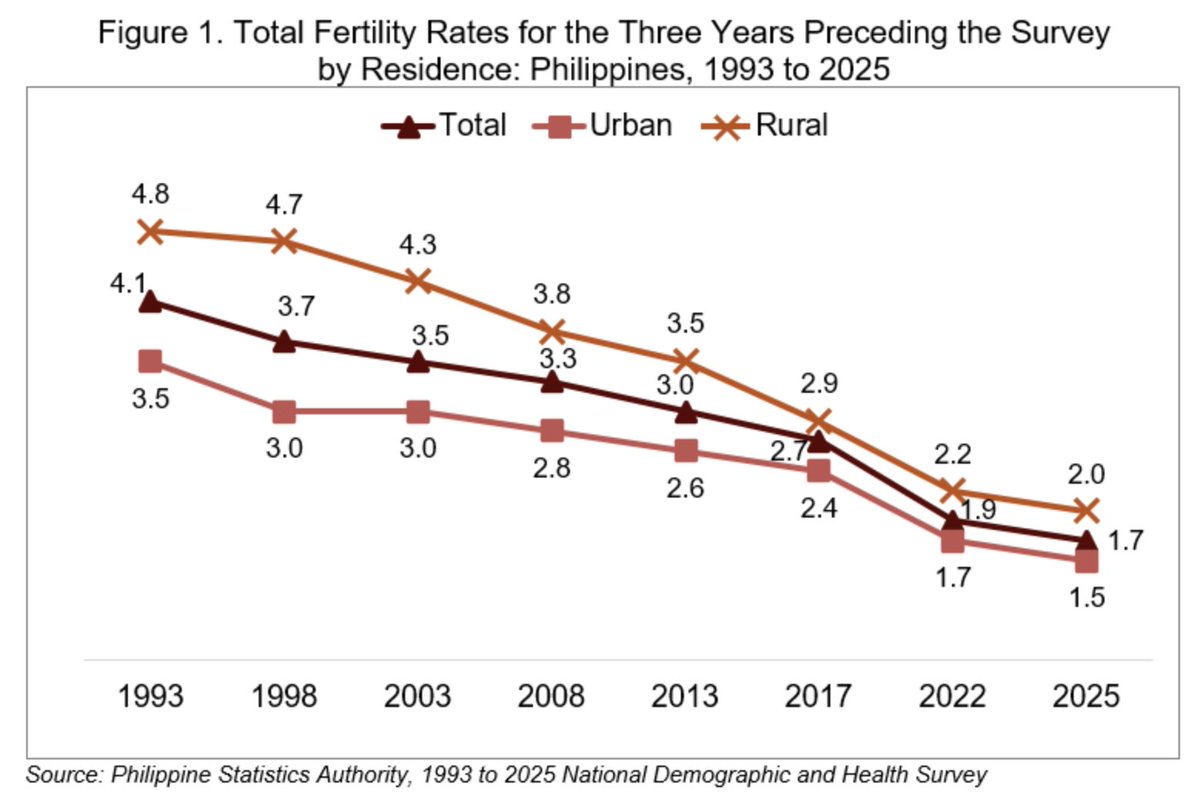
Just last week, on March 30, 2026, the Philippine Statistics Authority released the 2025 National Demographic and Health Survey (NDHS). The total fertility rate for the last three years has reached 1.7 children per woman, a dramatic fall from 4.1 in 1993, and well below the replacement rate (around 2.1 for a country like the Philippines).
Since the NDHS computes the total fertility rate over three years, and it is dropping quickly, the total fertility rate for 2025 alone should be around 1.6, the same level as in the U.S. Let me repeat this: the Philippines and the U.S. have roughly the same total fertility rate.
But U.S. income per capita is about 7.3 times the Philippine income per capita (when adjusted for purchasing power parity). Or to put it differently, Philippine income per capita today is the same as the U.S. had in 1910. In that year, the total fertility rate of the U.S. was around 3.5. At the same level of income per capita, the Philippines has a total fertility rate that is less than half.
In some more urban regions, such as Calabarzon, the total fertility rate is 1.3. Historically, the rest of the country has followed the patterns of regions like Calabarzon with some lag, so the most likely scenario is that in a few years, the Philippines will have a total fertility rate of around 1.3 as well.
Compared with the United Nations World Population Prospects (WPP), the Philippines is now at the fertility level the WPP had forecast for 2047, despite the aggressive reduction it made to the Philippines’ forecast fertility between 2022 and 2024.
The Philippines is interesting because, compared with other Asian countries, it is a relatively religious and rural country without the Confucian obsession with education found in China or South Korea.
It is also a country that many still associate with high fertility. Just yesterday, one reader left a comment on my previous post on fertility, using the Philippines as an example of high fertility, that “refuted” my claims. No, it does not.
Finally, three technical points.
First, I am reporting total fertility, not completed fertility (and yes, I am keenly aware of the difference between the two). Looking at age-specific fertility rates suggests that completed fertility for younger women will actually be below the current total fertility rate.
Second, no, emigration does not matter here. I am talking about fertility rates, not birth rates.
Third, the official release:
https://t.co/jlzpYOsYYk
I'll be publishing Part 2 this week. We're going to talk about a general theory of sensemaking, originally developed for the US military, and then use that to discuss how we can fail, and how to get better.
If you want to be updated for that, sub here: https://t.co/zaJ6Lulxkg
@AdamSinger That’s only because role players stopped taking the inefficient shots.
The top players in the NBA rn (Dončić, Gilgeous-Alexander, Jokić) dominate because they have a midrange game that gets their team over 1pt per possession
Starting to see woodworking, home improvement, photography as backup systems for when creativity is not flowing in my main endeavor (screenplay atm). If nothing can flow anywhere we get a plumbing disaster but with a backup path we can survive when the main's not online
I cannot believe I’m saying this, but: read The Nurture Assumption.
There is a lot of things written for and against the book, as it is deeply controversial. But learn from my mistake and ignore all that commentary.
Read it even if you do not currently have kids.


![kwharrison13's tweet photo. [New Essay] - I Wish I Knew How To Quit Roam Research
Dreaming Of The Global Knowledge Graph https://t.co/flCCAbIRcc](https://pbs.twimg.com/media/GzC19awaAAABQ0t.jpg)
![kwharrison13's tweet photo. [New Essay] - I Wish I Knew How To Quit Roam Research
Dreaming Of The Global Knowledge Graph https://t.co/flCCAbIRcc](https://pbs.twimg.com/media/GzC14SYbcAApg5d.jpg)
![kwharrison13's tweet photo. [New Essay] - I Wish I Knew How To Quit Roam Research
Dreaming Of The Global Knowledge Graph https://t.co/flCCAbIRcc](https://pbs.twimg.com/media/GzC1zLLa4AAi84F.png)





![kwharrison13's tweet photo. [New Essay] - I Wish I Knew How To Quit Roam Research
Dreaming Of The Global Knowledge Graph https://t.co/flCCAbIRcc](https://pbs.twimg.com/media/GzC2AWtbkAE14gj.png)


