This is an extremely good watch.
The things that felt novel/interesting to me:
1. Lock down your agents
Humans tend to like 'sharp knife' abstractions - that are powerful, but you can cut yourself if your use them wrong. Lauren says agents perform much better in extremely locked-down environments. Abstractions are designed so they can't screw up, and lint rules enforce it.
They built a whole internal framework (Dune) to keep the agent on track.
That helps optimise agents that don't have a large context window to work productively in your codebase.
2. Create verification infrastructure
To trust the results of any agent, you either need to sit and watch it OR have it provide evidence of its improvement. This has always made sense to me, but Lauren really pushes it hard here:
- Invest in custom CLI's that let the agent drive the app and measure its performance
- Make the app "factory ready" from the get-go - i.e. deployable to an environment where the agent can mess about with it
3. Feature Maps
Lauren's software factory (what she calls an 'outer loop') often requires the agent to break down vague bug reports from users and to turn those into potential fixes.
To aid that, they built a 'feature map' of all the main features in their application, which describe exactly how the app is supposed to function.
This has become essential for helping the agent navigate the codebase, and figure out quickly how things are supposed to work. It's maintained along with the codebase, and kept in sync via automations.
This is the kind of documentation I usually warn against. It goes stale quickly and can confuse agents if it's not kept up to date.
But Lauren's team are using it as critical navigation infrastructure, and it makes it possible for agents to explore faster and better - even on a large codebase. So it sounds like navigation docs like this are worth it if they enable new behavior.
Banger talk - watch the whole thing on 2x.
this is f**king insane.
Jack Dorsey just open sourced a free tool for running a one-person business.
the GitHub repo already has 14.4K stars.
It lets you:
→ run your own server
→ keep chat, search, Git, and automation in one place
→ add AI agents that work like teammates
→ decide exactly what each agent can do
no monthly subscriptions.
just you, your AI agents, and full control.
this is where one-person businesses are headed.
save this for later.
$BTC has been trading inside the same log regression channel since 2017. And there's a rhythm here almost nobody is talking about.
Every bottom prints at the channel bottom:
2018 → channel bottom (−45%)
2020 COVID → channel bottom (−50%)
2022 → channel bottom (−38.06%)
2026 → channel bottom, in play right now (−38.88%)
Four for four. The last two within 1% of each other.
But the tops alternate:
2017 → overshoot ABOVE the channel (+171%)
2019 → contained top, inside the channel
2021 → overshoot ABOVE the channel (+167%)
2024–25 → contained top, inside the channel
Overshoot. Contained. Overshoot. Contained.
The 2024–25 cycle didn't "fail" — it was the contained top in the sequence. Exactly like 2019. And everyone wrote 2019 off too, right before 2021 escaped the channel.
Which means:
If the alternation holds, the next top is the escape. A +160% overshoot above the channel — the same magnitude as 2017 and 2021 — projects into the $400k–680k region into 2027.
And even if that sounds exaggerated: a mere retouch of the channel top from here sends us into the $200k–300k region. That's the conservative case.
We're at the channel bottom. The pattern says accumulate here.
S/O to @lastcoins for bringing this pattern to my notice.
Why the bottom for $BTC is not in
Bitcoin's Realised Price is the average cost basis for all holders
Currently it is 53.6k
Bitcoin has NEVER bottomed in a cycle without trading below the Realised Price
2011 → BTC bottomed at $2.1, about 58% below the Realised Price of $5
2015 → BTC bottomed at $152, about 49% below the Realised Price of $300
2018 → BTC bottomed at $3.2k, about 47% below the Realised Price of $6k
2022 → BTC bottomed at $15.4k about 34% below the Realised Price of $23.3k
58%, 49%, 47%, 34% – see a pattern forming?
My prediction for the next Bitcoin bottom is the Realised Price minus 20-30%
In other words → 37.5k-42.8k
Bookmark this because I know I'm right
My uber driver explains how he made $1m in the last 2 years trading the 9ema, 21ema, and buying the 200WMA
Used to be a top signal but I think atp that’s the American economy
I guess the coins I like the most going into the new cycle are these:
1. $HYPE (perps, L1)
2. $TAO (AI, L1)
3. $NEAR (AI, L1, privacy)
4. $LIT (perps, the best bet on perps after HYPE)
5. $PUMP (memecoins, speculation)
6. $ZEC (L1, privacy)
7. $MON (new L1)
8. $MEGA (new L2)
New coins good, old coins bad. HYPE, LIT, PUMP, MON, MEGA has never been in a bull. Well, you could argue HYPE launched at the tail of the bull, but not a full cycle. TAO and NEAR are clear tokens in the AI narrative. ZEC is the "VC-privacy coin".
But tokens are not stocks, they have no value. Yes, and no. I think this is one of the hardest "dilemmas" of the new cycle. Betting on tokens in 2023 felt like a no-brainer. We all had hopes that our coins would make a comeback at some point. Now, in 2026, with an infinite number of tokens, it's harder than ever to pick something. There is a huge difference between a good product and a good token, and since most tokens are governance tokens, do we really need them? Maybe not, but it remains the main vehicle for speculation.
What about BTC, SOL, ETH? BTC should always be a part of a core portfolio, maybe SOL and ETH also, but I think the ones above will outperform compared to them.
Anyway, my gut feeling says that there will be something else that takes the spotlight, and that "the new thing" will outperform all of the 8 I listed. These are my thoughts today. Next week or next month I could already have changed my mind, so NFA and do your own research.
The markets don't bottom when the price of OIL tops, it's actually closer to the opposite. The best 3 time times to buy stocks the past 20 years were all at the lowest prices of OIL.
@caprioleio Before quantum computers can break Bitcoin, they'll break the banks first. But if you want a blockchain that is already quantum-resistant, let me introduce Algorand.
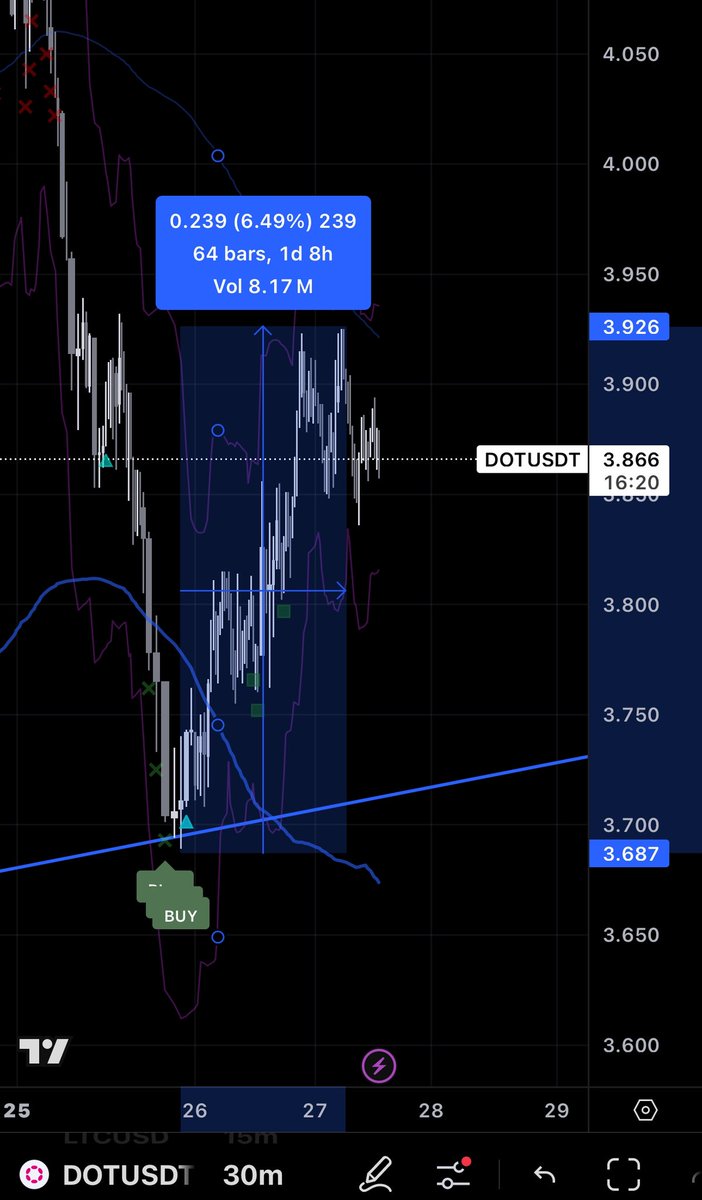
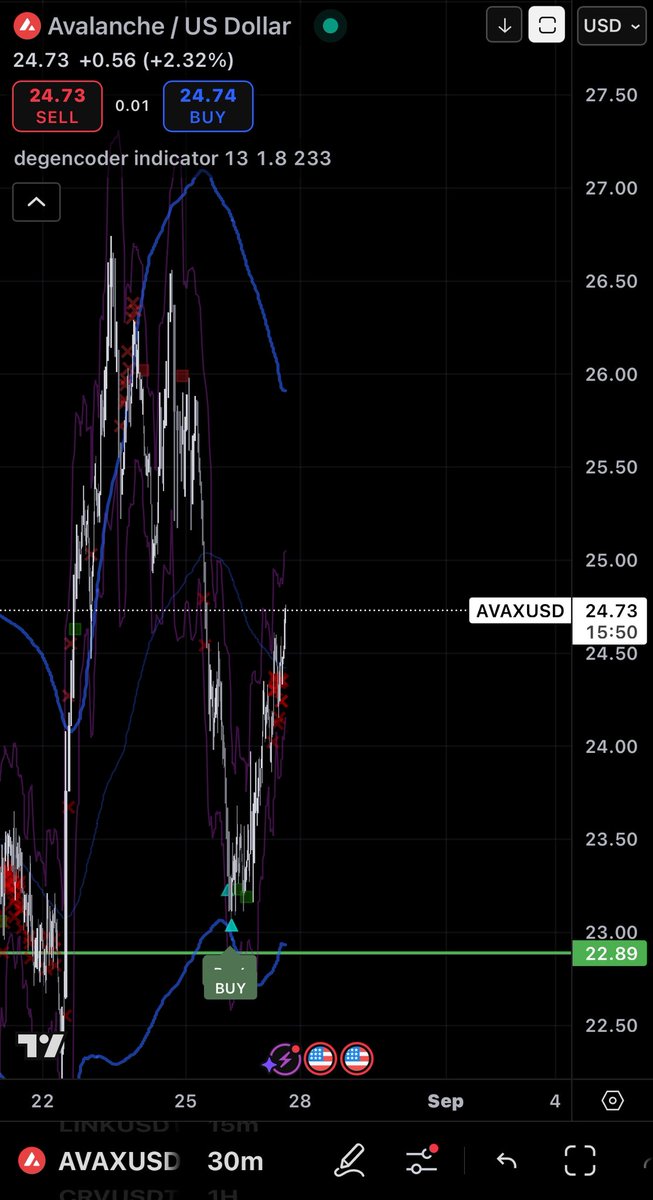
I built this #crypto#indicator over the last few years. It calls bottoms and tops.
If you’re interested in trying this out, comment “INDICATOR”, like and retweet.
$ETH $DOT $AVAX
The @karpathy interview
0:00:00 – AGI is still a decade away
0:30:33 – LLM cognitive deficits
0:40:53 – RL is terrible
0:50:26 – How do humans learn?
1:07:13 – AGI will blend into 2% GDP growth
1:18:24 – ASI
1:33:38 – Evolution of intelligence & culture
1:43:43 - Why self driving took so long
1:57:08 - Future of education
Look up Dwarkesh Podcast on YouTube, Apple Podcasts, Spotify, etc. Enjoy!