"However, while the EU boasts a strong university system on average, not enough universities and research institutions are at the top. Using volume of publications in top academic science journals as an indicative metric, the EU has only three research institutions ranked among the top 50 globally, whereas the US has 21 and China 15."
To wybrany cytat z raportu Draghiego, który można odnieść też do tego co pisałem jakiś czas temu w Wyborczej: https://t.co/VgpkeFO3Ej, a powód jest jasny:
"There are not enough academic institutions achieving top levels of excellence and the pipeline from innovation into commercialisation is weak. Universities and other research institutions are central actors in early-stage innovation, generating breakthrough research and producing new skills profiles for the workforce."
A ja się biorę za dalsze czytanie.
Polecam wywiad z prof. Martą Kwiatkowską w aktualnym wydaniu Forbes Women Polska: https://t.co/EDWlxUXnpx (za paywallem, albo jak rozumiem też w papierowym wydaniu). Pani Profesor opowiada o swojej drodze kariery i wyzwaniach związanych z tym, że kiedyś w informatyką zajmowali się właściwie sami mężczyźni. W szczególności mówi o tym jak jako pierwsza kobieta w historii wydziału nauk komputerowych zostaje Profesorką Trinity College w Oxford University.
Bardzo doceniam też, że przewodzi Radzie Naukowej IDEAS NCBR, bo w budowaniu instytucji na światowym poziomie ważne jest realistyczne spojrzenie na to gdzie teraz jest AI. Poniżej właśnie taki cytat z tego wywiadu.
"Generatywna sztuczna inteligencja rozwija się bardzo szybko, postępy na pewno będą, ale ile potrzeba czasu, by mogła imitować ludzki mózg i czy w ogóle to będzie możliwe, trudno dziś odpowiedzieć. To jest duże wyzwanie dla nauki. Na razie wszyscy zgadzamy się co do tego, że to, co rozumiemy pod pojęciem AI, jest „sztuczne”. Brakuje nam jednak powszechnie akceptowanej definicji „inteligencji”. Aby powstała, musimy najpierw znacznie lepiej zrozumieć, jak działa inteligencja ludzka. To zaś wymaga intensywnej współpracy informatyków z neuronaukowcami i psychologami."
Mam nadzieję, że interdyscyplinarne badania nad AI to będzie właśnie silna strona IDEAS NCBR.
Econometrics was and always will be the original causality. Econometricians analysed causality for decades even before it has become current hype.
Econometrics folks like Sir Clive Granger have done it without creating Bayesian Networks and contrived Bayesian assumptions. Granger also made significant contributions to nonlinear time series analysis and was awarded Nobel prize for his contributions to time series together with Robert Engle.
https://t.co/ofBQKkiidJ
#timeseries #econometrics #machinelearning #cauasality
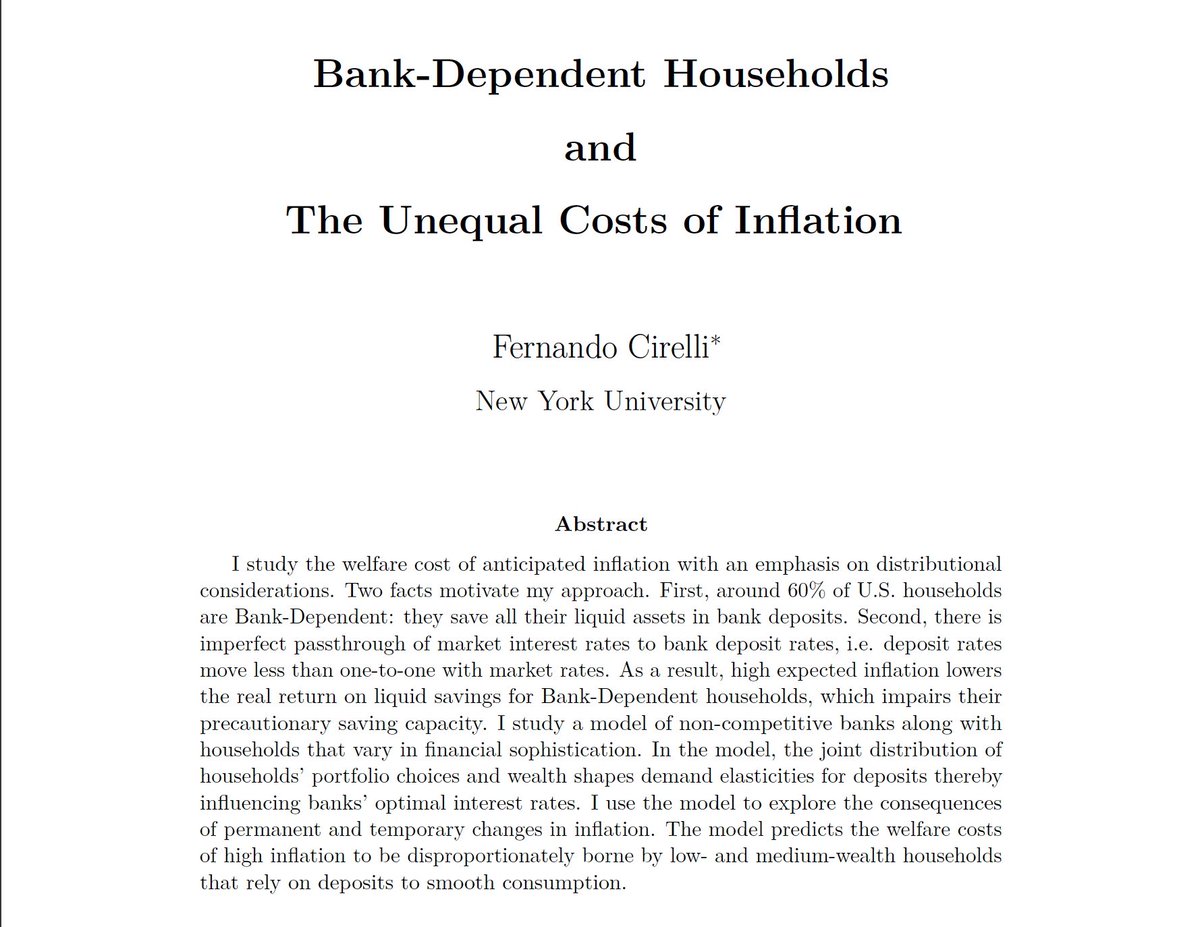
What makes inflation costly? Who bears these costs?
In my JMP, I explore an understudied mechanism:
Inflation impairs households’ ability to save for precautionary reasons
How? Let’s take a look at households’ liquid assets portfolios
#EconTwitter#Econjobmarket
Many other interesting exercises in the paper:
◆ temporary inflation shocks
◆ competitive banking counterfactuals
◆ implications for monetary policy
Thanks for reading!
Paper: https://t.co/cfA0slK2pH
Website: https://t.co/tgiVKxETfU
*** The original sin of QE (and QT)
QE policies, adopted by the most central banks in the last 15 years, suffered from a sin at birth. This came back to bite this Thursday in the UK.
Confusingly, there are three distinct policies that go under the name of QE.
🧵 [1/15]
It is great to see that today's Google graphic is dedicated to Stefan Banach - one of the top mathematicians of 20th century and the founder of functional analysis which has its applications i.a. in the area of stochastic caluculus and machine learning.
https://t.co/HVEBGvKi7R
“The breakthrough insight of Klein was to approach the definition of geometry as the study of invariants, or in other words, structures that are preserved under a certain type of transformations (symmetries).” — @mmbronstein https://t.co/OGm5AK08kj
Congratulations to🥇Alma Mater Studiorum-Università di Bologna, winner of the AI in ESG Investing competition.
🥈İstanbul Bilgi Üniversitesi
🥉SGH Warsaw School of Economics
Finalist (out of 45 teams): Akademia Leona Koźmińskiego
Uniwersytet Łódzki
Comenius University Bratislava