Student of Law and Philosophy | McGill and University of Toronto alumnus | Canadien français | Si Deus pro nobis quis contra nos? | @RunnymedeSoc alumnus | Papa
Maybe we’re living through increasing division of labour with influencers rewarded for being beautiful (mogg / looksmaxx) and singers rewarded for being ugly (nonchalance / depression).
🚨 Canada’s institutional capture is now complete.
Since 2015 the Liberals have appointed:
⚖️ 740 of 1,000 federal judges
🏛️ 7 of 9 Supreme Court justices
📜 100 of 105 senators
📰 Fund 30% of every reporter’s salary in Canada
And that’s just the foundation.
Add to that:
📺 CBC: $1.4B annually to defend the Liberal narrative
🏦 Bank of Canada: Redefining recession in real time
📊 StatsCan: Counting Census workers as permanent jobs
📬 Senate: Hiding 240,000 democratic postcards in a warehouse
🌐 Bill C-8: MPs can delete you from the internet without a judge
🎙️ Carney on tape: Admitting central bankers bypassed voters on ESG
They control the courts.
They control the Senate.
They control the Supreme Court.
They control the media funding.
They control the state broadcaster.
Now they want to control the internet.
Not one institution left standing independently.
This is not democracy.
This is managed decline with Canadian characteristics.
And most Canadians are still waiting for CBC to tell them about it.
🇨🇦 Repost and Bookmark🔖 this post.
🇨🇦💀 #CdnPoli #Democracy #InstitutionalCapture #Carney #DefundCBC
It was my pleasure to help write this paper on “Unseating Responsible Government” with @SunKerry@yuanyi_z for @MLInstitute and, yes, for the constitutional edification of Mr. @acoyne
I have noticed that our conversations with friends are also changing; much more functionalist and much more “optimized” than ever before, with no time for depth, context, nuance, education, and an increased focus for a fit, a response, a stimuli, an attention.
Within digital environments — structured to persuade — interaction is optimized to the point of rendering a real encounter superfluous; the otherness of persons in the flesh is neutralized, and relationships are reduced to functional responses. Dear friends, you, however, are real persons! Creation itself has a body, a breath, a life to be listened to and safeguarded.
Libs: “we need to make Trump look bad”
Journalist: “hey get a shot where he’s wearing royal purple and looks taller than a jumbo jet and has a 10 foot dick and everyone around him is kneeling or staring in awe”
@finseraste I was actually looking forward attending an event at La Voûte because I like going out but that was quite a lame show thrown in a lame atmosphere.
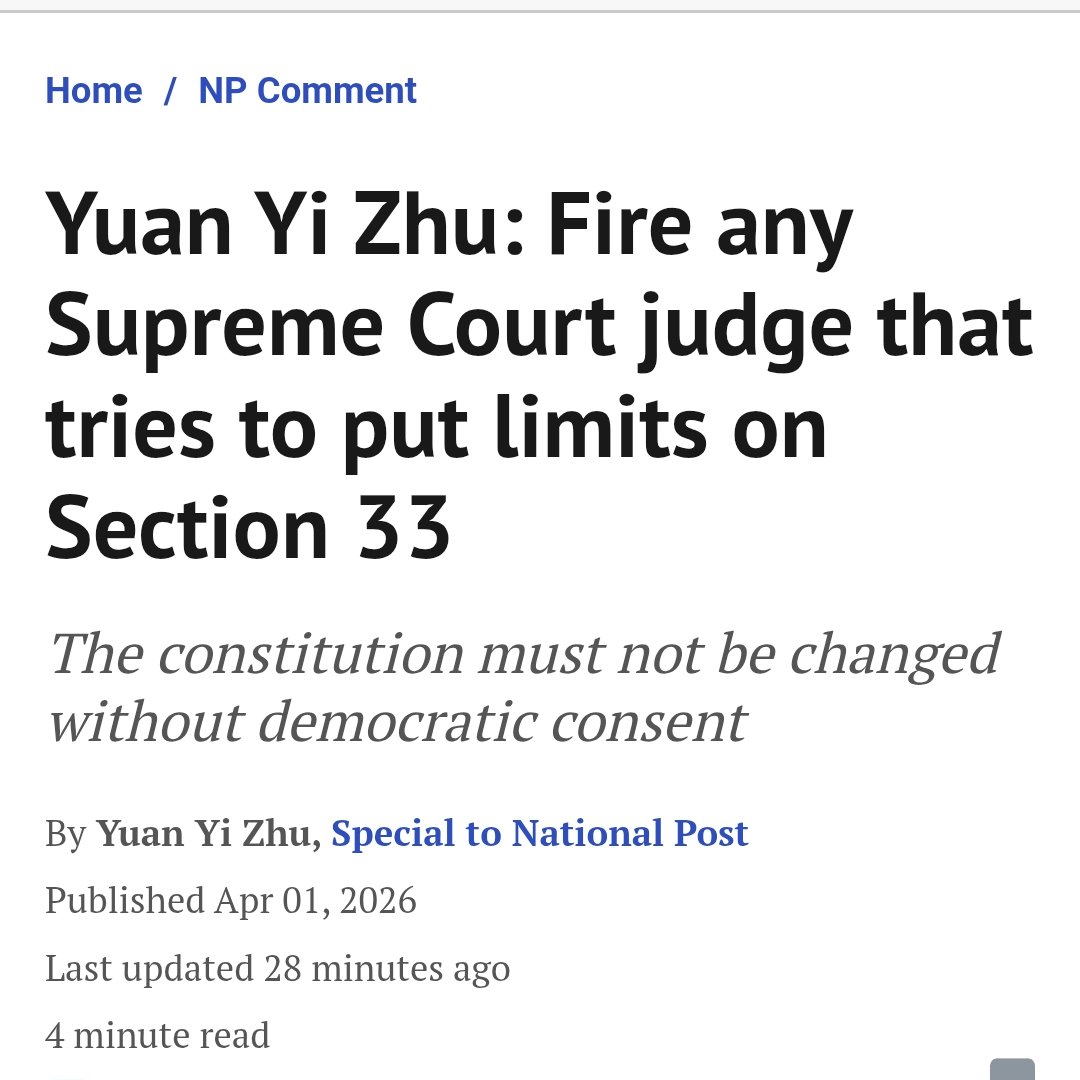
A major constitutional showdown is now before the Supreme Court of Canada, and at its core is a simple question of who decides.
Constitutional interpretation is not a straightforward exercise. Rights are stated at a high level of generality, as they must be, and don’t contain detailed instructions for their application. They must be interpreted and operationalized in the real world, and balanced in relation to other rights and other public policy objectives. Courts are not uniquely equipped to perform this task, nor were they ever meant to monopolize it. In our parliamentary democracy, legislatures have an essential role to play in that process, and that is what section 33 is for - a necessary condition of patriation and part of the constitutional design where coordinate interpretation can occur in a back and forth between courts and legislatures.
The federal government has intervened in these cases to argue contrary to the clear textual basis of the Constitution that repeated invocation of the clause “irreparably impairs” a rights. Though the clause clearly prohibits the policing of its use beyond correctness of application, they argue courts should in fact be able to assess whether legislatures have used it too much.
Ottawa has also argued that courts should be able to issue declarations that laws are unconstitutional even where section 33 prevents them from being struck down. A constitutional press release, if you will. Formally toothless, but plainly political in purpose and effect. And given the Court’s decision in Power, which contemplates retroactive damages for laws later found to be unconstitutional, this sort of declaratory power could become a backdoor route to financial liability as well. Given all the innovations the courts have been prone to, one would not put this past them.
Podcast discussion for Macdonald-Laurier Institute's Judicial Foundations Project between @CopelanPeter and @yuanyi_z, @xavierfm3, and @FCote_Avocat on the notwithstanding clause case (English Montreal School Board / Hak) pending at the Supreme Court of Canada.
Link in thread:
Updated on SSRN: Our response to every argument advanced in support of the admittedly audacious and creative thesis that courts can declare “incompatibility” with Charter rights notwithstanding the valid use of the notwithstanding clause.
https://t.co/1KTh6A36jO