You can now run Minimax-H3 faster than playback, without giving up quality.
Video generation has long faced a speed–quality trade-off. Turns out, with VDN, we don’t have to choose.
Such a fun summer exploring hybrid attention with @HaochengXiUCB and the team, more to come!
It was a lot of fun to play with live text to video generation in the last few days, in particular at the quality preserved well with best video models. Now we made it fully open.
Incredible technical work lead by @HaochengXiUCB
Also thanks to @MiniMax_AI, H3 is such a strong base model that will make many things possible.
Impressed by the quality of H3 generated videos, but fear that the process might take a little too long? Check out the latest work on efficient video gen architecture from Impossible Research.
Open-source video generation is now faster than playback without compromising quality.
Introducing Video Delta Net (VDN): hybrid attention for live text-to-video with near-lossless quality.
VDN accelerates Minimax-H3 by 75 - 90 x, generating 14 seconds of 768p video in 11 seconds on 8× NVIDIA B200 GPUs.
Checkpoints + training/inference code + Technical Blog ⬇️
(1/6)
Hiring! Postdoc / Research Leader on human–world interaction, interactive world models and /or human motion & appearance (faces + full body).
https://t.co/6DtJIBSD11
Amazing Tübingen ecosystem: @uni_tue@MPI_IS@ELLISforEurope
Feel free to forward to interested people!
From our team at Impossible Research - an agent harness that plays games, writes code, reasons like a physicist, and saturates the ARC-AGI-3 benchmark.
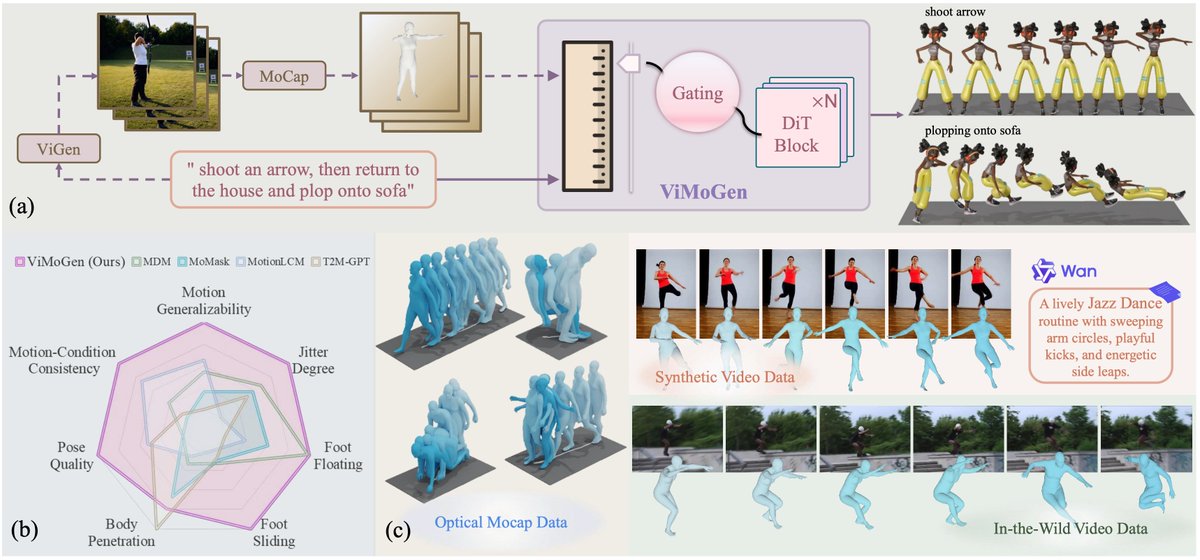
MoLingo, a text-to-motion (T2M) model that generates realistic, lifelike human motion by denoising in a continuous latent space. Recent works perform latent space diffusion, either on the whole latent at once or auto-regressively over multiple latents. This paper studies how to make diffusion on continuous motion latents work best.
Paper Title: MoLingo: Motion-Language Alignment for Text-to-Human Motion Generation
Project: https://t.co/ISK0eWtuT7.
Link: https://t.co/yqR19EI3LT
Mountain: climbed. Time to explore the world.
Our [schema] harness achieves 99% on ARC-AGI-3 Public by thinking like a physicist with coding agents. The rate of improvement in capability is amazing, and a lot of tasks need to be redesigned from the foundations up. More to come!
Today, we’re introducing [schema]: a harness reaching 99% RHAE with Opus 4.8 + Fable 5 and 95.35% with GPT-5.6 Sol on ARC-AGI-3 Public set.
[schema] makes an LLM think like a physicist. 🧵
Blows my mind that we currently possess the technology for Google Maps to turn all the street view images of the entire world into a video game you can play!
In the future, we'll be able to say "yeah let's check out New York City 100 years ago!"
Boris Cherny, the creator of Claude Code, shared his entire setup.
He runs 5-10 Claudes in parallel. Half his coding happens from his phone.
Here's his 3-part formula for better results:
Use the smartest model available
— Counterintuitive: it's actually cheaper
— Smarter model = fewer tokens = lower total cost
— "Once the plan is good, the code is good"
Invest in your Claude MD
— Plain text file. No special format.
— Whole team contributes multiple times a week
— Every mistake Claude makes gets added so it never happens again
Give Claude a way to verify its own output
— Let it run the code. Let it see the browser.
— "Imagine you're a painter wearing a blindfold"
— Same thing for an AI that can never check its work
His morning routine: wake up, kick off 3 sessions from his phone, check in later.
His workflow: start in plan mode
→ lock the plan
→ auto-accept edits
→ done.
No fancy setup.
No complex tooling.
Just multiple Claudes, a good plan, and a shared knowledge base.
Very interesting talk from @RuiqiGao on the current state of generative world models✨ Are compact 3D representations the missing piece to make them more efficient and interactive?
🎥: https://t.co/gkVdD8TWWd
Robot foundation models face a fundamental data bottleneck. Current paradigms (e.g., VLA / LBM) are data-bound and may require years, or decades, of real-world action data to reach the scale of MLLMs.
We explore a different scaling path: video policies, i.e. actions are generated directly in pixel space.
This shifts the from data-bound to compute-bound and algorithms-bound.
If forced to choose, I’d bet on compute-bound over data-bound research—because compute and compute-efficiency scale far faster than data collection.
Our new model, MoLingo, is a text-to-human-motion model that generates realistic, lifelike human motion by denoising in a continuous latent space. MoLingo's physically plausible motion output can be retargeted to Unitree G1's body shape facilitating robot tracking through RL. 👇
Using powerful multi-view 3D vision transformer models like π³ and Depth Anything 3 for 30FPS real-time tracking of objects and scenes via KV caching.
Dyson Robotics Lab at Imperial College London.
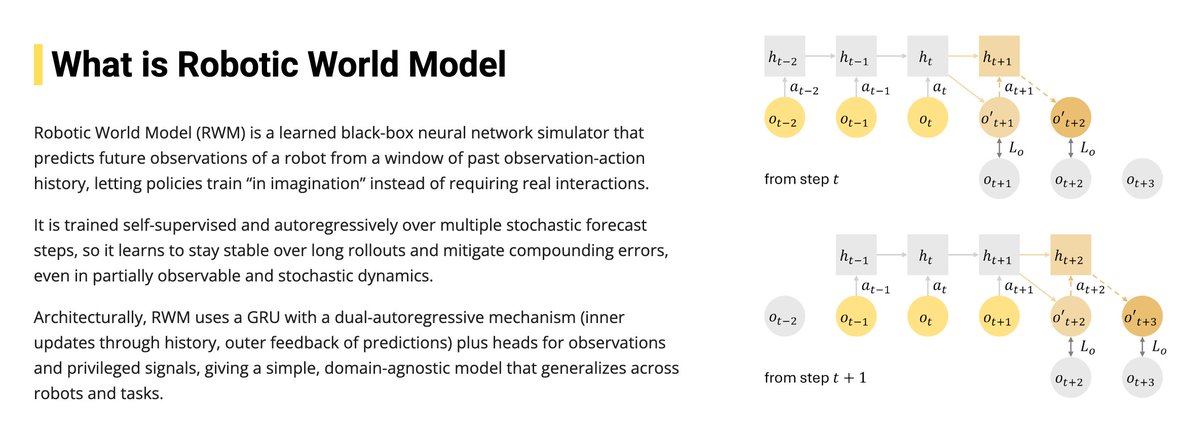
Robotic World Model: A Neural Network Simulator for Robust Policy Optimization in Robotics
Project: https://t.co/k2948yBtCc
Paper: https://t.co/x9Qs30r7ud
Code: https://t.co/k6to6Ksjb7
ETH just released a joint model-based RL policy and neural dynamics model framework for quadruped and humanoid locomotion task in IsaacLab.
- Robotic World Model: in this work, authors define the learned dynamics to support long horizon autoregressive prediction as world model. In implementation, this means next observation and privileged info as output of the World Model. The authors are considering a blind policy which only includes robot proprioceptive info as observation.
- Authors evaluated model-based and model-free RL policies in “imagined” rollout from learned dynamics. Conclusion: Model free RL + Robot World Model beats model-based RL methods in all dimensions - prediction accuracy, policy learning and sim-to-real transfer.
- While this brings some good news on world model use in real robotics applications, there’re still many limitations of this approach, and one of them is to introduce robust vision in this framework.