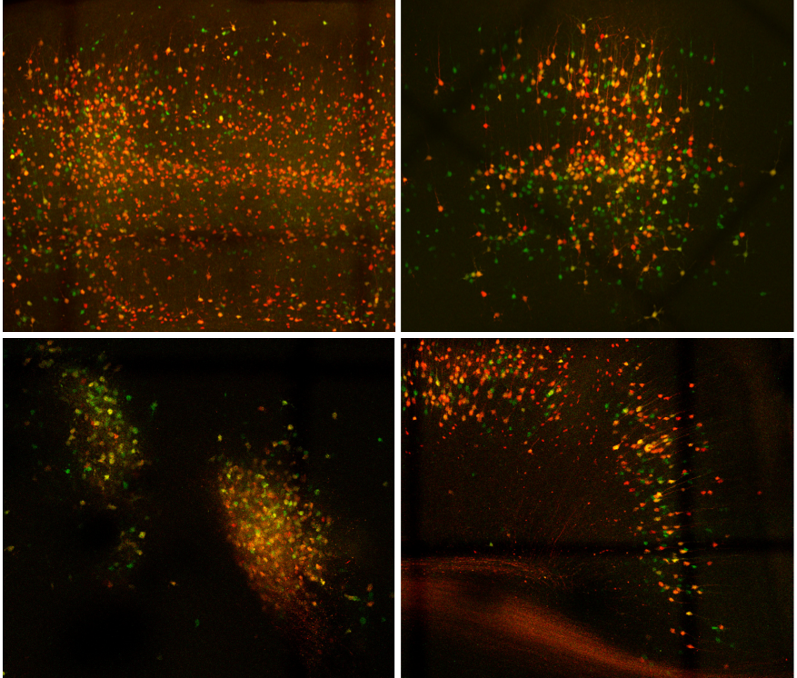
How widespread are our memories stored in the brain?
Our new study, open access in @NatureNeuro, investigates how category learning changes neuronal representations in mouse visual cortical areas. (1/8)
@mpi_neuro @sandra_tanja@t_bonhoeffer@MHuebener
https://t.co/6IVQBmwWOD
Are you attending FENS 2024? Do you care about generalisation vs specificity?
Join our symposium: S22 Generalisation of neuronal codes across behaviours, contexts and stimuli
Thursday 27th Jun 9:45 in Hall F
Speakers: @Luthi_FMI@caroline_runyan@mmf_89@sandra_tanja#FENS2024
I get to present our poster about two-timeframe monosynaptic rabies tracing and visual system plasticity this afternoon (Wednesday) at #FENS2024, PS02-26PM-137. Come by! 😊😊 @MPIforBI@t_bonhoeffer@MHuebener@xpieter
Falling behind: postdocs in their thirties tire of putting life on hold.
Read the results of Nature’s second global survey of postdoctoral researchers https://t.co/jYxKuLT3B9
Scientists of Twitter! The world needs more reminders that we're living, breathing human beings.
I was tempted to post a picture of me doing not-science, but my spouse confirmed that no one wants to see a picture of me napping on a weekend afternoon.
Curious about how maps form in the visual system? Check out our new preprint “Retinal origin of orientation but not direction selective maps in the superior colliculus” https://t.co/4Z0p3YHbTi, led by @DMalmazet and me, with @Chen___Li. @FarrowLab @__NERF@BiologyKULeuven 1/5
@KentaM_Hagihara@DavidLaubender@t_bonhoeffer@MPIforBI Anyway, hope this explains it a bit better. We ofc can think of further possibilities for these structures not having been observed before, but we think these are the most likely. If you like to discuss in more detail, just reach out, would be happy to 😀
Check out our latest preprint on ocular dominance columns, which we have found in mouse visual cortex!https://t.co/r81pmw02J5 @DavidLaubender@t_bonhoeffer Mark Hübener @MPIforBI#bioRxiv
@KentaM_Hagihara@DavidLaubender@t_bonhoeffer@MPIforBI By identifying ipsi-clusters using local density of only ipsi-eye preferring neurons (thus focusing on binoc V1) we work around this effect of the monoc/binoc division. However, this method requires a large number of ipsi-preferring cels in a single fov/volume to work reliably.
@TrackingActions Thanks 😀 And good question! We suspect because we looked at L4 (instead of L2/3; inspired by work of the Olavarria lab in rat), imaged a large part of binoc V1, lots of neurons, and variability across animals (see e.g. figs S2 and S5).