Excited to share our recent work! 😁
An Object is Worth 64x64 Pixels:
Generating 3D Objects via Image Diffusion
We generate meshes as a set of UV patches packed in an image, which we term as "Object Images" or "omages”.
Code is now live! https://t.co/LXkkt9CCRI
8 cool facts about omages:
1. Omage encodes geometry as a (R,R,3+1) image, which is essentially a 16-bit RGBA PNG!
2. PBR material is encoded in another (R,R,8) image.
So three PNGs will give you a realistic 3D object.
3. You can use image generation models to generate 3D objects, one image for one object!
4. Discrete patch structures emerge out of continuous noise during the denoising process.
5. Patch segmentation comes naturally from 2D disconnected components, no instance labels needed!
6. Irregular connectivity & complex topology?
No worries, all encoded in a regular image.
7. Change your object resolution by just rescaling the omage!
8. Generated shapes come with UV maps—no unwrapping required.
X. And there’s even more to discover!
#omages
I’m excited to share that I’ve joined the @wayve_ai Labs team in Vancouver as a Principal Scientist!
https://t.co/xdBMlGt9fB
I was drawn to Wayve Labs for two reasons: 🧵⬇️
If you're working on embodied AI, don't miss this articulated-objects dataset by @iliashdo and the team, premiering at #CVPR2026.
➡️ Honestly, it's pretty fun just exploring the dataset!
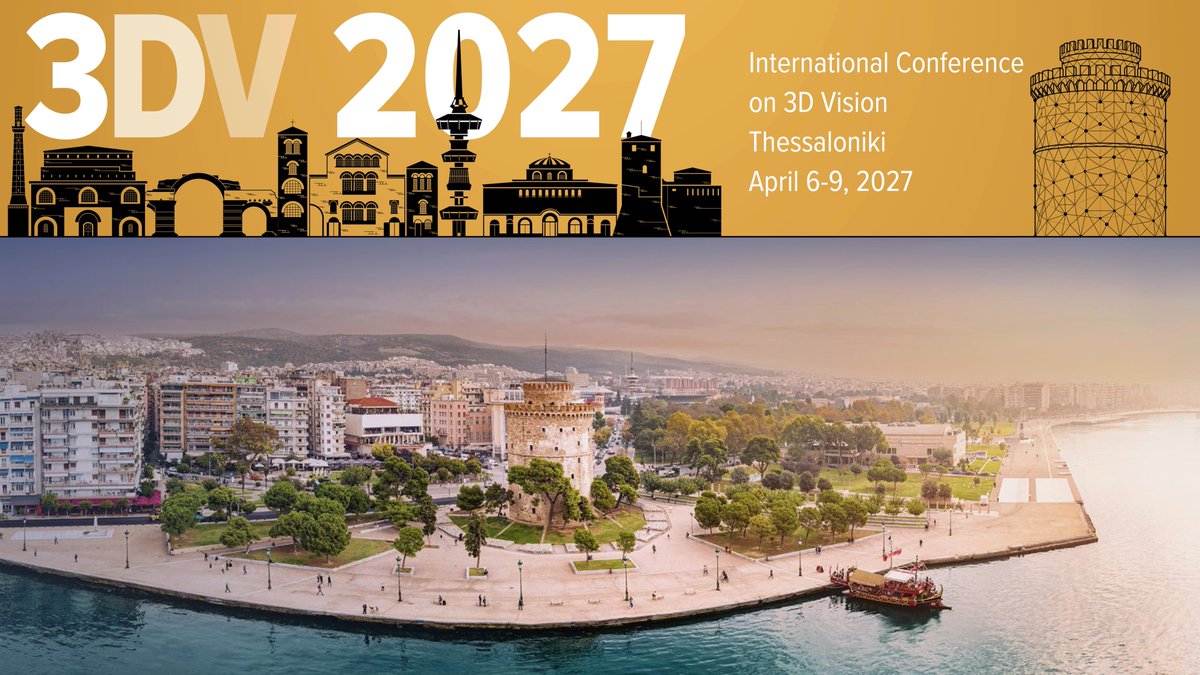
Looking for a nice home for your paper? #3DV2027 is waiting! 🎉
⏰ Conference dates: April 6-9, 2027
✈️ Place: #Thessaloniki (#SKG), #Greece 🇬🇷
📝 Paper ddl: Aug 28
🎥 Supp ddl: Sep 02
🆕 Rebuttal only upon invite for borderline papers!
#CallForPapers: https://t.co/6Fy3QG7PRE
🚀 🚀 🚀 Excited to share our new paper:
Remember to be Curious: Episodic Context and Persistent Worlds for 3D Exploration
What does it take for an agent to stay curious in a 3D world?
The answer is memory.
🌐 Project: https://t.co/G4SjLoFJht
📄 Paper: https://t.co/iUFwp5NvRu
💻 Code: https://t.co/KZRaQLyzyh
We’ve been working on geometry foundation models for self-driving. Following Rig3R at NeurIPS last year, here is another work from the team: learning camera motion from 10.2 million unlabeled driving video snippets, without pose labels. See our blog post and paper (CVPR2026).
GPT Image 2 has been deeply unsettling to me in the best way.
Some of its outputs make it hard for me to keep using the old criterion of vision, especially the old definition of visual representation learning.
Thus, I wrote this essay as a reflection on that shift: why knowledge may be the right name for what vision once called representation, and what can be the ultimate formulation for representation learning.
(An unexpected side path: it also led me to think about the relation between knowledge and representation through the old calligraphic relation between spirit and form 😃
https://t.co/AW8Nd8s9hw
Excited to share our recent work: Free-Range Gaussians 🥚✨
The core idea: instead of predicting Gaussians on a pixel- or voxel-aligned grid, we let them live freely in 3D space.
🌐 Project: https://t.co/HkwmGam0Pq
📝 Paper: https://t.co/OhHA6VnwZT
AI Native Seams... Finally? #3D
🔥 Excited to share our recent work MeshTailor: learned from real artist seam layouts, it places edge-aligned, coherent seams on low-poly meshes in seconds, enabling strong UV unwrapping.
🔗 Check out the paper below! ⬇️
AI Native Seams... Finally? #3D
🔥 Excited to share our recent work MeshTailor: learned from real artist seam layouts, it places edge-aligned, coherent seams on low-poly meshes in seconds, enabling strong UV unwrapping.
🔗 Check out the paper below! ⬇️
AI Native Seams... Finally? #3D
🔥 Excited to share our recent work MeshTailor: learned from real artist seam layouts, it places edge-aligned, coherent seams on low-poly meshes in seconds, enabling strong UV unwrapping.
🔗 Check out the paper below! ⬇️
AI Native Seams... Finally? #3D
🔥 Excited to share our recent work MeshTailor: learned from real artist seam layouts, it places edge-aligned, coherent seams on low-poly meshes in seconds, enabling strong UV unwrapping.
🔗 Check out the paper below! ⬇️
Exciting progress in the auto-seam & auto-UV space!🔥
Thrilled to share our recent work MeshTailor.
Huge congrats to @qixuema for driving this incredible project. We finally brought AI to native seam generation, learning directly from professional data.
Check the video below!
AI Native Seams... Finally? #3D
🔥 Excited to share our recent work MeshTailor: learned from real artist seam layouts, it places edge-aligned, coherent seams on low-poly meshes in seconds, enabling strong UV unwrapping.
🔗 Check out the paper below! ⬇️
Check out our work on robust 3D reconstruction from 360° captures.
Using casual 360 video capture, ✨FullCircle✨ leverages the full 360° field of view and removes the camera operator from the reconstruction.
Browse our data, code, and webpage.
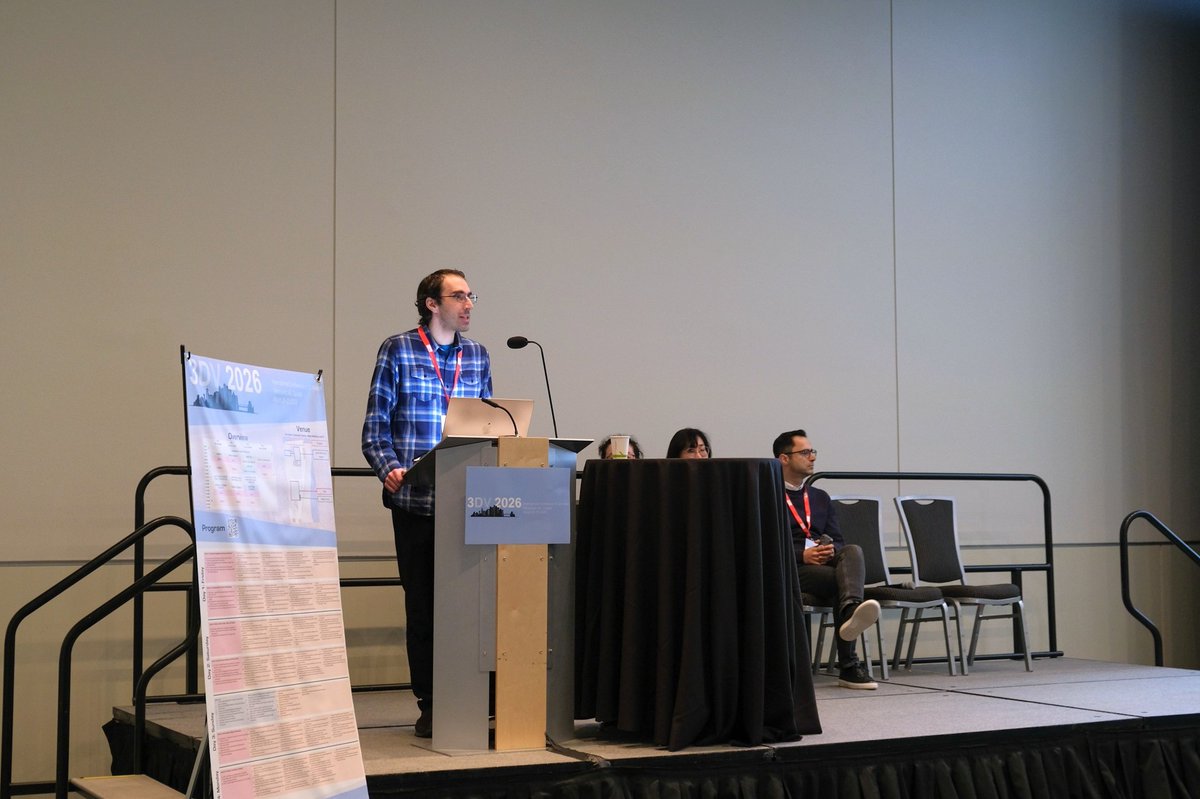
Filled with inspiration, innovation, and global collaboration, 3DV 2026 has officially come to a close after an incredible four days.
A special thank you to the 3DV 2026 organizers, sponsors, reviewers, speakers, staff, volunteers, and attendees for making this conference possible!
Christian Rupprecht explains their interpretability research in 3D computer vision, testing if (and where in the model) multi-view transformers like VGGT, DepthAnything 3, and DUSt3R use point/patch correspondences to make sense of 3D scene geometry.
The #3DV2026 Keynote and Award Talk recordings are officially live! 🎥🍿
Revisit all the fantastic presentations from our insightful speakers and keep the 3D vision inspiration going!
See the links below⬇️
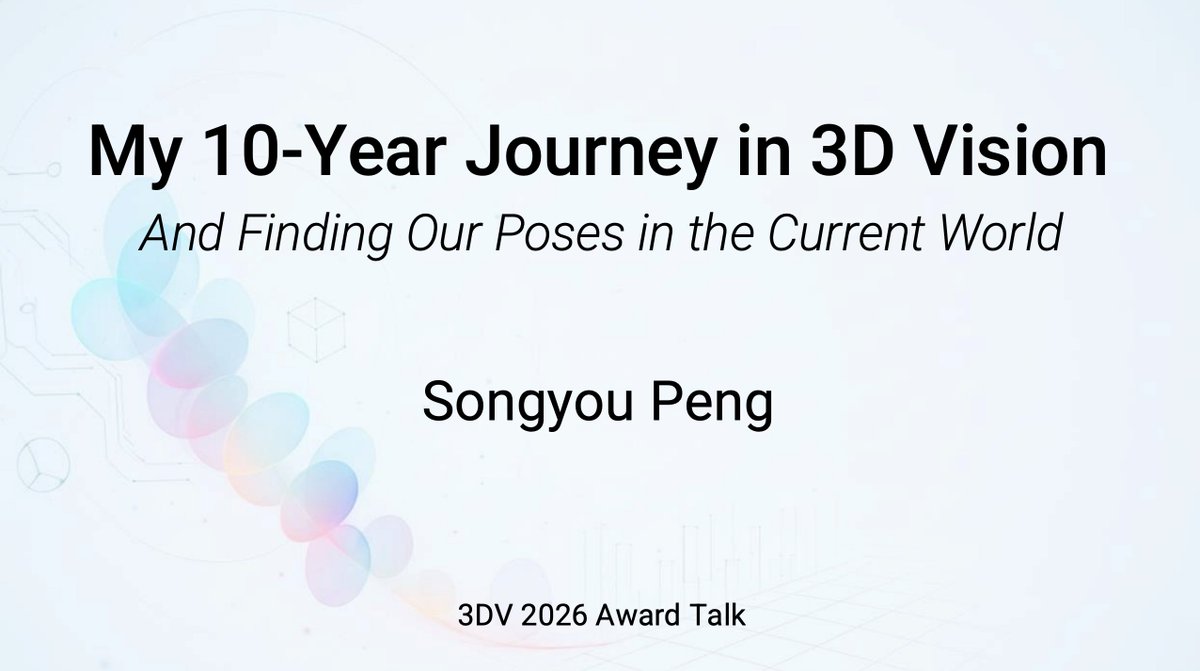
I gave an award talk @3DVconf that might be interested to some people. I took a step back and shared a few personal stories from my 10-year journey, reflecting on the profound impact of people, luck (you need a lot!), grit, and the art of giving up. (1/2)
Congratulations to
Bishoy Galoaa, Xiangyu Bai, Shayda Moezzi @shaydamoezzi, Utsav Nandi, Sai Siddhartha Vivek Dhir Rangoju, Somaieh Amraee, Sarah Ostadabbas @SOstadabbas
for winning the Best Paper Award for #3DV2026