Today, we are introducing Inkling.
Inkling reasons efficiently across text, image, and audio modalities. We are making the full weights available.
https://t.co/Ghebq5mG30
Available today for fine-tuning on Tinker. Play with it in the Inkling Playground. 🧵
Congrats to @AndrewDai and team on the launch. This is really a talented team. I worked with Andrew at Google DeepMind and have a lot of respect for his vision and leadership. Excited to see what’s ahead.
After almost 12 years in Brain/DeepMind, I’ve finally decided to take the leap. My cofounders: @yinfeiy, Seth and I have kicked-off @ElorianAI. The first multimodal reasoning lab founded and led by former LLM pretraining, data and multimodal leads. https://t.co/XHcEtvl9F9 (1/n)
After almost 12 years in Brain/DeepMind, I’ve finally decided to take the leap. My cofounders: @yinfeiy, Seth and I have kicked-off @ElorianAI. The first multimodal reasoning lab founded and led by former LLM pretraining, data and multimodal leads. https://t.co/XHcEtvl9F9 (1/n)
@yangarbiter and I verified this concern by tracking the performance of 9,149 freelancers across two platforms (Upwork and Bēhance): Creators who declare the use of AI receive significantly lower pay, but non-creatives jobs earn more by labeling themselves as "AI Pros."
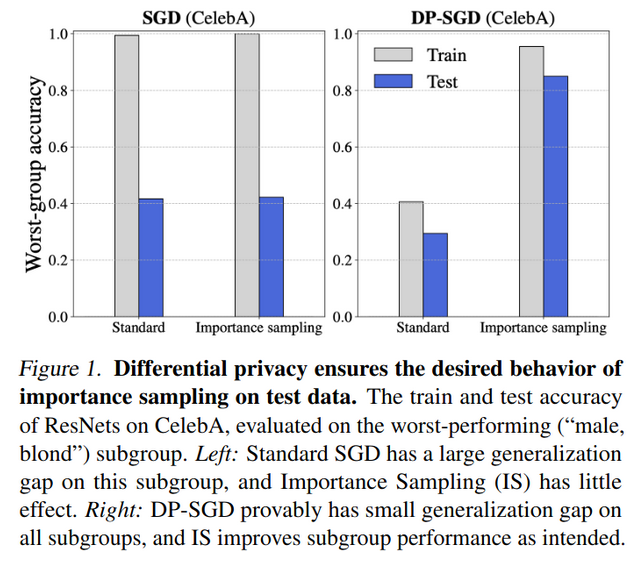
Presenting this paper in person at #NeurIPS2022 tomorrow (Tue) at 4pm. We apply the connections between privacy and generalization to (1) reduction of disparate impact of DP-SGD, (2) group DRO, and (3) adversarial training. Let's chat if you're around!
https://t.co/KqVfn4SU2W
A new preprint is out!
“What You See is What You Get: Distributional Generalization for Algorithm Design in Deep Learning” w/ @yangarbiter, @yaodong_yu, Jarek Błasiok, & @PreetumNakkiran, in which we show that differential privacy can ensure predictable model behavior.
Interested in models which are both interpretable and robust to adversarial perturbation?
Joint work with @yangarbiter and @kamalikac
Accepted to #ICML2021
1/5
Our paper "Robustness for Non-Parametric Classification: A Generic Attack and Defense" is on #AISTATS2020
live Q&A time at Aug 26, 27 10:00AM PDT
poster: https://t.co/I5Sm31LVau
blog post: https://t.co/T2ISgcG9Ha
Work w/ @CyrusRashtchian, Yizhen Wang and @kamalikac
Real image datasets are well-separated, and in retrospect, we expect them to be because they are clean and curated. So what's up with adversarial examples?! A thread #MachineLearning#DataScience [1/10]
New blog post: https://t.co/5CDcuVucOr
Paper: https://t.co/wcDaChbSeK
TLDR; we give a general defense against adversarial examples for non-parametric methods and attacks to evaluate.
Work w/ @CyrusRashtchian@yangarbiter Y. Wang
New blog post: Adversarial Robustness Through Local Lipschitzness:
https://t.co/a3WLT4OEWD
We posit that achieving both accuracy and robustness is possible by learning locally smooth classifiers.
Paper: https://t.co/7dH1b2hWv3
w/t Y Yang, @CyrusRashtchian, H Zhang, @kamalikac
#arXiv#machinelearning [cs.LG] Adversarial Robustness Through Local Lipschitzness. (arXiv:2003.02460v1 [cs.LG]) https://t.co/MfBxy7bBqK
A standard method for improving the robustness of neural networks is adversarial training, where the network is trained on adversarial examp…
Tough questions from @kamalikac at the #ITA2020 ML panel: Is deep learning going to solve climate change? @rsalakhu defers to Turing award winners but also "obviously not"


![CyrusRashtchian's tweet photo. Real image datasets are well-separated, and in retrospect, we expect them to be because they are clean and curated. So what's up with adversarial examples?! A thread #MachineLearning #DataScience [1/10] https://t.co/SNyc4Aq45p](https://pbs.twimg.com/media/EeCKomjVoAEqoFT.png)


