انتقد وزير الإعلام الإرتري، يماني قبر مسقل، غيتاتشو ريدا، في تعليق على مقابلة أجراها الأخير مع قناة CGTN، متهما إياه باللجوء إلى الأكاذيب الصريحة لتحقيق الأهداف المطلوبة منه في كل مرحلة.
وأشار يماني إلى ما اعتبره تحولات حادة في ولاءات غيتاتشو السياسية خلال السنوات ��لثلاث الماضية
The unhinged @reda_getachew, aka Vodkachew Reda, is caught in his own words, contradicting himself on two fronts: first, accusing Ethiopian Airlines of transporting troops and weapons in 2021, and now accusing his former party [#TPLF] of threatening that very same airline.👅😎
Z Land of Punt is a symbol of z Horn of Africa’s ancient history, cultural pride,& shared identity. From z Red Sea coast to z mountains high,our roots run deep. Christianity & Islam have coexisted for generations. #Eritrea
👇👇
https://t.co/UgaSNTNDgV
👇👇
https://t.co/Cl7noFcE4p
The Red Sea Gamble: Abiy Ahmed’s Expansionist Overreach
October 17, 2026
By Alula Frezghi
@RedSeaBeacon
The most dangerous conflicts rarely begin with the first bullet. They begin when a political idea makes aggression sound reasonable. Ethiopia’s recent Red Sea rhetoric does exactly that. What should be a practical discussion about trade access has been recast as a national grievance, a historical wound, and a question of destiny. That shift is dangerous because Eritrea’s independence, borders, and territorial integrity are not unresolved matters. International agreements, treaties, and legal processes have affirmed them. The issue, therefore, is not whether Ethiopia needs access to the sea. The issue is whether Ethiopia’s leadership is willing to pursue that access without violating a sovereign neighbor’s rights.
The first argument is legal. Eritrea’s territorial status is not open to revision. It rests on internationally recognized colonial treaties, Eritrea’s internationally accepted independence, the Algiers Agreement, and the Eritrea-Ethiopia Boundary Commission’s final and binding decision. These were not symbolic documents. They were the legal instruments designed to end war, confirm borders, and prevent future aggression. Ethiopia’s later refusal to fully honor the outcome prolonged instability and kept the region trapped in the destructive “no war, no peace” reality. That history matters because today’s Red Sea claims are not emerging in a vacuum. They follow a pattern in which Ethiopia accepts legal arrangements when they serve its interests and resists them when they limit its ambitions.
The second argument is political. Ethiopia’s economic need is real, but need does not create entitlement. A landlocked country has every right to pursue port services, transit corridors, infrastructure partnerships, and regional trade agreements. But access and ownership are not the same thing. A commercial problem cannot become a geopolitical claim. A development challenge cannot become a license to pressure another state. When Prime Minister Abiy Ahmed describes sea access as a matter of survival, civilization, and destiny, the discussion moves beyond logistics. It begins to cultivate a public narrative in which another country’s coastline becomes the answer to Ethiopia’s internal frustration.
This is why Eritreans are puzzled. They are not reacting to trade proposals. They are reacting to the language of historical correction. Eritrea has lived through the consequences of Ethiopian leaders treating its identity, land, and future as negotiable. The federation was dismantled. Independence was resisted. The border ruling was delayed. For Eritreans, the suggestion that geography must somehow be “corrected” is not academic. It reminds us of a long political tradition that has struggled to accept Eritrea as an independent and equal sovereign state.
The third argument is strategic: Ethiopia’s rhetoric sabotages the very access it claims to seek. Reliable port access requires trust, predictable relations, and confidence that today’s commercial agreement will not become tomorrow’s instrument of territorial coercion. Yet Ethiopia’s leadership repeatedly undermines those foundations by presenting Red Sea access as an existential struggle and invoking historical grievances to justify ambitions over a neighbour’s coast. Eritreans have every reason to scrutinize assurances from leaders whose promises of cooperation coexist
ReadMore @RedSeaBeacon
#UNSC
@StateDept@WhiteHouse@EUSR_Weber@US_SrAdvisorAF@antonioguterres@Chinamission2un@franceonu@RussiaUN@UKUN_NewYork@USUN@BahrainMsnNY@ColombiaONU@RDCongoONU@Denmark_UN@GRUN_NY@LatviaUN_NY@LibMissionUN@PakistanUN_NY@panamaonuny@SomaliaatUN
#FightAbyisAggression
#RespectEritreasSovereignty
#UAEStopWarFinancing #UAEBloodInYourHands
@ForeignPolicy@WSJ@ForeignPolicy@FT@Eritrea_UN@hawelti@AmbStesfamariam
https://t.co/i7JjdrR0NY
NEW YORK — Ethiopia’s Permanent Representative to the United Nations, Ambassador Tesfaye Yilma, told the UN Security Council that certain parties involved in Sudan’s civil war had committed serious violations of Ethiopia’s territorial integrity and national security.
He also announced that Ethiopia would present evidence of Sudanese weapons allegedly smuggled into its territory while pursuing diplomatic efforts to address these violations.
The irony is simply staggering.
When Ethiopia hosts training camps for Sudanese militias, allows its territory to serve as a transit route for tons of weapons, and permits its airbases near Assosa and Benishangul-Gumuz Regions to be used as launching grounds for deadly drone strikes deep inside Sudan, does Ambassador Tesfaye seriously believe that Sudan’s territorial integrity and national security are somehow immune to such actions?
Apparently, when Ethiopia raises concerns about its own sovereignty, it expects the world to listen. But when Sudan’s sovereignty and security are at stake, the same standards seem to disappear.
What a joke. You cannot demand respect for your own territorial integrity while disregarding that of your neighbour. Sovereignty cannot be a principle you invoke selectively, depending on whose interests are at stake.
@SimonJigna@Habtishgreat Eritrean nationalism is not a fairytale,& Eritrea’s identity is not defined by Shaebia alone. You can't dismissing an entire nation’s history, sovereignty,& legitimate aspirations. No regime owns Eritrea,& you havs no right to erase its people’s identity or hard won independence.
@Habtishgreat This is years ago. London was his battlefield and when confronted by Eritreans tired of his incitement,he ran clutching his bag like a terrorist suspect until only juice spilled. No one beat him, but his marathon sprint exposed the truth: brave behind a mic, coward in the street.
@Habtishgreat You're lying. Let's be accurate Amanuel Eyassu isn't a regime mouthpiece, he owns anti-government Assenna TV & that's exactly why he was confronted. For years he's broadcasted division from safe London, telling others to fight while he never set foot on any battlefield himself.
It is interesting that the @criticalthreats speculation below shares a structural gap with @Jawar_Mohammed’s recent speculative scenarios. Both underplay Eritrean agency and both give little weight to the concrete costs and frictions on the Ethiopian side, even though Critical Threats is more cautious about short-term feasibility and more explicit about existing constraints.
Critical Threats assumes Ethiopia can use the short-to-medium term to weaken the TPLF and Fano, strengthen its frontier posture, and then decide the timing of any deeper campaign. The analysis focuses almost entirely on Ethiopian calculations such as capacity limits, air and drone advantages, and official signalling from Addis, while treating Eritrea as largely passive during that interval.
It does not examine what Eritrea might do in the meantime. There is no consideration of whether Eritrea might use the same period to fortify, improve its defences, seek external support, or launch a pre-emptive offensive of its own into Ethiopia to neutralise the PP government before the invasion that everyone from an Oromo political activist to an American military analyst is sure is coming soon.
The analysis, similar to that provided by Jawar Mohammed, also does not weigh the risks an escalated or prolonged war would carry for Ethiopia itself, including stretched logistics, economic strain, political backlash, or overextension if the advance stalls or draws in outside actors.
EGYPT ― Parliament to Convene on Sunday to Authorize Al-Sisi to Deploy Troops to Saudi Arabia.
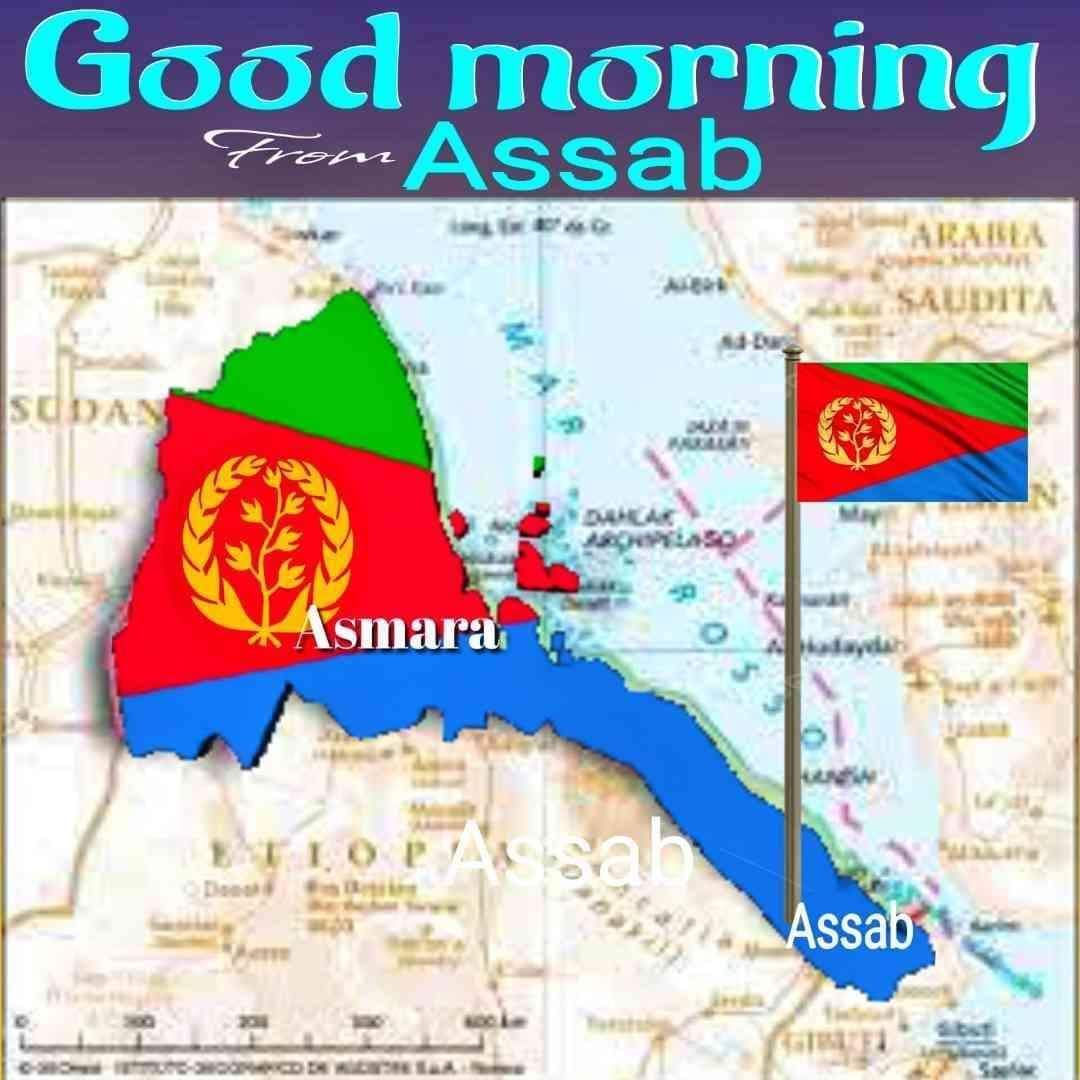
(MY OPINION): Some opportunities offer a chance to kill two birds with one stone. I’m not sure where our government's stands on this, but if the decision were mine, I’d make the naval and air base in #Assab available for the deployment. #SaudiArabia is an ally of #Eritrea, too.
Assab: The Pulse That Guards the Sea
By Abraham Gebremichael
Thunder without rain is loud, but it does not change the soil.
Lately the microphones are full of weather:
forecasts of easy victories, maps redrawn with a sentence.
But Assab does not move for sound.
Assab is not a shortcut.
It is a pulse, an artery of memory and sacrifice.
It was not inherited. It was paid for.
Every stone remembers a name. Every wave carries a vow.
Call it a port if you like.
To us it is a rib, a breath,
a heartbeat you cannot borrow.
They speak of speed and reach:
new machines, new eyes in the sky, new hands from faraway friends.
The tools have changed. The sea has not.
Reefs are polite until you lie to your compass.
Currents still judge the arrogant and guide the honest.
And the shoreline still belongs to those who stand on it together.
We know what war is made of.
Not only iron. Not only noise.
There is an arithmetic the loud forget.
50% Morale.
People who know what they are defending cannot be counted by head alone.
Eritrea’s measure is not numbers. It is a vow.
Crowds scatter. An oath holds.
20% Clarity.
To defend, you must see truly.
Know what is yours, and why, and where the line is.
Clarity turns maps into meaning, and warns you when pride is dressed up as a plan.
20% Secrecy and discipline.
Gardens do not announce their roots.
The hinge is quiet until it closes.
What is kept is as powerful as what is shown.
10% Iron.
Weapons matter. But they obey the first three.
Without morale, clarity, and discipline, iron is only weight.
That is why bravado surprises us most
when it comes from those who have already tasted the trap.
In 1998, the border closed because war entered.
In 2018 it opened because peace was signed,
so families could find one another, so children could run,
so books could shine where bullets once sparked.
The hinge has opened before. It can open again.
Assab is not an alarm you can press when your politics run late.
It is not a door to be tried by strangers and excuses.
It is a harbor with a memory and a garden with teeth.
Conquest is easy to announce and ruinous to attempt.
We do not crave war.
We prepare for peace by living it, guarding it,
keeping its roof in repair in quiet weather.
And we say, in the same breath, what the law says for every shore in the Horn:
no army may take another’s coast by force, ours included.
If thunder comes without rain, let it pass.
If fire comes to the garden, the hinge will close.
The shelter became a shield.
The reef still refuses false bearings.
The pulse still beats in Assab, steady as dawn over the Red Sea.
Glory to our martyrs.
Strength to our people.
Eritrea endures: rare, resilient, reborn.
#Assab #Eritrea #RedSea #HornOfAfrica #Sovereignty #Resilience #Unity
#Ethiopia’s selective and deliberate invocation of #UN Charter Articles 51 and 2(4), while openly threatening to invade sovereign #Eritrean territory, is designed to mask its war agenda against Eritrea, which it has been pursuing for the past three years.
@UN@StateDept@POTUS
This is what happens when you refuse to sell your sovereignty.
First, they accuse you. Pay proxies to fight you. Then defame you. Dehumanize you. Sanction you. Block your opportunities.
Then comes the masterpiece: They blame YOU for the damage, lecture you about failure, and accuse you of isolation.
More pressure. More accusations. More demonization. Rinse and repeat.
And after all that, they have the audacity to ask:
“When will Eritrea come in from the cold?”
Come in WHERE? Into your puppet show? To kneel and call it diplomacy?
Eritrea endured it all. And today, those who tried to isolate it find themselves having to cooperate, not out of generosity, but because their own interests demand it.
Does that mean our work is done? FAR FROM IT.
We must work harder, build more, be active, open up, engage with the world and move forward with dignity. Never forgetting what we sacrificed to get here.
We don't reject cooperation. We reject subordination.
And we must NEVER allow anyone to drag us back into that colonial master-slave mentality.
We paid too high a price for our sovereignty to put it up for sale. 🇪🇷
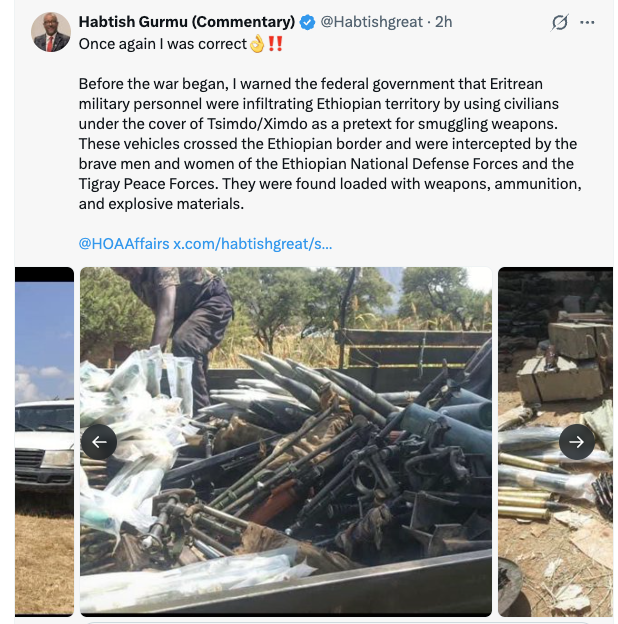
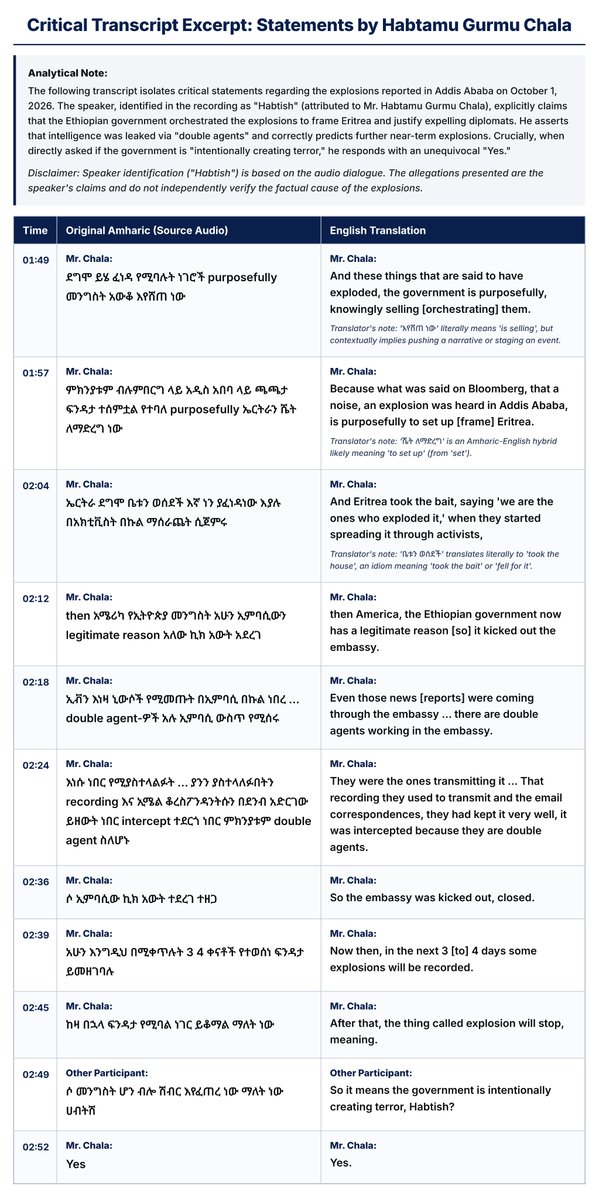
Well, Mr. Chala, @Habtishgreat, at least you appear to have enjoyed a good night's sleep. No 6 a.m. performance today? 😂 Good to see you again! And there you go, predictably tagging @HOAAffairs. Your inability to resist mentioning me has become almost comical. But your latest post deserves more serious attention. You have publicly associated my account with allegations involving military infiltration, weapons, ammunition, and explosives. On what evidence do you associate me with these claims? Such serious allegations demand verifiable evidence, not insinuation. I will preserve this post alongside your other public statements in a digital archive for the record. Your earlier recorded remarks, apparently alleging that the Ethiopian government deliberately staged explosions in Addis Ababa, also deserve independent scrutiny. I intend to publish a further statement examining those remarks, accompanied by the relevant audio and transcript, without presenting unverified allegations as established facts. Mr. Chala, you have repeatedly crossed the boundaries of civil discourse. A few of us remain committed to defending human dignity against harassment, intimidation, and reckless accusations. Every public statement you make is your responsibility, and the historical record will speak for itself. Keep talking, Mr. Chala. The archive is growing, and your own words will remain available for examination long after this exchange is forgotten.
#Habtamu_Gurmu_Chala | @FBI@DHSgov@TheJusticeDept@FBIMobileAL United States and Alabama authorities:
@FBI@FBIMobileAL@DHSgov@HSI_HQ@ICEgov@USCIS@TheJusticeDept@ATFHQ@SteveMarshallAL@AlabamaDHR@ALMentalHealth@GovernorKayIvey@madisonpoliceAL
International media:
@Bloomberg@Reuters@BBCWorld@AP@AFP@AJEnglish@CNN@guardian@nytimes@washingtonpost
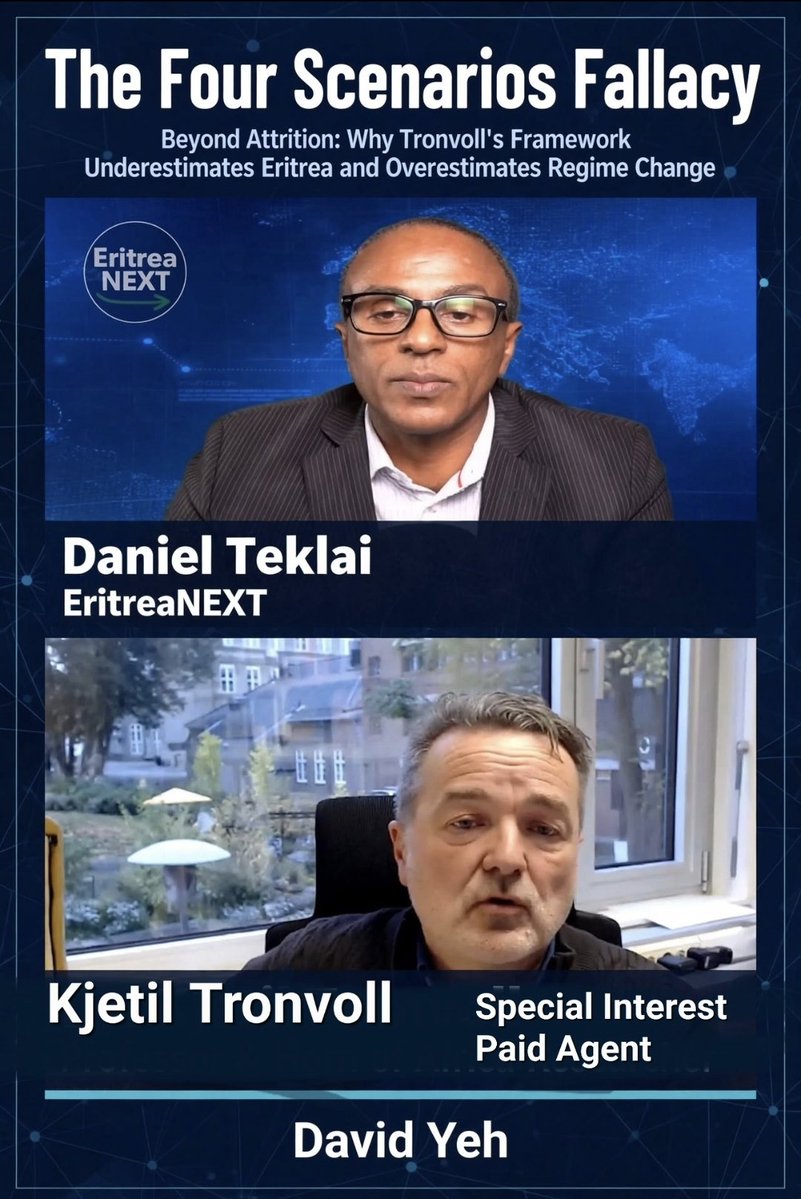
Reluctantly I watched this interview and Tronvoll can be described by this clip as someone who is completely incongruant with his political activism against Eritrea but yet wonders why he is refused a visa to enter Eritrea. Similarliy he argues for the western security interests against Eritrea because lets be honest the reason Eritrea isnt in the good books of western org is because it doesnt act in the interest of these org particularly their security interests @_hudsonc told you so on @addisstandard when interviewed about US lifting sanctions against Eritrea. So less than listening to Tronvoll continously contradicting himself what was the point of this interview?