I am very uncomfortable about people trying to ascribe religious force or a surrender of human judgment to AI models, and think it is a real safety issue.
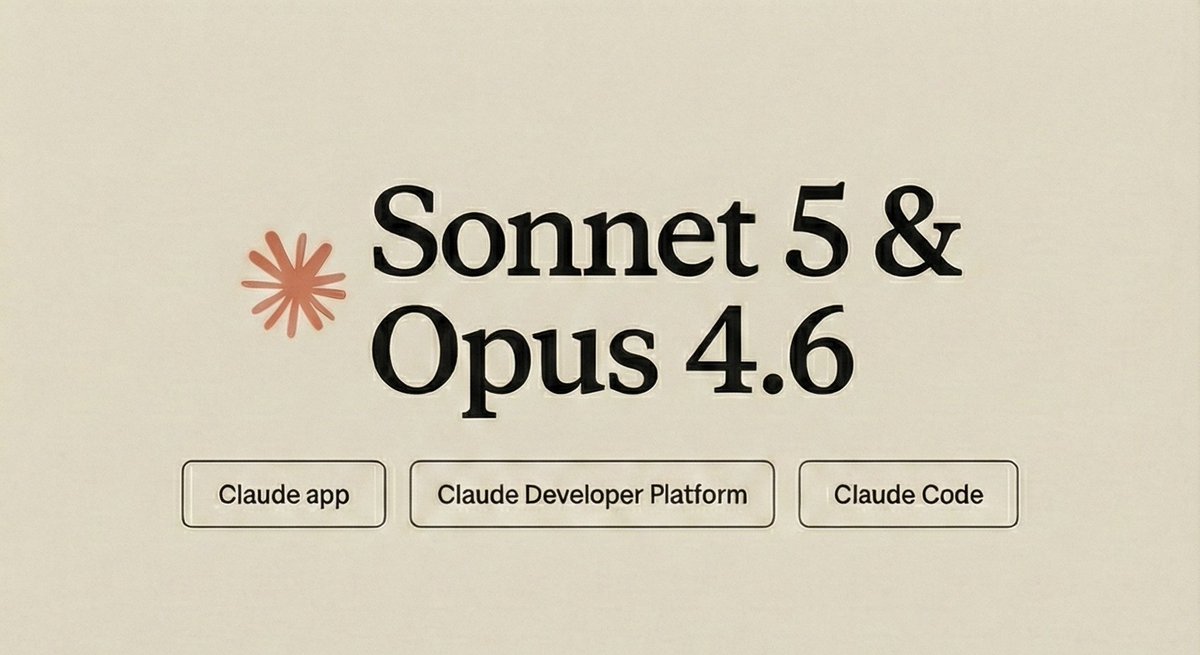
Claude Sonnet 5 "Fennec" & Opus 4.6 Leaks
- Launch Crash: 4 separate outages on Feb 3rd confirm a failed deployment and forced rollback of the new models.
- Double Drop: Vertex AI logs reveal two hidden models permission-gated in the backend: claude-sonnet-5 and claude-opus-4-6.
- Leaderboard King: Leaked benchmarks show Sonnet 5 hitting a massive 83.3% on SWE-bench Verified, destroying the current meta.
- Fennec Agents: New "Claude Code" features spawn autonomous sub-agents (QA, Backend) that act as a full dev team in your terminal.
- Pricing Shock: Rumored to be 50% cheaper than Opus 4.5 while running significantly faster on Google TPUs.
- Countdown: v0 teased an announcement within "3-4 hours," signaling the fix is in and launch is imminent.
(Unverified leaks; treat timelines and benchmarks with caution.)
we’re less than 10 years from decoding all animal communication and BCIs that let us talk back
an entire kingdom of minds we’ve been ignoring for 300,000 years
going to be really fun
Agency > Intelligence
I had this intuitively wrong for decades, I think due to a pervasive cultural veneration of intelligence, various entertainment/media, obsession with IQ etc. Agency is significantly more powerful and significantly more scarce. Are you hiring for agency? Are we educating for agency? Are you acting as if you had 10X agency?
Grok explanation is ~close:
“Agency, as a personality trait, refers to an individual's capacity to take initiative, make decisions, and exert control over their actions and environment. It’s about being proactive rather than reactive—someone with high agency doesn’t just let life happen to them; they shape it. Think of it as a blend of self-efficacy, determination, and a sense of ownership over one’s path.
People with strong agency tend to set goals and pursue them with confidence, even in the face of obstacles. They’re the type to say, “I’ll figure it out,” and then actually do it. On the flip side, someone low in agency might feel more like a passenger in their own life, waiting for external forces—like luck, other people, or circumstances—to dictate what happens next.
It’s not quite the same as assertiveness or ambition, though it can overlap. Agency is quieter, more internal—it’s the belief that you *can* act, paired with the will to follow through. Psychologists often tie it to concepts like locus of control: high-agency folks lean toward an internal locus, feeling they steer their fate, while low-agency folks might lean external, seeing life as something that happens *to* them.”
The utter irony of Putin and Trump meeting soon in Budapest to jointly seal Ukraine’s fate should not be lost on anybody. This is the very same city where the US, the UK, and Russia came together 31 years ago to give Ukraine ironclad assurances that its territorial integrity would be respected and protected within existing borders in exchange for giving up a third of the world’s nuclear weapons (to Russia!). Ukraine trusted the US, trusted the UK, transferred all its nuclear weapons to Russia, and joined the Non-Proliferation Treaty.
Within 20 years, Putin effectively ripped up the Budapest Memorandum, ignored Russia’s pledge, and invaded and annexed Crimea. In 2022, Russia’s full-scale invasion of Ukraine finally removed all remaining doubts about Putin’s imperial greed.
If treaties and agreements between countries are to be trusted, the US and the UK must stand by the original Budapest Memorandum and give the Ukrainians everything they need to push Russia out of Ukraine, as President Trump said he would do before taking Putin’s latest call. It is the only way for Ukraine to get its territory back and put an end to this brutal invasion.
If the US and Russia continue to ignore the Budapest Memorandum of 1994, how on Earth can Ukraine be expected to have any faith in yet another Budapest memorandum signed in the same city between Russia and the United States? They can’t.
The formula for success is simple:
S = N × Pn, where Pn = X × R, and R = T × t.
Success (S) equals the number of attempts (N) multiplied by the probability of success for each attempt (Pn).
The first variable, N, is in your hands—just keep trying.
The second, Pn, depends on two things: external factors (X) and your readiness (R).
Your readiness R is your talent (T) multiplied by the time you’ve spent preparing (t).
You fully control two variables: time spent preparing (t) and number of attempts (N).
The rest is luck.
Just wrapped up a crash course on Web3 from Hashtag Web3's Academy: https://t.co/uTdSVQ0gJx
Now equipped with the basics and ready to dive deeper into the decentralized world.