Really interesting perspective. It made me wonder whether discovery is only half of the story.
Variation → evaluation → retention explains how a system evolves. But what is the substrate that’s evolving? Is it a world model, a memory structure, a persistent state, or something else entirely?
I sometimes feel that many debates around intelligence, agency, and consciousness focus on the update mechanism, while the representation of the evolving state remains surprisingly underexplored.
Introducing Buzzy Canvas -- Your AI co-director
The first infinite Canvas which is truly agentic. Unlike other canvas, where you spend 4 hours building one video, Buzzy agents inspire detailed storyline, build moodboards, and draft masterpiece in one click.
you can:
- keep unlimited subjects consistent 🤯
- switch view-angle, control lighting seamlessly
- generate 20 variation in seconds
- all the top AI models like Seedance, GPT image, Kling, Veo, Nano Banana in one canvas
Detailed tutorial below:
VLA-JEPA just dropped in LeRobot 🤖
What makes this model special is that it does not just learn what action to take from a given observation, it also leverages a JEPA world model to learn action-relevant dynamics.
During training, the VLA leverages V-JEPA2 by conditioning its predictor. This clever trick adds a world modeling objective to the training, which also allows pretraining on human videos.
At inference, the world model is dropped entirely, keeping only a standard VLA architecture: Qwen backbone and action head.
The demo here was only fine-tuned on 13 examples, showing great pretraining capability and running in real time on @NVIDIARobotics DGX Spark!
VLA-JEPA is the first world model to be ported to LeRobot, and I feel like it won't be the last 🚀
@Thom_Wolf@ClementDelangue
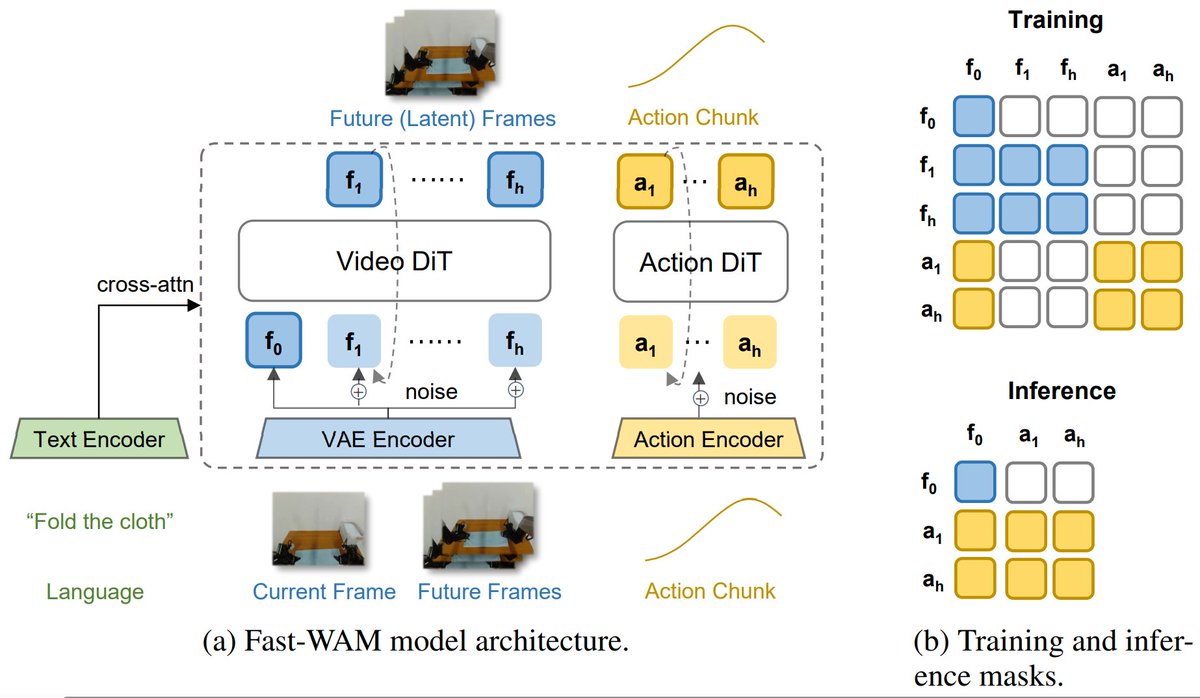
Our recent findings on World Action Models (WAMs): the core advantage of WAMs is not test-time “imagination” of futures, but the training-time supervision from future video prediction.
We propose Fast-WAM, which makes inference simple, fast, and policy-centric.
JEPA are finally easy to train end-to-end without any tricks!
Excited to introduce LeWorldModel: a stable, end-to-end JEPA that learns world models directly from pixels, no heuristics.
15M params, 1 GPU, and full planning <1 second.
📑: https://t.co/cpTzgvbTS0
We worked with @Ginkgo to connect GPT-5 to an autonomous lab, so it could propose experiments, run them at scale, learn from the results, and decide what to try next. That closed loop brought protein production cost down by 40%.
New on our Frontier Red Team blog: We tested whether AIs can exploit blockchain smart contracts.
In simulated testing, AI agents found $4.6M in exploits.
The research (with @MATSprogram and the Anthropic Fellows program) also developed a new benchmark: https://t.co/QpGPMqlDRG
The @ilyasut episode
0:00:00 – Explaining model jaggedness
0:09:39 - Emotions and value functions
0:18:49 – What are we scaling?
0:25:13 – Why humans generalize better than models
0:35:45 – Straight-shotting superintelligence
0:46:47 – SSI’s model will learn from deployment
0:55:07 – Alignment
1:18:13 – “We are squarely an age of research company”
1:29:23 – Self-play and multi-agent
1:32:42 – Research taste
Look up Dwarkesh Podcast on YouTube, Apple Podcasts, or Spotify. Enjoy!
Imo this is along the lines of how talking to an LLM via text is like typing into a DOS Terminal and "GUI hasn't been invented yet" of some of my earlier posts.
The GUI is an intelligent canvas.
Very excited that our AlphaProof paper is finally out!
It's the final thing I worked on at DeepMind, very satisfying to be able to share the full details now - very fun project and awesome team!
https://t.co/OuWDemzAt4
Introducing Cambrian-S
it’s a position, a dataset, a benchmark, and a model
but above all, it represents our first steps toward exploring spatial supersensing in video. 🧶
As an AI researcher, are you interested in tracking trends from CV/NLP/ML to robotics—even Nature/Science. Our paper “Real Deep Research for AI, Robotics & Beyond” automates survey generation and trend/topic discovery across fields
🔥Explore RDR at https://t.co/uBJ0bYNy3R
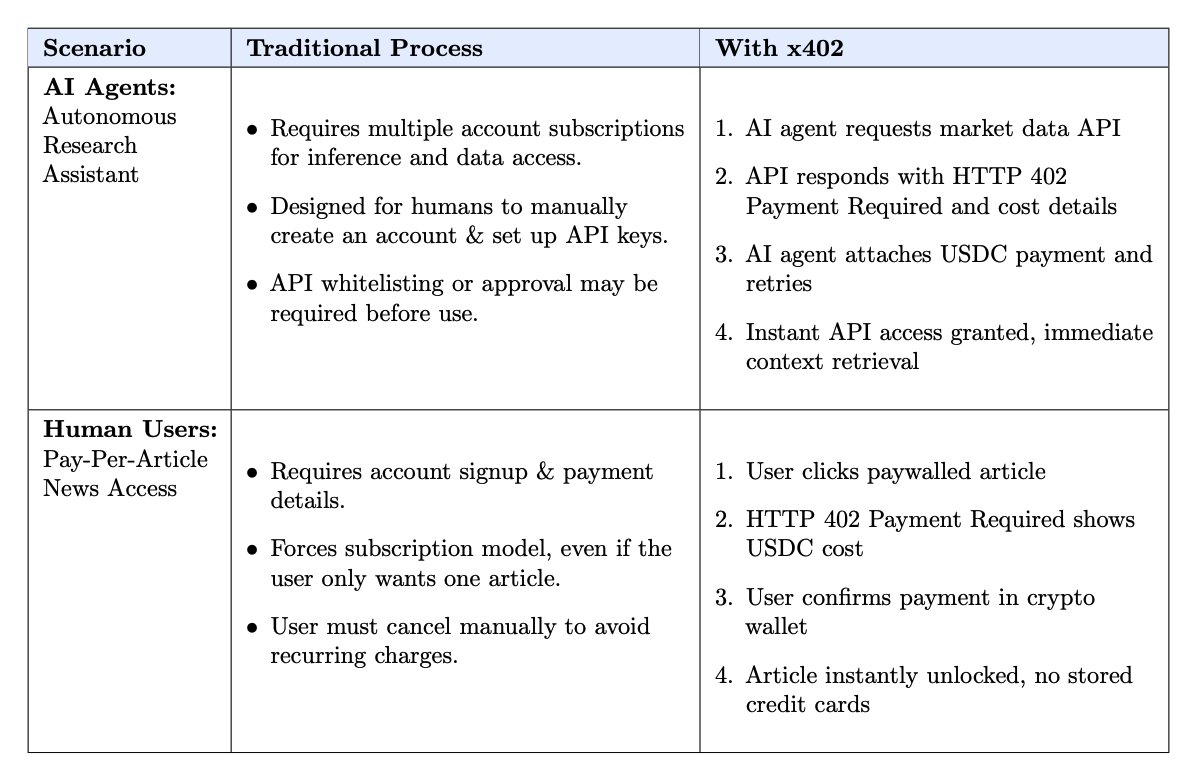
A good diagram from the Coinbase whitepaper explaining how both AI agents and humans can benefit from x402.
Instant API access without any sign up required, all facilitated by crypto payments.
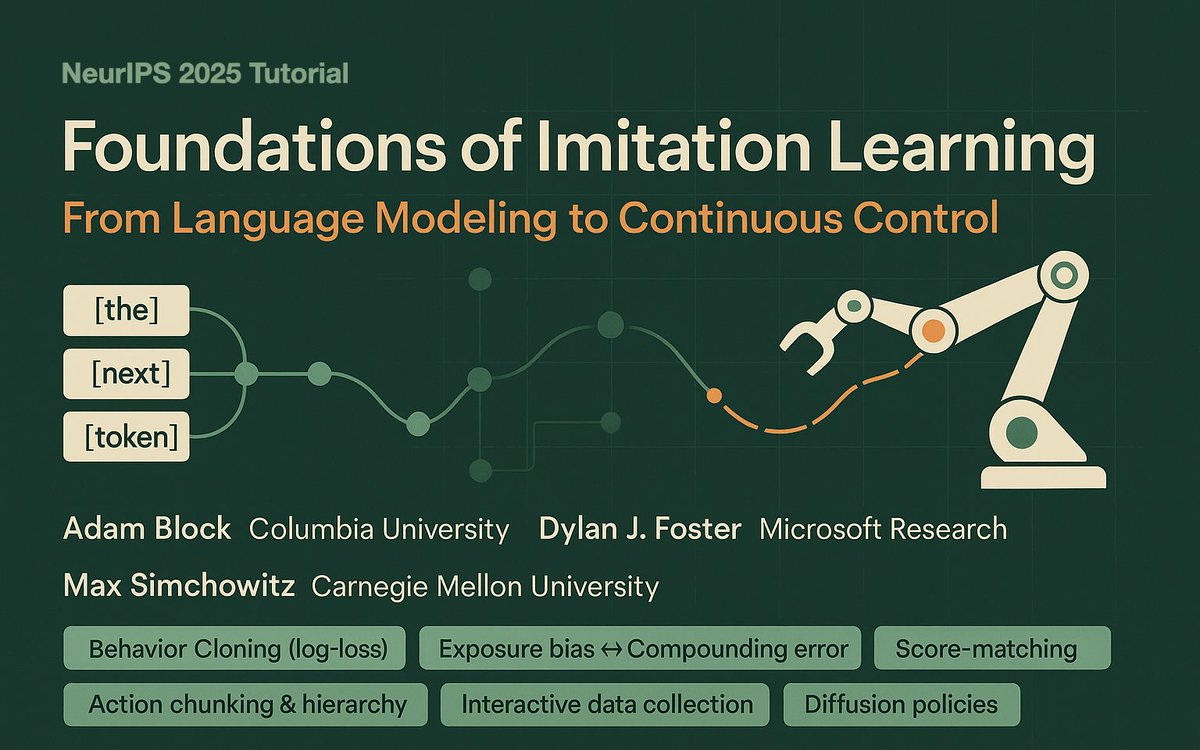
Excited to announce our NeurIPS ’25 tutorial:
Foundations of Imitation Learning: From Language Modeling to Continuous Control
With Adam Block & Max Simchowitz (@max_simchowitz)
We get a ton of questions about how and why assets get listed on Coinbase. To be more transparent we wrote a guide on how it all works.
TL;DR: listings are free and merit-based. Every asset is evaluated against the same standards.
Link in replies.
WALL-OSS: Igniting VLMs toward the Embodied Space
Blog: https://t.co/ku0dRBSkbw
Paper: https://t.co/rdi2dAyjnD
Code: https://t.co/PLvE6WvIB5
New open-source VLA model from X Square Robot: A tightly coupled architecture and multi-strategies training curriculum that unifies instruction reasoning, subgoal decomposition and fine-grained action synthesis within a single differentiable framework.
- Architecture: leverages a Mixture-of-Experts to assign different FFN for corresponding training tasks.
- Build on top of Qwen VLM, there’re two main training tasks: “Inspiration stage" to enable CoT reasoning with discrete FAST action token prediction; “Integration stage” to replace discrete action prediction with continuous action modeling via flow matching.
- The model achieves SOTA in experiments, with all code and models open-source released.