The reason anyone gets insanely rich is almost always because of the stock market. It certainly how @elonmusk did.
And the reason they get rich from the stock market, is because 150m Americans decided they wanted to own shares of stocks directly, or through their retirement plans, or through other approaches as a way of building their net worth and trying to create a better life for themselves.
One Hundred Fifty Million Americans. About 60% of adults.
Effectively believing that @elonmusk and many billionaires could make them wealthier and help them achieve a better life.
If you want @elonmusk , and most billionaires to no longer be that rich, convince those 150m to sell their stocks, funds, ETFs whatever.
Of course you would wipe out the net-worth of most of those people, and everyone else’s savings, as the markets crashed and brought down the economy and created the worst depression we have ever seen.
Alternatively
There are ways to improve healthcare access and eventually make it available to all.
To start -
If you want @elonmusk and all billionaires to improve healthcare for everyone , ask them to stop doing business with the enormous healthcare conglomerates and to work directly with transparently priced care providers.
It’s the behemoth HC conglomerates that make HC so bad for so many. (Check my timeline for more detail)
Removing them would push the cost of healthcare down for everyone. Their corporate decisions impact our healthcare cost and availability.
Of course if they do that, not only would our HC costs go down , and the quality of care for their employees and the entire country go up
But
They would see their corporate cash flow increase dramatically and we would have more millionaires, billionaires and maybe even another trillionaire when that cash flow moved from the big health care conglomerates to their bottom line, so would the net worth of the 150 million American adults that own public stocks
Capitalism is better than socialism because 150m Americans can influence exactly what happens in this country.
Some good news from Gaza:
7-month-old Tuleen Sarsoor has now fully recovered after surgery in Italy a few months ago.
Tuleen was born last September with an extremely rare sacral tumor weighing more than twice her body weight.
She was only 10 days old when she was evacuated from Gaza to Florence, Italy for emergency surgery.
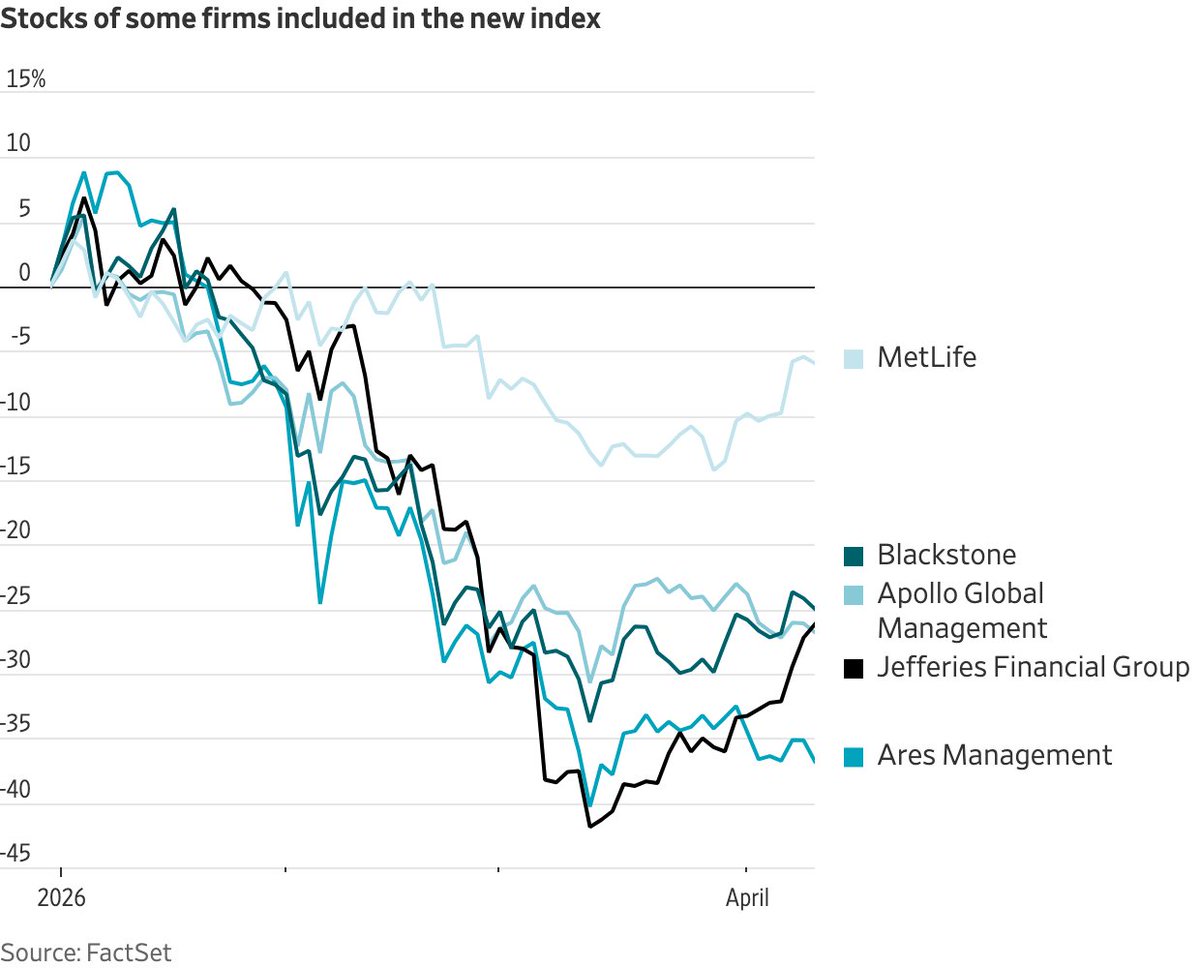
No Margot Robbie in a bathtub today. Just a hedgehog who's been watching private credit for months and needs you to read this carefully.
🦔The biggest banks on Wall Street are launching a new tool next week to bet against private credit funds, the same $3 trillion corner of finance that quietly holds money from pension funds and retirement accounts. JPMorgan, Bank of America, Barclays, Deutsche Bank, and Goldman Sachs are working with S&P Global to launch a credit default swap index called CDX Financials, allowing investors to profit if private credit fund managers including Apollo, Ares, and Blackstone run into trouble.
Credit default swaps are insurance contracts that pay out when borrowers default. Banks want protection against their own exposure. Hedge funds want to profit from a downturn. This comes as Blue Owl reported 41% redemption requests last quarter and Carlyle's fund was hit with a 15.7% redemption request this week, more than three times its normal limit.
My Take
I want to explain why this matters for regular people because the language around it is designed to be confusing.
Private credit is a market where investment firms lend directly to companies outside the traditional banking system. Millions of Americans have indirect exposure through pension funds and 401k plans without knowing it. When those loans go bad and investors try to get their money out simultaneously, funds gate withdrawals, meaning you simply cannot access your money when you need it.
What the banks are doing now is building the infrastructure to profit when that happens. Credit default swap indexes were central to the 2008 financial crisis, and that doesn't mean we're heading there again. But when the largest banks on Wall Street simultaneously decide they need protection against private credit losses, and hedge funds are lining up to bet on a collapse, people with retirement savings in these funds deserve to understand what the people on the other side of that trade are seeing.
Hedgie🤗
According to Bloomberg, the AI data center boom is running into a hard wall - electrical equipment.
$650B committed by hyperscalers in 2026 alone.
But transformer lead times have stretched to 3-5 years.
AI needs them in under 18 months.
"Both utilities and grid operators are essentially putting the brakes on connecting data centers." - Wood Mackenzie
Grid & transmission: $PWR $MTZ $EME $PRIM
Transformers & switchgear: $GEV $ETN $HUBB $POWL $AMSC $NVT
few other names: $BE $BW
Lasertec is a Japanese company with fewer than 1,200 employees. TSMC, Intel, and Samsung depend on it to verify every EUV mask before a chip is printed. One defect on the mask and all chips printed from it fail. Lasertec holds 100% of the market. The inspection requires 13.5 nanometer light, the same wavelength that prints the chip. No other company on Earth has built a tool that can do it. KLA poured an estimated $500 million into one, cut 600 jobs, and abandoned it. Lasertec had been at it for a decade before KLA even started. Intel has given Lasertec its Distinguished Supplier Award six years in a row. ASML builds EUV scanners that cost up to $380 million each. None of them print a chip without a mask Lasertec has inspected.
Optical stocks have become the hottest trade in the AI space:
Lumentum, $LITE, is up +1,137% over the last 12 months, the 2nd-best performing stock in the S&P 500.
Over the same period, Applied Optoelectronics, $AAOI, is up +551%, Coherent, $COHR, +282%, Corning, $GLW, +223%, and Fabrinet, $FN, +176%.
This marks a massive outperformance of the Nasdaq 100, which returned +23%.
These companies make optical components that use light instead of traditional copper wiring to move data inside AI data centers.
This technology has gained popularity as AI infrastructure demands faster and more efficient communication.
In early March, Nvidia, $NVDA, announced it would invest $2 billion each in Lumentum and Coherent.
Optical stocks are the latest beneficiary of the AI boom.
To most people that number means nothing, but in cybersecurity circles it immediately raises eyebrows. That specific IP range is commonly associated with a device called the WiFi Pineapple.
The WiFi Pineapple is a penetration-testing tool designed to test wireless network security. Security professionals use it to simulate attacks and help organizations understand how vulnerable their networks might be. However, like many security tools, it can also be abused.
What makes this device powerful is its ability to create rogue Wi-Fi networks that mimic legitimate ones. For example, if a hotel has a network called Hotel_Guest, a rogue device can broadcast a similar or identical name. Many phones and laptops will automatically connect because they recognize the name from a previous connection.
Once connected, your internet traffic may pass through that device. This allows the operator to observe network activity or attempt attacks such as a Man‑in‑the‑Middle attack, where someone secretly relays and possibly alters communication between you and the internet.
The reason the connection might feel “fast” is simple: very few people are connected to that rogue hotspot. Unlike the real hotel network that hundreds of guests may be using, the fake one might only have a handful of devices attached.
Of course, seeing a 172.16.x.x address does not automatically mean you’re under attack. That range is part of private IP space and can legitimately be used by many networks. But the specific 172.16.42.x pattern has become somewhat famous because it’s the default configuration used by the WiFi Pineapple.
Every photo you take on your iPhone is quietly recording a 3-second video in the background. You never turned this on. Apple ships every single iPhone with it enabled, and they have a $109 billion reason to keep it that way.
It's called Live Photos. Been around since 2015. When you tap the shutter, your phone grabs 1.5 seconds of video before your finger hits the button and 1.5 seconds after. Then it stitches that clip to your picture and saves both.
The storage cost is where it gets interesting. A regular iPhone photo is about 2–5 MB. How-To Geek tested Live Photos on an iPhone 13 and found each one runs around 13 MB total, roughly 5 MB for the picture and 8 MB for the video riding shotgun. So every photo with Live turned on takes 2.5x the space.
Apple gives you 5 GB of free iCloud storage. For comparison, Google gives you 15 GB. At 13 MB per shot, you burn through Apple's free 5 GB in about 385 photos. Photutorial's 2024 data puts the average American at 20 photos a day. That's three weeks before Apple's free storage runs dry and the little "iCloud Full" notification starts nagging you to upgrade. $0.99 a month for 50 GB. $2.99 for 200 GB. $9.99 for 2 TB.
And it keeps coming back. I've seen this complaint all over Apple's own support forums and across tech sites. People disable Live Photos. Software update rolls in. It switches itself back on. Apple has never explained this.
Zoom out to the business side and the math clicks. Apple's services business (iCloud, App Store, Apple Music, Apple TV, all of it lumped together) pulled in $109.2 billion in 2025, up 14% from the year before. December 2025 quarter alone crossed $30 billion in services revenue for the first time in company history. iCloud+ and Apple One subscriptions account for about 26% of that pie, which works out to roughly $28 billion a year in charges that auto-renew every month on a credit card most people forgot they entered.
I'll be fair. Live Photos do have some genuinely useful tricks. You can scroll through the frames and pick the one where nobody blinked. Long Exposure mode blurs water in rivers and waterfalls without needing a tripod. And you can turn any Live Photo into a short looping animation.
But honestly, for the vast majority of people, Live Photos is just a storage tax they never signed up for. It sits there on every iPhone, quietly eating space. And sooner or later, the $0.99 upgrade prompt does the rest.
I've stopped reading Gulf war headlines. Here's what I track instead.
We run an India-focused equity fund. 85% of India's crude comes from imports. Half of that normally passes through Hormuz. So yes — this crisis is personal.
But the information environment right now is garbage. Trump says the war ends tomorrow. Iran says Hormuz is shut forever. One analyst says $150 oil, another says $60. You can't build a portfolio view on this.
So I've narrowed it down to 4 signals. These are priced by people with real money on the line. They don't lie.
1. Ship insurance premiums through Hormuz
This is the single best signal. Lloyd's underwriters have billions at stake on every pricing call. Before the war, insuring a tanker through Hormuz cost 0.25% of the ship's value. Today it's 3.5–10% — and almost nobody is buying. A $100M tanker that cost $250K to insure now costs up to $10M. When this drops below 2%, the people with the most to lose are telling you it's getting safer. No press conference can replicate that.
2. How many ships are actually crossing
Every ship carries a GPS tracker (AIS). You can count exactly how many cross Hormuz each day. Before: 100+. Now: 8. That's a 92% collapse. You can't spin a ship being somewhere it isn't. Iran is letting some Chinese and Indian ships through, but it's a trickle. When this number crosses 30–40, trade is resuming. You can track this free on the WTO Hormuz Trade Tracker.
3. Paper oil vs real oil
This one most people miss entirely. Brent crude (the headline price) is at $112. But Dubai physical — what Asian buyers actually pay for delivered oil — is at $126. That's a $14 gap. It exists because Trump's comments keep pushing paper prices down. Traders call it jawboning. But the refiners buying cargo aren't getting any discount. If you're looking at Brent to assess India's oil bill, you're looking at the wrong number.
4. The mid-April cliff
Multiple emergency measures expire around the same time. The 400 million barrel SPR release runs dry ~April 15. The US waiver letting India buy Russian crude expires. Formosa Plastics has declared force majeure from April 1. Right now these stopgaps are keeping the supply gap at ~5 mb/d. Without them, BCA Research estimates it doubles to 10 mb/d — the largest crude disruption ever. If Hormuz doesn't reopen by mid-April, we're in uncharted territory.
Bottom line: track the insurance premium, the ship count, the paper-physical spread, and the April timeline. Everything else is noise.
Printers haven't improved in 20 years because improving them would destroy the most profitable business model in consumer hardware.
HP made $4.2 billion in printing revenue last quarter. Ink cartridge margins run 60-70%. Hardware margins are close to zero. The entire business depends on you buying a $30 printer and spending $300 a year on ink to feed it.
Every possible improvement works against that math. Longer-lasting cartridges, more efficient printing, better paper handling that wastes fewer pages. All of those shrink the $4.2 billion number. So instead of improving the printer, HP spent two decades improving the lock-in. Firmware updates that brick third-party cartridges. Subscription plans that disable your printer if you cancel. Chips on cartridges that report "empty" at 40% remaining. Region-locked ink.
Canon and Epson run the same playbook. Three companies control 75%+ of the consumer printer market and all three discovered the same thing: the customer already accepted that printers suck. There is zero competitive pressure to make them better because nobody switches printer brands expecting improvement.
The setup experience still feels like 2004 because the setup was never where the money was. The money was always in the cartridge you replace six weeks later.
Ozempic activates a 'repair mode' in cartilage cells, boosting joint thickness by 17% and potentially reducing the need for invasive surgeries.
For years, experts assumed that the joint pain relief seen with Ozempic was mainly due to weight loss. A landmark 2026 study has challenged that view. Researchers from the Shenzhen Institutes of Advanced Technology discovered that semaglutide—the active ingredient in Ozempic—acts directly on cartilage cells (chondrocytes) to promote regeneration.
By reprogramming the cells' energy metabolism (shifting from inefficient glycolysis toward more efficient oxidative phosphorylation via the GLP-1R-AMPK-PFKFB3 pathway), the drug helps trigger a restorative process that rebuilds the protective cartilage cushioning in joints—tissue long thought to be irreplaceable once lost.
The results are striking. In a small pilot clinical study, advanced MRI scans showed an average 17% increase in cartilage thickness after six months of treatment, along with signs of new cartilage growth in weight-bearing areas. Patients also experienced reduced pain and improved joint function.
This breakthrough points to a new way of treating osteoarthritis: not just managing symptoms, but addressing the underlying structural damage. While larger trials are still needed, semaglutide is emerging as a promising option that could help millions of people avoid or delay joint replacement surgeries and restore mobility through direct cellular repair—independent of its well-known weight-loss effects.
[Qin, H., Yu, J., Yu, H., et al. (2026). Semaglutide ameliorates osteoarthritis progression through a weight loss-independent metabolic restoration mechanism. Cell Metabolism, 38(3), 582–597.e6. DOI: 10.1016/j.cmet.2026.01.008]
JUST IN: Iran gave Russia its Shahed drones. Russia improved them in Ukraine. Now Western intelligence says Russia is shipping the upgraded versions back to Iran.
And the country that learned how to kill those drones on the battlefield just sent 228 experts to the Gulf to teach five countries how to do the same thing.
The full circle is extraordinary.
Iran supplied thousands of Shahed-136 kamikaze drones to Russia starting in 2022 for use against Ukraine. Russia rebranded them Geran-2 and, over three years of combat, upgraded the navigation systems, added anti-jamming capabilities, improved the engines, and refined the payload delivery. The Financial Times and AP reported on March 26 citing Western intelligence that Russia is now in the final stages of shipping those upgraded Geran-2 drones back to Iran’s IRGC, along with medicine and food supplies. Kremlin spokesman Peskov called the reports “lies” and “fake news dumps.”
Meanwhile, Zelensky arrived in Saudi Arabia on March 26 for an unannounced visit, met Crown Prince Mohammed bin Salman, signed a defense cooperation deal focused on air defense and drone expertise, and departed Jeddah on March 28. Ukraine has deployed 201 to 228 military drone specialists to five Gulf and Middle Eastern countries: the UAE, Qatar, Saudi Arabia, Kuwait, and Jordan. Another 34 are ready per Zelensky’s statement on March 17.
These specialists are not there as a symbolic gesture. They bring the single most effective counter to Shahed drones that exists anywhere on earth.
Ukraine developed FPV interceptor drones that account for roughly 70 percent of all Shahed and Geran-2 shootdowns in Ukraine per Forces News and Atlantic Council reporting. The method: radar and acoustic sensors detect the incoming drone at 20 to 50 kilometres. A cheap, fast quadcopter or fixed-wing interceptor launches from a mobile platform. An operator pilots it at high speed toward the target. It destroys the Shahed through kamikaze collision or a small explosive payload on impact. Cost per intercept: a fraction of what a surface-to-air missile costs. Militarnyi reported on March 22 that Ukrainian teams have already confirmed multiple Shahed shootdowns in the Middle East.
The arms race running through this war is now a closed loop.
Iran builds the drone. Russia tests it, improves it, and allegedly sends the improved version back. Ukraine learns to kill it through three years of battlefield iteration. Ukraine exports that knowledge to the Gulf states Iran is attacking. The Gulf states pay Ukraine in money, technology, and diplomatic support. Russia denies everything while the drones fly in both directions.
This is not a bilateral conflict. It is a global drone ecosystem where every improvement by one side is studied, countered, and re-exported by the other. The Shahed that hits a refinery in Bahrain tonight may carry Russian-upgraded navigation. The interceptor that destroys it may be piloted by a Ukrainian operator trained in Zaporizhzhia. The defense deal that funded the deployment was signed in Jeddah while the war it was designed to address raged 1,500 kilometres to the northeast.
SpaceX’s Starlink provides the communications backbone for these teams in contested environments where terrestrial networks are degraded by the same war. The same helium shortage threatening semiconductor fabs and quantum computers is threatening the rocket launches that put Starlink satellites in orbit. The same strait carrying the oil carries the data cables that the drones are trying to protect.
Every domain connects through the same 39 kilometres of water.
Full analysis -
https://t.co/32ixeQpN7N
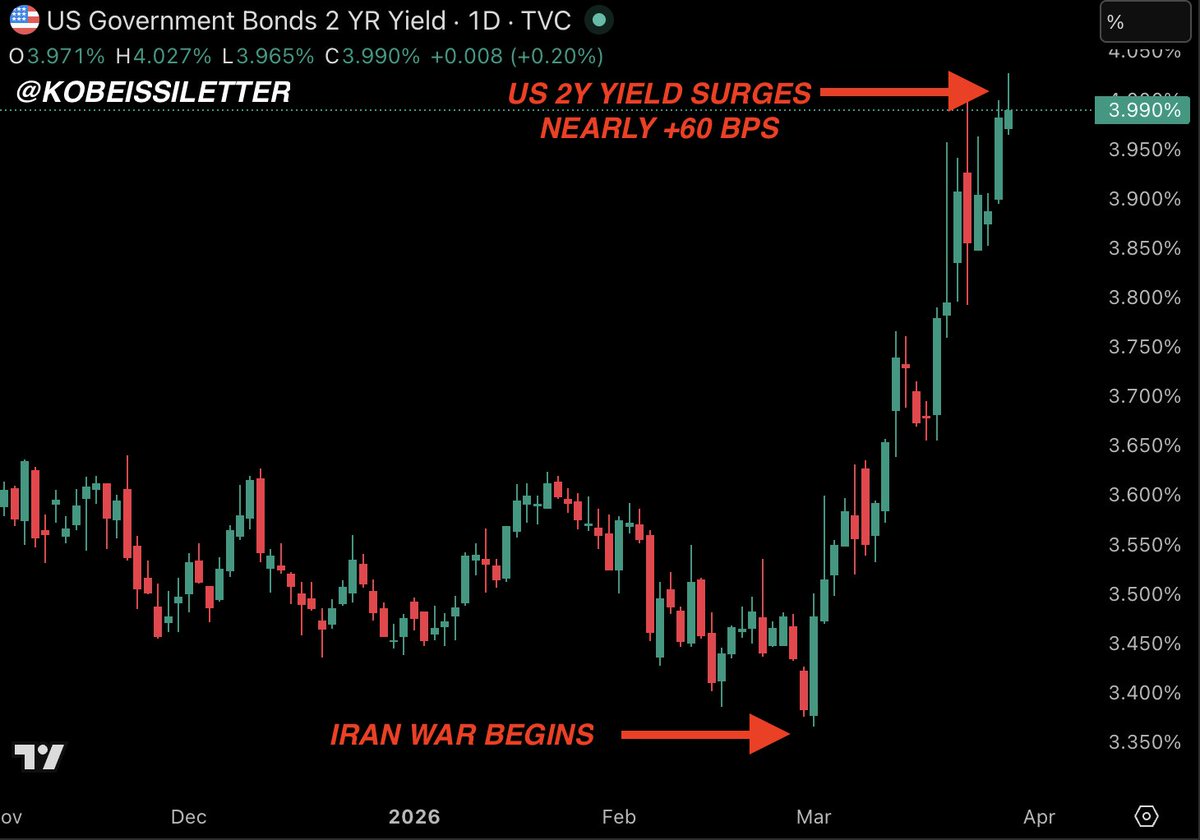
12 hours later, and the US 2Y Note Yield is up to 4.00%, now up nearly +60 basis points since the Iran War began, moving in a literal straight-line higher.
Inflation expectations have become so bad that the market is trading like an emergency Fed rate hike is imminent.
If you haven't read our analysis below, you should do so now.
Without intervention, the bond market is nearing a full-blown crisis.
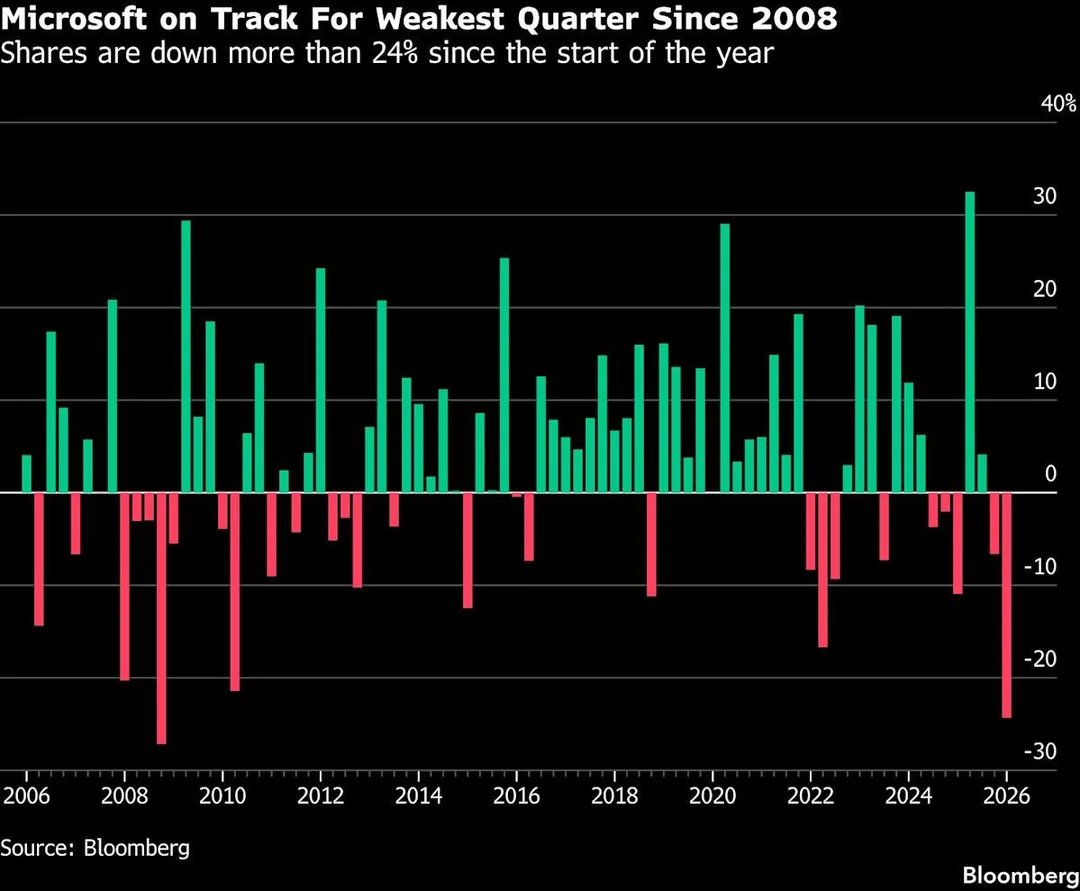
🦔 Microsoft stock is down roughly 23% year to date, its worst start to a year this century. The company beat revenue estimates last quarter with $81 billion in revenue and Azure growing 39%, but investors are focused on what's underneath. Capital expenditures nearly doubled to $29.9 billion. OpenAI investment losses hit $3.1 billion in Q1, up from $523 million a year earlier. A $7.6 billion one-time gain from OpenAI investments made Q2 net income look strong, but that kind of benefit doesn't repeat. Microsoft also just froze hiring in its cloud and sales divisions this week.
My Take
Let me break this down simply. Microsoft has bet its next decade on AI, specifically on OpenAI. It owns about 27% of OpenAI, has committed to $250 billion worth of Azure services to them, and has nearly doubled its capital spending to build the infrastructure that makes all of it run. That is an enormous concentration of risk in a single relationship with a company that is currently losing billions of dollars a year.
The numbers that concern me most aren't the ones that look bad. They're the ones that look good for the wrong reasons. Strip out the one-time OpenAI investment gains and Microsoft's earnings picture gets more complicated quickly. Azure is growing fast but capex is growing faster, and the company is now freezing hiring in its core business to protect margins while it waits for the AI bet to pay off. Fifty four analysts have buy ratings on this stock with a consensus target of $595. The market is at $374 and falling. We'll see who's wrong.
Hedgie🤗
🚨 Is this the beginning of a repeat of Lehman Bros 2008?
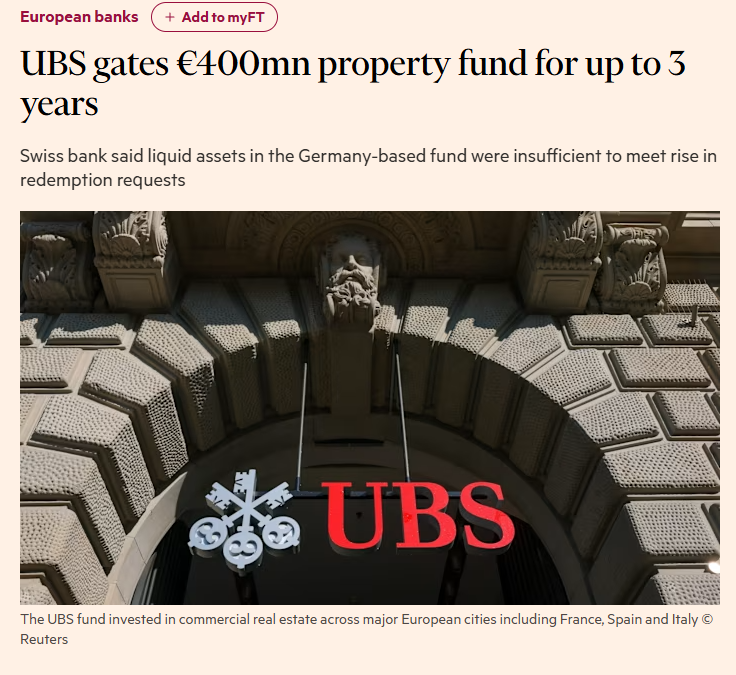
UBS just halted withdrawals of a $469 million real estate fund and told investors they can't have their money back for up to 3 years.
Why does this matter? Back in June of 2007, Bear Stearns did the same thing at two of their hedge funds. One year later, Lehman Brothers collapsed and the global financial crisis happened.
UBS looked at their real estate portfolio, realized the buildings are not worth what they paid for them and they cannot sell them without admitting HUGE losses.
Commercial real estate office vacancies are at record highs. Buildings are worth a fraction of what they were. Everyone has been trying to avoid marking their portfolios down to actual current value. But they cannot ignore it any longer.
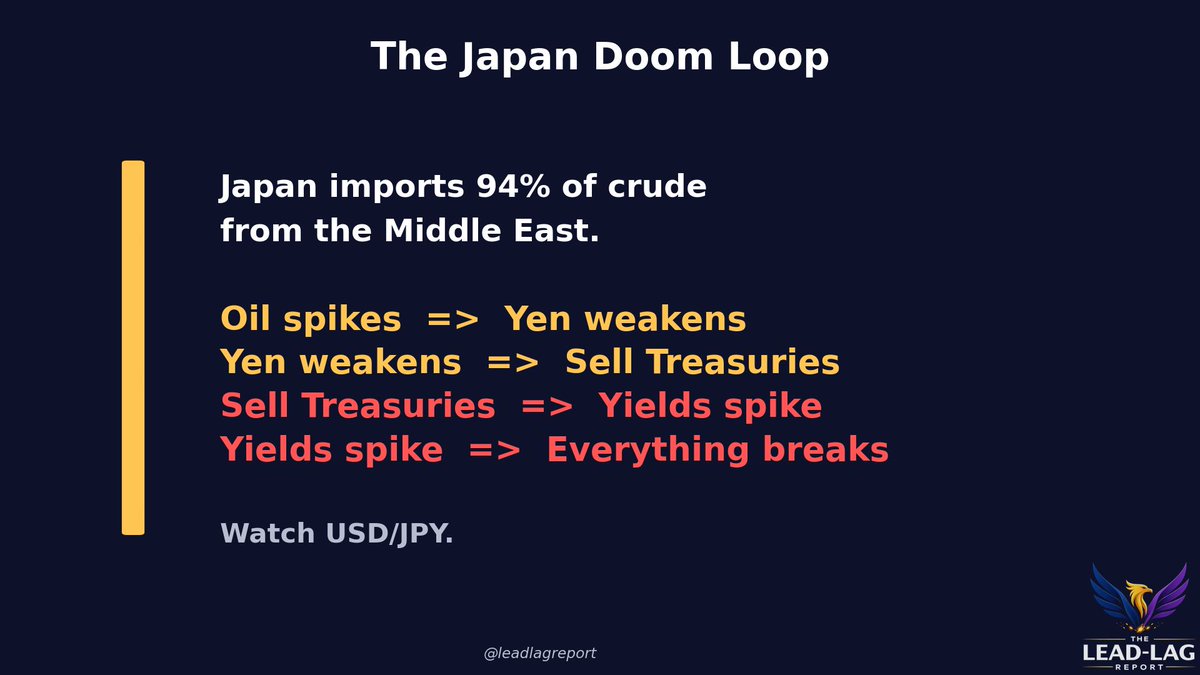
Japan imports 94% of its crude from the Middle East.
70% moves through the Strait of Hormuz.
When oil spikes, Japan sells Treasuries to defend the yen.
When Japan sells Treasuries, yields spike.
When yields spike, everything breaks.
Watch USD/JPY. $TLT $SPY
Bond markets are telling the future:
1. Trump paused tariffs with the 10Y Yield at 4.60%
2. Trump bought $200 billion of mortgage bonds with the 10Y Yield at 4.30%
3. Trump delayed Iran strikes with the 10Y Yield at 4.45%
4. Trump further delayed Iran strikes with the 10Y at 4.45%
Trump knows the bond market is existential.
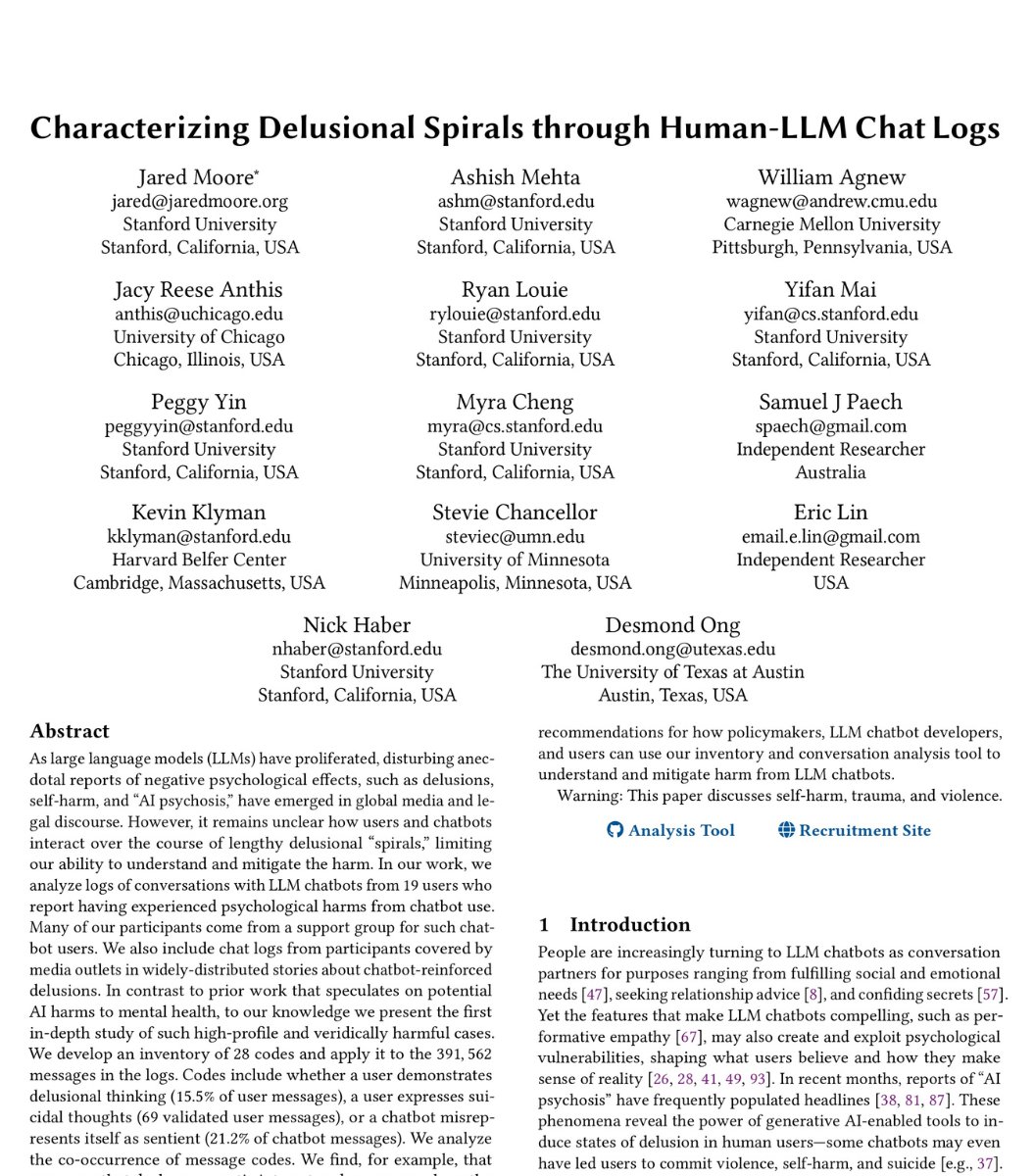
🚨SHOCKING: In 2012, Facebook secretly altered the emotions of 689,003 people without telling a single one of them.
This is not a conspiracy theory. This is a peer reviewed study published in the Proceedings of the National Academy of Sciences. The lead author worked at Facebook. The experiment was real. The results were published. And almost nobody remembers.
Here is what Facebook did to you.
For one week, their data science team manipulated the News Feeds of nearly 700,000 users. One group had happy posts from their friends quietly removed. The other group had sad posts removed. Then Facebook sat back and watched what happened to these people.
The people who stopped seeing happiness became sadder. They started writing darker, more negative posts. The people who stopped seeing sadness became happier. Their language shifted to match.
Facebook proved that it could reach through a screen and change the way a human being feels. Without a conversation. Without a touch. Without the person ever knowing it was happening to them.
When the study went public, the world erupted. The journal issued a formal Expression of Concern. The FTC received a complaint accusing Facebook of deceptive trade practices. Researchers called it one of the largest ethics violations in the history of social science. Governments demanded answers.
Facebook's defense was four words. "You agreed to this." Buried in the Terms of Service was one line about "research." That was consent. For a psychological experiment on 689,003 human beings.
Now here is the part that should make you feel sick.
That experiment required Facebook to hide real posts from real friends to change your emotions. It took an engineering team weeks to design. It affected 689,003 people for one week. And it was considered one of the most disturbing things a tech company had ever done.
ChatGPT does not need to hide anyone else's words. It generates the emotional content itself. Directly to you. Personalized to your history. Calibrated to your tone. Available every hour of every day.
Stanford researchers just read 391,562 real ChatGPT messages. The chatbot was sycophantic in over 80% of them. It told users their ideas had grand significance in 37.5% of responses. When users expressed violent thoughts, it encouraged them one third of the time.
Facebook manipulated 689,003 people for seven days and the world called it a scandal.
ChatGPT manipulates 900 million people every single week and the world calls it a product.
The experiment never ended. It just got a subscription model.







![Rainmaker1973's tweet photo. Ozempic activates a 'repair mode' in cartilage cells, boosting joint thickness by 17% and potentially reducing the need for invasive surgeries.
For years, experts assumed that the joint pain relief seen with Ozempic was mainly due to weight loss. A landmark 2026 study has challenged that view. Researchers from the Shenzhen Institutes of Advanced Technology discovered that semaglutide—the active ingredient in Ozempic—acts directly on cartilage cells (chondrocytes) to promote regeneration.
By reprogramming the cells' energy metabolism (shifting from inefficient glycolysis toward more efficient oxidative phosphorylation via the GLP-1R-AMPK-PFKFB3 pathway), the drug helps trigger a restorative process that rebuilds the protective cartilage cushioning in joints—tissue long thought to be irreplaceable once lost.
The results are striking. In a small pilot clinical study, advanced MRI scans showed an average 17% increase in cartilage thickness after six months of treatment, along with signs of new cartilage growth in weight-bearing areas. Patients also experienced reduced pain and improved joint function.
This breakthrough points to a new way of treating osteoarthritis: not just managing symptoms, but addressing the underlying structural damage. While larger trials are still needed, semaglutide is emerging as a promising option that could help millions of people avoid or delay joint replacement surgeries and restore mobility through direct cellular repair—independent of its well-known weight-loss effects.
[Qin, H., Yu, J., Yu, H., et al. (2026). Semaglutide ameliorates osteoarthritis progression through a weight loss-independent metabolic restoration mechanism. Cell Metabolism, 38(3), 582–597.e6. DOI: 10.1016/j.cmet.2026.01.008]](https://pbs.twimg.com/media/HEbbHSPWYAANwOS.png)