Everyone is trying to make LLMs “think longer.” But what if the next leap in reasoning is not more thoughts…
…but knowing which thought to commit first?
Our new paper studies this question in diffusion language models.
Introducing SAS: Self-Aware Scheduling.
#ICML2026
#LLMReasoning #DiffusionModels
https://t.co/kZRT9KwMHG
🧵
Today, we introduce Oratomic.
We are on a focused mission to build the world’s first fault-tolerant quantum computers and unlock their transformative applications. Quantum computers offer a fundamentally new way of understanding and interacting with the physical world.
Our recent scientific advance finds that Shor’s algorithm is possible with as few as 10,000 reconfigurable atomic qubits: https://t.co/VS6Ste00fC
Our team integrates world-class expertise in quantum error correction, neutral atom systems, artificial intelligence, and optical engineering. We are working together to make fault-tolerant quantum computing a reality.
To learn more about Oratomic and our team, visit https://t.co/Pjtg9n2R2P
Monte Carlo meets randomized linear algebra! Join us next Tuesday, February 3, 2026, for a talk by Ethan N. Epperly. Learn how Monte Carlo ideas improve large-scale computation, variance reduction, and hard sampling problems. Zoom link on event page. #MonteCarlo
Together with @yuxiangw_cs and Maryam Fazel, we are excited to present our tutorial "Theoretical Insights on Training Instability in Deep Learning" tomorrow at #NeurIPS2025!
Link: https://t.co/e4T1eI45Ql
*picture generated by Gemini
Tired to go back to the original papers again and again? Our monograph: a systematic and fundamental recipe you can rely on!
📘 We’re excited to release 《The Principles of Diffusion Models》— with @DrYangSong, @gimdong58085414, @mittu1204, and @StefanoErmon.
It traces the core ideas that shaped diffusion modeling and explains how today’s models work, why they work, and where they’re heading.
🧵You’ll find the link and a few highlights in the thread.
We’d love to hear your thoughts and join some discussions!
⚡ Stay tuned for our markdown version, where you can drop your comments!
New paper out with Chris Camaño, Raphael Meyer, and Joel Tropp re-examining sketching algorithms! Included: subspace injections as an alternative to subspace embeddings, the theory and practice of sparse sketching, tensor sketching, and much more! https://t.co/gq6z1CKsRW
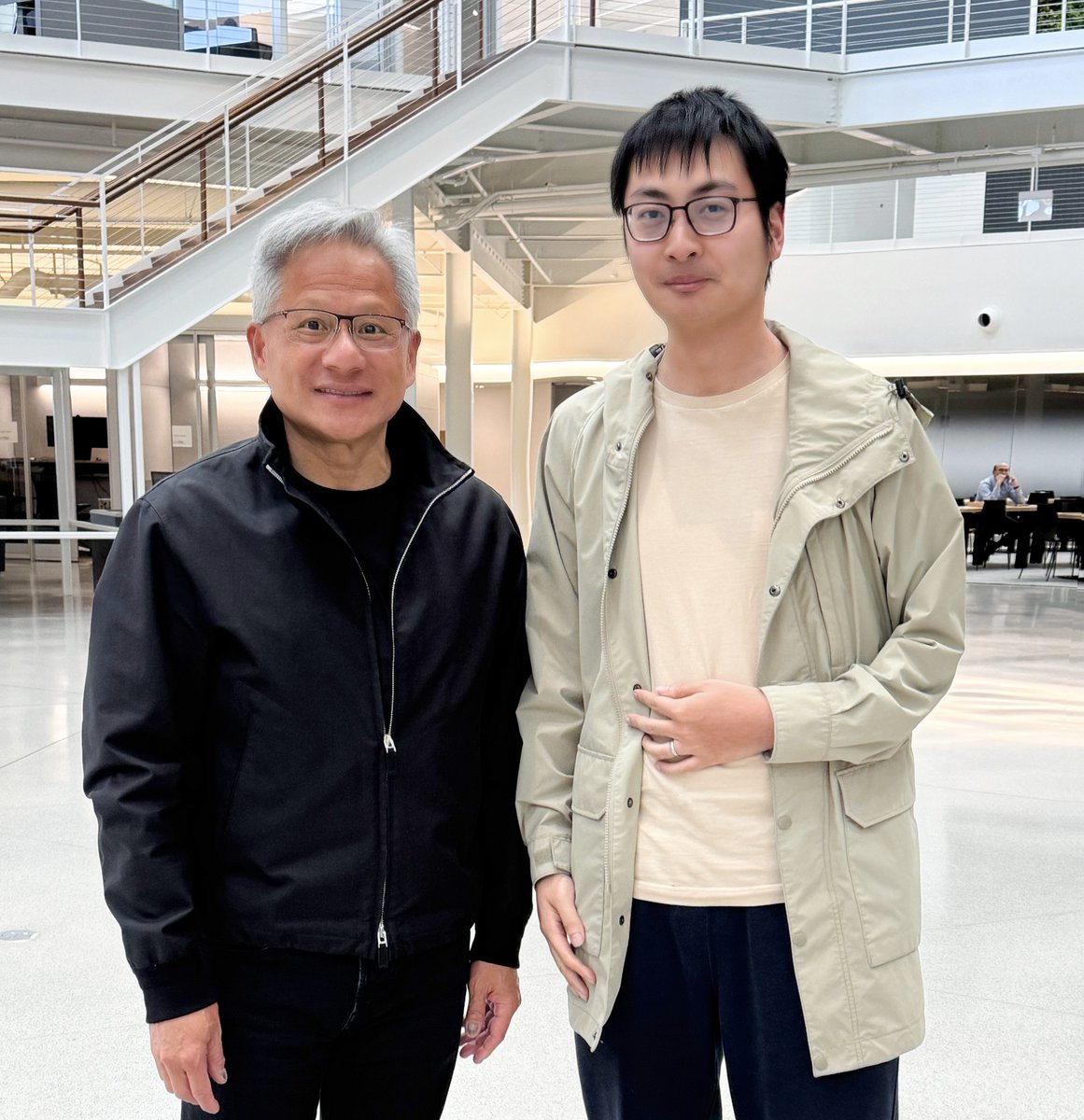
Excited to share that I’m joining NVIDIA as a Principal Research Scientist!
We’ll be joining forces on efforts in model post-training, evaluation, agents, and building better AI infrastructure—with a strong emphasis on collaboration with developers and academia. We’re committed to open-sourcing our work and sharing it with the world. Let’s build a stronger, more open AI community together!
New paper out with @mateodd25, Zach Frangella, Joel Tropp, and Rob Webber on randomized preconditioners for kernel ridge regression! Our goal was to develop simple preconditioners that are robust to different parameter choices for the kernel model https://t.co/W4Pptnj0Zw
@OwhadiGroup@HoumanOwhadi For scientific computing problems in high dimensional physical space, such as chemistry, Cholesky factorization can also work very well! Keep an eye on the randomly pivoted Cholesky that uses randomness to discover low rank structures effectively https://t.co/LelyLDAVuu
https://t.co/oBbng4DmrB Provably accelerating Gaussian process and kernel methods to near-linear complexity, even with derivative information, such as in solving PDEs! By @yifanc96@HoumanOwhadi and FlorianSchaefer
New preprint up about a simple, efficient, and (surprisingly) effective algorithm for positive semidefinite (psd) low-rank approximation joint with @yifanc96, Joel Tropp, and Robert Webber 1/4 https://t.co/ZfWwM30RKB