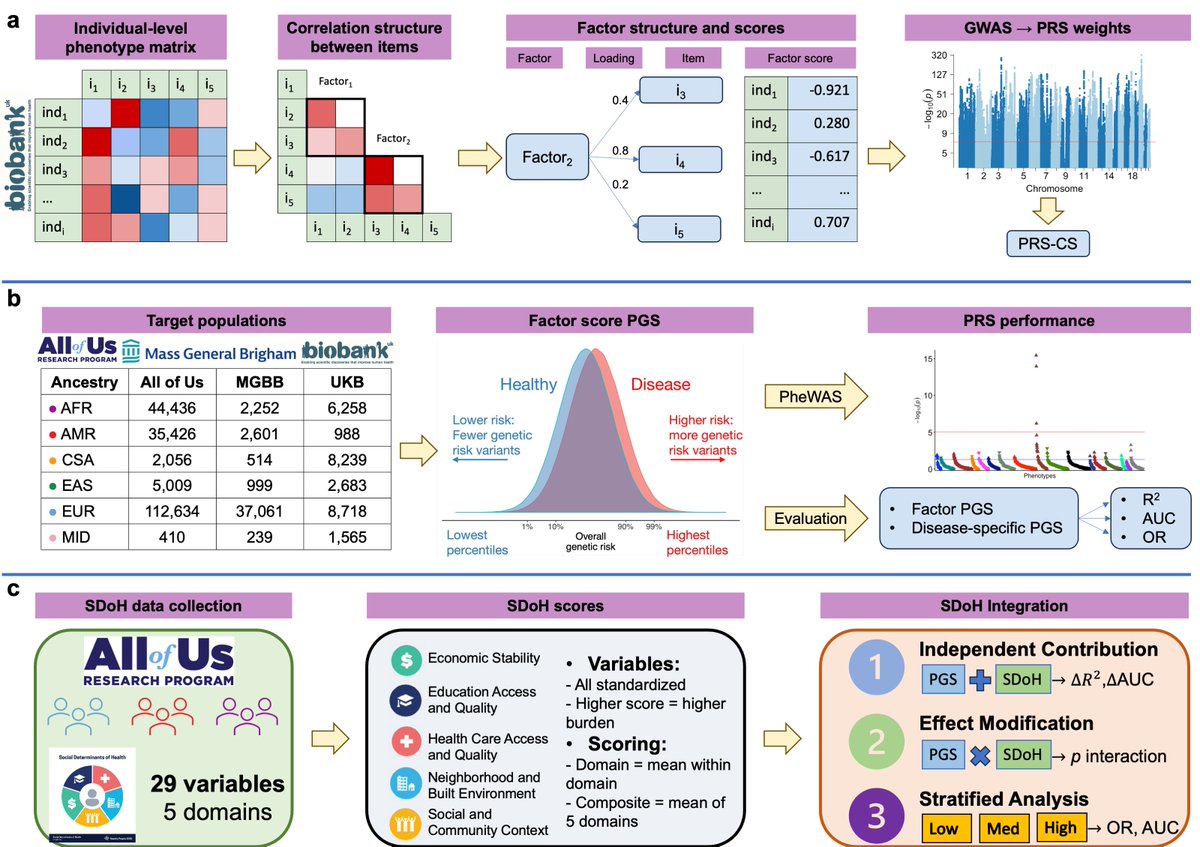
1/🎉New preprint: Phenome-derived polygenic scores and social determinants jointly shape context-dependent disease risk.
We evaluate disease risk along 2 axes:
• how genetic liability is represented
• the social context in which it is expressed
https://t.co/6UuXW85gOq
🎉Check out our preprint led by @LinkeLi_MGH@_ahmedmalaa with @pnatarajanmd : )
One of the biggest hurdles in proteomics is the non-replication of associations due to limited cross-platform correlation. We tackle this with ML models that bridge the two major ones, SomaScan and Olink, plus a tiered protein reliability system to guide which signals to trust.
We validate against gold-standard measurements, AlphaFold 3 predicted structures, and 3 real-world applications, including replication of published dementia🧠and heart failure🫀associations, showing markedly improved cross-platform replicability.
https://t.co/wCPdZrDbZd
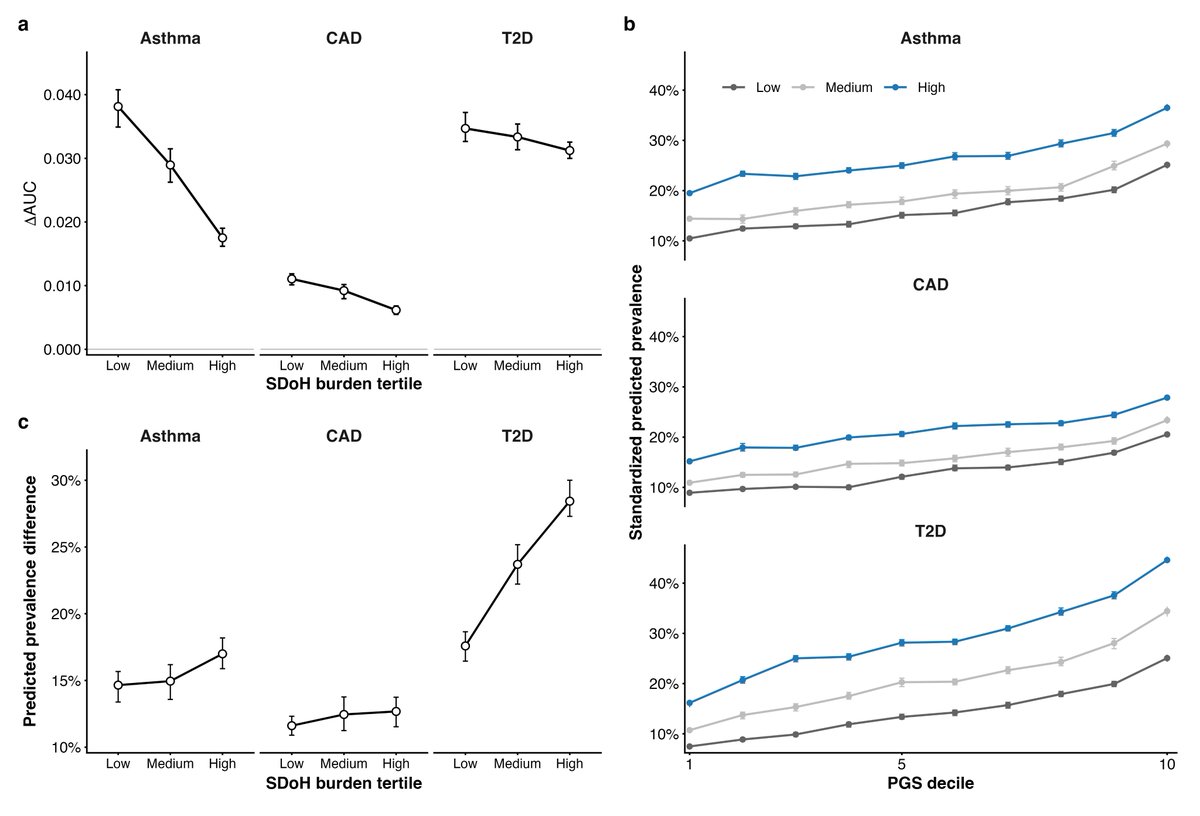
5/Third, explicit modeling of social determinants of health (SDOH) changed calibration and interpretation of genetic risk in AoU: the same genetic percentile could correspond to different predicted prevalences across social strata.
1/🎉New preprint: Phenome-derived polygenic scores and social determinants jointly shape context-dependent disease risk.
We evaluate disease risk along 2 axes:
• how genetic liability is represented
• the social context in which it is expressed
https://t.co/6UuXW85gOq
4/Second, predictive performance was strongly disease dependent:
• for asthma, the broader respiratory score performed best and showed stronger cross-ancestry portability
• for CAD and T2D, disease-specific scores remained stronger
🧵Super excited to share our new paper in @NatureGenet ⭐️
We apply a new multiple traits and ancestry approach to improve genetic discovery and polygenic prediction in lung diseases and traits 🫁
🎉Thrilled to receive the NoA for my NHGRI K99! Looking forward to studying disease progression using longitudinal EHRs + biobanks! Grateful for the support of my mentors Drs. @genetisaur, Mark Daly, and advisory committees Drs. @GENES_PK@pnatarajanmd@chiragjp@weizhouw
The lab has been busy these days! Some exciting new work:
- blended genome exome sequencing across >50k diverse genomes
- optimal PRS strategies in All of Us
- GWAS across dozens of traits in a Korean biobank
- deep dive into multi-trait genetics of lung diseases
We are pleased to share our latest study entitled "Exome wide association study for blood lipids in 1,158,017 individuals from diverse populations" (1/19) https://t.co/fpwBNP8OaH
Our SBayesRC method is now published in Nature Genetics! SBayesRC is a full Bayesian method for polygenic score prediction that can analyse all common variants jointly with functional annotations in a single step. @zhili_zheng@IMBatUQ https://t.co/r41yL58PWK
Examining genomic advances across diverse populations & highlighting reproductive genomics & precision oncology, @genetisaur & @yingwangyw et al. emphasize integrating genomic advances w/ social determinants of health in the latest @AJHGNews article: https://t.co/VHrVDG65Kn #ASHG
Delighted that our review discussing @genome_gov's bold prediction that by 2030 diverse ancestries will benefit equitably from genomics (https://t.co/Mv4X7oILAo) is published in AJHG! Focus is on major societal uses: reproductive medicine and oncology. https://t.co/JZNUuJrSkz.
Delighted to share our new work entitled "Integrative polygenic risk score improves the prediction accuracy of complex traits and diseases" is now on @CellGenomics
https://t.co/q02EkcgWPH
Very excited to share our new paper on Bioinformatics: https://t.co/wDHvy1c5Td, introducing admix-kit, a new software for analyzing admixed populations. @kangchenghou @bpasaniuc @PRSdiversity @NCIEpiTraining @OxfordJournals
4 years ago, we ran 16,554 GWASes for 7,271 traits across 6 ancestry groups and released the data to the public along with meta-analysis. After many careful dives through the results, we are happy to present these analyses on behalf of the Pan-UKB Project: https://t.co/hA1piiaSWH
I'm so excited the last piece of my PhD work is finally out! In this study, we unravelled the complex causal relationship between substance use behaviours and common diseases by Mendelian Randomization, genetic correlation, and dosage-dependent analyses. https://t.co/uVjysFK422