From the world stage at SNO in Philly straight to tomorrow morning's investor webcast.
$DRTS is putting targeted tumor-localized alpha therapy front and center for the entire oncology world.
8:30 AM ET. Don't miss it.
BREAKING: Israeli company Alpha Tau Medical has released updated results to their FDA brain cancer (rGBM) trials.
5 patients show NO SIGNS of the lesion after a one month MRI follow up.
SAFETY: 100% All patients treated met safety/feasibility results.
EFFICACY: 100% ORR. Complete Responses (CR) went from the initial 2/3 to 5/6. Every patient saw at least 58% reduction in tumor size. All patients are still alive.
IMPACT: While there are still 12 patients left in the FDA trial and survival duration is being monitored, it appears clear that $DRTS has achieved results thought impossible.
Targeted radiation from Alpha Tau’s platform is eliminating inoperable brain tumors.
@AlphaTauInsight If you know $DRTS, you know Piper Sandler has always been on the bearish/lowball side with their Neutral stance and that $8 PT. Changing to Overweight and raising the target to $22 is huge validation. If even Piper is this bullish now, this thing is primed to take off.
The $DRTS accumulation continues, as the index funds keep loading up just days before the next trail update
As Alpha Tau is set to share new data from the REGAIN trial for Recurrent GBM, it’s trading on the TASE at ~$14.5
“The company is expected to join the TASE indexes (TA-90 and TA-125) in the upcoming indexes update (November 5, 2026)”
The Head of Sales and Market Development at the Tel Aviv Stock Exchange (TASE) officially welcomes $DRTS at the opening ceremony
Alpha Tau (NASDAQ: $DRTS) “rings the bell” to start the TASE (Tel Aviv Stock Exchange) trading day
CEO Uzi Sofer: “This is just the beginning”
The company has been confirmed to join the indexes next Thursday (Nov 5)
Alpha Tau Medical and Samsung Medical Center have signed an MOU to explore a clinical trial of #AlphaDaRT for #PancreaticCancer in Korea.
A major step to bring new therapeutic hope to patients with limited options.
https://t.co/xJQpfuvg5A
#MedTech#ClinicalTrials#Oncology
$CLGN is running two completely separate companies under one Nasdaq ticker, and most investors are still only paying attention to one of them.
CollPlant's rhCollagen platform and AbbVie collaboration have anchored the CLGN story for years. A $2 million AbbVie milestone payment was triggered in 2025. The BioFlex DLP bioprinting kit launched in February 2026. Japan and South Korea patent coverage secured for the BioInk portfolio. These are real, ongoing commercial programs.
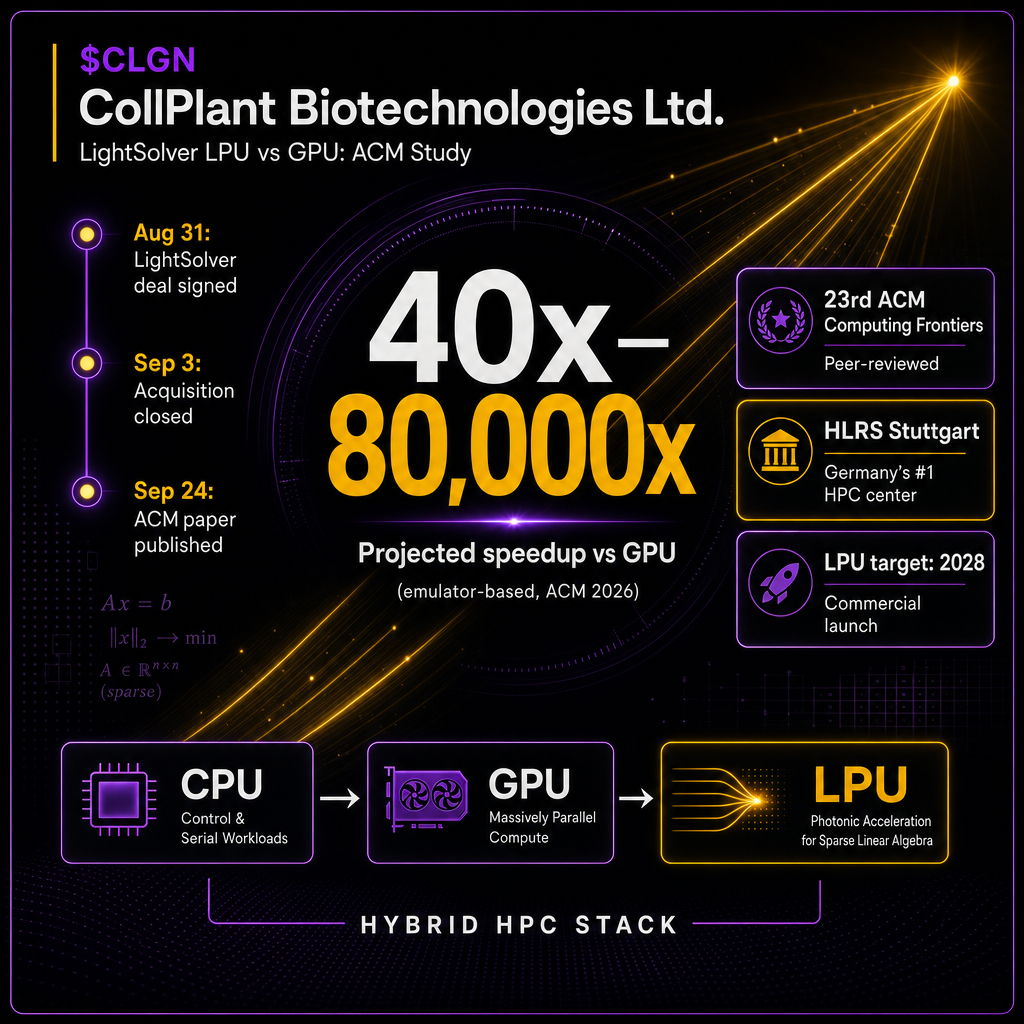
But on September 3, CollPlant closed the LightSolver acquisition, entering the photonic computing sector with an all-optical Laser Processing Unit that uses laser physics instead of transistors. Three weeks later, the first peer-reviewed scientific paper on LightSolver's architecture was published in the ACM Computing Frontiers proceedings, co-authored with HLRS, Germany's first federal supercomputing center, established 1996. The study projects 40x to more than 80,000x time-to-solution acceleration versus GPU algorithms on large-scale sparse linear equations. These are emulator-based projections, but the paper is peer-reviewed, the institutional co-author is world-class, and Boeing is among the named commercial validation partners.
Three weeks from acquisition close to a peer-reviewed ACM benchmark paper with HLRS is not a routine post-deal announcement cadence.
LightSolver's commercial availability target is 2028. The next catalyst: whether Boeing and the other named validation partners move from pilot evaluation to formal deployment commitments.
https://t.co/Bj57C1wmJ2
_
Disclosure: This content is not financial or investment advice. CollPlant Biotechnologies Ltd. is a paid subscriber to Wall Street Wire's coverage and distribution platform. Full disclosure: https://t.co/e8Ttqq9LeX
$CLGN just posted the first peer-reviewed external validation that photonic computing can outrun the GPU by five orders of magnitude. That claim is no longer a pitch deck thesis. It is ACM-published science, co-authored with one of Europe's premier supercomputing institutions.
⚡ LPU architecture projects 40x to 80,000x speedup vs. GPU on sparse linear solvers.
🔬 Peer-reviewed paper published in 23rd ACM Computing Frontiers proceedings, Sep 24.
🤝 Joint research with HLRS Stuttgart, Germany's first federal HPC center, est. 1996.
🌐 Vision: CPU + GPU + LPU hybrid stack, each handling its optimal workload class.
📅 LightSolver commercial availability target: LPU platform ready in 2028.
https://t.co/TkWvqDirkT
The LightSolver story inside CLGN is a structural inflection, not a product release. When CollPlant completed the LightSolver acquisition on September 3, it did not simply add a new subsidiary. It repositioned itself at the intersection of deep-tech computing and advanced biotechnology. The two verticals share almost no customers, no go-to-market infrastructure, and no underlying science. What they share is a Nasdaq ticker, a leadership team, and a thesis: that the same company can build world-class IP in biological fabrication and computational physics simultaneously. The ACM paper published September 24 is the first piece of external scientific evidence that the computing side of that thesis has independent credibility.
The specific technical claim requires careful reading. The projections, 40x to more than 80,000x acceleration over GPU algorithms, come from an emulator of LightSolver's LPU architecture, not from measurements on physical LPU hardware. The variance in that range is real: the speedup depends heavily on the algorithm and problem structure. For highly structured sparse systems, optical computing can exploit the physical properties of light in ways that silicon processors cannot. For less structured problems, the advantage narrows. This is standard photonic computing physics, not a caveat that diminishes the result. The paper validates the architectural concept, establishes a peer-reviewed methodology, and provides the scientific foundation for the next stage: validation on physical LPU hardware at HLRS-class supercomputing environments.
The HLRS partnership carries strategic weight beyond the benchmark numbers. HLRS is not a startup lab or a friendly collaborator. It was established in 1996 as Germany's first federal supercomputing center, operates infrastructure used by academic researchers and industrial partners across aerospace, energy, and engineering, and publishes in top-tier venues. The HLRS Director framing the LPU as a potential component in future hybrid computing architectures is not a marketing quote. It is an academic endorsement with downstream procurement implications. LightSolver's existing commercial validation program includes Boeing, a top-tier global financial institution, leading defense companies, and oil and gas organizations. Moving those relationships from evaluation pilots to embedded deployment is the commercial arc the ACM paper is designed to accelerate, and CollPlant's next series of announcements will show whether that arc is tracking.
https://t.co/TkWvqDirkT
_
Disclosure: This content is not financial or investment advice. CollPlant Biotechnologies Ltd. is a paid subscriber to Wall Street Wire's coverage and distribution platform. Full disclosure: https://t.co/XfvLkFMKXu
$CLGN: 40x to 80,000x. That is the projected performance gap between LightSolver's Laser Processing Unit and a GPU, for the workload class that dominates computational fluid dynamics, structural mechanics, and materials science simulations.
https://t.co/YaGDOwcY5T
Those numbers come from a peer-reviewed ACM study published September 24, 2026, conducted jointly by LightSolver, a CollPlant subsidiary, and HLRS, the High-Performance Computing Center Stuttgart, which was established in 1996 as Germany's first federal supercomputing center. Researchers benchmarked an emulator of LightSolver's LPU architecture against established iterative GPU algorithms across large-scale sparse linear equation problems.
The workload is not niche. Linear systems underlie some of the world's most computationally intensive science: molecular dynamics, electromagnetics, finite element analysis. These problems dominate HPC runtime and energy cost. LightSolver's vision is a hybrid stack where CPUs handle orchestration, GPUs handle parallel tensor compute, and LPUs handle the linear algebra bottlenecks optically.
The next update will reveal whether a physical LPU system can replicate these emulator-projected speedups at the scale HLRS operates, the test that determines whether this architecture moves from scientific validation to procurement.
_
Disclosure: This content is not financial or investment advice. CollPlant Biotechnologies Ltd. is a paid subscriber to Wall Street Wire's coverage and distribution platform. Full disclosure: https://t.co/c2JcMjJfRE
@AlphaTauMedical Announces #FDA Approval to Expand Alpha DaRT® U.S. Recurrent #Glioblastoma REGAIN Trial; New Trial Data to be Presented at SNO 2026 Annual Meeting
https://t.co/yHXrV8dOYV
$DRTS published two meaningful updates today: the FDA approved an IDE supplement doubling the REGAIN recurrent glioblastoma trial to 20 patients, and the Society for Neuro-Oncology accepted a REGAIN abstract for its 2026 Annual Meeting.
These are not standalone events. They are steps in a sequence. In December 2025, the first REGAIN patient was treated at The Ohio State University Comprehensive Cancer Center. In February and March 2026, two more followed. In May 2026, Alpha Tau reported 100% local disease control and a 67% complete response rate from those three patients. In June 2026, the FDA cleared the company to finish enrolling the original 10-patient cohort across two additional U.S. sites. In July 2026, the fifth patient was treated. Today, the trial doubles to 20 patients and gains meaningful new endpoints.
The updated protocol adds progression-free survival as a secondary endpoint, incorporates quality-of-life assessments, and opens enrollment to IDH-mutant grade 4 patients. It also includes an additional interim analysis six months after the fifth patient's treatment in July 2026.
The stakes frame on the 20-patient dataset: Alpha Tau stated it believes the expanded trial may support market submission requirements for Alpha DaRT in recurrent glioblastoma. This study began as a feasibility and safety trial. It is now being shaped, with the FDA's agreement, into a dataset that could support a regulatory filing for the deadliest form of primary brain cancer.
https://t.co/9Xl9iJWIds
_
Disclosure: This content is not financial or investment advice. Alpha Tau Medical Ltd. is a paid subscriber to Wall Street Wire's coverage and distribution platform. Full disclosure: https://t.co/vHItYxJ9Fk