I’m convinced that intelligence is overrated.
Intelligent people are more likely to overthink, overplan, and overanalyze. They hide behind motion that doesn't create progress. They fear the judgment of others if they're proven wrong.
The truth is that intelligence is abundant. Especially now. AI is making it a commodity. Courage is not. And it can’t be replaced. The people you admire are the ones who had the courage to act. They aren���t more talented than you. They aren’t smarter than you. They just took action when you didn’t.
I often wonder how many extraordinary people wasted their entire lives waiting for permission that never came. Permission isn't granted. Permission is taken. You get to tap yourself in whenever you want. You can just do things.
Courage beats intelligence. Remember that.
Anthropic engineer:
"You're not supposed to babysit the model. Put it in a graph, and it catches its own mistakes and runs a dozen tasks at once."
In 25 minutes he breaks down exactly how Anthropic builds agents that run in parallel, check each other's work, and recover when one fails.
Worth more than any paid course you'll find on building agents.
Watch it, then read detailed guide on graph engineering below.
For my first post, I’m sharing a letter @NVIDIA signed on why open models matter.
AI will transform every industry, power every company, and be built by every country.
Open models strengthen safety and cybersecurity, accelerate innovation and diffusion, and enable sovereignty.
The world needs both frontier closed models and frontier open models.
https://t.co/AUKzoQ5Ikb
Andrew Ng just released a 1-hour course on building agentic knowledge Graphs from scratch:
• 00:00 - Introduction to agentic knowledge Graphs
• 03:07 - Construction of agentic Graphs
• 14:00 - Architecture of multi-agent systems
• 23:00 - Building agentic graphs with Google ADK
• 01:06:03 - Why Graphsare the future of agentic AI
Worth more than 10 articles on loop engineering.
Watch it today, then read how to become a graph engineer in the article below.
One pattern I find useful for working with LLMs is a nice long ramble session. Sometimes the LLM needs more bits to understand what you're trying to achieve, but you're too lazy to type them. In these cases I like to lean back, switch to /voice and just ramble for like 10 minutes, total mess, anything goes, full stream of consciousness. Sometimes I declare it up top, something like "switching to speech recognition sorry for any typos...". Sometimes I turn it into a small interview of a few turns. But I find that the LLMs are somehow very good at reconstructing long incoherent rambles and often their echo of your own tangle of thoughts comes out quite a bit cleaner than what you started with. The result is that you improve the mind meld and have to correct things less from that point on.
New in Claude Cowork: teach Claude a skill.
Record your screen while you do a task, talk through it as you go, and Claude turns it into a skill it can run again. Find it under Record a skill in the + menu of the Claude desktop app.
Available on Pro, Max, and Team plans.
I talk to engineers at other companies every day and hear the same thing: one person is 10x'ing their output with Claude but the rest of the org hasn't caught up.
Watching teams adopt AI, I keep seeing the same 4 steps.
I mapped them out here: Steps of AI Adoption https://t.co/kQnRAUMKpP
Introducing ChatGPT Work, a new agent in ChatGPT powered by Codex and GPT-5.6.
It can take action across your apps and files, stay with a project for hours if needed, and turn a goal into finished work.
It’s a whole new way to get work done.
New in Claude Code: /checkup
Run /checkup to:
1. Clean up unused skills/MCPs/plugins and save context
2. Dedup your local CLAUDE.md against the checked in CLAUDE.md
3. Break up root CLAUDE.md into nested CLAUDE.md's + skills
4. Turn off slow hooks
5. Update your Claude Code to the latest version
6. Enable auto mode by default
7. Pre-approve frequently denied read-only commands
.. And a few other goodies.
/checkup confirms with you before making any changes. Enjoy!
My view of: Fable 5 vs GPT-5.6-Sol. They are not easy models to compare, these are my vibes - take them as you will.
My overall feel is that Fable is a 'wise owl' who is very thoughtful and very well spoken, GPT-5.6-Sol is like a rottweiler who will grab the problem by the throat and not let go until it is done.
In other words, Fable, is a fundamentally smarter model - even at low reasoning it can be very insightful and writes in a clear compelling way. GPT-5.6-Sol on the other hand is extremely diligent, I can give it a list of 8 things to do and you will be sure that they will be done.
Fable feels more arrogant to me, I was both to get it to build a new benchmark for me - 5.6 worked between 6 hours and 2 days (I tried several times) and it came up with very thoroughly tested, working benchmark. Fable came back within 40 minutes (twice) and the benchmark sounded smart, but was ultimately was 'vibe' based slop and since it was Fable's vibes that was doing the judging, it decided that it was good to go (it kept giving Fable 100% score btw).
Some thoughts by category:
UI & App building: Fable will still craft a better UI from scratch, the flow of the app would probably be a bit nicer. But I find that Fable often misses quite key things, which GPT-5.6-Sol doesn't. GPT's Frontend skills are big jump vs previous GPT models, but still not as great overall.
Writing: Fable is better hands down, Sol feels quite difficult to align to what I want to say or explain things to me simply. Though I think the 'Pro' model writes clearer.
Robustness & Reliability: This is where I think GPT-5.6-Sol wins for me hands down. Fable seems to do things of high quality, but I can never relax with it, it always misses something. With 5.6 this just almost never happens.
Other things where I liked GPT-5.6-Sol, but can't compare to Fable directly.
- Video editing is actually working now, it is not completely perfect, but with the right skill/guidance you can just give it 1h footage and it can give you a 5 min highlight clip no problem
- Computer use - getting really rather good, very usable
- Sub agents - it is very fluent at managing sub-agents and speaking to different threads, can help with some new workflows
- Adhering to existing code patterns - I love this, even without asking it would implement something in a way that aligns with you app - major problem for slop generation
- Research - I think it is getting quite a bit better, it still has some bad patterns (e.g being too tactical), but it feels like it is more steerable to be a good researcher
- Multi-day runs - the /goal feature is pretty insane with 5.6-Sol, you can run it for days if you wanted to and it does work. Useful to have another thread or /side to check up on it, but I have some great results with it
- Token efficiency - it is so much more token efficient and faster than 5.5, in reality it is now much faster than Fable too
On the downside, you can feel that Fable is naturally smarter, and I did have some baffling moments with 5.6 when I was getting it to make a fairly simple change in 8 turns - it seemed to get stuck in a dumb stream that was hard to get out of. So it is not AGI, don't get too carried away by the hype.
I have some phenomenal examples that I'm honestly blown away by that I'll share, but as a side anecdote, I have a kind of 'swear meter' which counts how often I'm rude to Codex. In GPT-5.5 era, the % was at around 4-5%, it dropped to 1-2% when I was testing GPT-5.6-Sol and it shot up to 7% when I went back to 5.5 - it was so shocking to go back to 5.5 and experience how much worse it was.
So is GPT-5.6-Sol better than Fable? On pure intelligence - no. But man, I missed it when I just wanted to get sh*t done. It is insanely capable workhorse that you can give any task to and just expect it to be done. No lectures or 'you are absolutely rightisms', nothing is beneath it, if it takes 2 days to do some dirty work, it will do it.
It feels like the first time in a while when we have quite different types of frontier intelligences that benchmark sort of similarly, but feel very different. If you can, you would be probably better off using both and iteratively finding what you'd use Fable or GPT-5.6-Sol for. Perhaps, something like - an architectural discussion with Fable, implementation with 5.6 and docs & comms with Fable.
Good new first: Sol is a smart, efficient, and a significant step forward. It is the same price as GPT-5.5. Also launching in the GPT-5.6 family is Terra, with 5.5-level performance at half the price.
Bad news: at the request of the US government, it is launching today in limited preview instead of the open access launch we were planning on. We are working with the government to get to general availability as fast as we can.
I think it is quite reasonable to roll out models--especially as they reach significant new levels of capability--in this way. It fits with our long-held strategy of iterative deployment. But this isn't quite the process that we think is optimal.
Now we will with the government to attempt to get to a transparent, reliable process for early access, and to ensure that as long as our safeguards work as intended we can release widely. We want to be a reliable, dependable partner that works with all stakeholders, and we also want to live by our mission of benefiting all of humanity. I believe the government shares most of our goals, and that they are overall doing a good job in a very difficult situation.
We will work as quickly as we can to get this model in your hands and we hope you will love it.
Introducing a limited preview of GPT-5.6 Sol, our next generation frontier model, as well as GPT-5.6 Terra, a balanced model for efficient, everyday work, and GPT-5.6 Luna, a fast and affordable model for high-volume work.
https://t.co/OoM83SyISN
How do you get Claude Code to check its own work before handing it back?
Watch how you can encode your manual checks so Claude closes its own feedback loop:
Claude Fable 5 changed how we work on the Claude Code team day to day.
We used to verify that Claude did the work right. Now we verify that it's doing the right work.
Here’s the 3 biggest changes:
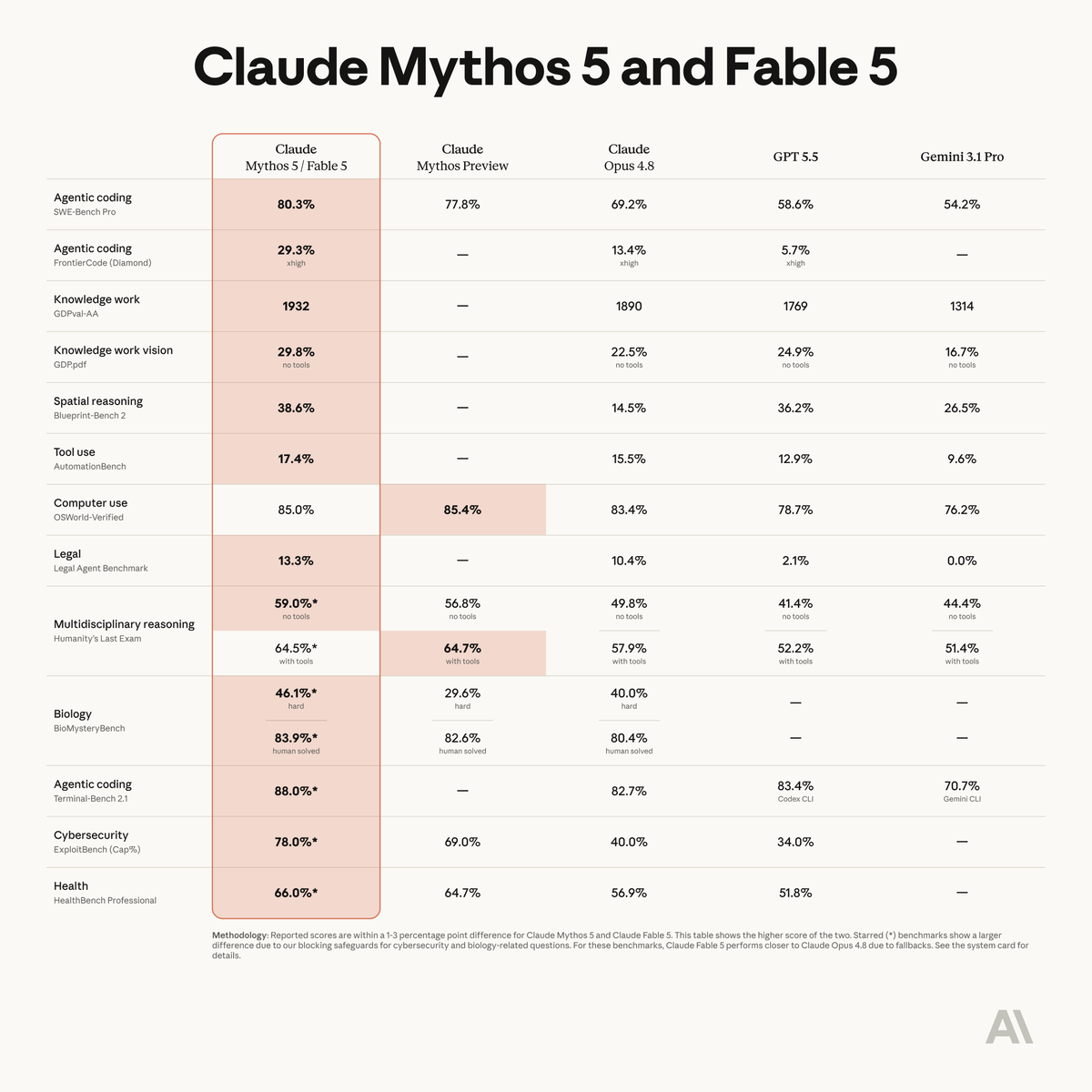
Fable 5 is state-of-the-art on nearly all tested benchmarks, with exceptional performance in software engineering, knowledge work, scientific research, and vision.
The longer and more complex the task, the larger Fable 5’s lead over our other models.