.@michaelpollan Perhaps I missed it, but why no mention of @penrose & @StuartHameroff ‘s Orch OR Theory in A World Appears? Seems like it’s worthy of a mention.
@FreedomFlash10@Jeopardy Sorry to confuse you. I didn’t say I was a celebrity. I’m saying the people on Celebrity Jeopardy aren’t really celebrities. Hopefully that clears it up.
@michaelpollan Maybe I missed it, but why no mention of @penrose & @StuartHameroff ‘s ORCH OR theory of consciousness in your book A World Appears?
@FrancescaHongWI@journalistish@GovEvers So, what’s your plan? Can your plan actually be implemented? Sometimes you have to cut deals to get things done, even though they aren’t perfect.
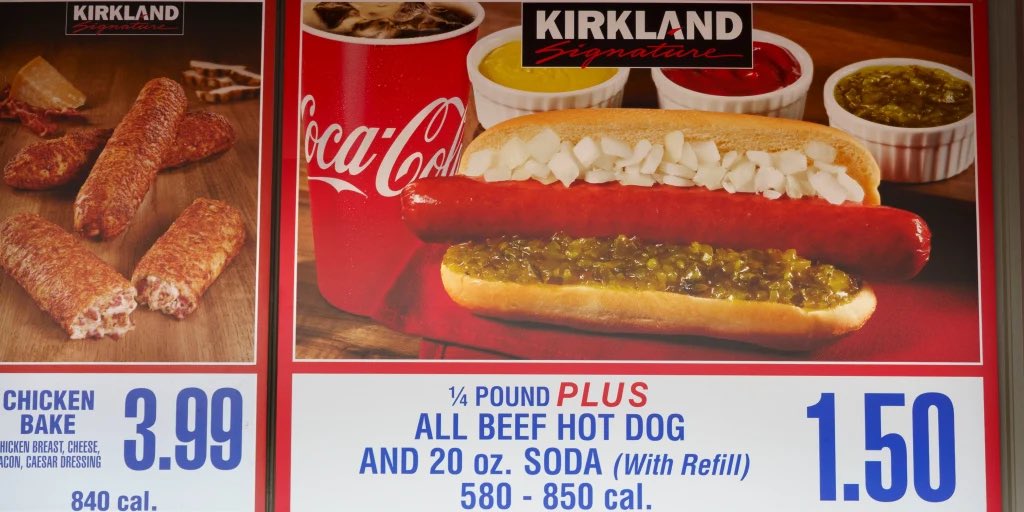
Costco has changed it’s $1.50 hotdog combo for the first time in 40 years 🌭
Instead of the soda on the side, you can now get a bottle of water if you’d prefer instead.
@pbeisel Do you think V15 will integrate Grok more deeply? I’m imagining Grok could be the conduit from Robotaxi passengers to the car. Taxi is in a tough spot and passengers can provide feedback via Grok that could help the car navigate without the need for Tesla remote team.
@farzyness@mikepat711 You seem to be basing your theory on the supposed 2,500 autonomous vehicle limit. But the thing is, that limit will not apply to Cybercab.
https://t.co/HJGYZU9V8L
Can Tesla scale the Cybercab beyond the 2,500 annual limit now?
It appears that Tesla could produce and deploy Cybercabs above the 2,500-vehicle cap only if the vehicle fully complies with all applicable FMVSS (Federal Motor Vehicle Safety Standards).
If Tesla certifies compliance, the exemption system - and its 2,500-vehicle annual limit - is irrelevant.
Tesla can scale far beyond 2,500 per year if Cybercab:
1) Meets all crashworthiness standards.
2) Meets all remaining FMVSS (lighting, glazing, braking, occupant protection, etc.).
3) Self-certifies like any normal vehicle.
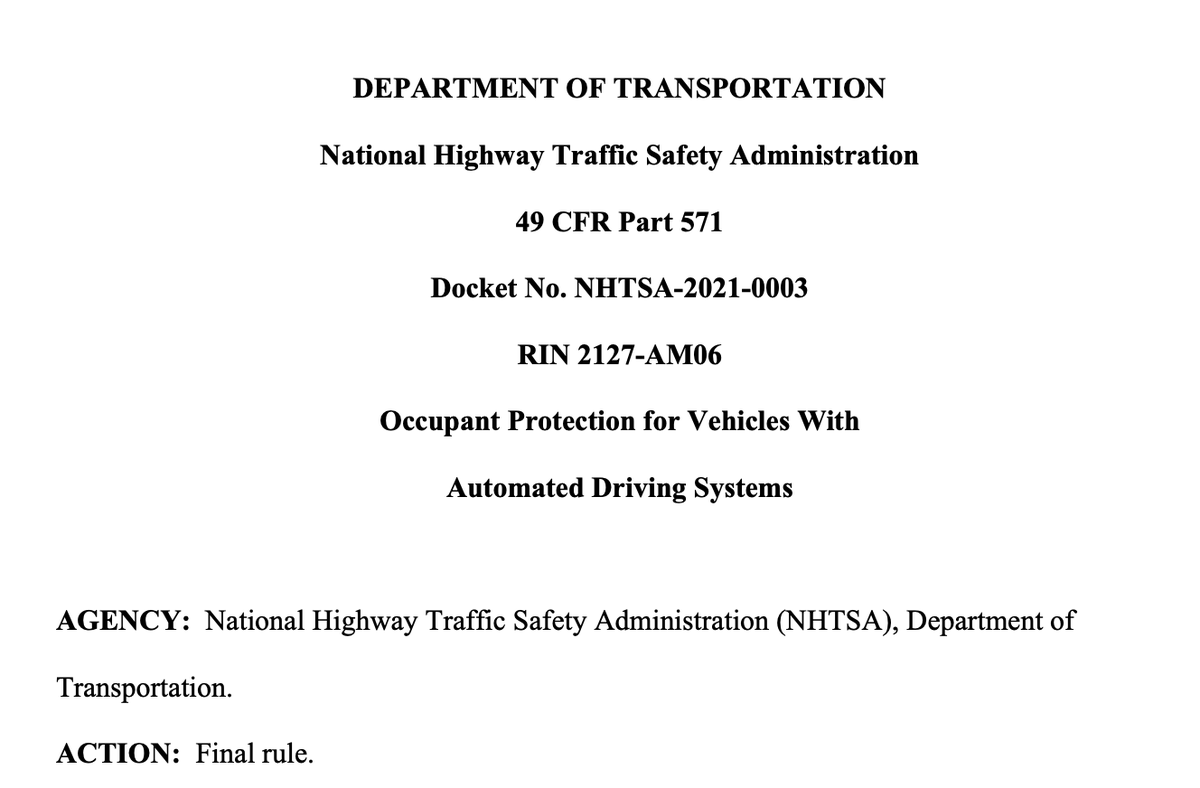
This rule (see linked post below) helps because it removes barriers tied to having no steering wheel.
If Cybercab is engineered for compliance from day one, the 2,500 limit never matters.
The rule explicitly acknowledges vehicles designed to operate solely by ADS may have no manually operated driving controls (including steering). Standards written around steering controls simply don’t apply and manufacturers do not need to add redundant manual controls just to comply (sorry @farzyness).
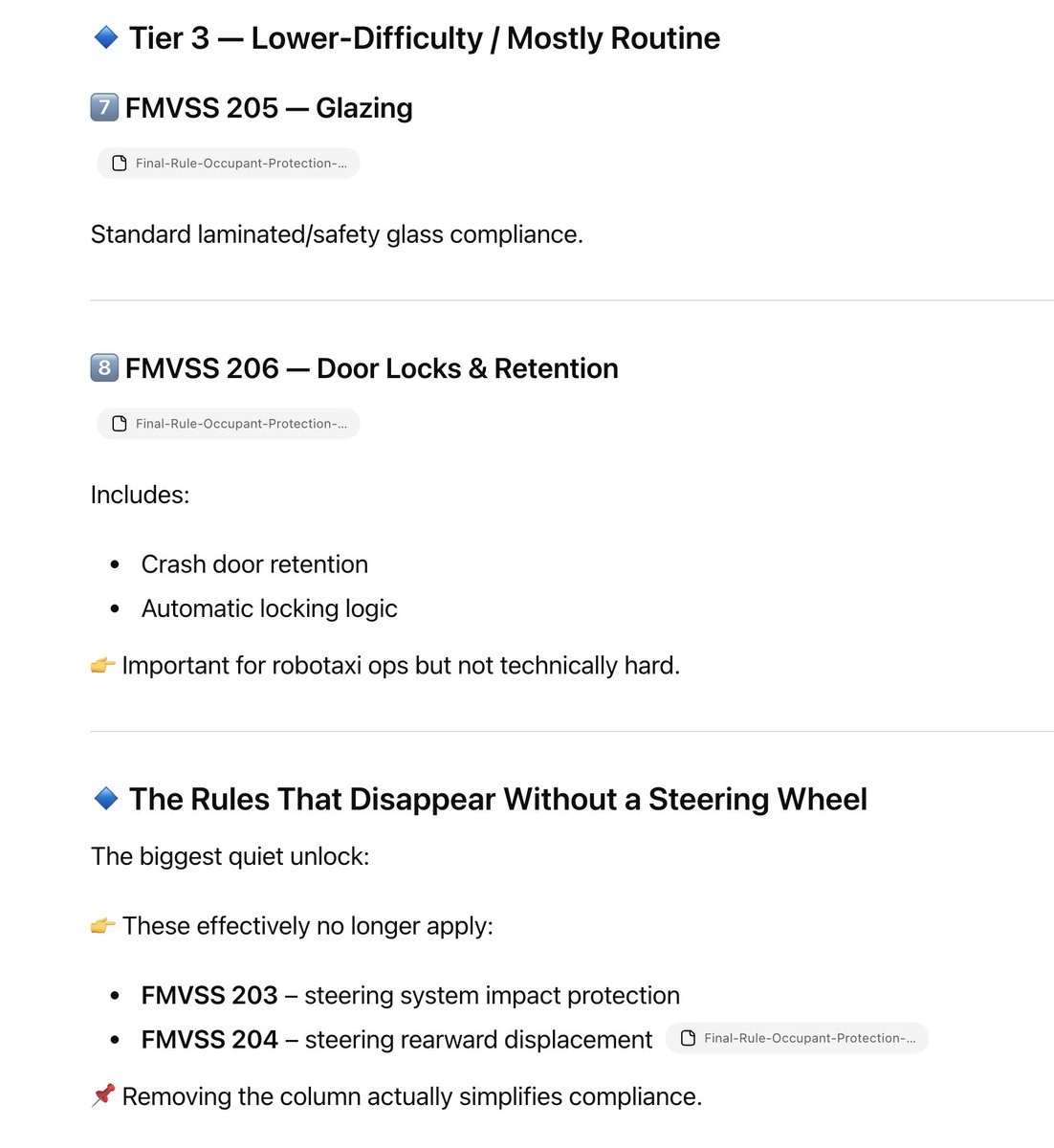
If a vehicle has no steering control system, these standards effectively drop out:
FMVSS 203 – impact protection from the steering control system
FMVSS 204 – steering control rearward displacement
Because there is no component to regulate.
Removing the wheel does NOT relax safety standards.
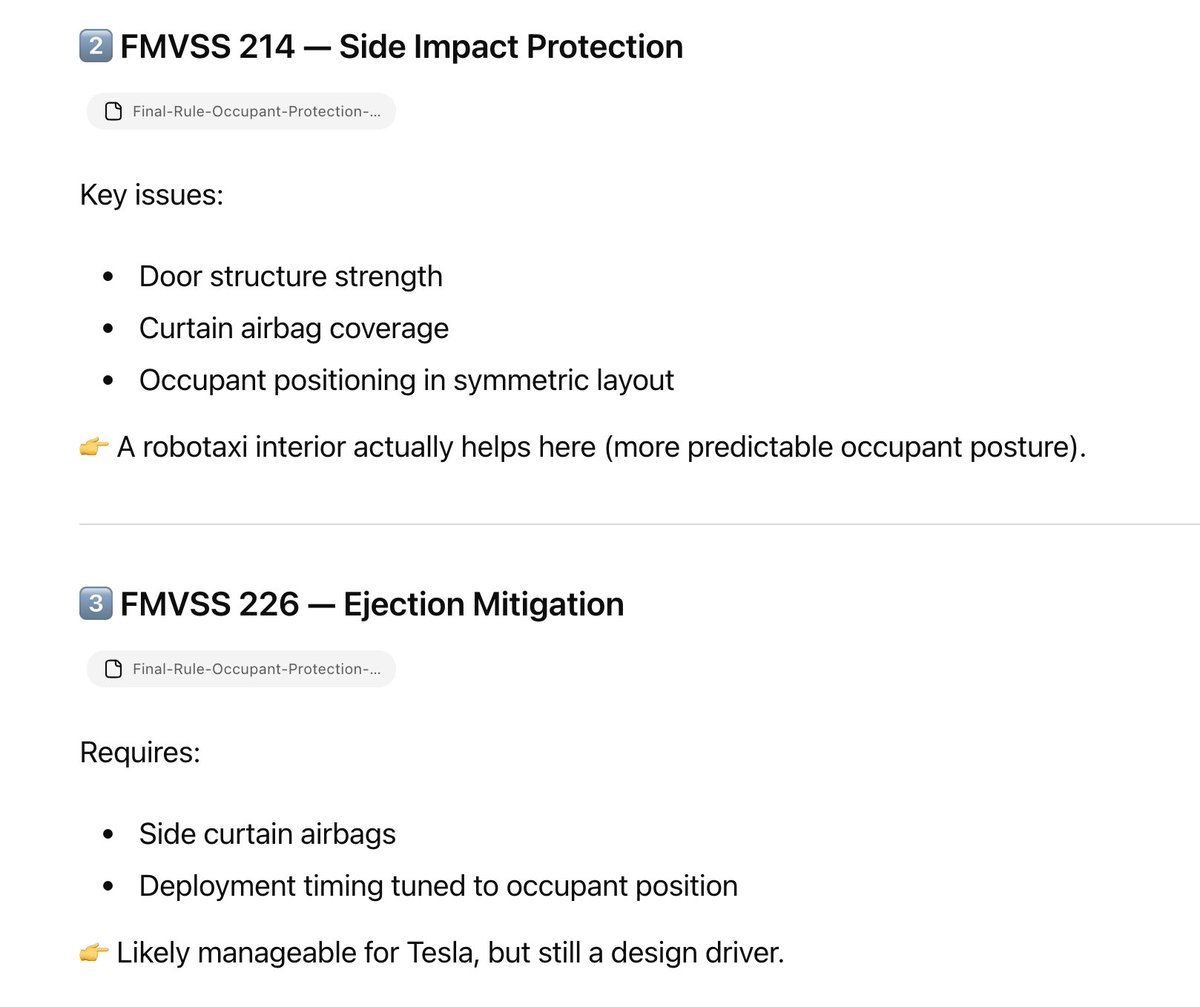
Vehicles without steering wheels must still meet:
- FMVSS 208 (airbags, restraints)
- FMVSS 214 (side impact)
- FMVSS 226 (ejection mitigation)
- Other crashworthiness rules
Dual-Mode Vehicles Follow Different Rules
If a vehicle has manual controls (even stowable), then the seat with access to them is still regulated as a driver position. So, removing the wheel entirely results in a simpler compliance path. Whereas stowable controls results in more regulatory complexity.
There is no “steering wheel rule.”
There is only a compliance rule - and post-2022, a driverless vehicle with no steering wheel is fully permissible under FMVSS if it meets all other safety standards.
@CernBasher How do you think geography will play into it? I live in WI and I feel we’ll be on the later end of regulatory approval for AVs. I actually have to travel to IL just to buy a Tesla. Would Tesla only offer Cybercab sales to limited areas?