Today's ENIGMA Summit compared over 20 brain disorders in tens of thousands of people scanned with MRI, and suggests that:
1. brain disorders that hit very early, before birth (e.g. those due to genomic copy number variants such as genetic deletions) tend to affect cortical surface area, often excessively in primary sensorimotor cortex
2. neurodevelopmental brain disorders that hit after birth but before adolescence tend to reduce cortical surface area more than (i.e. with greater effect sizes than) they reduce cortical thickness but more in a transmodal association cortex pattern than a primary sensorimotor pattern; these can be split into an strong externalizing and a weak internalizing pattern depending on the disorder type [4]
3. brain disorders that hit after puberty tend to affect cortical thickness, more so than regional cortical surface area, with some exceptions, as do adult onset disorders
4. the last category of mainly-thickness-deficit disorders can have their abnormality decomposed into 3 components - (1) a general component common to all disorders (PC1 in Zhipeng Cao's work [2]), (2) a disorder specific component, and (3) a medication effect;
5. focusing on the first two of these, there is a transdiagnostic covariance [1] that spans the set of disorder effects on the cortex and consists of 2 primary axes of disturbance, G1 and G2
6. to some extent, the amount and anatomical distribution of structural brain deviation in a disorder depends on the location and profile of greatest normal age-related brain change that is normally occurring in healthy people when the disorder hits and can look like an exaggerated version of that change, i.e. 'aging'
7. some of this is set out more formally in the transdiagnostic ENIGMA papers by Meike Hettwer/Sofie Valk on transdiagnostic covariance [1] and brain gradients, and in the linear PCA paper by Zhipeng Cat Hugh Garavan and ENIGMA [2]. For the CNV part see work by Clara Moreau [3], and for the childhood part see work by Sophie Townend and 4 of the ENIGMA neurodevelopmental working groups [unpublished except an abstract].
This is not really obvious until you see all the work presented together (as it was today at the ENIGMA Summit). Links in the thread below. @sofievalk@MMG_Kirschner@ClaraMoreau9@JulioVillaln1@kkumar_iitkgp@enigma_bipolar@ENIGMA_Diabetes@ENIGMA_ACRI@SCAN_Lab
חידוד אחרון לעניין הטור של ליבסקינד: הטור הוא כמובן מופע מפעים של התנשאות, וככזה נוטף מתפיסת העליונות של ליבסקינד ודומיו, אדוני הארץ. הם טובים יותר, נאמנים יותר, שווים יותר. אבל מאחורי כל תפיסת עליונות מסתתרת תחושת נחיתות, ולכן יותר משליבסקינד ודומיו בזים לעוזבים, הם מרגישים מושפלים על ידם. הם יודעים שהעוזבים דוחים אותם ואת השותפות איתם ולכן ליבסקינד מגיב כמו גבר דוּש שנזרק על ידי האישה שהוא חפץ בה, ואז צועק אחריה בעלבון ״לכי לכי יא מכוערת, מי בכלל רוצה אותך״.
וכשקוראים את הטור באור הזה, מבינים שכאשר ליבסקינד כותב על העצה לחברו להתחתן עם עוד אישה שנייה ״על כל צרה שלא תבוא״, הוא בעצם חושף את הפחד העמוק להינטש, מוסווה מאחורי עמדת כוח של הבעל.
איזה ממזר הוא הלא-מודע, הא?
Great talk by my colleague Dr. Xi Zhu at @ColumbiaPsych ground rounds on data-driven computational psychiatry. Exciting to learn more about the transition from neuroimaging to clinical settings, specifically in PTSD.@ColumbiaPTSD@yuvalneria
Today's Grand Rounds features 3 presentations as part of our Spotlight on Innovation - Early Stage Investigators Series.
Wei-li Chang, MD, PhD, @DrAlessiaM, and Xi Zhu, PhD, will be presenting soon! Zoom link and full presentation details: https://t.co/iGwbid1IxY
Congratulations to @myrnaweissman, PhD, who recently received the 2024 @WIMLF's Alma Dea Morani Award, which recognizes outstanding women physicians or scientists who have furthered the practice and understanding of medicine!
הכנס השנתי של האיגוד הישראלי לפסיכיאטריה ביולוגית יערך ב 27.3, ב @OpenU_Israel רעננה. בערך חצי ממנו יהיה על #טראומה כולל הרצאה של @yuvalneria ושני פאנלים על טראומה בהנחיית @RoeeAdmon ופרופ' חגית כהן. לפרס המנטורית המצטיינת נבחרה @STsoory 👏👏👏
**הרשמה מוקדמת מסתיימת מחר**
Proud of Dr Maja Bergman at @ColumbiaPTSD who envisioned and tested a novel treatment, Mindfulness-based Intervention Shows Promise for PTSD in Cardiac Arrest Survivors https://t.co/splSLOScf4
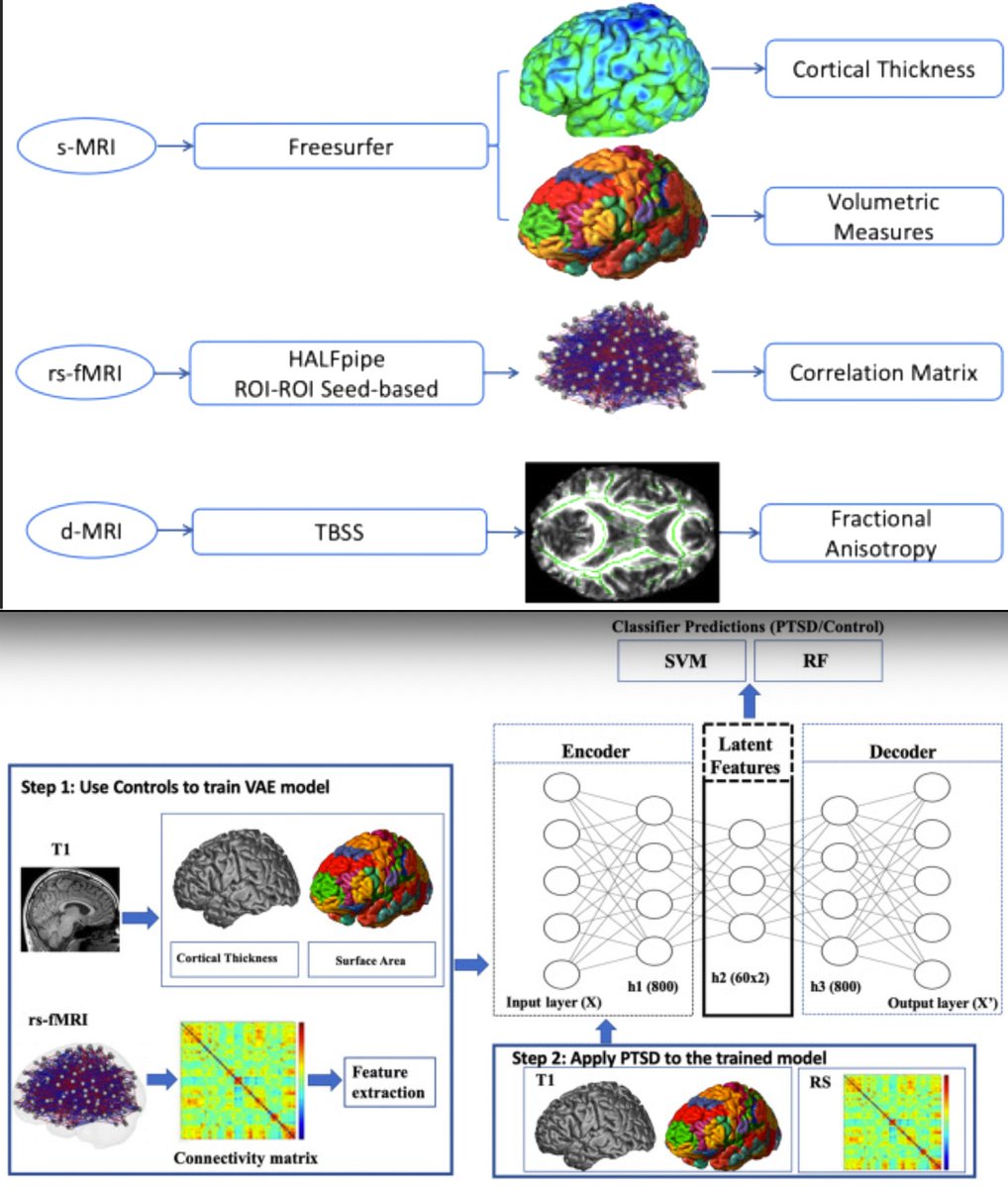
Combine anatomical MRI, diffusion MRI, functional MRI in psychiatry, by using deep learning to distill information from each type of brain scan: Xi Zhu + colleagues showcase their multimodal denoising variational autoencoder (DVAE) in "Neuroimaging-based classification of PTSD using data-driven computational approaches: A multisite big data study from the ENIGMA-PGC PTSD consortium" https://t.co/frebt8AJ8H
Speaking with @LeviYonit & @Freedland on their amazing podcast. We have touched on the true meaning of combat bravery, and in what way a personal trauma might be entirely different from collective trauma. @columbiaPTSD@ColumbiaPsych
The Yom Kippur war began 50 years ago today. To mark it, @LeviYonit and I spoke with @yuvalneria, veteran of that war and one of only 40 people ever to receive Israel’s medal of valour - and now a world authority on PTSD. Latest Unholy https://t.co/5DHtcbxgPd
Thank you....this full academic paper looks like a useful piece of thought provoking critical research into trauma.....an important area.....showing that proving what does and doesn't work may sometimes be progress of a sort....leading to further possibities.....🤔🙂
A wonderful turn out for the #WashingtonHeights Mental Health Awareness walk yesterday. Thank you to Wurzweiler Care Cafe, NYC Councilmember @CnDelarosa and Assemblyman @MannyDeLosSanto for giving me the opportunity to speak on veteran issues and how @ColumbiaPsych can help our community


![PTenigma's tweet photo. Today's ENIGMA Summit compared over 20 brain disorders in tens of thousands of people scanned with MRI, and suggests that:
1. brain disorders that hit very early, before birth (e.g. those due to genomic copy number variants such as genetic deletions) tend to affect cortical surface area, often excessively in primary sensorimotor cortex
2. neurodevelopmental brain disorders that hit after birth but before adolescence tend to reduce cortical surface area more than (i.e. with greater effect sizes than) they reduce cortical thickness but more in a transmodal association cortex pattern than a primary sensorimotor pattern; these can be split into an strong externalizing and a weak internalizing pattern depending on the disorder type [4]
3. brain disorders that hit after puberty tend to affect cortical thickness, more so than regional cortical surface area, with some exceptions, as do adult onset disorders
4. the last category of mainly-thickness-deficit disorders can have their abnormality decomposed into 3 components - (1) a general component common to all disorders (PC1 in Zhipeng Cao's work [2]), (2) a disorder specific component, and (3) a medication effect;
5. focusing on the first two of these, there is a transdiagnostic covariance [1] that spans the set of disorder effects on the cortex and consists of 2 primary axes of disturbance, G1 and G2
6. to some extent, the amount and anatomical distribution of structural brain deviation in a disorder depends on the location and profile of greatest normal age-related brain change that is normally occurring in healthy people when the disorder hits and can look like an exaggerated version of that change, i.e. 'aging'
7. some of this is set out more formally in the transdiagnostic ENIGMA papers by Meike Hettwer/Sofie Valk on transdiagnostic covariance [1] and brain gradients, and in the linear PCA paper by Zhipeng Cat Hugh Garavan and ENIGMA [2]. For the CNV part see work by Clara Moreau [3], and for the childhood part see work by Sophie Townend and 4 of the ENIGMA neurodevelopmental working groups [unpublished except an abstract].
This is not really obvious until you see all the work presented together (as it was today at the ENIGMA Summit). Links in the thread below. @sofievalk @MMG_Kirschner @ClaraMoreau9 @JulioVillaln1 @kkumar_iitkgp @enigma_bipolar @ENIGMA_Diabetes @ENIGMA_ACRI @SCAN_Lab](https://pbs.twimg.com/media/GeDuPXaWIAAHQZS.jpg)
![PTenigma's tweet photo. Today's ENIGMA Summit compared over 20 brain disorders in tens of thousands of people scanned with MRI, and suggests that:
1. brain disorders that hit very early, before birth (e.g. those due to genomic copy number variants such as genetic deletions) tend to affect cortical surface area, often excessively in primary sensorimotor cortex
2. neurodevelopmental brain disorders that hit after birth but before adolescence tend to reduce cortical surface area more than (i.e. with greater effect sizes than) they reduce cortical thickness but more in a transmodal association cortex pattern than a primary sensorimotor pattern; these can be split into an strong externalizing and a weak internalizing pattern depending on the disorder type [4]
3. brain disorders that hit after puberty tend to affect cortical thickness, more so than regional cortical surface area, with some exceptions, as do adult onset disorders
4. the last category of mainly-thickness-deficit disorders can have their abnormality decomposed into 3 components - (1) a general component common to all disorders (PC1 in Zhipeng Cao's work [2]), (2) a disorder specific component, and (3) a medication effect;
5. focusing on the first two of these, there is a transdiagnostic covariance [1] that spans the set of disorder effects on the cortex and consists of 2 primary axes of disturbance, G1 and G2
6. to some extent, the amount and anatomical distribution of structural brain deviation in a disorder depends on the location and profile of greatest normal age-related brain change that is normally occurring in healthy people when the disorder hits and can look like an exaggerated version of that change, i.e. 'aging'
7. some of this is set out more formally in the transdiagnostic ENIGMA papers by Meike Hettwer/Sofie Valk on transdiagnostic covariance [1] and brain gradients, and in the linear PCA paper by Zhipeng Cat Hugh Garavan and ENIGMA [2]. For the CNV part see work by Clara Moreau [3], and for the childhood part see work by Sophie Townend and 4 of the ENIGMA neurodevelopmental working groups [unpublished except an abstract].
This is not really obvious until you see all the work presented together (as it was today at the ENIGMA Summit). Links in the thread below. @sofievalk @MMG_Kirschner @ClaraMoreau9 @JulioVillaln1 @kkumar_iitkgp @enigma_bipolar @ENIGMA_Diabetes @ENIGMA_ACRI @SCAN_Lab](https://pbs.twimg.com/media/GeDuNbtWUAAolYN.jpg)
![PTenigma's tweet photo. Today's ENIGMA Summit compared over 20 brain disorders in tens of thousands of people scanned with MRI, and suggests that:
1. brain disorders that hit very early, before birth (e.g. those due to genomic copy number variants such as genetic deletions) tend to affect cortical surface area, often excessively in primary sensorimotor cortex
2. neurodevelopmental brain disorders that hit after birth but before adolescence tend to reduce cortical surface area more than (i.e. with greater effect sizes than) they reduce cortical thickness but more in a transmodal association cortex pattern than a primary sensorimotor pattern; these can be split into an strong externalizing and a weak internalizing pattern depending on the disorder type [4]
3. brain disorders that hit after puberty tend to affect cortical thickness, more so than regional cortical surface area, with some exceptions, as do adult onset disorders
4. the last category of mainly-thickness-deficit disorders can have their abnormality decomposed into 3 components - (1) a general component common to all disorders (PC1 in Zhipeng Cao's work [2]), (2) a disorder specific component, and (3) a medication effect;
5. focusing on the first two of these, there is a transdiagnostic covariance [1] that spans the set of disorder effects on the cortex and consists of 2 primary axes of disturbance, G1 and G2
6. to some extent, the amount and anatomical distribution of structural brain deviation in a disorder depends on the location and profile of greatest normal age-related brain change that is normally occurring in healthy people when the disorder hits and can look like an exaggerated version of that change, i.e. 'aging'
7. some of this is set out more formally in the transdiagnostic ENIGMA papers by Meike Hettwer/Sofie Valk on transdiagnostic covariance [1] and brain gradients, and in the linear PCA paper by Zhipeng Cat Hugh Garavan and ENIGMA [2]. For the CNV part see work by Clara Moreau [3], and for the childhood part see work by Sophie Townend and 4 of the ENIGMA neurodevelopmental working groups [unpublished except an abstract].
This is not really obvious until you see all the work presented together (as it was today at the ENIGMA Summit). Links in the thread below. @sofievalk @MMG_Kirschner @ClaraMoreau9 @JulioVillaln1 @kkumar_iitkgp @enigma_bipolar @ENIGMA_Diabetes @ENIGMA_ACRI @SCAN_Lab](https://pbs.twimg.com/media/GeDuL9pWMAAkilg.jpg)


![PTenigma's tweet photo. Today's ENIGMA Summit compared over 20 brain disorders in tens of thousands of people scanned with MRI, and suggests that:
1. brain disorders that hit very early, before birth (e.g. those due to genomic copy number variants such as genetic deletions) tend to affect cortical surface area, often excessively in primary sensorimotor cortex
2. neurodevelopmental brain disorders that hit after birth but before adolescence tend to reduce cortical surface area more than (i.e. with greater effect sizes than) they reduce cortical thickness but more in a transmodal association cortex pattern than a primary sensorimotor pattern; these can be split into an strong externalizing and a weak internalizing pattern depending on the disorder type [4]
3. brain disorders that hit after puberty tend to affect cortical thickness, more so than regional cortical surface area, with some exceptions, as do adult onset disorders
4. the last category of mainly-thickness-deficit disorders can have their abnormality decomposed into 3 components - (1) a general component common to all disorders (PC1 in Zhipeng Cao's work [2]), (2) a disorder specific component, and (3) a medication effect;
5. focusing on the first two of these, there is a transdiagnostic covariance [1] that spans the set of disorder effects on the cortex and consists of 2 primary axes of disturbance, G1 and G2
6. to some extent, the amount and anatomical distribution of structural brain deviation in a disorder depends on the location and profile of greatest normal age-related brain change that is normally occurring in healthy people when the disorder hits and can look like an exaggerated version of that change, i.e. 'aging'
7. some of this is set out more formally in the transdiagnostic ENIGMA papers by Meike Hettwer/Sofie Valk on transdiagnostic covariance [1] and brain gradients, and in the linear PCA paper by Zhipeng Cat Hugh Garavan and ENIGMA [2]. For the CNV part see work by Clara Moreau [3], and for the childhood part see work by Sophie Townend and 4 of the ENIGMA neurodevelopmental working groups [unpublished except an abstract].
This is not really obvious until you see all the work presented together (as it was today at the ENIGMA Summit). Links in the thread below. @sofievalk @MMG_Kirschner @ClaraMoreau9 @JulioVillaln1 @kkumar_iitkgp @enigma_bipolar @ENIGMA_Diabetes @ENIGMA_ACRI @SCAN_Lab](https://pbs.twimg.com/media/GeDuSNmWEAAA-eC.jpg)