OpenAI at 70b net never really made any sense intuitively.
Still seems like net ARR added in September was 17b similar to 17b in August. 17b is still pretty ridiculous and suggests we finish the year ~200b gross across ANT / OAI.
$SPY Seasonality (Since 1928)
1) January: +1.1% — Often strong from the “January Effect” as capital gets redeployed, though variability is high.
2) February: +0.3% — Moderately positive, but typically softer than January.
3) March: +0.8% — Generally constructive as Q1 wraps up.
4) April: +1.4% — One of the strongest months, supported by optimism and tax-related flows.
5) May: -0.1% — Marks the “Sell in May” period; returns tend to flatten with higher volatility.
6) June: -0.2% — Historically weaker with lower volumes and early summer slowdown.
7) July: +1.3% — Strong, often driven by earnings season tailwinds.
8) August: -0.1% — Volatile and inconsistent, with frequent drawdowns.
9) September: -0.7% — Statistically the weakest month, with rising caution post-summer.
10) October: +0.8% — Known for volatility, but positive on average and often a rebound month.
11) November: +1.3% — Seasonally strong, supported by holiday demand and sentiment.
12) December: +1.0% — “Santa Claus Rally” effect, with year-end optimism lifting markets.
-data source from refinitiv
Just being real, 9/10 of you won't make it trading , you won't put it the work it takes and you're going to go from course to course looking for a magically method and never really make fuck all because your lazy and lack discipline.
Someone's gotta say it
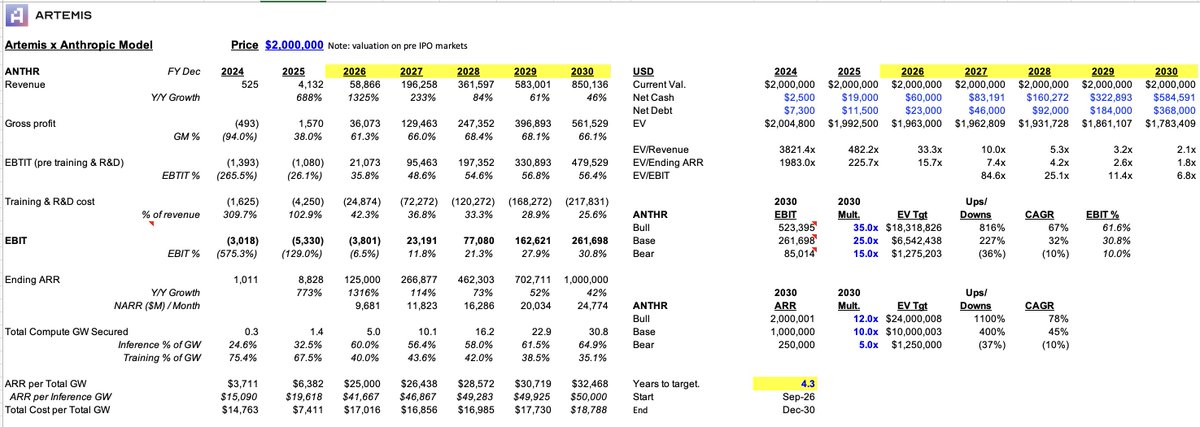
HERE'S THE ANTHROPIC MODEL: Anthropic will go public at $2T in Oct '26 and will be a $1T ARR company and $10T+ company Dec' 2030 as the winner of AI.
Here's how Anthropic gets to $1T ARR in 2030:
- 2026E: $125B ARR +14x YoY w/ 5 GW live
- 2027E: $266B ARR + 114% YoY w/ 10 GW live
- 2028E: $462B ARR +73% YoY w/ 16 GW live
- 2029E: $700B ARR +52% YoY w/ 23 GW live
- 2030E: $1T ARR + 42% YoY w/ 30 GW live
I'm dropping my full Excel model modeling out:
- ARR by business model (e.g Consumer, B2B, Enterprise, API)
- API business broken down by model type (e.g Fable 5.1, Mythos, Opus, Sonnet)
- Training costs and inference cost as a % of revenue
- Gross Margin ($ ARR per MW and Cost of Compute per MW) as well as forecasting GW secured.
- Net ARR (vs Gross ARR reported by trackers) removing marketplace pay out, Meta, Chinese AI labs
- and more
I also share the @artemis thesis for WHY Anthropic is the AWS of AI and winner of AI in the enterprise (and open source and ANT / OpenAI can win)
Get the full model here: https://t.co/FWIHfFEyVa
Full Disclosure: I don't have inside information. I took what's publicly available from the July '26 @SemiAnalysis_ model and added my own judgement based on public information and my own world views. I've spent a life time modeling as a former HF and VC analyst. I'll update the model as soon as the S-1 drops.
The hard rotation in technology is wreaking havoc on many recent breakout names. A number of former leaders that suffered significant declines rallied quickly back up their right sides, but that rapid recovery created another problem: technical time compression combined with substantial overhead supply.
When a stock suffers a large decline and then races back up in a quick V recovery, it may look strong on the surface, but the structure underneath can still be vulnerable to sharp volatility. There simply hasn't been enough time for the stock to properly repair the technical damage, shake out weak holders, and work through the supply created during the prior decline.
We're seeing the consequences of that now as some of these stocks experience sharp pullbacks.
The question is what happens next.
Do these former leaders find support, tighten up and begin constructing legitimate right sides to their bases? Or is the current weakness the beginning of another leg lower and a continuation of the correction?
At this stage, there is no reason to guess.
The best course of action is to avoid questionable structures that haven't had sufficient time to develop proper pivots. A stock moving rapidly back toward its highs does not automatically mean it has built a sound base or offers a low-risk entry.
Particular caution should be exercised with stocks that have suffered declines of 45% or greater in a relatively short period and then rallied rapidly back into overhead supply. These situations can produce powerful rebounds, but they can also create significant volatility as trapped shareholders use the strength to get out near breakeven.
Let the stocks prove themselves.
The strongest names will absorb the supply, hold important support levels, tighten their price action and eventually present properly developed setups. If they can't do that, there is no reason to force the trade and play right into the hands of volatility.
Time is an important ingredient in technical repair. Don't confuse a fast recovery with a completed base, and don't confuse volatility with alpha.
https://t.co/FfBnR93ojq
https://t.co/TFyCpPHZis
https://t.co/JXzFFTmMtn
How to recognize a fake bottleneck / monopolist:
1. Low gross margins and R&D - indicators of a commoditized business in semis
2. Lack of historical growth - indicator of no pricing power and that historically this company hasn't benefitted from a strong semis cycle
There's a lot of illiquid bags being pumped, of mediocre and even lower quality, make sure you're not the last one holding these
Hej Sven synd att du inte fårr svar. Skall försöka summera några saker som jag ser som helt nytt.
1. Sivers is being integrated directly into GF's SCALE platform. GF only introduced SCALE publicly about a month ago. Until now, GF had announced the platform itself, but not a laser partner embedded into that ecosystem. The release states that Sivers' laser arrays will be available in GF's SCALE™ (Silicon Photonics Co-packaged Advanced Light Engine) platform and reference designs. Being picked as GF reference design vs Lumentum/SmartPhontics is strong statement and validation of Sivers as Laser supplier into the AI ecosystem. That means Sivers is no longer just supplying components into the market generally; it is becoming part of GF's preferred silicon photonics architecture.
2. Expansion beyond CPO into LPO and broader optical connectivity like Pluggables with a large TAM that is closer to ramp (1.6T. Pluggables). Earlier Sivers announcements focused heavily on External Light Sources (ELS) for CPO deployments. This release explicitly says the collaboration supports: a) Co-Packaged Optics (CPO) b) Linear Pluggable Optics (LPO), c) Other emerging datacenter interconnect architectures. This broadens the addressable market materially beyond the ELS/CPO discussed previously.
3. The first full foundry-level endorsement of Sivers' laser technology. All other communications with GF had been in group of companies or partnerships with Ayar Labs, or Wireless. Now adding foundry-level endorsement to previous announcements, with system and module partners such as O-Net, Enablence and Jabil. This is different because GF is one of the world's leading silicon photonics foundries. Having GF publicly state that it is pairing Sivers laser arrays with its silicon photonics and SCALE platforms is a stronger ecosystem validation than a group of partners on list or module-level partnership.
4. A big signal that Sivers is positioning for hyperscaler qualification for Pluggables via GF like they done for Jabil. If GF succeeds in becoming one of the major SiPh platforms for 1.6T or 3.2T Pluggables, then Sivers potentially gains visibility to: NVIDIA ecosystem suppliers, Broadcom ecosystem suppliers, AMD ecosystem suppliers, hyperscaler custom-AI programs.
What's happening in the MLCC market
First off, MLCC as a whole is a $15B market. MLCCs for servers were a $1.3B market in 2025 ($600m for AI servers, $700m for general servers)
The AI server MLCC market is growing at 80%+ CAGR, and the general server MLCC market will also accelerate due to agentic AI increasing CPU demand (around 30%-40% CAGR)
We will see negative growth in the smartphone/mobile MLCC market for at least 2026-27.
Humanoids are another future high-growth market for MLCCs
Book-to-bill ratio for most MLCC suppliers is over 1 now
Reasons for price hikes-
High Nickel & Silver are affecting all segments
There is a supply-demand mismatch in the high-end (high capacitance, high voltage) segment, which is used in autos & servers
High-end MLCC lead time is over 20 weeks
Spot/distributor prices have increased by 20%-40% for low capacitance & consumer device MLCCs due to hoarding and double booking, especially in China
OEM contracts have not seen large price hikes yet
What's happening now:
Rapid capacity expansion happening across the industry
Murata expects blended ASP prices to remain flat (ASP going down in consumer electronics, expansion in AI server market)
Tier 1 players like Murata, Taiyo Yuden, SEMCO building capacity to serve AI server MLCC market
This will create opportunities for Tier 2/3 and Chinese suppliers to expand in the mid to low end market (Macronix effect)
Future:
MLCC production equiment & raw materials suppliers will be the biggest beneficiary of this CAPEX boom
MLCC producer stocks have performed well, and it is finally spilling to raw material/equipment producers
I expect them to outperform MLCC producers now
No matter what your profession is, remember this: You do not need to know what every single company does to trade the market successfully.
It is incredibly easy to get overwhelmed trying to memorize the entire ecosystem. You might understand the core business models of $NVDA, $MU, or $AMD, but you don't need to know the deep internal details of $CLS, $AMKR, $KLIC, $IONQ, or $APLD. I know SpaceX, $RKLB, $PL. I made money on $FLY, $YSS, $SATS but doesnt exactly know what they do, as I don't need to for a trade.
It is not our job to be a corporate historian for thousands of stocks.
Keep it simple(KISS). Focus entirely on the setups you understand, the key levels you know, and the frameworks you can repeat.
The market doesn't pay you for knowing the most trivia, it pays you for executing your specific edge with discipline. Simplify the process.
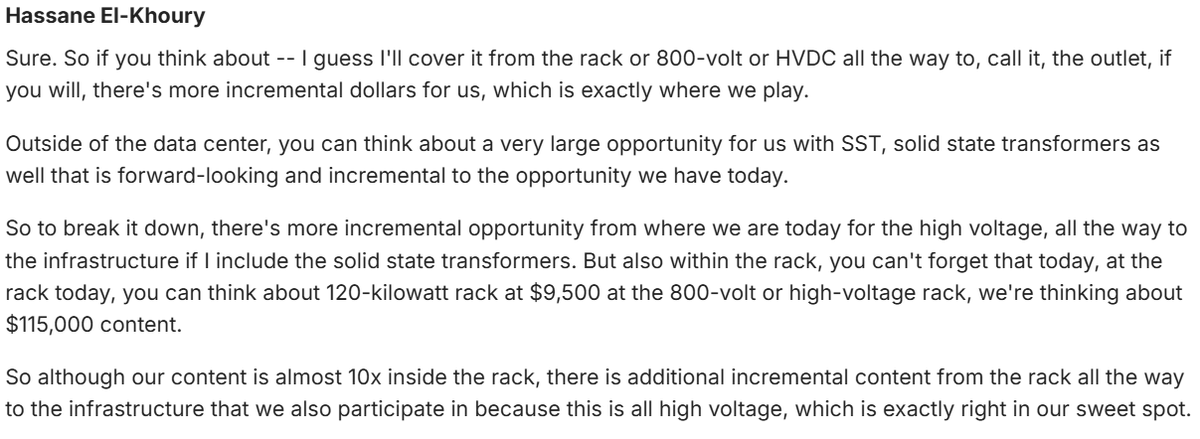
"Power semi content will 10x with the move to 800V racks. Lots of power semi content outside the rack with solid state transformers" - ON CEO
We did the last review of this space in Feb, link below. Will update in the coming weeks as the outlook continues to get better
$ON $IFX $WOLF $MPWR
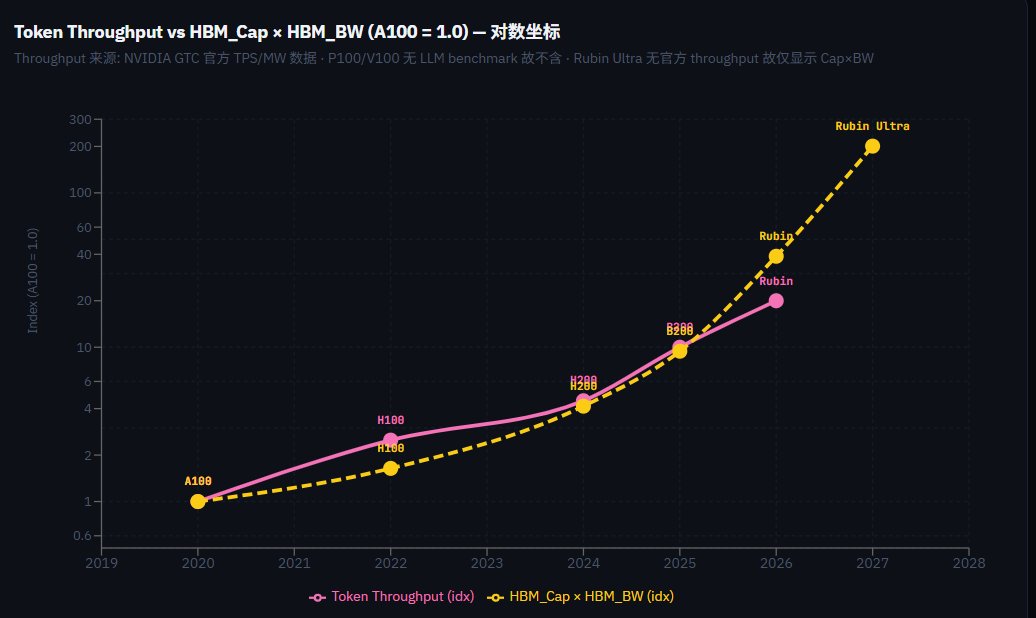
@TradexWhisperer HBM: GPU = exponential : 1
clearly capex share gainer
as long as KV cache is still architecturally exist
Market just get to know HBM size per GPU doubled only at GTC/TPU release, but not realize the hidden rule behind it
https://t.co/g5lDJsNf6z
@aleabitoreddit Have you thought about writing a quick piece on options tips/ best practice? Your execution is so remarkable. Surely folks would love to have a chance to learn from you.