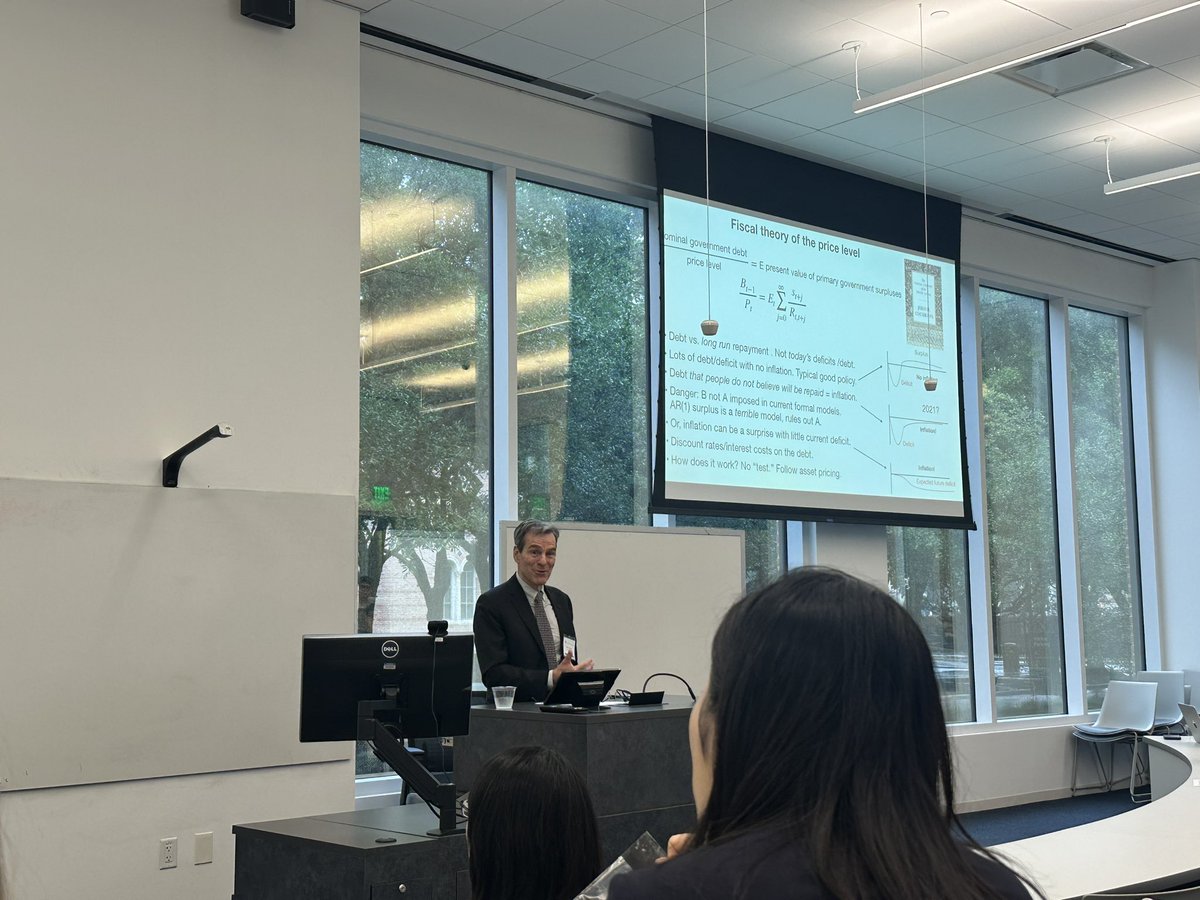
Thank you, Florin, for sharing this beautiful paper.
What I will remember most about Perry, though, is that he eventually took a different road and the courage it took to do so.
He had a Harvard PhD and a JPE paper. Everything was there for a conventional career in macroeconomics.
Instead, he turned away from mathematical economics and read Bagehot, Hawtrey, Allyn Young, Hicks and Minsky, forgotten traditions of monetary thought that he brought back to life as what he called the money view. He later said he almost did not survive it. Most of his papers were rejected, and Barnard told him his record was not strong enough for tenure. He eventually got it for a book, The Money Interest and the Public Interest, in which he went looking for what he called his intellectual ancestors.
Perry sometimes called himself, too modestly, a historian of economic thought. As Florin says, he remained to me an elegant and deep theorist even when not using mathematics, while now working in a direction orthogonal to most of the profession. I genuinely believe he had far more impact this way, and did more for our understanding of money, than he ever could have on the conventional path.
He also made a choice that would be unusual today, spending much of his time building his synthesis in his money and banking course at Barnard, with his students. The course became a MOOC with close to 200,000 enrollments, and an eye-opener for many.
I was one of them. I signed up while interning at the ECB as a PhD student, without expecting much. I was amazed by how much I learned. It was different from everything I had been taught, and complementary to it. I remember trying to follow the balance sheets of the shadow banking system he drew on the pixelated board, and the eureka moments when he had us look past the institutional details to the same economics of banking and central banking across countries and centuries. I remember him deciphering the euro crisis live.
That course, and the reading that followed, shaped the monetary economist I became. Writing on repo, FX swaps and stablecoins, I have tried to understand shadow banking the way he taught us, as an ecosystem of interlocking balance sheets where heterogeneous institutions together transform liquidity exactly as a bank would. Almost every paper I have written starts with the balance sheets of the model.
As always happens when someone you have learned so much from passes, I wish I had interacted with him more, and had been more explicit about what my work owes him.
Perry found his intellectual ancestors in forgotten books. He is now one of mine, and I will do my best to carry the money view forward.
Finding NBER Summer Institute talks on YouTube is surprisingly frustrating.
I asked Claude to build a searchable webpage that finds any talk by paper, author, or session, and jumps straight to where it starts in the video.
Link in the first reply.
Thrilled to have @BasilHalperin join the podcast. Three big points discussed: (1) AI could supercharge growth, but bond markets aren’t buying the hype as evidence by real interest rates; (2) inflation targeting not an optimal response to AI supercharged growth... (1/2)
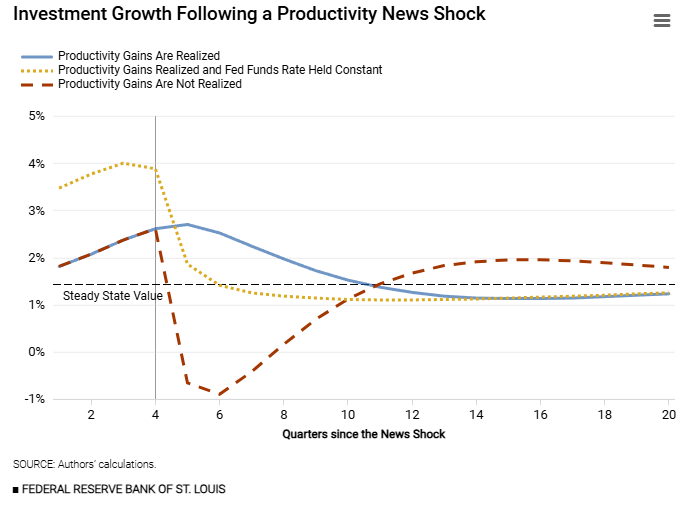
1/ New with @serdarozkanEN: using the St. Louis Fed DSGE model, we ask whether expectations of future AI-driven productivity gains can raise inflation today. We argue that they can, and that the Fed's response matters a lot.
https://t.co/eUHwIfH8TE
📢 Exciting opportunity for PhD students! 🎓
The @stlouisfed Dissertation Internship program is now accepting applications
🗓️ Deadline: February 27th
🔗 Details: https://t.co/NaO2awRIKl
Looking forward to seeing you at @stlouisfed 🚀#econtwitter
Jen-Jen and I are ready to put together the best SED program ever :) We have an amazing committee, plenary speakers, and local organizers.
Submissions are open! See you in Athens!
#sedathens2026
I couldn't be more excited to share that submissions to 𝐉𝐅: 𝐈𝐧𝐬𝐢𝐠𝐡𝐭𝐬 & 𝐏𝐞𝐫𝐬𝐩𝐞𝐜𝐭𝐢𝐯𝐞𝐬 are finally open!
Insights are short (<7,000 words) high quality pieces. Perspectives outline promising future research directions.
https://t.co/CuAh3RpnF9
The Texas A&M University Department of Economics is hiring for a macroeconomics position! Please consider applying, and feel free to share this opportunity with others who may be interested in joining our department.
https://t.co/6QPOSpJmV3
If interested: Do join us next week, Search and Matching Macro Finance:
November 24, 2025, 12:00 PM Eastern Time (US and Canada)
https://t.co/ylq9MUkyz3
@_SaMMF_
What happened since Wednesday in the US repo money markets? Why did banks have to borrow $15.1bn from the Fed's recent lending facility? Could we see this coming? What does it imply for QT?
(good clues in this thread...) [1/5]
https://t.co/nHY1npA5Xl via @ft
Waller emerges as favorite to replace Powell.
Why? Waller is a data (not political) based dove -- see my article here "Trump, Waller, and the Coincidence of Correctness" https://t.co/nDyn7re1P6
https://t.co/5Z7I86GRGw
If you read the word “manufacturing” to stand for accessible middle class jobs (with rising real wages), these results make a lot more sense. The bigger issue is how many people believe manufacturing jobs are the solution to stagnant income growth.
“America would be better off if more people worked in manufacturing.”
• 80% of Americans agree
• 20% disagree
“I would be better off if I worked in a factory.”
• 25% of Americans agree
• 73% disagree
• 2% currently work in a factory
👉🏻 https://t.co/fq1rItVKC2
“America would be better off if more people worked in manufacturing.”
• 80% of Americans agree
• 20% disagree
“I would be better off if I worked in a factory.”
• 25% of Americans agree
• 73% disagree
• 2% currently work in a factory
👉🏻 https://t.co/fq1rItVKC2
Many thanks to @BSultanum and @ioannis_kospe for taking the time to talk with @poweill, Julien, and I about our new book, The Economics of Over-the-Counter Markets, available soon from @PrincetonUPress.
@_SaMMF_ had an awesome time interviewing @poweill, @benjamminlester and Julien Hugonnier about their new book: The Economics of Over-the-Counter Markets https://t.co/WmWud7U4Rp
Thanks to @ioannis_kospe for co-hosting the interview!
What are Over-the-Counter Markets? Get the answer from @poweill, author of "The Economics of Over-the-Counter Markets" with Julien Hugonnier and @benjamminlester@_SaMMF_
https://t.co/Q9yV5AW6sD
https://t.co/KanQPiegAu