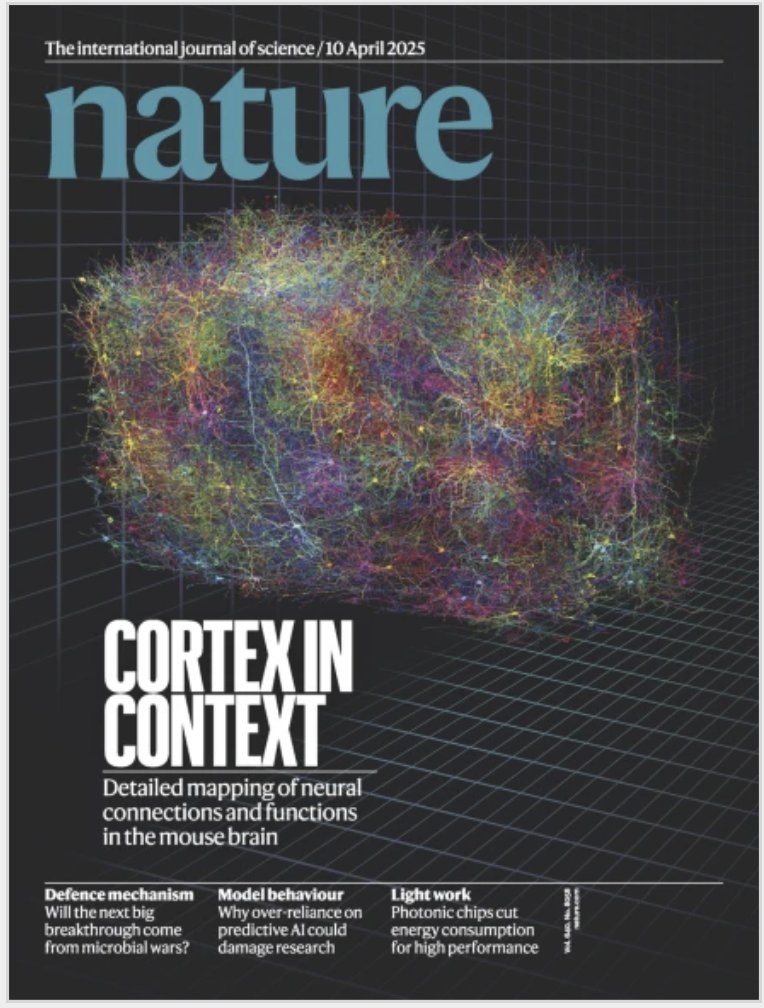
After 7 years, thrilled to finally share our #MICrONS functional connectomics results!
We recorded activity from ~75K neurons in visual cortex in a single mouse, then mapped its wiring using electron microscopy. To systematically characterize neuron function, we built the first foundation model of the mouse visual cortex—trained via deep learning on data pooled from multiple mice and visual cortical areas.
Our foundation model generalized to new neurons, animals, and even unseen stimulus domains. It also accurately predicted entirely new modalities, such as anatomically defined cell types. Importantly, this robust generalization enabled us to create accurate functional digital twins of individual mouse brains.
Using the digital twin of the MICrONS mouse—where we knew the exact neuronal wiring—we discovered that neurons don’t connect randomly, even when anatomically positioned to do so. Instead, given multiple potential partners (axons near dendrites), neurons preferentially choose partners with similar feature selectivity (“what”) rather than receptive field overlap (“where”).
Foundation models offer a powerful approach to systematically decode the neural code of intelligence.
Huge thanks to @IARPAnews for funding this groundbreaking effort through the @BRAINinitiative, and to our amazing team at @Stanford@StanfordMed@bcmhouston, @Allen, @Princeton, @uniGoettingen and others!
#Neuroscience #MICrONS #NeuroAI #Connectomics #FoundationModels #AI
https://t.co/Rb9rypR9zA
The Sensorium 2023 competition is over. Here are the winning teams:
🥇IRomul
🥈YuZhu
🥉dunedin
All winners used custom architectures. To learn more about their approaches, join our in-person workshop at NeurIPS on Friday, Dec 15, 2023. 🗓️ 1/4
My latest preprint is out! 🥳
We introduced a new diffusion guidance method EGG 🥚 using energy functions that allowed us to optimize neurally exciting images.
Many thanks to @KonstantinWille@ArneNix@pavithraE_@kfrankelab@AToliasLab@sinzlab
Check out the preprint now
Unraveling structure-function links in the brain is a relentless pursuit! Our collaborative analysis of #MICrONS data unveils a universal wiring rule, including feedback! Synaptic connectivity is driven by shared feature preference, not receptive fields. https://t.co/oltZ0MoiK3
📣Excited to share our preprint on excitatory morphological cell types in mouse visual cortex led by Marissa Weis. In this paper, we describe a set of principles that capture the morphological diversity excitatory neurons. A thread: (1/10)
https://t.co/FtFygvdZpe
Industry offers training (CPT) to help students’ educations. So what they learn should impact their research. Companies must preserve intellectual property (IP).
My institution won’t allow this opportunity without a shared IP review. Company won’t agree.
How do you navigate this?
#GPT4 saved my dog's life.
After my dog got diagnosed with a tick-borne disease, the vet started her on the proper treatment, and despite a serious anemia, her condition seemed to be improving relatively well.
After a few days however, things took a turn for the worse 1/
@Juanonyme@Wei_Li_Vision Awww thank you so much Juan! You and Wei are the people who started my “brain exploration” journey 🧠 Truly appreciate our time together with the squirrels!
High-Low frequency detectors found in biology!
Very cool to see mechanistic interpretability seeming to predict in advance the existence of biological neuroscience phenomena. 🔬
Excited that my thesis work in collab w/ with Dat T. Tran & @AToliasLab is out as a preprint
https://t.co/NwnpG3ByDZ
We use #DeepLearning to study single-cell invariance in 🐭 V1 and discover a new form of bipartite invariance that may play a role in object boundary detection.
Very excited that my thesis work is out as a preprint🎉
https://t.co/TEt1RVeqbg
We discovered a new rule of contextual modulation in 🐭V1: pattern completion enhances & pattern disruption suppresses neuronal responses, w/ @kfrankelab@AToliasLab@sinzlab@haefnerlab & others