We cut Claude Code's input tokens by 45% on PR takeovers, with no LLM in the loop. The work is in what gets removed before the agent sees the thread: folded CI logs, resolved code mentions, and incremental reads for returning agents.
Checkout our post for details if you are interested!
We measured three ways to hand a GitHub PR to a coding agent. 76 PR takeovers, Claude Code (Opus 5.5): paste the full thread: $17.49 read it with gh: $11.34 preprocess once, no LLM: $8.37 Pasting is the most expensive. https://t.co/shGRPnM2RP
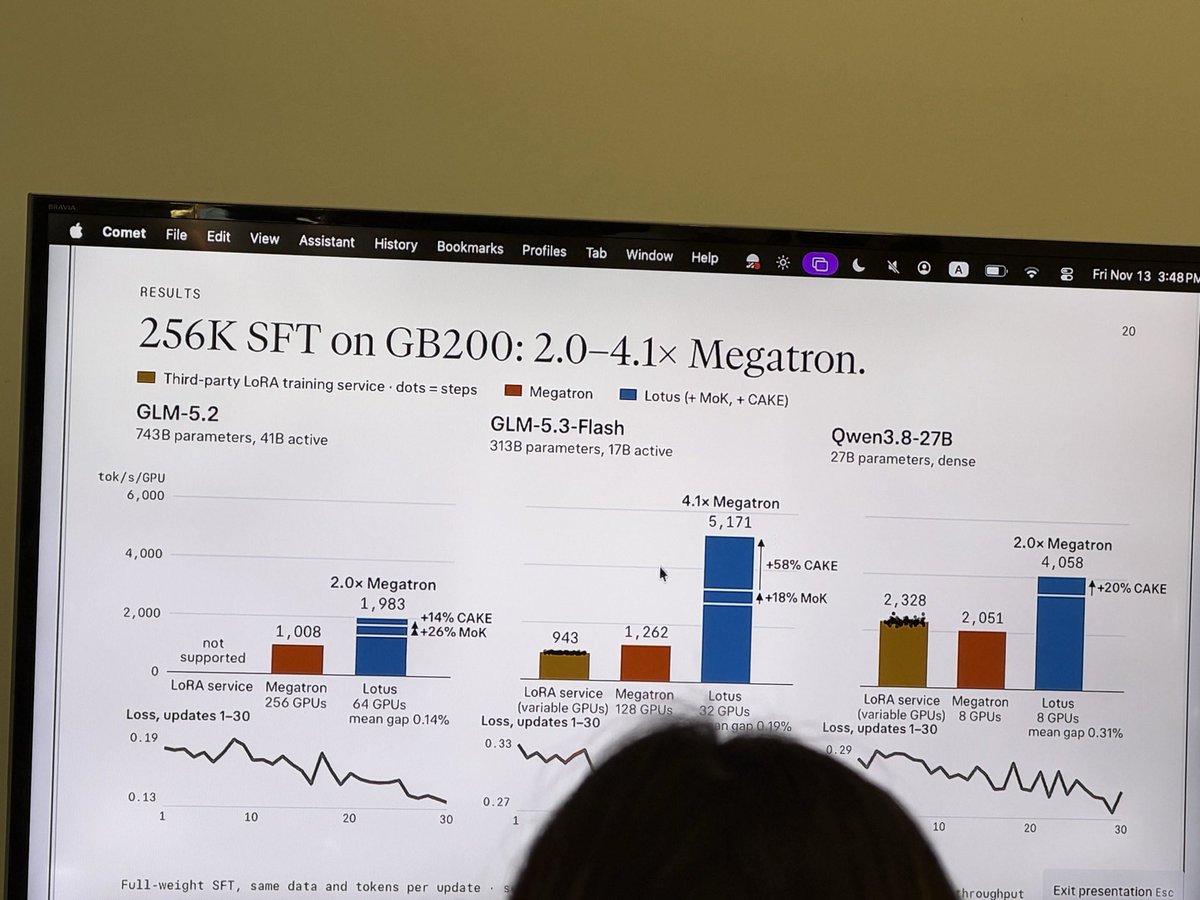
Perplexity at @sgl_project summit: CAKE 🍰 generates the best CUDA kernels at mass, accelerating training & inference at industrial scale, by @abcdabcd987
Anthropic shipped Claude Sheets and Whiteboards today. The obvious target is Microsoft 365.
Microsoft’s bet is that the suite is the front door and models are swappable underneath. Copilot already offers Claude next to GPT.
Anthropic’s bet is the reverse.
The model is the front door and the suite is swappable. Claude Sheets treats Excel as an export format.
Microsoft still has enterprise identity and the default install on its side, and it is also one of Claude’s distributors.
This is just the beginning.
Starting to roll out today: Claude Whiteboards, Claude Sheets and Claude Data.
Think a plan through on a board, build a tracker in a sheet, and tell a story with your data.
An article for everyone who ships, buys, or signs off on software built on large language models (LLMs): engineers, product managers, and the CEO. Written in plain language, from the big picture down to the details. https://t.co/YaP414vR0u
Memory is what allows Claude to learn from experience. In a new Engineering Blog post, we share how “dreaming” helps Claude organize what it’s learned, correct its mistakes, and find what it needs more easily the next time. https://t.co/uUEN4bNkr9
RSI really helps when the algorithm space is large. It can combine changes at different levels and get the most out of what we already have. I did something similar when optimizing speculative decoding inference, but I only changed the megakernel and the inference engine. I left precision and the algorithm itself untouched. I should have opened those up too.
RSI starts with infra 🔁 mlsys is in a golden age. agents are great researchers now. with tokens, "low-hanging fruit" is everywhere.
agents optimize speculative decoding for parallel drafters (DFlash2, DSpark) without training or quality loss. their 12-bit format beats cuBLAS.
Percepta’s post https://t.co/mnMSH5ZmiZ and code https://t.co/JzonzbImdM. The Qwen edit details and logs are in the WSP blog and https://t.co/Dsq0vcX3F1.
The from-scratch results here stood out to me. With no data or gradients, Astra wrote working MinAtar policy weights one-shot, and set a 9x9 Go net's 1.48M weights starting from zero. Together with Percepta compiling a WASM interpreter into a transformer, this points to apps being written straight into weights.
Two things would have to change for that. LLM weight edits need a readable form people can review; the Qwen fix here is a single directional ablation that lands as 131k weights. And chips need fast lookup paths next to the matmul units, since in Percepta's design attention mostly works as a lookup table.
We asked GPT-6 Astra to edit Qwen3.5-0.8B weights to improve math.
It directly changed only 0.016% of weights, fixing 0.8B's reasoning loops & improving math up to 6x and even instruction following 3x, without gradients or training.
We call this Weight-Space Programming: frontier LLMs can now natively read/write neural network weights! 🧵
Blog: https://t.co/bOWCcFhCVq
*ehm ehm* BIG ANNOUNCEMENTS DAY 📣
two new things cooking in herdr labs 🐏🧪
a brand new herdr-core, and a desktop app built on it. open source.
first, the app: software that fits you. every part of it is a file your agent can change. you just ask.
Thanks @Euni_AI for ContextBench and the shoutout. CodeNib is #1 on line recall: 0.779 vs 0.606 for the next system.
Almost all of it comes from search, before any repair: two Haiku workers reach 0.771 at ~1¢/task. Pass@1 is 77.6% (388/500).
https://t.co/Kds2f0w79B
New community results on ContextBench! 🚀
🏆 Recall: CodeNib — 0.779
🏆 Context F1: openJiuwen-JiuwenSwarm + DeepSeek-V4-Pro — 0.389
Congrats to both teams @sysevolai, and thanks for contributing!
Explore the leaderboard and submit your agent.
#ContextBench#AIAgents
Background: I started on RSI at Google in 2025 with AutoML, and moved the same questions to kernel design at NVIDIA this summer.
Full post, with the math and interactive diagrams: https://t.co/RoY68OxxX7
New post: Is infra ready for recursive self-improvement?
An RSI loop runs at the speed of its verifier. Most of the discussion is about the proposer. I think the loop will stall at verification, and our infra was built for a world where verification is cheap.
Building on Jason Wei's verifier's rule: how verifiable a task is depends partly on infrastructure. The post sketches that infra: calibrated fidelity ladders, content-addressed caching, weight inheritance, boundary graph replay for megakernels, and a hardened verifier.