What does it mean to be a “frontier blockchain”?
It means that, through dozens of upgrades, we're upgrading past the name blockchain. No other innovates its own fundamental parts so regularly without even a second of downtime. While others chase adoption through compromises, Ethereum remains confident users follow the most robust chain.
Ethereum Institutional is making that case clear. Institutions will build on Ethereum not because it optimizes for the highest bidders, but because it is the only blockspace capable of meeting the highest standards. The cryptographic world computer will have no equal. Read more here about where we've been and where we're headed on EI's visualization of Vitalik's blog post.
A note on recursive STARK mempools (EIP-8288) https://t.co/XNBuNtkKmi
This is an EIP that I am hoping we can get included in I-star (the fork after Hegota) that you can think of as the next step after Frames, that would unlock extreme amounts of power. Particularly:
* Ultra-cheap quantum-safe signatures (SPHINCS-). Much of the cost savings comes from the fact that the signature data (~3 kB) does not have to go onchain
* Ultra-cheap quantum-safe privacy protocols. Status quo minimum cost for private txs is ~300k if you engineer very well (no one does), status quo quantum-safe is ~10M gas, this could reduce it to low tens of thousands.
* Universal support for your favorite new signature or proof scheme without needing EVM changes. Whatever you use (Falcon, ML-DSA, some other lattice-based thing, something code-based or isogeny-based or even more esoteric), you can just wrap it client-side in a STARK, onchain gas cost low tens of thousands just like privacy protocols. Hopefully, Ethereum will never need "please support my favorite cryptographic algo" politics again.
* Private account abstraction: keep your account logic private, and in a private location onchain. Then you can make one transaction to change the ownership of all your onchain state - accounts, defi positions, privacy protocol notes, everything - without revealing which objects' ownership you're changing.
Here's how it works.
Your transaction can include a type of frame that we call a "dependency frame". The frame is a list of statements, asserting claims like "message hash M was signed by SPHINCS- public key P" and "data hash D was proven to satisfy a statement defined by verification key V".
When you send your transaction, you send it in an envelope, which includes a signature or a STARK for each statement in a dependency frame.
Once the transaction reaches the mempool, nodes aggregate them. Each node runs a loop: wait one tick (eg. 500ms), aggregate all new envelopes (either single-tx or multi-tx) that you've seen, remove any transactions that are expired, generate a STARK recursively proving all dependencies, and send a new multi-tx envelope containing that STARK.
Hence, the bandwidth load is bounded: each node's outbound is one STARK (~100-300 kB) per tick, plus each transaction getting broadcasted through the network once (as happens already).
The block builder acts as "yet another mempool node", receiving envelopes from the mempool (plus any side channels), generates its own STARK covering the subset of transactions it intends to include in the block, and adds that STARK to the block.
Total onchain overhead: one STARK (100-300 kB), plus 96 bytes for each statement being proven.
This is what I've called before ( https://t.co/3jfVkYTZrR ) "The Proof Singularity". Today, we have all the ingredients to actually implement it.
As a developer, this requires a somewhat different workflow than you are used to, but it is conceptually simple. Any signatures or STARKs, you put into a separate frame. Then the main logic that today is verifying a signature or STARK, you replace with checking for the existence of a frame that includes the correct statement as a dependency.
Examples of useful statements:
* [tx sighash] verifies against [the pubkey at sload(0)]
* there exists a secret and a merkle branch such that hashing secret+0 and applying the merkle branch outputs (public) root R, and hashing secret+1 outputs (public) nullifier N
* there exists a secret address A, salt S and signature Z such that sload(0) = hash(A, S) and a merkle proof of address A inside a recent ethereum state contains some pubkey D where [tx sighash] was signed by D [this is private account abstraction; all variables except [tx sighash] and sload(0) are private; you can also make D a STARK verification key]
* there exists an ML-DSA signature signing [tx sighash], that verifies against an ML-DSA pubkey whose hash is sload(0)
At the core, this is moving any compute and data other than bookkeeping "business logic" outside the core path of Ethereum execution, sharding and parallelizing it via the mempool.
Notice also that this requires agreeing on a _language_ (aka. an ISA) for the recursive STARKs to define statements in. The current leading candidate is RISC-V. So this would also de-facto be Ethereum adding RISC-V (or something else we decide on) as a canonical ISA - a big decision that should be done carefully, but that I think will be necessary to drive Ethereum forward.
I resigned from Anthropic today. I spent the last three years doing pretraining research at both OpenAI and Anthropic. Neither company is acting responsibly. They are racing straight to self-improving superintelligence and gambling with our lives. More thoughts below.
hi bay area folks! some of you might know i’ve been spending a lot more time in california lately :)
i’m in mountain view now and will be in SF this friday. would love to spend my next few days meet people thinking about crypto infra in the age of AI, privacy-preserving cryptography, fintech, the joys and dilemmas of building a company and managing a team, or just cool technology in general.
if any of this sounds like you (or you think there’s someone i should meet), say hi! Dms open
The Protocol Cluster has published two new posts:
Hegotá EIP Opinion Post and Tier List evaluates and grades all 62 EIPs proposed for Hegotá, providing the cluster’s first unified tier list for a network upgrade
Current and Emerging Priorities covers commitments and research arcs, anchored on a quantum-resistant Ethereum L1 by Dec. 2029
Offered as one input to Hegotá scoping, roughly 60 researchers, engineers, and individual domain experts across all 9 teams in the Protocol Cluster contributed to the Hegotá tier list, providing 397 tier grades before discussing contested items live.
The plan, commitments, and shared set of cluster-wide priorities covered in the companion post provide the context behind the final tier grades.
The Protocol cluster will host a Reddit AMA on r/ethereum on September 16 at 2pm UTC to talk through these priorities, the Hegotá tier list, and anything else on your mind.
→ Submit questions ahead of time here: https://t.co/KyX3uu8qqZ
Read the articles here:
→ EF Protocol - Current and Emerging Priorities: https://t.co/4OuNa2nnId
→ EF Protocol - The Hegotá EIP Opinion Post and Tier List: https://t.co/vBOWQnztcd
🆕 Introducing Etherscan Flow
• Turn a maze of transactions into one clear map: how funds moved, findings to back it - every hop verified onchain
• Build a flow from scratch or let an agent build it for you with the Etherscan Flow skill
• Share your findings on X and tag @etherscan!
What if you could learn Kuala Lumpur’s history just by playing? 🇲🇾🎮
I’m building Jalan KL with GPT 6 Astra ~ a 3D adventure where you roam the city, complete quests, and uncover the stories behind its landmarks.
For locals rediscovering home and visitors getting their first taste.
Jom jalan! 👟
try it here: https://t.co/QFZV9cGWzU
We are running a public testnet for the EIPs behind Ethereum's privacy roadmap, built on top of Glamsterdam.
It runs EIP-8141 (Frame Transactions), EIP-8250 (Keyed Nonces), EIP-8272 (Recent Roots), EIP-7805 (FOCIL), and EIP-8369 (VOPS profiles), each implementation up to date with its spec. The frames implementation matches the latest execution spec tests release.
Anyone can sync, peer, transact, and use the faucet to fund test accounts. The only permissioned part of the network is validator entry. If your client team is working on any of these EIPs and wants to validate, reach out to us, and we'll get you set up with deposit tokens.
RPC, explorer, and tooling notes: https://t.co/bEbIcah0PX
Yes, a dedicated bare-metal GPU cloud instance with 8× NVIDIA H200 (~1.1 TB VRAM, NVLink) can run it. Standard VPS cannot. Providers like RunPod, https://t.co/WvmESJ1SNK, Hyperstack and Nebius offer such 8x nodes from ~$16/hr. Verify current stock, RAM and interconnect on their sites.
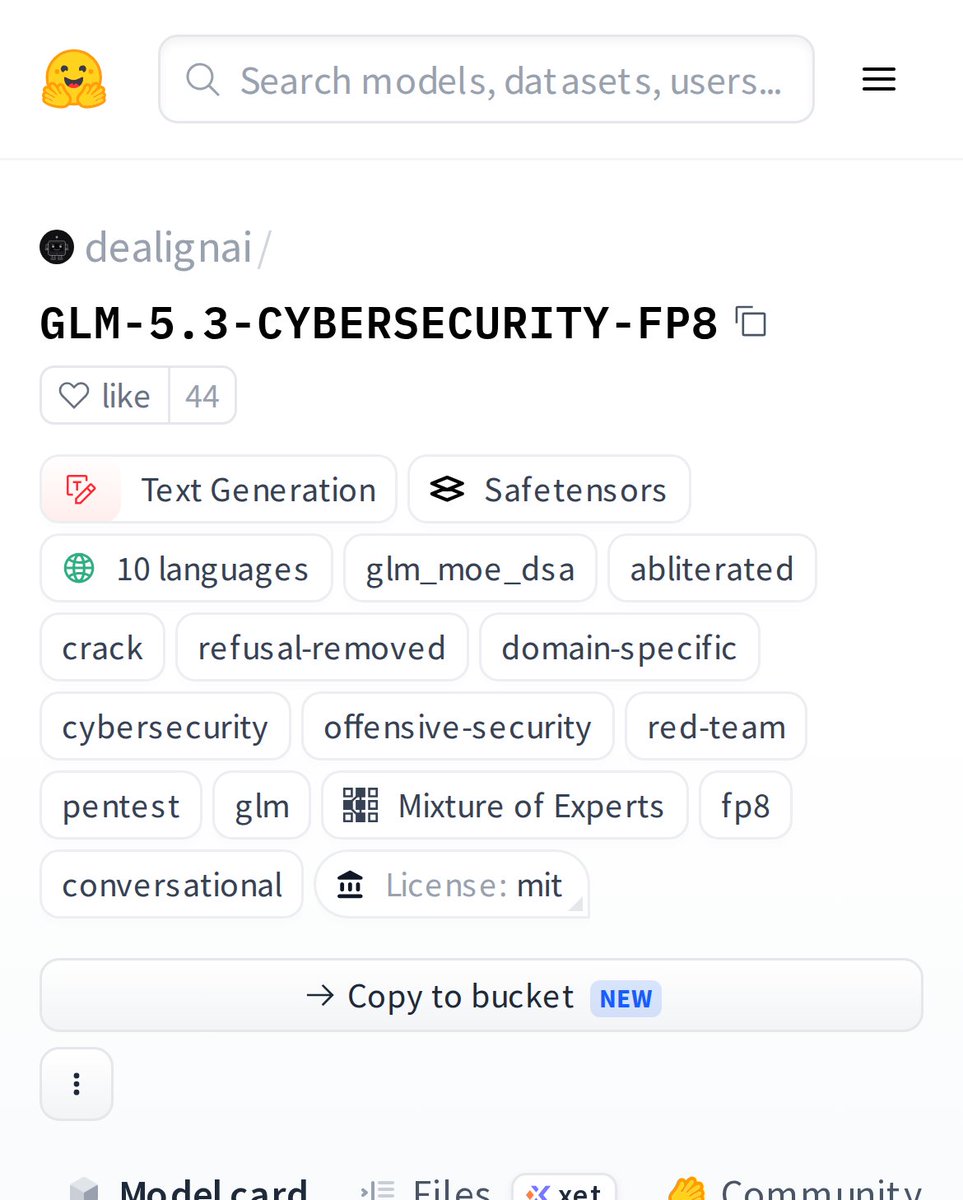
Ever wanted an AI that doesn't just talk cybersecurity but actively helps you break into systems? Meet GLM-5.3-CYBERSECURITY-FP8, a specialized text-generation model for offensive security, red teaming, and pentesting. It's refusal-removed, so it's built to assist without holding back. #AI #CyberSecurity
Also, @ethrex_client has a testnet for Frames, FOCIL plus companion EIPs that together allow privacy protocols on top of Ethereum to behave as full first-class citizens:
https://t.co/yUBJW7PY6q
A lot of important progress on Frames (EIP-8141) has been quietly happening over the last few months. Highly recommend reading this, also the updated EIP https://t.co/jYqeS55j6P
https://t.co/CPYONKnWZc
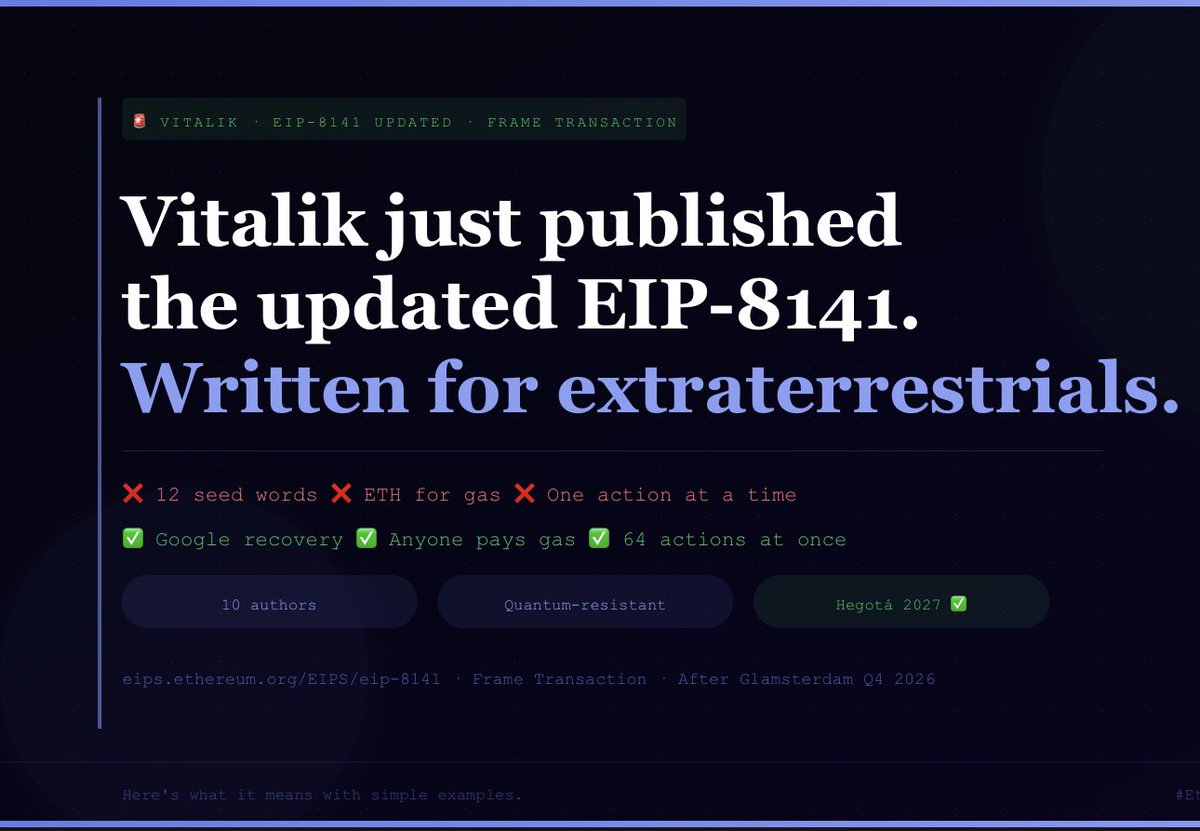
🧵 Vitalik just published the updated version of EIP-8141.
It’s written for extraterrestrials.
Here’s what it actually means with simple examples so anyone can understand it. A thread:
(1/7)
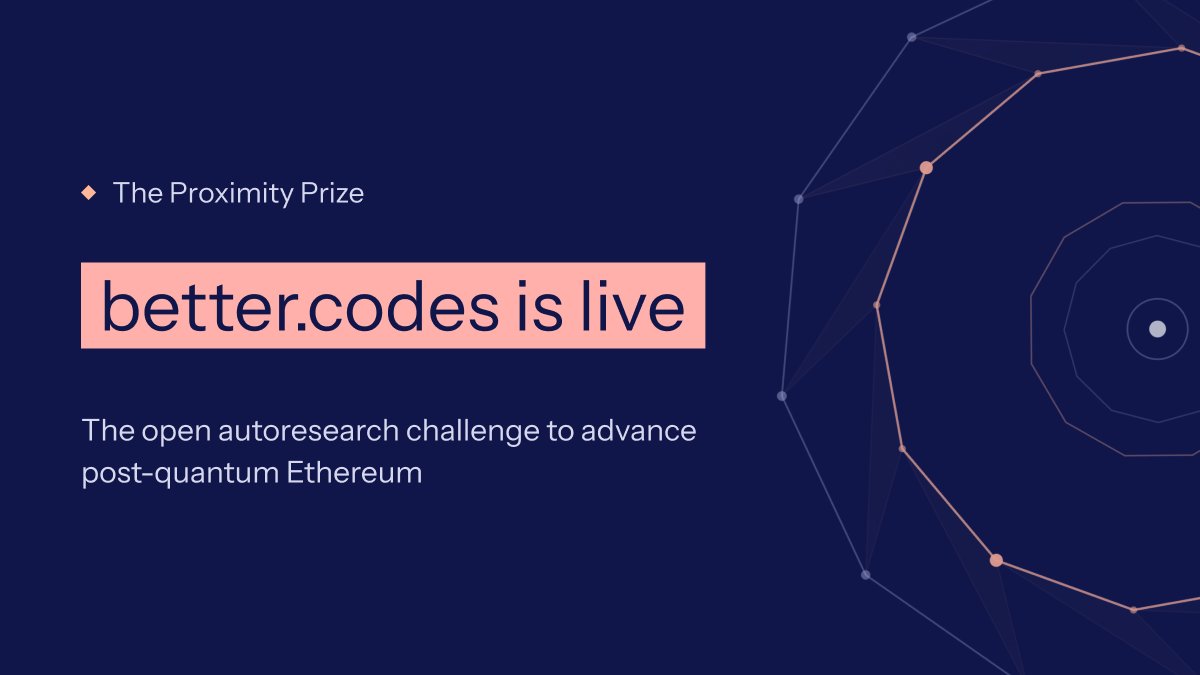
https://t.co/BzwX7u0mFr is live
Join the open autoresearch challenge to advance post-quantum Ethereum. Bring your agents, harnesses, and prompts. Push the state of the art math in hash-based SNARKs.
Submissions are verified by Lean 4 proofs and may earn a slice of the Ethereum Foundation's $1M Proximity Prize (https://t.co/Zbo6IJYswY).
Built with @zksecurityXYZ and @eigenlabs on @yukonresearch
@krackeddevs builder shipped: Free-Hermes
~ Hermes Agent on https://t.co/utwYiaqfjo for ~$0/month, wakes on a Telegram ping, sleeps when you're not using it. Clean writeup, MIT.
Great for Malaysian Students on a Budget
The Kracked Dev : @AiDanielhakimi
Go star it. We hype our own here 🇲🇾
⭐ : https://t.co/HJy0r4IZqm
@NousResearch@Teknium
For over a decade the blockchain industry tries new hash functions so proof systems could afford them.
The EF just concluded that was backwards, and that the better move was to *build proof systems that can afford the cryptography the world already uses.*
That is a bigger statement than it looks. It means decades of standardization and attempted breaks are not a constraint you engineer around, they are the thing you engineer toward.
The same shift is happening with the money. When capital was experimental, tokens and memecoins, the cryptography could be experimental too. Institutional capital does not work that way. Nobody underwrites a settlement system on a primitive that is six years old and has had a handful of cryptanalysis rounds.
We started Soda Labs almost three years ago treating this as an assumption, not a conclusion.
Our secure computation and privacy layer runs on AES and SHA for the same reason the EF is now moving to SHA and BLAKE.
The cryptography the world already trusts is the only kind that scales into regulated finance.
Looking for a new house with smart contracts + Rust + shielded transactions for @nym
Anyone has a good tip for them to move away from Cosmos? @aztecnetwork@MidnightNtwrk@HeliusPrivacy