@patrick_oshag Domestic open weight models and the supporting RL for enterprises will be priority themes in 2027. Aversion to Chinese open weight models will snowball
ParseBench-2 hit 30k monthly downloads in 3 days, and is #3 on @huggingface trending benchmarks! 📈
In ParseBench-2, we tried hard to create a comprehensive taxonomy of metrics to evaluate document processing, while creating a severity-based framework to align these metrics with human judgment.
Whether you’re deeply familiar with document OCR and document OCR benchmarks, or just getting started, we encourage you to check out the ParseBench-2 methodology. We’re happy to help you pick whatever subset of metrics you care about if you’re looking to process documents in production.
We’ve merged dozens of PRs since the release date, including fixes/metric updates from some of our peers. We’re aggressively fixing any lingering annotation and metric issues.
Report: https://t.co/f6SxkKIlme
Hugging Face: https://t.co/T1FLO2V2xd
Github: https://t.co/9hWGjYacmf
Today we’re introducing ParseBench-2 - our most ambitious document parsing benchmark to date.
It is the only benchmark that provides both extreme granularity into every single type of production parsing error, while also making sure that metric scores are highly aligned with human judgment. We do this by painstakingly assigning severity scores to 330+ error types, and tuning each metric to match the severity scores.
Existing benchmarks either use brittle deterministic metrics (e.g. OmniDocBench) or LLM-as-a-judge (ParseArena), which can help recognize equivalent representations but are coarse/stochastic/subject to bias by the prompt+model.
ParseBench-2 also contains:
✅ 4.3k+ document pages (double from ParseBench-1).
✅ An extra dimension (forms)
✅ Much better ground-truth across all dimensions compared to ParseBench-1.
This is the next evolution of ParseBench, our hugely popular benchmark that has 50k+ monthly downloads, over 150+ OCR solutions benchmarked, and has been adopted by companies like NVIDIA, Cohere, Aleph Alpha, Perplexity, and others.
Alongside ParseBench-2, we are also releasing OCRia-1.5 - a new family of document parsing models that powers all our modes in LlamaParse. They represent a massive step up in capabilities from our latest release, and are state of the art in parsing complex tables, forms, charts, formatting, and assigning bounding boxes to complex layouts.
Come check out our blog post, technical report, and website.
Blog: https://t.co/TKbfCyTjht
Technical Report: https://t.co/eAu0s6ttA1
Website: https://t.co/PWczfhp0OX
If you’re interested in trying out our OCRia-1.5 capabilities, come sign up for LlamaParse: https://t.co/XYZmx5TFz8
In other news…
Norwest 18 is here, it’s $4B and the largest fund in @NorwestVP’s history. The new fund gives us even more opportunities to back founders building for the emerging generation of enterprise AI, data, and infrastructure.
Welcome to the Norwest family, Circuit Mind! @tomadesanmi and Basilio have built a physics-driven AI platform that helps engineers design electronics faster and make better decisions.
https://t.co/bA1oNbKqxx
We've believed for years that data loss prevention was a category ripe for reinvention. What @MilnerNitay and the ORION team have built is exactly the kind of innovation we knew was possible.
Using AI to combat AI 🥊
AI is introducing new risks to enterprise data security. It's also enabling an entirely new approach to solving them.
At Black Hat 2026, ORION Security's @MilnerNitay and Norwest's @Zilberman discussed how AI is reshaping data protection. Listen in ⬇️
What a fun ride with the @tursodatabase team! Thoroughly enjoyed partnering with @glcst, @penberg
and the Turso team since 2022! And today is an exciting new chapter in the Turso journey as they join
@Supabase 🚀
@NorwestVP
https://t.co/LuBZ5KjngR
Introducing DocJev - a lightning-fast OSS library for document classification and splitting with jev ⚡️
Give a document alongside some natural language category rules. Jev will predict the document category (classify) or the boundaries between sub-documents (split).
It is 6x faster than gpt-5.6-luna with equivalent accuracy.
You can choose between different OCR backends:
liteparse: the fastest/most accurate free+OSS text parser out there. Perfect for digitalized documents. The speedups vs. luna above are inclusive of liteparse times.
LlamaParse: the most advanced VLM-based solution for complex docs. Using this will of course add latency on document preprocessing. But it’s a good option if you want to cache the digitalized representations of documents for a variety of downstream tasks.
Check it out: https://t.co/PVE4hbEyFR
If you want to dive deeper into liteparse or LlamaParse check the links below:
liteparse: https://t.co/JNER0mVcB8
LlamaParse: https://t.co/XYZmx5TFz8
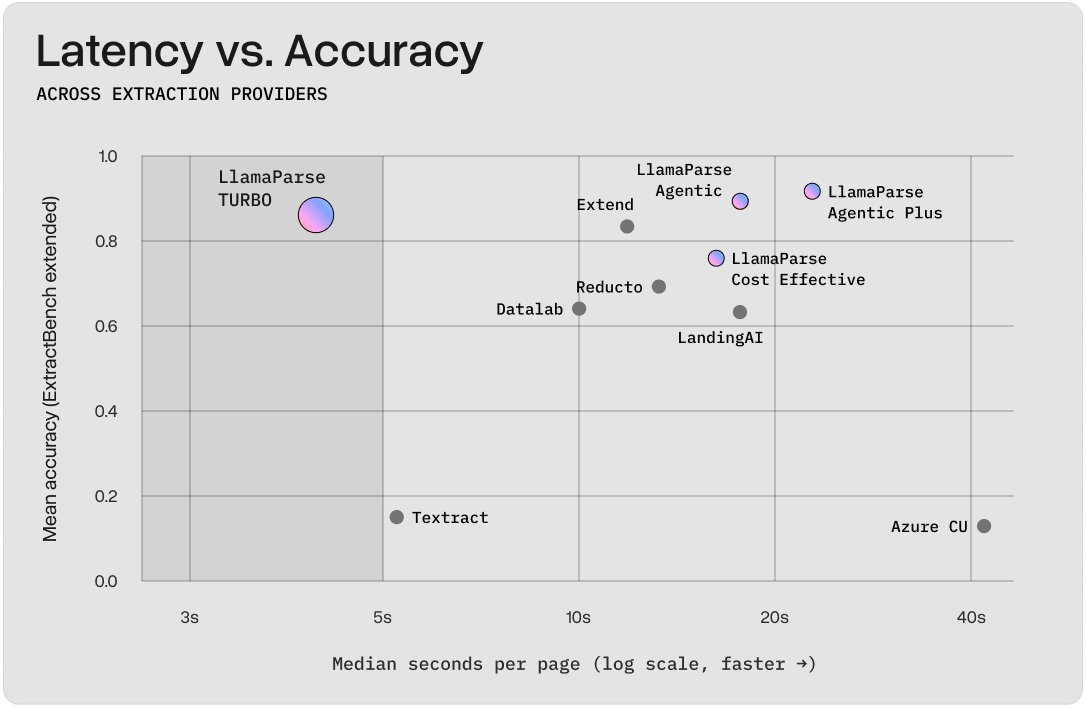
Today, we're excited to launch Extract Turbo ⚡️ - the fastest VLM-powered document extraction solution.
It is 3-5x faster than all other comparable OCR solutions, including our other LlamaParse tiers, at equivalent or higher accuracy.
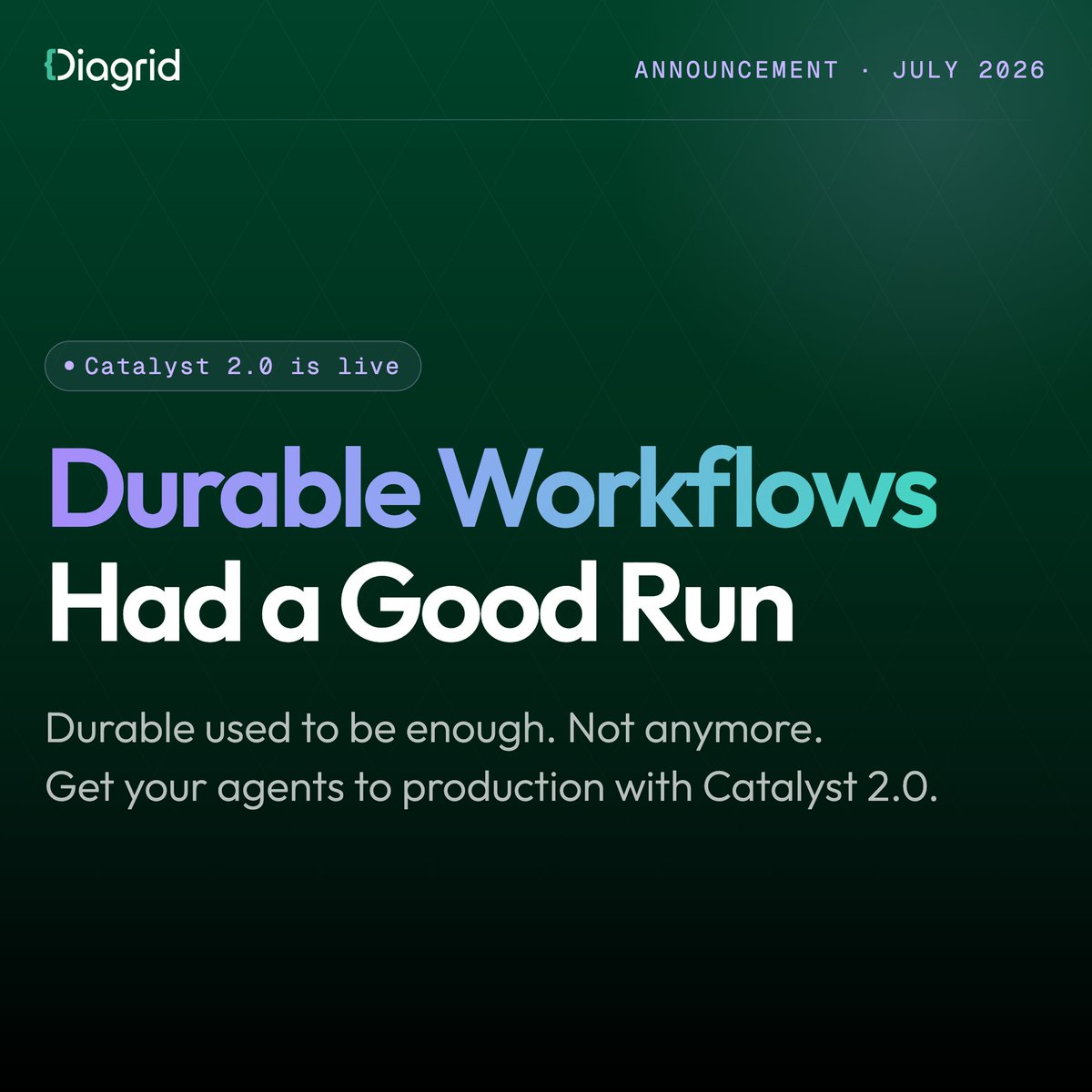
Durable execution is now Agentic: introducing Diagrid Catalyst 2.0.
Now teams can make their existing agent workflows resilient to failure and cryptographically provable, without re-architecting how those agents are built. Agents automatically resume from the exact point of failure, and every step can be cryptographically signed and traced back to its source.
It brings durable and verifiable execution to the AI frameworks developers already use: LangGraph, Microsoft Agent Framework, Google Agent Development Kit (ADK), AWS Strands, OpenAI Agents SDK, CrewAI, and more.
Most of those frameworks have no built-in way to guarantee a long-running workflow recovers and finishes when something breaks. Work is lost, tokens burn, and someone has to step in.
Keep the framework you build on. Add a Diagrid code package, gain durable workflows immediately.
Read the release 👇
https://t.co/EbGVpf3dUe
#AIAgents #DurableExecution #PlatformEngineering #LLMOps #DiagridCatalyst
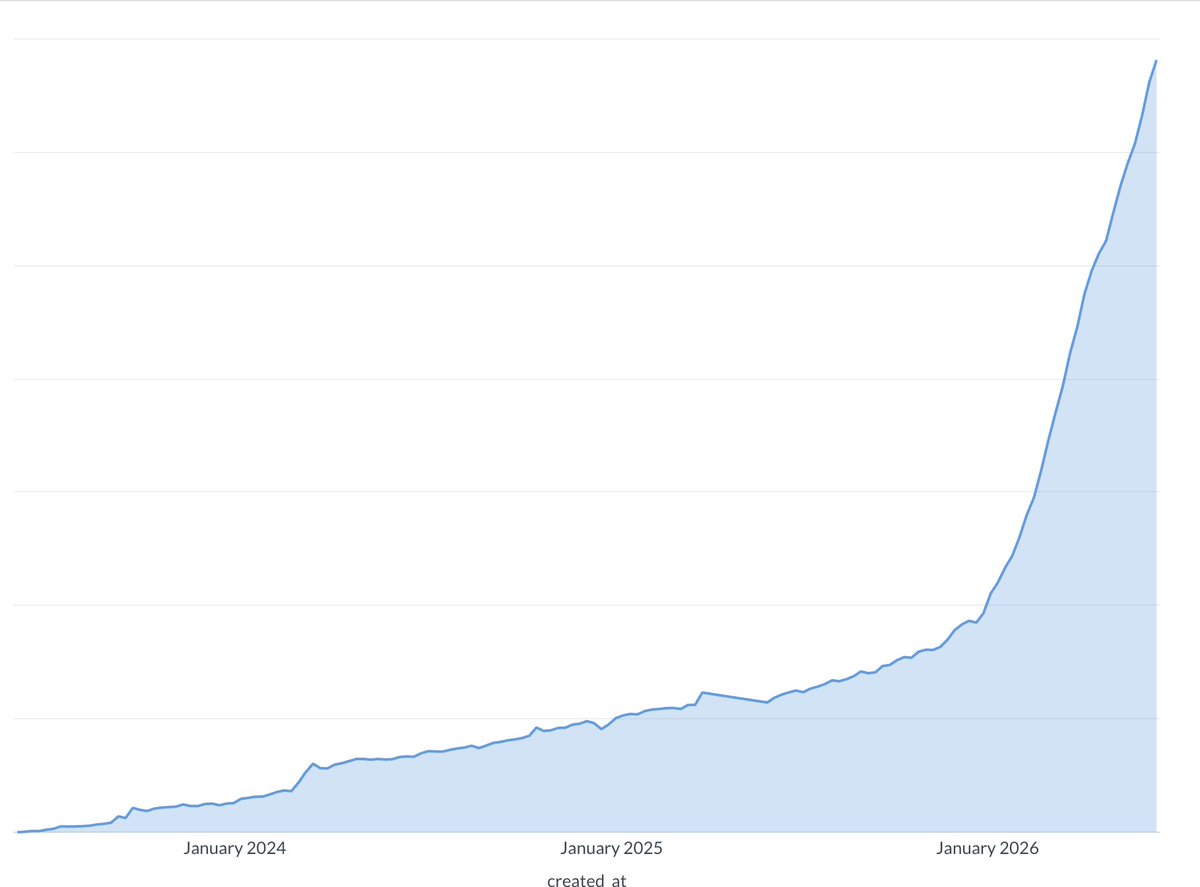
Weekly Active Users on the Turso Cloud
If you are one of the users now finding what a lighweight database can do, either locally or in the Cloud... welcome!
We’re proud to welcome @GeneralistAI to the @NorwestVP portfolio! The company is on a mission to make general-purpose robots a reality and is led by a world-class team in @peteflorence and @andyzengineer and Andrew Barry
https://t.co/onmjEtJrei
We Parse PDFs
We spent 7 figures to put this on billboards throughout SF.
I thought long and hard about putting something more creative and whimsical. But then you wouldn’t know what we do.
AI agents (and humans) are consuming exponentially more documents as they do real work. They need the best quality document parser to not output garbage on downstream tasks.
This is what we do today as a company. If you have any PDFs (or other documents), we parse them :)
If you’re around SF in June for one of the following events, come stop by our booths:
✅ Snowflake Summit (this week, Booth 1123)
✅ Databricks Data+AI Summit (June 15-18, Booth 137)
✅ AI Engineer World Fair(June 29-July 2, Booth L-G47)
You can find us by the same sign we put on our billboards!
We Parse PDFs
@llama_index
Invest and sign a definitive agreement in the same quarter? Well, this is a new one!
Congrats to @pratyus and the @natomalabs team on entering into a definitive agreement with @Snowflake.
The demand for agentic AI infrastructure is moving fast.
https://t.co/2cvaqcl0kx
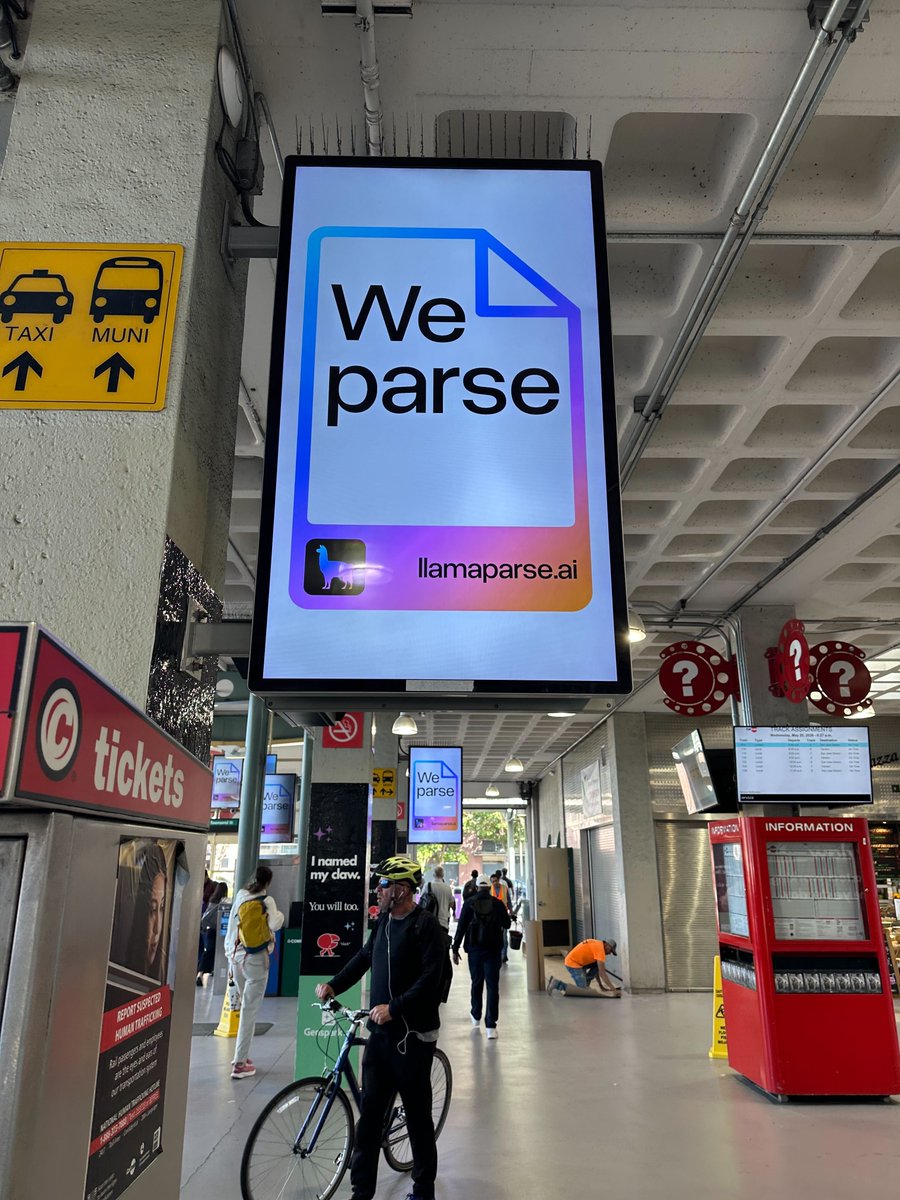
If you're stopping by the SF Caltrain station over Memorial Day weekend, you might catch a glimpse of our digital ads 📺
We parse
(PDFs)
(50+ other document types)
Turso now includes unlimited active databases in every plan. We already had unlimited databases, but we would charge you based on how many of them were active. That is now gone. You want a database, you get a database.
This is why we released liteparse :)
Free, open-source, designed for agents.
Natively supports OCR / screenshotting for deeper visual understanding in a document when needed.
We’re open sourcing the first document OCR benchmark for the agentic era, ParseBench.
Document parsing is the foundation of every AI agent that works with real-world files. ParseBench is a benchmark that measures parsing quality specifically for agent knowledge work:
✅ It optimizes for semantic correctness (instead of exact similarity)
✅ It has the most comprehensive distribution of real-world enterprise documents
It contains ~2,000 human-verified enterprise document pages with 167,000+ test rules across five dimensions that matter most: tables, charts, content faithfulness, semantic formatting, and visual grounding.
We benchmarked 14 known document parsers on ParseBench, from frontier/OSS VLMs to specialized parsers to LlamaParse. Here are some of our findings:
💡 Increasing compute budget yields diminishing returns - Gemini/gpt-5-mini/haiku gain 3-5 points from minimal to high thinking, at 4x the cost.
💡 Charts are the most polarizing dimension for evaluation. Most specialized parsers score below 6%, while some VLM-based parsers do a bit better.
💡 VLMs are great at visual understanding but terrible at layout extraction. GPT-5-mini/haiku score below 10% on our visual grounding task, all specialized parsers do much better.
💡 No method crushes all 5 dimensions at once, but LlamaParse achieves the highest overall score at 84.9%, and is the leader in 4 out of the 5 dimensions.
This is by far the deepest technical work that we’ve published as a company. I would encourage you to start with our blog and explore our links to Hugging Face to GitHub. All the details are in our full 35-page (!!) ArXiv whitepaper.
🌐: Blog: https://t.co/57OHkx0pQW
📄 Paper: https://t.co/Ho2oH2xEAM
💻 Code: https://t.co/6P7UxqOZYA
📊 Dataset: https://t.co/YguIXWm41j
🎥 YouTube: https://t.co/6Fh1Nsk9ei