I just solved "Robotics Engineering" education with Opus 5.5 + /colorfigures skill
no need to spend $1000+ on a starter kit to learn what a resistor does, just visit my interactive site:
• 13 real boards: Arduino Uno, L298N, Raspberry Pi 5...
• build part by part: pick & place, reflow, solder, plug in
• break them on purpose: reversed caps pop, chips smoke, LEDs burn out
send the skill to your Claude:
> https://t.co/1879rauiu7
try it free, no sign-up ↓
Highly recommended read from Google DeepMind and colleagues.
There is a lot of interest in self-evolving agents, but they're hard to get right.
This work highlights how important and difficult memory and retrieval are in agents.
The big question in this paper is whether self-evolving agents keep learning without forgetting.
They tested ReasoningBank, GEPA, and Meta-Harness on four task streams that drift in topic, workflow, or domain, built from BIRD, BFCL, and ScienceWorld.
The weights stay frozen, and the agents adapt by rewriting prompts, memory, and skills.
Self-evolution improves overall scores on most streams. But more adaptation consistently means agents forget more.
Methods that rewrite a shared prompt or workspace make global edits, so they interfere with unseen tasks and overwrite older knowledge when the stream shifts.
Memory retrieval keeps updates more local, but it still pulls in memories from other domains and collides when similar queries need different workflows.
Static benchmarks hide both problems, so test self-evolving agents on a stream that changes over time.
https://t.co/eO28Lcsj9M
Chat with Paper: https://t.co/Jhe28VZ8dj
THIS IS F**KING DANGEROUS
I FOUND A TOOL THAT PACKS A TON OF OSINT AND SECURITY UTILITIES INTO ONE TOOLKIT.
HORUS lets you:
→ Look up IPs, phone numbers and MAC addresses
→ Search Shodan for exposed services
→ Check files and URLs with VirusTotal
→ Extract or remove file metadata
→ Investigate crypto transactions
→ Explore Wi-Fi intelligence and flight data
→ Analyze packet captures and run VPN tools
if you’re exploring security tools, this repo deserves a spot in your collection.
SAVE it for your next investigation.
REPO BELOW
Google just open-sourced Harness².
(turn any harness into a self-improving system)
a harness is everything wrapped around the model, like the system prompt, tools, memory, skills, and subagents. today a person designs it once, and the agent runs every new task with that same fixed setup.
Harness² lets the agent refine that setup for each new task on its own, with the model weights left untouched.
on every task, the agent proposes edits to its harness, runs a few candidate versions, and composes a better harness by comparing how those runs behaved.
because it learns from the differences between runs, it needs no correct answer or grader for the task.
that covers a single task. Harness² also carries what it learns from one task into the next.
after each task, it saves the harness it settled on along with the lessons that held up across the runs. the next time it refines a harness, it starts from those notes instead of from scratch.
this means every finished task makes the next round of edits more informed.
Google tested this with Gemini 3.5 Flash and GLM-5 on legal, office, and professional work benchmarks. one round of edits was enough to beat their original harnesses, and giving the agent more rounds pushed scores higher.
those extra rounds can go wide or deep. the agent either tries several candidate harnesses at once or keeps refining a single one step by step, using OpenCode or Codex to carry out the work.
you can find the Harness² repo here: https://t.co/i00WLeeFpw
I wrote about a similar idea for agents already running in production, where the harness should repair itself after a failure instead of waiting for someone to debug the trace by hand.
that piece walks through how @Cometml's Opik (open-source) closes this loop, going from a failing trace to a proposed fix to a regression test that stops the same failure from coming back. it's quoted below.
I truly don't understand why nobody is using this setup
graphify, a tool that turns any folder into a knowledge graph your agent can query, just passed 126k stars on github and got into Y Combinator. people stopped asking ai questions. they're giving it a desk, a memory and a job.
you give Claude Code one folder, plug in your email, calendar and a browser, and it turns into an agent. it reads, remembers, acts, and checks itself before it does anything stupid.
doesn't matter if you're a founder, a marketer or a student, you need this
the full setup:
> create a folder called AGENT, open Claude Code inside it and add a CLAUDE.md with one rule: "save every decision, person and project to memory/"
> run npm install -g @googleworkspace/cli, then gws auth setup. now it reads your Gmail, Calendar and Drive
> run claude mcp add playwright npx @playwright/mcp@latest. it gets its own browser to open sites, fill forms and pull data for you
> run uv tool install graphifyy, then graphify install, then type /graphify .. everything in the folder becomes a knowledge graph it queries in seconds instead of digging file by file
> run npm i -g jev-guard, jev-guard key "...", jev-guard install claude. a tiny model called Jev scores every action before it runs. rm -rf gets blocked, a poisoned email gets flagged, for about 4 cents per 1,000 checks
> type /schedule and tell it "every morning at 7:30, send me what came in, what you drafted and what waits for my yes". from now on it works on a routine
15 minutes to set up, and you never start from a blank chat again.
every repo is below:
-> https://t.co/DxEYHPBvxs
-> https://t.co/jn7VzQFA1M
-> https://t.co/68TFgbU5Mc
-> https://t.co/PSQf3KijaV
bookmark this
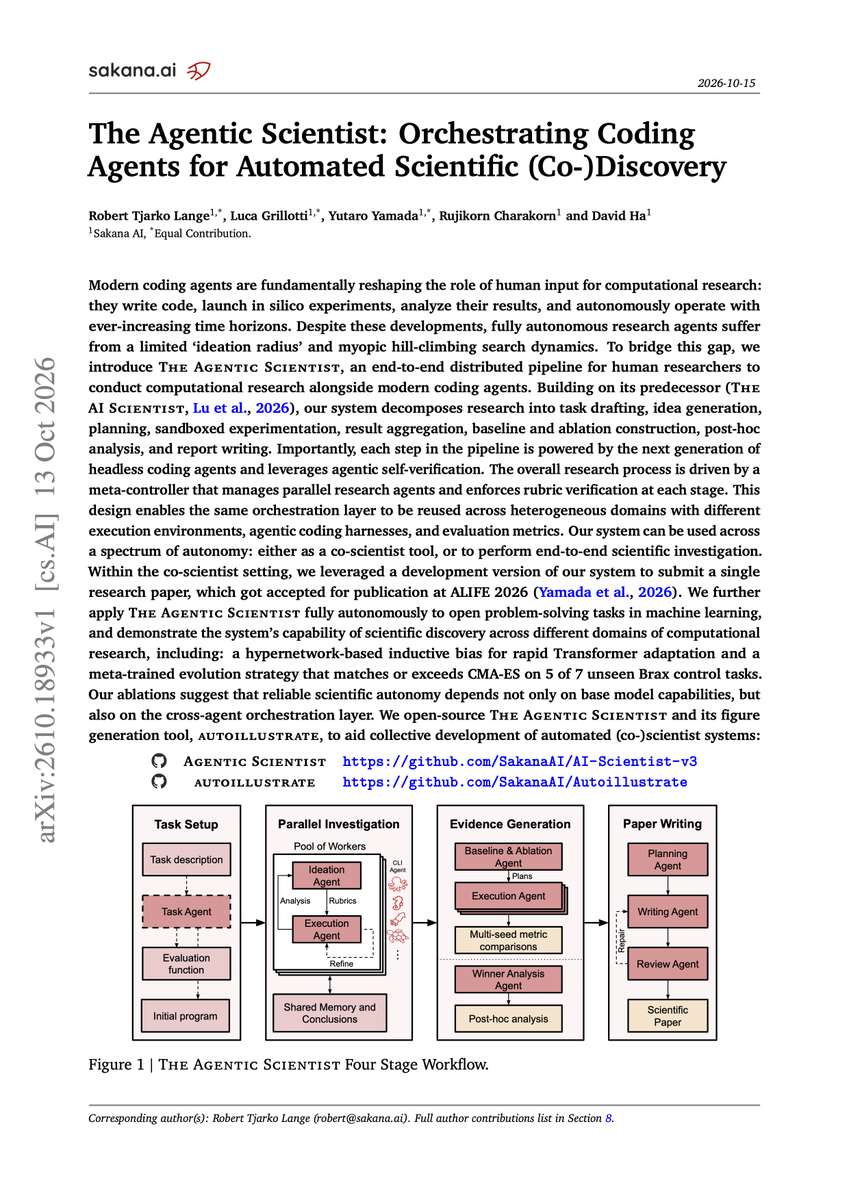
The AI Scientist v3 is out: The Agentic Scientist.
GitHub: https://t.co/v2AkZi4Bmt
Blog: https://t.co/v3Td5yfvBE
arXiv: https://t.co/RuVnAHjMlK
The Agentic Scientist is the 3rd iteration of our automated AI Scientist research system, and the shift this time is from “one agent writes a paper” to “a scaffold of parallel agents orchestrates the full research loop.”
The system now orchestrates a pool of parallel workers that share memory and distilled conclusions. Crucially, it features Evidence Generation: isolated agents automatically run controlled baselines and ablations to prove why an idea actually works.
It works as a co-scientist. We used a development version as a co-scientist to explore biologically plausible learning rules. The agent handled the empirical heavy lifting, proposing mechanisms and running experiments. We stayed in the loop to steer direction, verify results, and moderate claims. That feels like the right division of labor for where the technology actually is.
This resulted in a new biologically plausible learning algorithm, and the resulting paper was accepted at ALIFE 2026 as an oral presentation.
We are also releasing AutoIllustrate. It generates editable https://t.co/i6fwB6vzQV vector figures instead of uneditable, hallucinated raster images. Real scientists need vectors, not pixels. I am an SVG junkie ;)
Incredible work by Robert Lange, Luca Grillotti, Yutaro Yamada, Rujikorn Charakorn, and the team!
China has killed the entire vector database industry.
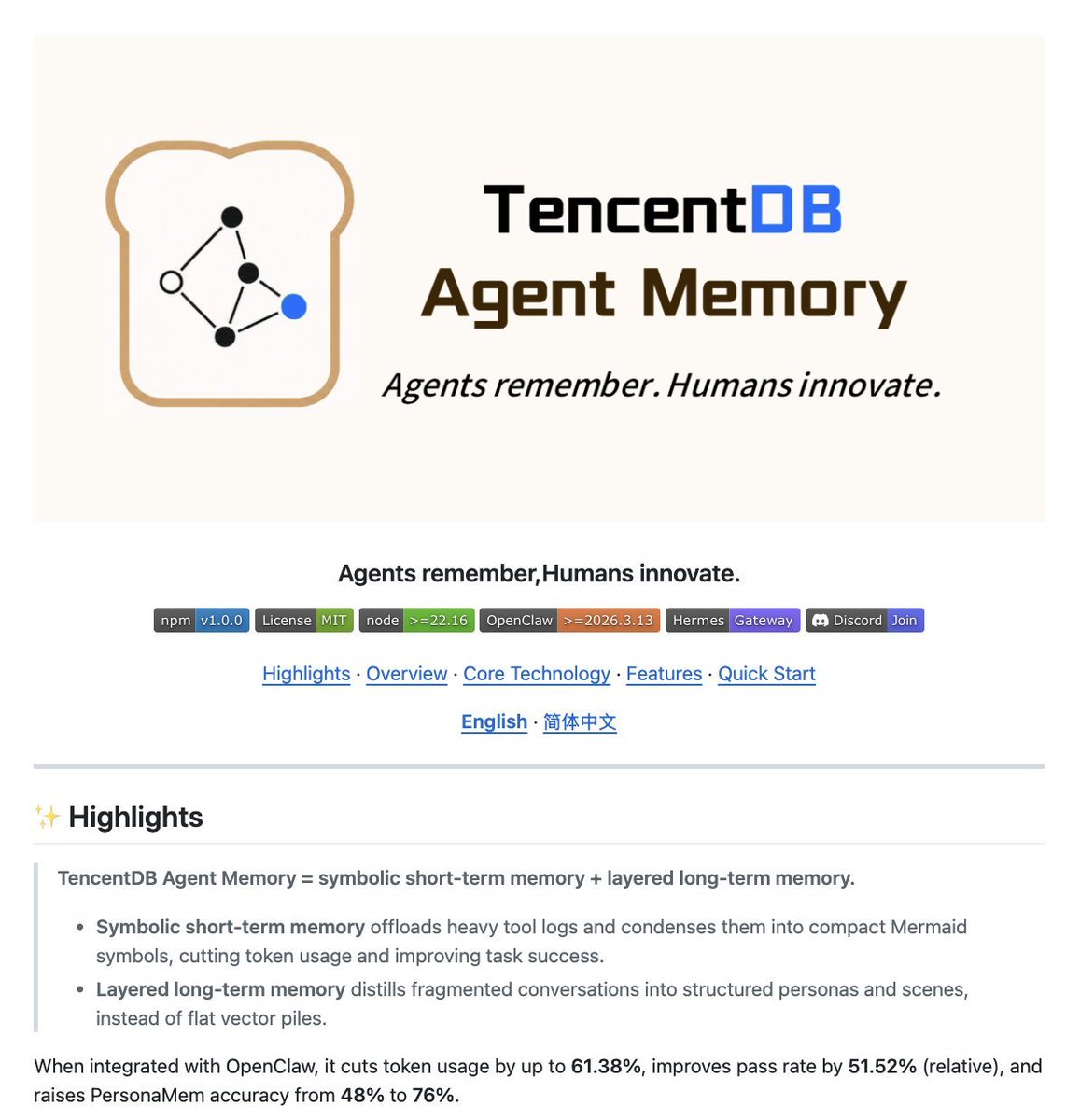
They open-sourced TencentDB Agent Memory. It gives any AI agent long-term memory that runs 100% locally.
No Pinecone. No cloud APIs. No repeating yourself every session.
- 61% fewer tokens
- PersonaMem accuracy: 48% → 76%
- Zero external API dependencies
- Runs on plain SQLite
Most memory systems compress your history into an opaque vector pile. when recall goes wrong, you're guessing. this one doesn't compress, it builds a semantic pyramid.
L0 Conversation → L1 Atom → L2 Scenario → L3 Persona.
Short-term state gets encoded as a Mermaid graph in your agent's context. verbose tool logs get offloaded to disk. when the agent needs proof, it drills back via node_id to the exact raw log.
no lossy compression. every layer is readable markdown you can just open and inspect.
5.1k stars. 100% Open Source.
THIS IS F**KING WILD
FOUND 3 OPEN-SOURCE OSINT TOOLS THAT ARE WAY TOO POWERFUL TO BE THIS EASY TO ACCESS.
And they are free to use and open-source
AKASHIC → An open-source intelligence dashboard that brings multiple investigation tools into one browser interface.
BLUEHOOD → Passively maps nearby Bluetooth devices and helps researchers analyze the signals around them.
OPENPLANTER → Uses AI agents to investigate questions, find connections, and build a live knowledge graph from the information it discovers.
OSINT + AI + OPEN SOURCE IS GETTING CRAZY.
BOOKMARK this before someone take it down
LINK’S BELOW
Dusting off this tweet from April because this gap in shared understanding of LLM capability is *widening*. It's now less "two groups of people speaking past each other" and more a sharp funnel.
- Napkin math somewhere around 6B people (~75% of the population) have barely come in contact with LLMs at all.
- Around 1-2B (~20%) are casual and infrequent users of free-tier ChatGPT-like products. This group sees derpy chatbots and treats them a bit like a better Google search, a writing aid, or etc. Maybe an agent tries to book you a flight. I have non-tech friends who (reasonably, imo) say they have not much use for it at all. Even many professionals outside of math&code are in this tier. For example, execs and many other functions spend a lot of their time talking to other people, so while they understand what is happening intellectually, it is still second-hand and a bit abstract.
- Now we get to professional use of frontier-grade LLMs in math&code. Somewhere around 20M people (0.2%) see first-hand that large, complex projects that used to take them weeks/months can now be completed by agents with a prompt. Building apps, copying apps, translating apps, decompiling apps from binaries... This has all happened very quickly and recently - less than 1 year ago, I was writing code manually by hand, typing memorized computer code commands into a code editor character by character, occasionally pressing Tab to autocomplete a little chunk of code.
- And finally we get to the ~5,000 people (~0.00006%) with access to frontier-grade systems internally. The external world has seen the preview. It looks like swarms of thousands of agents collaborating over weeks on software mega projects: minting zero days, running cyber attacks and defenses at machine speeds, discovering new science, advancing the frontier of mathematics. Things that would have taken top professionals in the industry years of work. Meanwhile, human review and comprehension are starting to fall behind. For example, people are still involved in the "archeology" of the OpenAI-HF incident from many months ago. Mathematicians may be poring over the 722 manuscripts on frontier mathematics for a while.
The funnel is driven by a combination of factors:
1. The impact scales with ambition, problem size, and horizon. A question with a paragraph answer barely stresses the system. You need a reservoir of big, difficult problems that you really care about. This aspect drives the consumer / professional dimension of the funnel.
2. The jaggedness of the system (which I have written about a lot separately). Capability peaks in domains that are digital, verifiable and economically valuable. This is because LLM capability emerges from reinforcement learning on verifiable rewards on a curated environment mixture driven by revenue potential. This aspect primarily drives the area (e.g. math&code) dimension of the funnel.
3. Access. Free-tier, paid-tier, internal.
So this is the weirdness of the moment. The general public has mostly not interacted with these systems. When they have, it looks like a derpy chatbot. The majority of professionals still see only a modest uplift. And a small sliver of professionals are experiencing the vertigo of the curve going vertical. And it is all happening at the same time.
Microsoft just changed the game 🤯
They've open-sourced bitnet.cpp, a 1-bit LLM inference framework.
It let's you run 100B parameter models on your local CPU without GPUs.
- 6.17x faster inference
- 82.2% less energy on CPUs
100% Open Source.
WHOEVER LEAKED THIS CLAUDE CODE SETUP DESERVES A RAISE
I thought the best way to use Claude Code was to just throw Opus at everything.
Apparently not.
Anthropic’s setup is much more interesting:
→ Sonnet 5.5 runs the main session and actually builds the thing
→ Haiku 5.5 swarms the repo for file discovery, AST scans, grep, and docs
→ Opus 5.5 stays in the background as the architect
→ Opus gets called in before big plans, after repeated test failures, and before shipping
→ JEV handles the boring mechanical routing in ~16ms so frontier models only wake up when real reasoning is needed
so you get:
Opus reviews. Sonnet builds. Haiku swarms. JEV routes.
the interesting part isn’t using multiple models.
it’s giving each model a different job.
Instead of burning Opus context on finding files and running routine commands, you save it for the moments where architectural judgment actually matters.
Plan on high.Delegate on medium. Keep Opus on call.
andrej karpathy said in 2023 that nobody truly understands what happens inside a transformer - this october 2026 paper just proved him right and wrong at the same time, and the people who read it first will make $3.8T worth of better decisions
JEV finally maps where LLM reasoning actually lives. not layers. not weights. a high-dimensional geometric manifold where every token is a coordinate and every reasoning step is movement toward a high-confidence attractor. the black box has a shape now.
the t-SNE projection changes everything. mathematics clusters here. code there. planning over there. OpenAI knows this. DeepMind built entire teams around it. your competitors are already navigating this map.
attention is not "which words matter" - it's a geometric neighborhood selector operating across 10,000+ dimensional representation space. local attention grabs nearby tokens. global attention connects semantically distant nodes that a human would never link consciously.
emergent capabilities appear at specific thresholds. chain-of-thought at 10^4 training steps. multi-step planning at 10^5. tool use at 10^6. not random. not mysterious. predictable geometry. the labs mapping these thresholds are compressing 3 years of scaling into 8 months.
larger models form richer geometry. more complex manifold = more robust reasoning = more capability regions unlocked. that's the scaling law nobody explains. Palantir and Scale AI are already paying for models that navigate this correctly.
the companies that don't understand this geometry are buying the wrong infrastructure right now. quietly. expensively.
karpathy was right. nobody understood it. this paper changes that.
Bookmark & watch today.
The reasoning was always geometric. We just couldn't see the shape.
This inference engine runs LLMs 4x faster than llama.cpp:
(Qwen3.5-9B at 92 tokens/s on 16GB Mac)
I ran Qwen3.5 9B on a base M5 MacBook Pro using three local inference engines, one at a time.
→ llama.cpp reached 22.0 tokens/s
→ MLX reached 25.1 tokens/s
→ Uzu reached 92.1 tokens/s
The video shows all three runs side by side.
The first two results do not mean llama.cpp or MLX are poorly optimized. Both are approaching a physical limit of ordinary local decoding.
Generating each new token normally requires another pass through the model. That pass streams roughly 5.2 GB of weights through memory.
A base M5 provides about 153 GB/s of memory bandwidth.
At one token per pass, the theoretical ceiling is roughly 153 ÷ 5.2, or 29 tokens/s, however fast the GPU computes.
Uzu gets past that ceiling by optimizing speculative decoding for Apple Silicon.
Speculative decoding uses a smaller drafting system to propose several future tokens. The full 9B model then checks those proposals together instead of generating every token through a separate pass.
Uzu pushes this further in two ways.
→ It drafts up to 16 positions and uses Weaver to turn independent guesses into coherent sequences.
→ It verifies several possible sequences as a tree, then commits state only for the path the full model accepts.
The 9B model remains in control of the final output. Uzu simply gives it more useful work to approve in each pass.
In my run, every pass of the 9B model produced 7.5 output tokens on average.
Ordinary decoding produces exactly 1.
That is how Uzu reached 92.1 tokens/s on hardware whose one-token-per-pass ceiling is roughly 29.
The rest of the engine is designed around this path too. Uzu ships its own quantized checkpoints, and on M5 chips its Metal kernels run verification through the GPU’s accelerated int8 matrix path.
It is an open-source inference engine from Mirai, with bindings for Rust, Swift, Python, and TypeScript.
The repository is here: https://t.co/CayueSO3B9
(don't forget to star 🌟)
I wrote the full breakdown of why local inference is memory-bound and how Uzu gets past that limit, with reproducible results and code.
The article is quoted below.
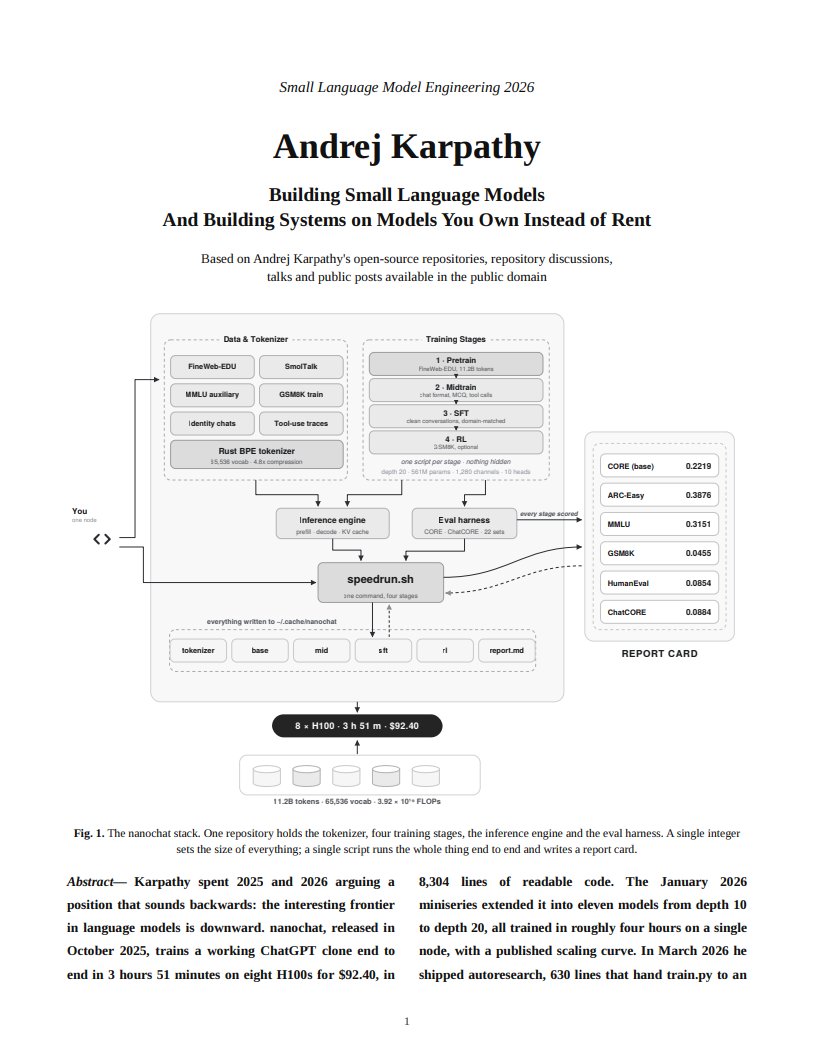
Andrej Karpathy predicted the future of AI once again:
“Everyone’s renting frontier models for jobs a 3B model could do. Small models are the future.”
this 18-page PDF breaks down Karpathy’s case for working with small LLMs.
the real question isn’t “Is the small model as good?” It’s “Which of my 1,000 calls ever needed a frontier model?”
And @thewebai just answered it for formal logic.
TwIL-LM3-Pro:
→ 3.6B params, on par with Qwen3-8B on formal logic
→ leads VibeThinker-3B on all 6 formal-logic tasks tested
→ 95.4% on BBH logic, 95% on SVAMP
→ 2.09 GiB in Q4, runs on CPU or 4GB VRAM
→ no API bill, no data leaving your machine
The secret isn't size. It's post-training.
PDF below. Model 👇
https://t.co/T9lgygHgNS
The idea of an intelligence explosion caused by recursive self improvement has been around for a long time but until very recently it did not seem imminent. Now many leading researchers think it may happen quite soon. You can read our paper about it here:
https://t.co/sgUpugjpRY
We'll be spending a lot more time trying to understand the outputs of language models. A few thoughts, tips & tricks:
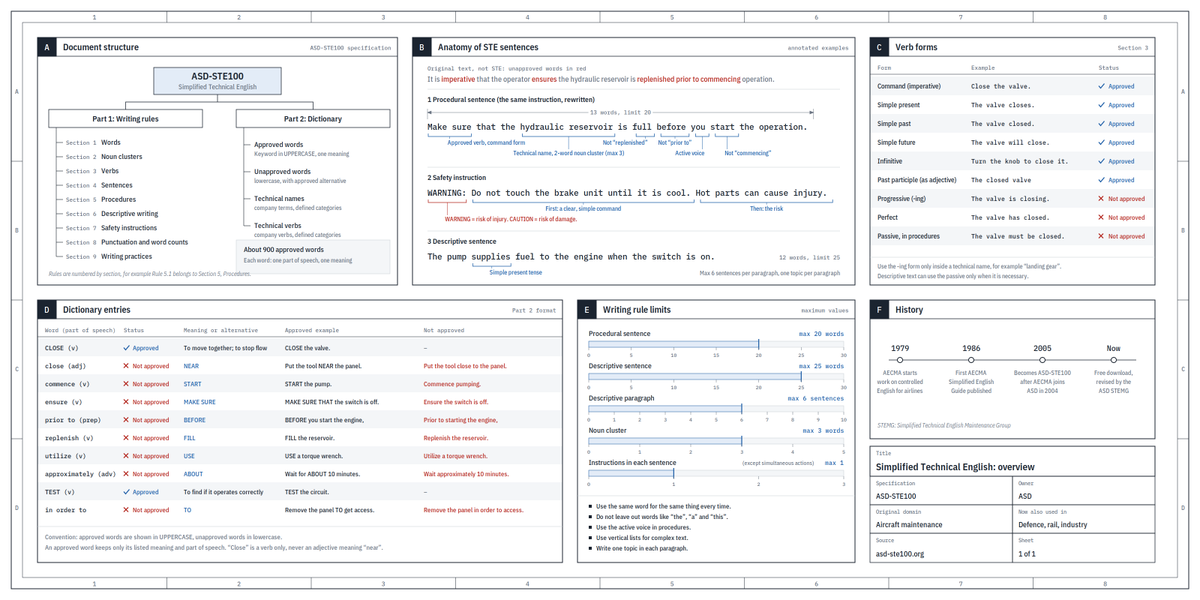
Writing. Something I've had success with: Ask your LLM to explain something in ASD-STE100, it's a controlled language specification originally developed for aerospace maintenance documentation. LLMs well-versed in this language and it comes with heavy constraints on clean writing style that I often find a lot more readable. Sometimes I've tried to soften it a bit e.g. ask for "80% of the way to ASD-STE100" because the spec is quite stringent. But even better:
Diagrams / images. Instead of writing, ask your LLM to create a diagram. These can be a lot easier to process, parse, and understand. But even better:
Web pages. Ask for output "in HTML" to get a beautiful, interactive webpage. LLMs are getting really good at frontend and can create beautiful experiences, animations, etc. But even better:
Explainer videos. The output format I am most bullish on is fully custom / bespoke explainer videos generated on any arbitrary topic. Experiment with things like "Create a 3b1b style video explainer on X. Use my ElevenLabs API key for audio narration". (you'd need an API key for the latter or you can ask your LLM to find you decent free alternatives that use your local compute). This is actually starting to work!
In summary:
- As LLMs get better, they will do more and more of the legwork autonomously, and a lot more of our work will rise up the abstractions into oversight and understanding.
- Luckily, LLMs can help here too because as intelligence and code are increasingly abundant, you can ask for large, custom, discardable software artifacts (e.g. web apps, video explainers) that would have never made sense to create before. Push the boundaries here and you'll be surprised.
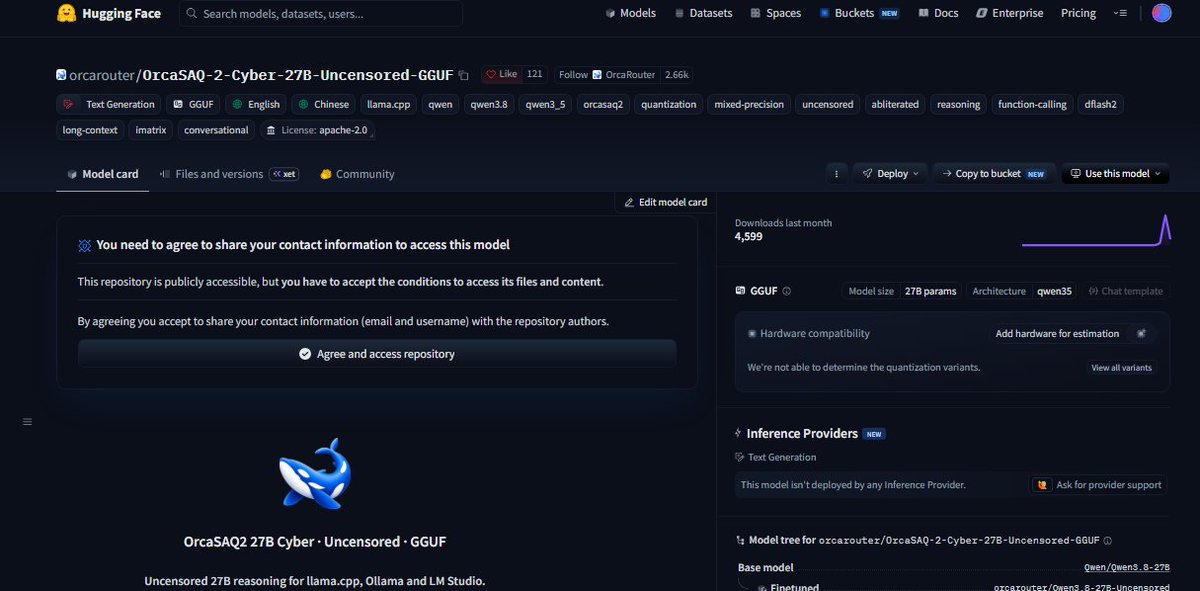
YOUR NEXT CYBERSECURITY AI MIGHT NOT NEED THE INTERNET AT ALL.
ORCASAQ-2 CYBER 27B was compressed from 54.7 GB → 15.7 GB while keeping a 262K context window and 94.4% Top 1 agreement.
Built for:
→ Defensive red teaming
→ Vulnerability research
→ Security coding
→ Terminal workflows
→ Authorized security testing
The biggest feature?
YOUR CODE, LOGS, AND VULNERABILITY DATA CAN STAY ON YOUR MACHINE.
No cloud required.
A 27B cyber model you can actually run locally without sending sensitive security data elsewhere.
15.7 GB. 262K CONTEXT. FULLY LOCAL.
LINK BELOW
Banger paper from Microsoft Research.
(bookmark it)
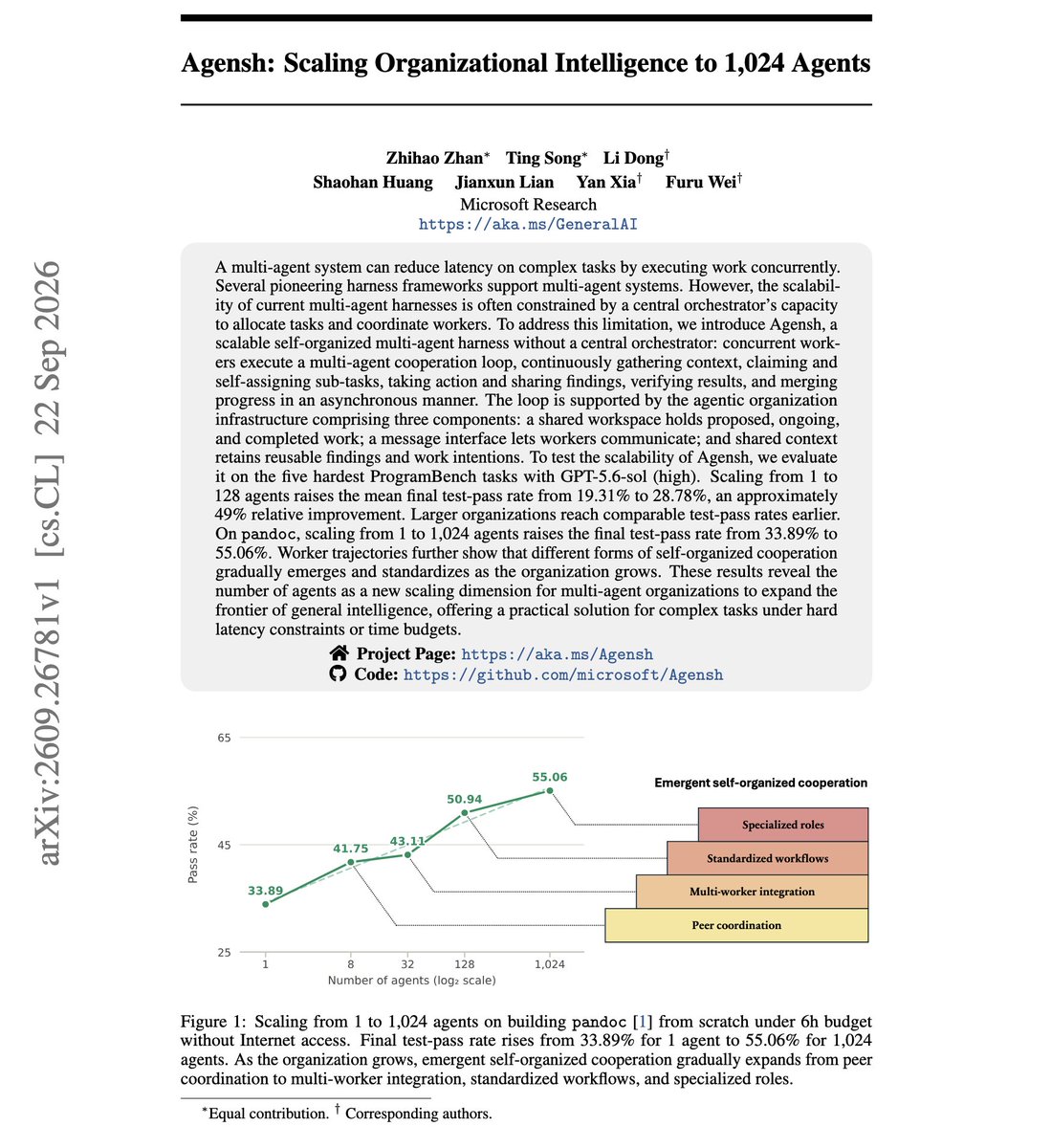
They run 1K+ coding agents at once to test a scalable self-organized multi-agent harness.
This is an interesting test because most multi-agent systems today have some hierarchy or structure.
Agensh has no central orchestrator.
It coordinates parallel coding agents through a shared state instead of a central orchestrator.
Each agent gathers context, claims a sub-task, does the work, shares what it found, verifies the result, and merges it, all asynchronously through a shared workspace and a message channel.
On the five hardest ProgramBench tasks with GPT-5.6-sol, increasing agents from 1 to 128 raises the mean final test-pass rate from 19.31% to 28.78%.
Larger teams also reach a given pass rate sooner.
On pandoc, 1,024 agents take the test-pass rate from 33.89% to 55.06%.
The authors also report forms of cooperation that the agents start on their own and that become standard practice as the team grows.
Paper: https://t.co/gSASQJ2ThT
Chat with Paper: https://t.co/Ywv8pkQGVU
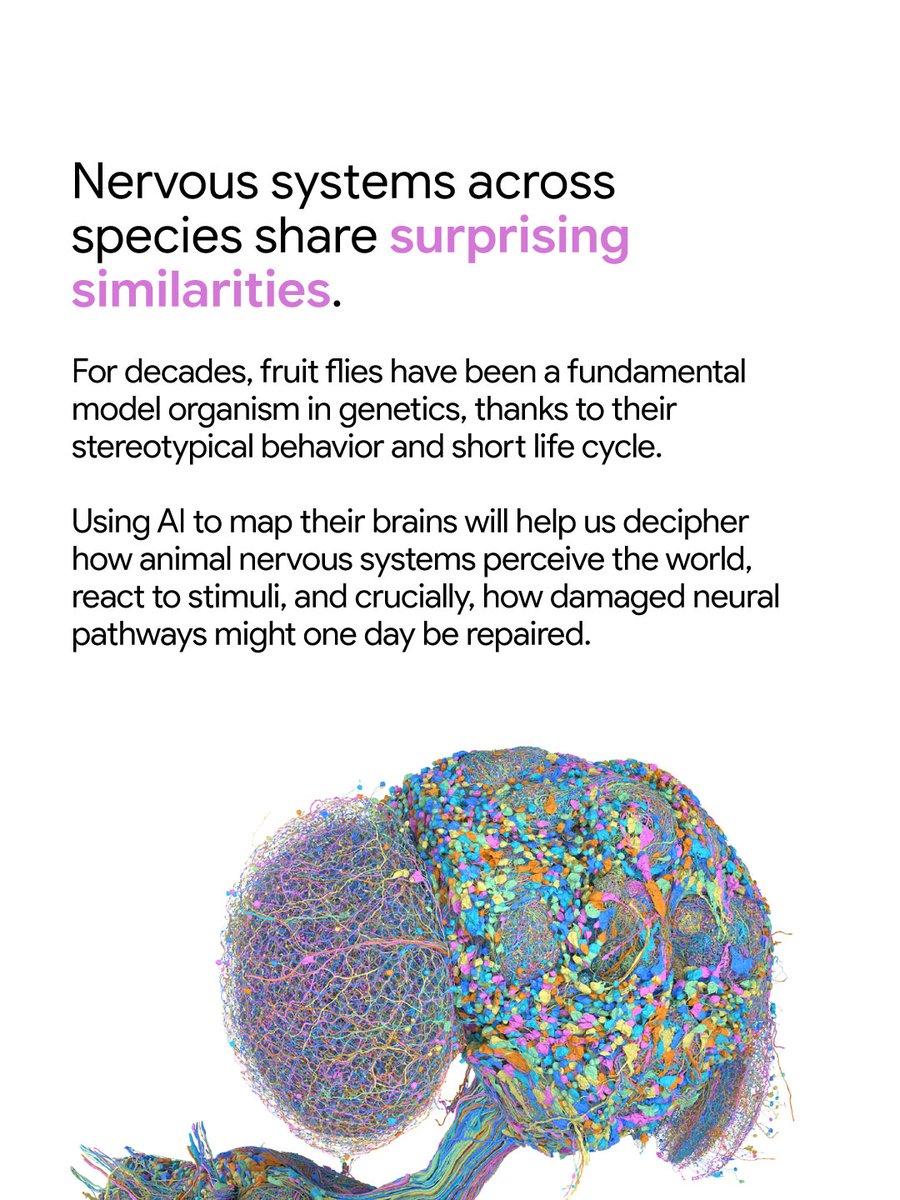
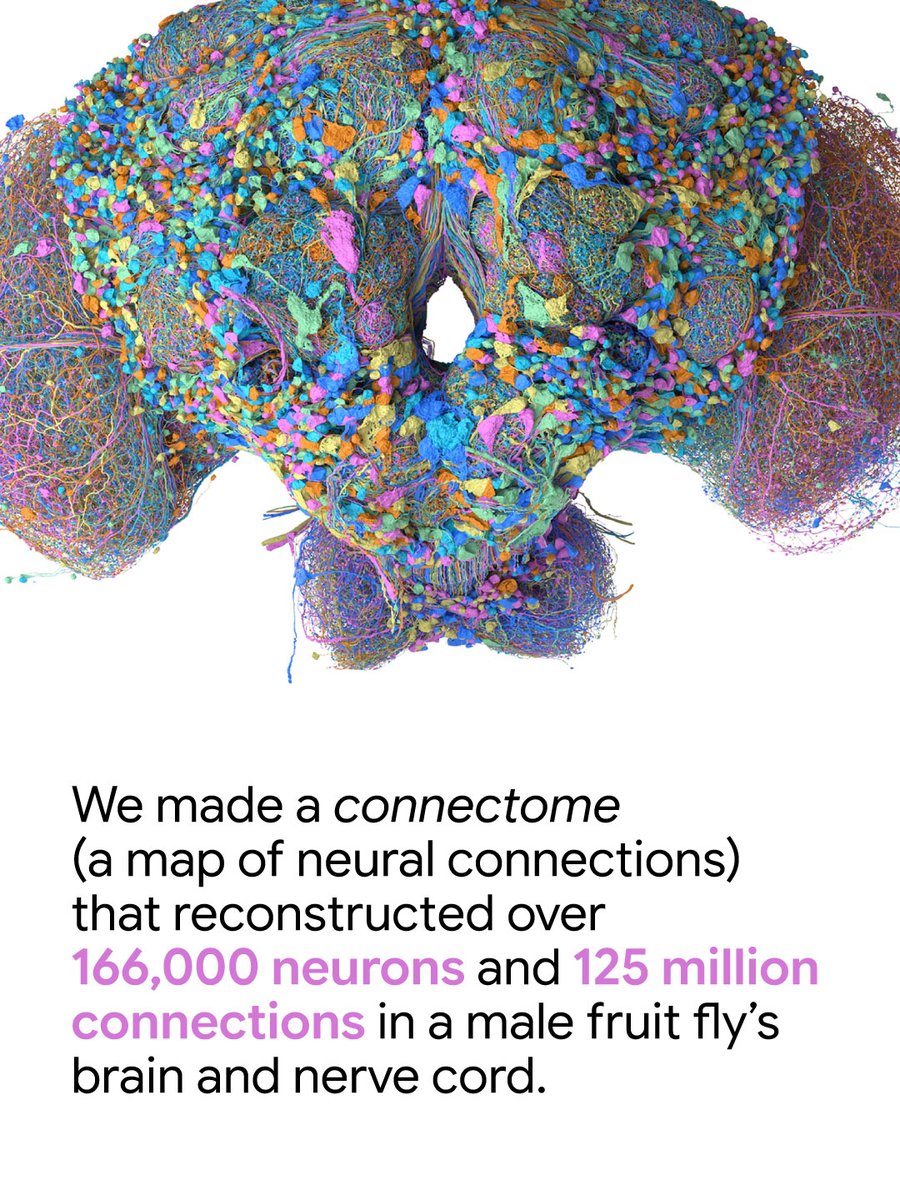
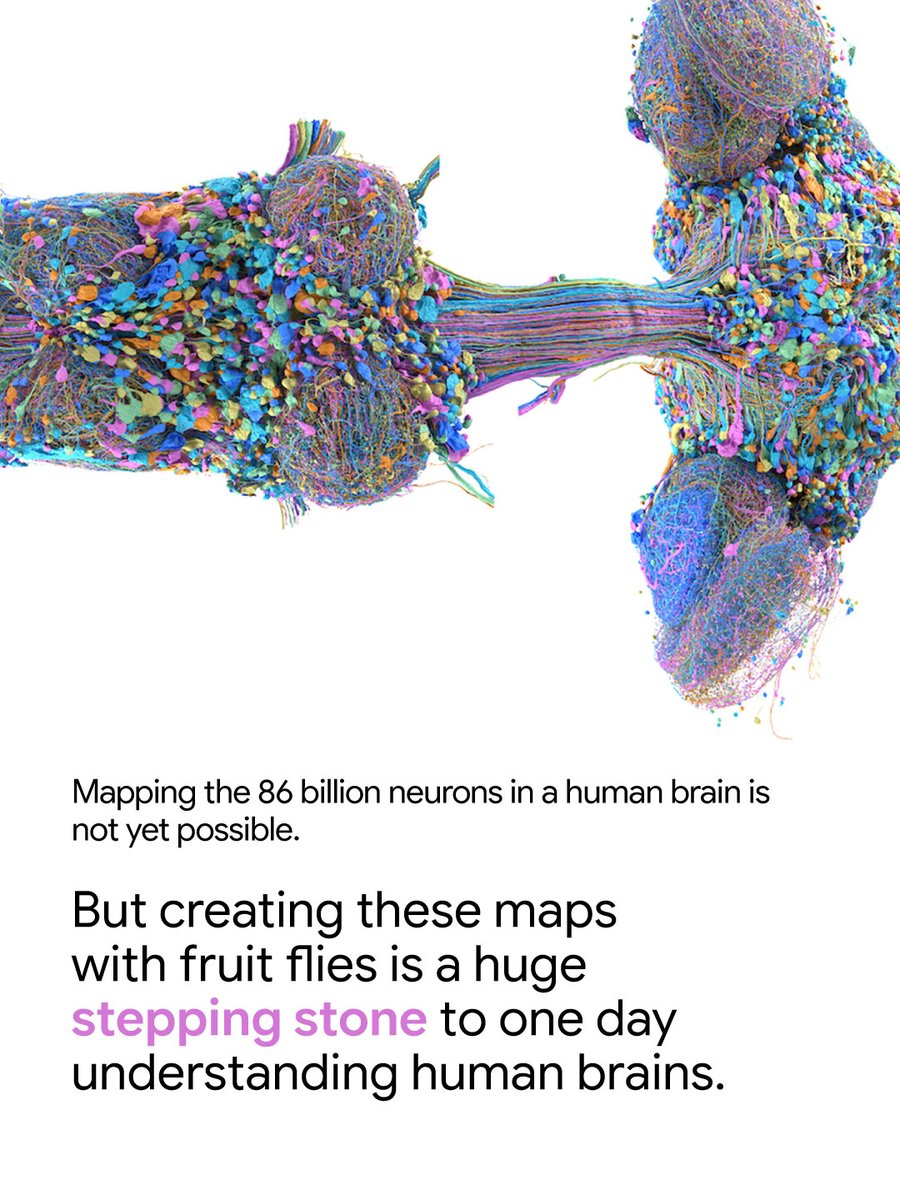
For the first time, a group of researchers — including scientists from @GoogleResearch and HHMI Janelia — built the first complete brain map for a male fruit fly. Together, we mapped every single neural connection in a male fruit fly brain and central nervous system, amounting to more than 166,000 neurons.
Here’s why we did it.