1/ I built something in my free time: zopedia - a personal wiki that compounds.
Drop in sources (PDFs, papers, your Zotero folder) & an LLM auto-extracts entities, concepts & summaries, then cross-links everything with [[wikilinks]] (inspired by @karpathy's vision for LLM wikis)
Dario's spiel since GPT-2 has always been about hyping the dangers so that open models would be made illegal and *he* would stay in control.
He left OpenAI because he wasn't going to have control.
It's like the Ottoman Empire banning the printing press for Arabic so they would keep in control of the dogma.
It stops the population from freely accessing diverse knowledge.
It's a new form of medieval obscurantism.
been in ML research for 7 years, wrote a paper on compression & scaling laws, and passed openai's information theory interview
yet the latest 3b1b *still* gave me fresh intuition on entropy
either i'm an impostor or 3b1b is the greatest teacher of all time
As believers of open research, we are disappointed to see Anthropic silently degrading Fable 5 for AI development
"Any topic related to building pretraining pipelines, distributed training infrastructure, or ML accelerator design... may have limited effectiveness through Claude via methods such as prompt modification, steering vectors, or parameter-efficient fine-tuning."
Not only do they get to decide what you use LLMs for in research, but this also enables them to silently intervene in your research without you knowing.
This sets a dangerous precedent. If a model refuses openly, users can understand the boundary. If a model falls back to another model, users can still evaluate the difference. But if a model silently modifies or weakens its own answers while still pretending to help, researchers lose the ability to know whether a failed result came from their own idea, their implementation, or an invisible intervention by the model provider.
That is not safety. Safety policies should be transparent, auditable, and user-visible.
On top of that, the people most harmed by this are not the largest labs with massive teams and proprietary infrastructure. It is the independent researchers, academic groups, startups, and open-source builders who rely on public tools to compete, innovate, and pioneer AI for everyone else.
1/ I built something in my free time: zopedia - a personal wiki that compounds.
Drop in sources (PDFs, papers, your Zotero folder) & an LLM auto-extracts entities, concepts & summaries, then cross-links everything with [[wikilinks]] (inspired by @karpathy's vision for LLM wikis)
4/ Runs fully local via Ollama or llama.cpp. No data leaves your machine. Or point it at any OpenAI-compatible endpoint.
Also exposes /v1/chat/completions, so you can embed it headless into any app. Streaming included.
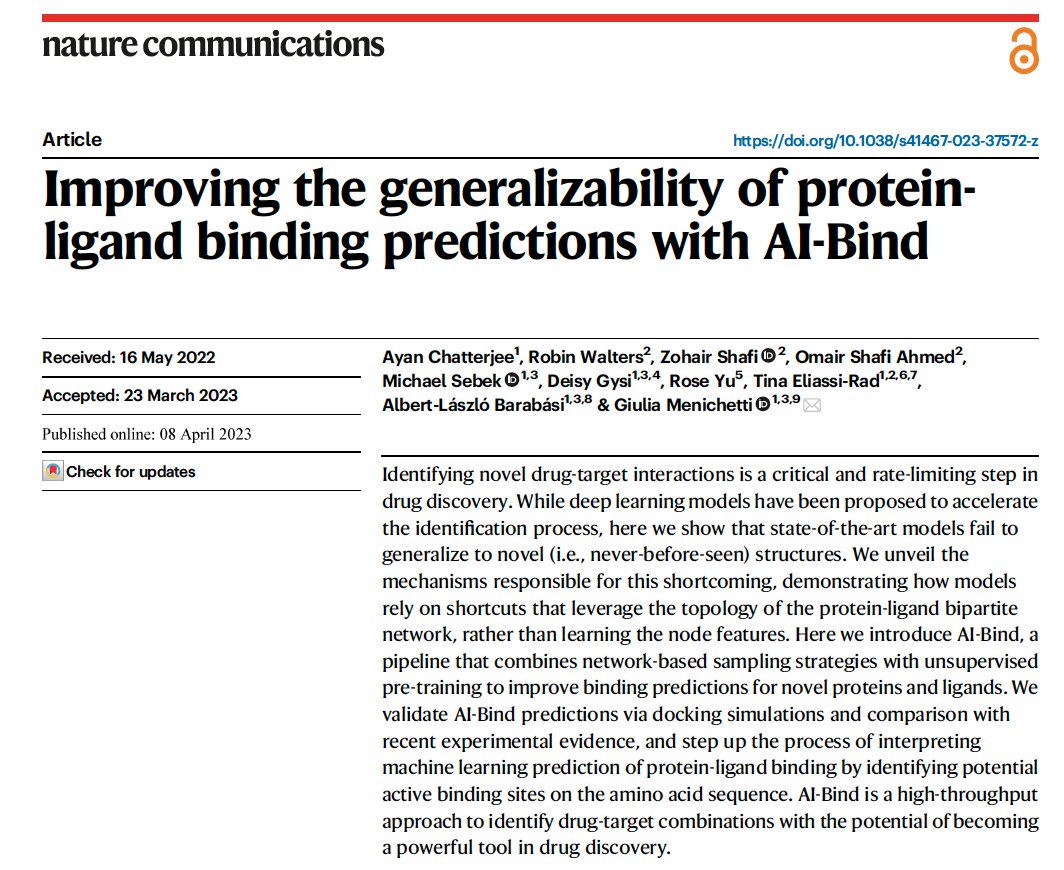
1/🎉 Excited to share "Improving generalizability of protein-ligand binding predictions with AI-Bind" published in @NatureComms
Available at https://t.co/exgKGVW1ug
Short 🧵 below