🚀 PhD opportunity – AI & Rheumatology in Montpellier 🌞
Join @umontpellier for a fully funded PhD at the crossroads of AI & clinical research.
🎯 Topic: Drug-free remission in rheumatoid arthritis
💻 ML, clustering, LLMs
📍 Montpellier, France
Apply 👉 https://t.co/il2JisoztB
1/ We discovered something totally unexpected about the neural structure of consciousness that overturns decades of thinking on its biological basis and brings us significantly closer to the recipe for generating conscious awareness.
New preprint: https://t.co/K8BwiHXvXg (led by @HesseJanis, with @FrankLanfranchi, @_conor_mcgrory, @Yuelin_Shi, and @EngelTatiana)
A universal predictive model of the cell would dramatically accelerate science, allowing biologists to perform experiments digitally. Today we’re announcing a major partnership with the DOE and NIH. The goal of this partnership is to generate the data that will be needed to build an accurate model of the cell with artificial intelligence.
Isomorphic, Google DeepMind, and Meta are joining us as founding partners in the Virtual Biology Initiative. This is the beginning of a large scale coordinated effort to map cellular biology to power the development of digital models of life. Other leading scientific institutions and consortia including the Allen Institute, Broad Institute, Gladstone Institutes, the Human Cell Atlas, the Human Protein Atlas, the Wellcome Sanger Institute, as well as NVIDIA, are working together as part of this international scientific project.
Creating a predictive model of the cell is one of the most important challenges for the next decade of science. The insights that come from this could unlock a far greater understanding of disease, and open new paths for cures.
We invite the worldwide scientific community and other funders to join us in this effort.
AI in Medicine Probably Won’t Look Like “AI Replaces Doctors”— at least not for a long while.
My office experience has been revealing…
I’m already seeing what the supposed future of medicine looks like in my office, and it doesn't look like physicians will be disappearing from the exam room anytime soon.
Patients now arrive with AI-generated summaries of their symptoms, imaging reports, possible diagnoses, and treatment options. They have already asked a model what their shoulder pain might mean, whether surgery is necessary, whether a medication is appropriate, or what questions they should ask me.
Then they sit across from me and ask what I think.
That part is key, because many aren’t actually asking for more information… They are asking for... validation, context, judgment, and someone to tell them whether the answer they received makes sense in the real world and for them.
That is one reason I found Arvind Narayanan and Sayash Kapoor’s Princeton essay AI as Normal Technology so useful.
Their central argument is that even very powerful technologies do not instantly reorganize society simply because the underlying technology improves quickly.
Electricity is one of their best historical examples. Electric motors were available long before factories saw their largest productivity gains because manufacturers first had to redesign factory layouts, how work moved through them, and how people interacted with the new technology.
The important lesson is not that AI will follow the same timeline, but that inventing a powerful tool and reorganizing a complex system such as healthcare around it are two very different things.
Medicine might be one of the clearest examples of this.
Let’s face it… Large language models can already do remarkable things. They can summarize a chart, organize a differential diagnosis, translate medical language into plain English, identify patterns across years of laboratory data, explain a disease process, and help a patient prepare questions for an appointment. But those capabilities are not the same thing as practicing medicine, because real clinical care depends heavily on context, non-verbal cues in the office setting, physical examination, probability, pattern recognition, and knowing which pieces of information actually matter.
I see this limitation regularly when patients query an LLM about their pain. Someone may (has, on a few occasions) enter something like, “I have pain on the outside of my upper arm,” and receive a response that includes a concerning discussion of malignancy.
Technically, cancer belongs somewhere in the universe of possible causes of pain, but that is not how a clinician reasons about the problem. I am also considering age, duration, mechanism, range of motion, weakness, night pain, trauma, constitutional symptoms, cervical findings, the exact location of tenderness, which movements reproduce the symptoms, prior cancer history, and a dozen other variables the patient may never think to include in the prompt.
The problem in that situation is not necessarily that the modelcan't reason. It is answering the question it was given. The problem is that the question did not adequately describe the patient. Most people do not know how to frame a medical question and turn it into a useful prompt for an LLM.
We talk constantly about how sophisticated the models are, but far less about whether the person using one knows what information to provide, how to interpret uncertainty, how to recognize an implausible answer, or when a problem requires examination, imaging, laboratory testing, or simply years of clinical experience to place it in context. Asking a properly structured medical question of an LLM is a skill in itself.
This is why I think the current debate around whether AI will replace doctors misses the more interesting question. The better question is what happens when a well-informed patient, a capable AI system, and an experienced physician are all involved in the same decision.
Used well, AI could make medicine substantially better. It can remove low-value cognitive friction, help organize complex histories, flag medication interactions, create better after-visit explanations, help patients arrive more prepared, and give clinicians another set of eyes when thinking through an unusual problem. If those tasks are handled well, the result may actually leave more time for the parts of medicine patients value most: listening, examining, explaining uncertainty, weighing tradeoffs, and making decisions together. I have been using AI in my office routinely for more than a year. Sometimes it has helped enormously, and other times it has been far too aggressive or off base until I clarified the prompt.
For now, this will not make the physician less important. It may make the physician’s role more focused on what's hardest to automate.
Healthcare will also move more slowly than the underlying technology because it has to. This is a safety-critical environment. Hospitals have to decide how to verify AI outputs, where they belong in the medical record, who is responsible when they are wrong, how to protect patient privacy, how clinicians avoid becoming rubber stamps for automated recommendations, and which tasks are safe to delegate in the first place. Models may improve every few weeks/months, but the systems around them will change much more slowly.
And humans will take time to learn how to use these frontier models to generate more accurate and reasonable case summaries and suggestions.
I do think AI will eventually automate some tasks physicians currently perform, and probably more than many of us expect. But the changes to medicine I see emerging right now are not doctor versus AI.
It is doctor + AI.
If you let them (some office visits are way too short), patients are already showing us what that looks like. They often use the model first, then bring the result into the room and ask someone with experience to decide whether it makes sense. They want the access, speed, and breadth of the machine, but they still want a human who understands the person behind the data.
For now, that seems like a pretty reasonable model of where this is going: AI can expand access to information, but clinical judgment and human factors remain the layer that turns information into care.
@hubermanlab@Michael_Easter
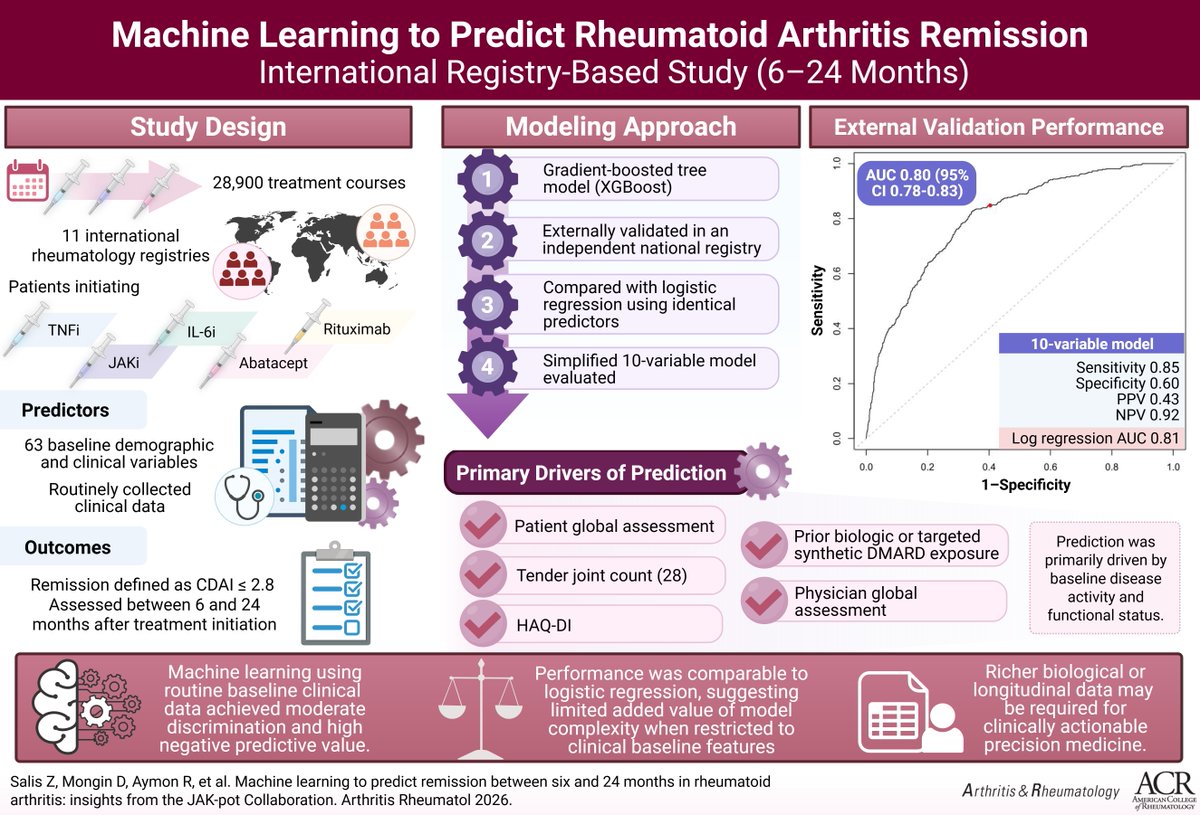
Can rheumatoid arthritis remission be predicted using routine baseline data? In 28,900 treatment courses across 11 registries, an externally validated machine learning model showed good rule-out performance but limited gain over logistic regression
A&R
https://t.co/inX6sbx04A
@zsalis
Our new paper is out in Scientific Reports:
BMI is not associated with incidence or progression of DIP joint OA in RA, using >2500 patients from SCQM.
Open access here: https://t.co/0ZoXp6ymJ0
📢New from our international #RA collaboration: No increased risk of major cardiovascular events with JAK inhibitors vs TNF inhibitors in real-world data from 15 registries.
🫀💊 The JAK-pot study
🔗 https://t.co/m7xGdMDR8Q
#Rheumatology#JAKi#bDMARDs
🚀 Hiring! Join us as a Postdoctoral Researcher in AI for Biomedical Data Analysis at Université de Montpellier.
🔬 Work at the intersection of AI & biomedical science
📍 France 🇫🇷
🔗 Details:
https://t.co/7dPa4xbiql
#AI#BiomedicalResearch#PostdocJobs#Hiring
🚨 New research alert! 🚨
Does smoking protect against knee osteoarthritis? 🤔
Our meta-analysis using data from over 8,000 participants across three major cohorts finds no evidence of protective effects.
Read more: https://t.co/PzCBKXncbZ
#Osteoarthritis#Smoking#research
@ProfDavidHunter@NEJM Hi @ProfDavidHunter ! Although semaglutide was effective, the placebo group did show a notable improvement, which is interesting and warrants attention. What do you think?
@ScottM2018@pash22 Thanks for engaging with our study @ScottM2018 . Our study was conducted independently with no pharma involvement. All disclosures are transparent and align with rigorous academic standards.
🚨New study: Weight loss shows a dose-response effect on hip osteoarthritis! Just 10% weight loss led to a 31% boost in hip-related quality of life. Evidence that weight management is key for hip OA relief. #HipOA#Osteoarthritis#WeightLoss#HealthyAging https://t.co/zyR20hpg0Q
The State of the Nation 2024. Diabetes Australia’s new report, released today, reveals the diabetes epidemic shows no sign of abating. It comes at a critical time in the national conversation about diabetes. The time for bold, decisive action is now. More https://t.co/8r0fZayUxr
Out now: Our findings suggest that long-term NSAID use could accelerate the progression to total knee replacement by markedly exacerbating symptoms #pain#osteoarthritis#arthroplasty#NSAID https://t.co/7b6VmoJJog
Just published our latest #research: No significant associations were found between weight change and #hand#osteoarthritis (OA) incidence/progression over 4 years or pain development/resolution over 8 years. More evidence for the complex nature of OA! https://t.co/ZMXoa0gS1u