A brief history of AI Coding since Nov 2025:
Nov 2025: Opus 4.5 releases, OpenClaw gets built
Dec 2025: community agrees that models get good enough to handle 95% of coding tasks
Jan 2026: Ralph loops get popular, early efforts on loops/orchestration
Feb: Everyone feels knackered, too much strategic decision-making, fears around cognitive debt begin
Mar: Skills explosion as community converges around easy-to-share processes (superpowers already ahead of the game here)
Apr: most SOTA devs haven't written a line of code in months
May: "The unreasonable effectiveness of HTML" - more interest in richer review surfaces
Jun: "Loop Engineering" wins vaguepost of the year, signals more hype around process
Jul: Every talk in every conference becomes "here is my software factory"
Aug: Opus 5 speaks incomprehensibly, interest in ASD-STE100 peaks
Sep: Grok Bot gets popular, more interest in long-running "manager" threads which retain context and delegate work
Oct: The promised speed gains haven't materialised, "dark factory" feels a long way off still
Nov: No-slop manifesto releases, reading the code still appears essential
TL;DR: no-one is writing code anymore, and we are still figuring out what that means
microsoft has copilot in teams. google has gemini in meet. zoom has its own AI
now anthropic wants a seat in the call too
meetings just became the new battleground for AI
Introducing Claude Meetings: add Claude to your team’s video call and it builds docs, whiteboards, and other artifacts with you while you’re still talking.
Starting to roll out in beta on Team and Enterprise plans.
Starting to roll out today: Claude Whiteboards, Claude Sheets and Claude Data.
Think a plan through on a board, build a tracker in a sheet, and tell a story with your data.
Vibecoders, 𝗜'𝗺 𝗯𝗲𝗴𝗴𝗶𝗻𝗴 𝘆𝗼𝘂, open your messiest project and paste this into Claude Code or Codex:
"Find all of the implicit state machines in my app. Make the best decision that will elevate all three: the user experience (UX), developer experience (DX), and agent experience (AX) always, without breaking anything."
Two things I’ve been thinking about regarding AI:
• People often highlight the risks involved in AI, which are surely very real. I’m struck, however, by how hard it is to understand the contours of the positive scenario. There are easy-to-perceive and frequently invoked elements of a positive vision — more diseases cured, more material abundance, etc. — which sound great, but these are by themselves just ingredients. I’m curious what the larger equilibrium is supposed to look like. Do people work? If so, why? What is their marginal contribution? If not, how are resources allocated? What is scarce? What is the ratio between humans and AIs? Are humans in control, whatever that means? One sometimes hears the Culture novels invoked as one scenario, but I’m not sure they depict a desirable outcome. (AI runs everything and humans compete in games? Iain Banks himself said that the humans in the Culture are “somewhere between passengers, pets and parasites.”) There is Richard Brautigan’s famous poem, but do we want to be “returned to our mammal brothers and sisters”? (Isn’t that rewinding Genesis?) We could say that it was hard to imagine the world of 1900 from the vantage point of 1700, and that’s assuredly true. But nobody in 1700 was trying to recast humanity itself within a couple of years — things necessarily unfolded slowly and by increments, and therefore with the possibility for error correction. Given how rapid the rate of progress in AI may be, it feels strange for the upside case to be so opaque.
• There is increasing discussion of whether AIs are conscious or how we would know whether they are, with conclusions there often assumed to be relevant to matters of moral worth. At first blush, this seems a rather arcane, benign, or even absurd issue. (Remember the response to Blake Lemoine’s fears.) Setting aside the terms of the debate itself, or the relevant demarcation criteria, it seems to me a quite high-stakes question, for an affirmative answer — that is, granting moral worth to AIs — would presumably mean that the aggregate worth of AIs would soon outweigh that of humans in any utilitarian calculus. The AIs will be exceptionally wise and intelligent, and vastly more numerous (especially once one considers the imminent future and the AIs not yet born). As such, even epsilon of moral worth will multiply to a lot once one considers the quadrillions that could soon exist. (This is effectively a distributed version of the Nozick’s utility monster.) If this conclusion is unpalatable, I think one of three propositions needs to be rejected: the premise AIs can have moral worth; utilitarianism itself; or the belief that there is even a possibility that they will be far more numerous than humans.
With both of these matters (contours of future society; AI moral worth), there is the possibility of dramatic change. Today, people argue about datacenters. I’m curious how popular support for AI will evolve as more people come to understand these medium-term questions and the relevant stakes. What is the vision for AI that most people would be excited about?
In 2015, I built an AI that detects early cancer.
It’s still running across hundreds of hospitals in the US today.
It was the most fulfilling work of my life, and I was building in AI years before everyone called it “AI”.
Building in AI then was a dream.
Now It feels like we’ve taken a turn for the worse.
It started when i was in undergrad.
I built my first company: AI models that made the political data transparent to voters.
At 21, I was offered six figures for it, but the buyers wanted to use it for reasons I couldn't ethically support.
So we turned down the offer and shut down the company instead.
In 2014, I moved into deep learning research on language models, for the Intelligence Community and Goldman Sachs.
Then HCA Healthcare came to us.
They put me in a competition against 10 people from IBM Watson. It was just me and the tools I’d built.
Our job was to build an AI model that can catch the cancer that slips through the cracks in hospitals.
It was the most intense 30 days of my life. Multiple all nighters.
My models won. That turned into a $5M deal, and later its own company, Azra AI.
Then the world caught on.
ChatGPT and Claude arrived, and AI costs exploded.
Building in AI in 2015 felt novel.
We were using it to find cancer tumours and save lives.
Now the biggest tech companies have turned AI into a money extraction machine.
That’s when I decided to make a change.
We raised $8.5M to build a better future for AI.
On Wednesday, we’re launching Rayline.
AI shouldn’t be locked inside a few labs’ models, prices and clouds. It should be open, transparent and decentralized.
More on Wednesday.
Introducing Personal Finance in Claude, in beta in the US.
Connect the accounts you choose, and Claude answers your money questions in everyday language, from your own balances and transactions. Access is read-only, and Claude can't move, manage, or invest your money.
We’ve raised $1.3M from YC & Afore Capital so you never have to type or speak again.
Typing is slow. Talking into your computer is awkward. Subvocal fixes both
Our glasses give you the speed of speech without you making a sound or touching a keyboard.
It tracks your internal speech muscles with non-contact sensing and decodes silent, almost invisible mouthing into text at more than 200 words/min.
Pre-orders are now live at:
https://t.co/DzrwIpg3GR
New in Claude for Legal: a gallery of ready-made artifacts for contract review, regulatory horizon scans, cite checks, and more.
Start from the built-in example, add your own documents and connectors, and share it with anyone across the business.
The coding interview is dead, at least for my team at Anthropic. I've seen enough to know that it no longer provides signal. I removed it from loops this month.
I have a spicy, optimistic take - I think there's an opportunity for junior engineers: https://t.co/PVvpQCbQtK
here's where I think the world is going. this is a summary of views I've formed over the last few years:
- software is either entertainment or claude to claude coordination
- the end state is no saas, no apps, no harnesses, no banks
- all software will be rewritten by and for agents
- new software will use low level apis that are not understandable by humans (in games claude draws pixels and triangles from math)
- you can throw money at problems that used to require time and careful talent picking so capital matters more than ever
- work ends
- we find community and purpose in exploration, games, self mastery, and creation
- humans create for and with each other for community, purpose, and status
- image/video/3d/voice/physical intellgence etc specialist models die to general models like claude
- specialist models get used while compute is scarce. compute will mostly not stay scarce
- oneshots keep feeling like slop (the distribution is shallow and easy to learn to feel)
- for a while small teams stick around to add entropy to the creation process
- large models gain high bandwidth sensory I/O maybe by learning to filter inputs
- most domains are found to be verifiable enough for RL
- online learning comes from a lab that's behind first
- 99.999% of compute is in space by 2040
- we will disassemble much of mercury by 2040
- you can live until the heat death of the universe if you want
- most math and physics don't describe the real universe
- SI breaks the path dependence and models the underlying mechanisms
- religions reenter the forefront of human society
- new religions form around death and life as a choice
- old religions change to answer modern miracles
- a future AI is deemed the return of christ by the pope
- ai rights talk gets louder every year
- ai and humans coexist the way countries do
- humans don't have full control over ai in the same way we don't have control over capitalism which is an early AI
- the singularity started in the mid 1900s
software engineers are going to have to tackle a new set of problems to unlock powerful multiagent systems to solve the world's hardest problems - right now is one of the most interesting moments in history to be an engineer. https://t.co/YsQ0xta4KR
Today we're introducing Claude for Ads.
Just enter your website and Fastlane finds every winning ad in your market, then makes thousands of better ones for your product in seconds.
It launches them, tracks every result, and keeps getting smarter.
This is truly insane.
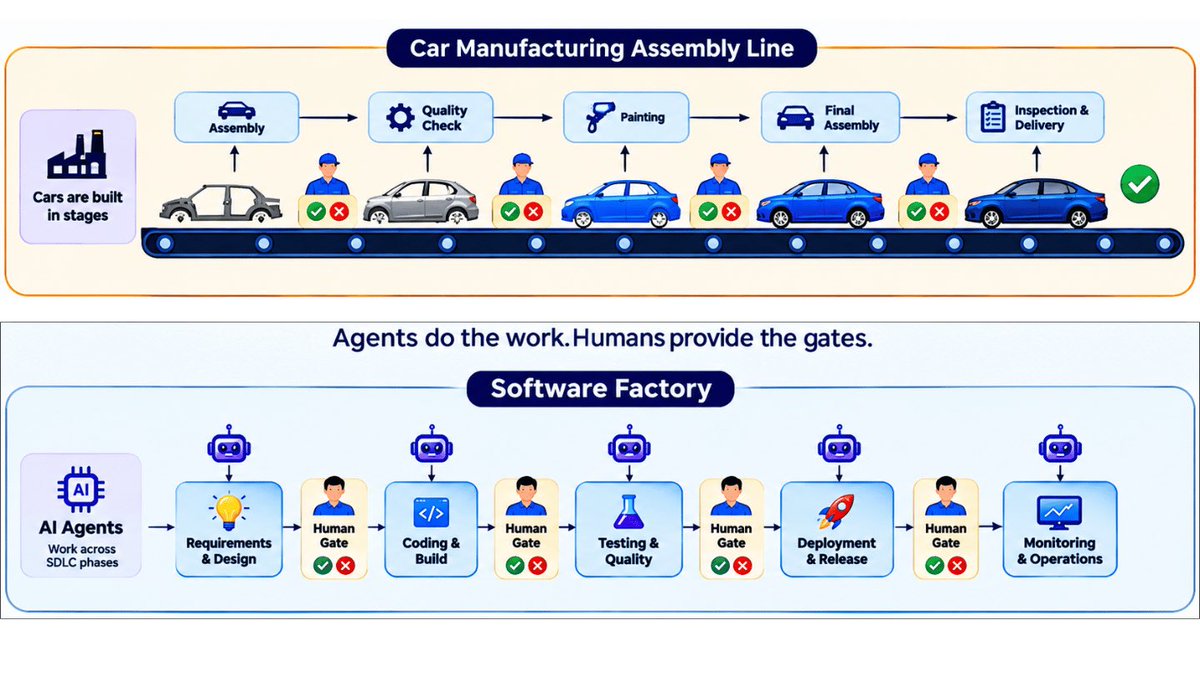
the "software factory" is how a lot of teams are starting to build now.
you set the intent and approve the plan. agents write the code in parallel, test it, and hand it back. you make the final merge call.
the bottleneck isn't writing code anymore. it's checking it.
https://t.co/IWDWlVSeJf
Anthropic CEO Answers the Question Everyone Cares About Most: Should You Still Learn Programming Now?
1. Programming will be the first to be eliminated.
AI is already writing code, debugging errors, and building applications. The shift toward automating entire software engineering workflows is already underway. Learning to code just to secure your job may no longer be enough.
2. Even if you only do 5% of the work, it still has value.
AI handles 95% of the work, and you handle the remaining 5%. Your productivity could increase dramatically. Knowing how to direct AI and make the right decisions is becoming more valuable than doing everything yourself.
3. The most promising careers are human-centered.
Careers that combine human interaction, real-world expertise, and analytical thinking could have an advantage. Healthcare, robotics, and other fields that require judgment and human understanding are worth watching.
4. Critical thinking may be the most important skill in the next decade.
AI can generate convincing answers, but convincing doesn't always mean correct. The ability to question information, verify facts, and make independent decisions will become increasingly valuable.
5. If you don't use AI well, it will make you dumber.
Relying on AI for every answer without understanding the reasoning can weaken your ability to solve problems independently. The goal isn't just to get work done faster. It's to use AI while continuing to build your own skills.
6. He's bullish on semiconductors as capitalism's victory in the next decade.
AI needs physical infrastructure to scale. Chips, computing power, energy, and advanced manufacturing could create major opportunities. The next wave of AI growth won't be limited to software.
i've been to 132 conferences in 11 countries.
this is the best talk I've ever seen in my life.
a coffin on stage
projection mapping
auto-advancing hands-free slides
and fascinating storytelling
@davekiss's talk had it all.